Do we really do that?
Unconscious acts
It’s all well and good teaching language in conversation, but have you ever noticed you open your mouth when you are about to ask a question, or raise your eyebrows when surprised or expecting a question, or even rapidly inhale when you are ready to speak? It all adds to the flavour of practicing conversation and students’ non-verbal actions.
Action Research: “If you want it done right, do it yourself.”
(411 Words)
‘If you want it done right, do it yourself’ is a seeming generalised way of introducing the subject of Action Research, this may succinctly give an idea of what it is, although as this piece of writing on action research continues I will delve a little deeper into how this research process relates to what the teacher can do to enhance a holistic experience within their classroom. This ‘teacher can do’ approach is echoed by British educational thinker Lawrence Stenhouse who said ‘curriculum research and development ought to belong to the teacher’ (Stenhouse, 1975 p. 142). Stenhouse proposed that the teacher’s work should not be studied; they themselves should be the ones studying it.
Additionally, Wilfred Carr, a Professor of Philosophy of Education, and Stephen Kemiss, Professor of Education, stress ‘since only the practitioner has access to commitment and practical theories which inform praxis, only the practitioner can study praxis. When teaching is looked at from an outside perspective, it can be seen to be difficult. Action Research as a study of praxis must thus be research into one’s own practice (Carr & Kemmis (1986: 191). The focus here is on a world of teaching that is constantly changing and the social situations that teachers find themselves in with their teaching where they can make a social and organisational change. The teacher can then be the one who is in charge of the situation for change whilst with the participation of others, namely the stakeholders, striving for everyone’s well-being in education.
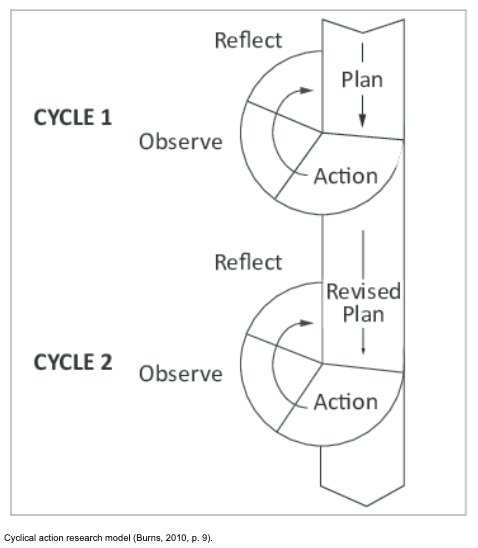
Moreover, Action Research is learning by consulting and daily problem solving and what the teacher can do to improve on the situations that surface through their teaching. Thus, within this daily practice, the teacher has to identify a problem, they have experienced, then imagine how they may change this, thus putting a plan of action together to overcome it. Once this plan has been instigated, it is to evaluate how the plan effectively succeeded or not. Action Research does not stop there as the focus is on cyclical research, so in this process, once the evaluation’s results have been collated, the process can start again where the class is modified on the back of the results. This may well end up as an ongoing process as shown in Stephen Kemmis’ diagram. In short, Action Research can be explained as – identifying the problem, then resolving it, then seeing how successful it was, then if you are not satisfied, do it again.

Grammar assignment
Students are always worried about grammar. There is a consensus of opinion that they need to study a lot more on their grammar. Of course, a teacher who does not know grammar would seem a bit strange, and they will be asked about it and will at times have to highlight it in the course of their teaching; once they are over that I feel the teacher should, in essence, focus on providing information about the students’ specific goals so that acquisition activities can focus on the topics and situations most relevant to the students’ needs. It can be shown that “we determine the situations in which they will use the target language and the sorts of topics they will have to communicate about” notwithstanding “we do not organize the activities of the class about a grammatical syllabus” (Krashen and Terrell 1983:71). All the same, on my TEFL course I had to complete a grammar assignment. I have added it here for you guys to get a feel of what is involved which is not just knowing how the grammar point is formed.
Grammar Assignment
Form
Past perfect tense in the if clause and would have + past participle
(had + past participle) the other part of the sentence
Example
If you had asked me I would have told you
Real situation = you didn’t ask me, so I didn’t tell you.
Use
When do we use 3rd conditional?
We use the 3rd conditional to talk about – regret, wishes, hindsight
Meaning
*Unreal past situation (imagining the impossible): to talk about hypothetical past situations. The speaker is dreaming of or imagining a different past. But the past cannot be changed.
*The conditional may be with a negative. In the case of a negative with the past tense, the opposite of what is said is true, that what was said in the negative did, in fact, happen, like ‘If it had not rained…’, meaning it did rain.
*You must watch the tense; maybe it is in the past, even though a conditional sentence. If the verb is in the past perfect tense, it can refer to something that did not happen in the past.
Example
‘If I had known I would have told you’.
Real situation = I didn’t know. I didn’t tell you
* The if sentence that describes the past, describes something different from what happened,
Example
‘ If we hadn’t invented paper we wouldn’t have had newspapers; in fact, we did invent newspapers.
When the time referred to is the same in both clauses, we have:
‘If he had done this (or ‘Had he done this’), he would have sinned’; ‘Had we done this, we should have let you know.’
Real situation = He didn’t do this, so he didn’t sin.
*Strategy: When you hear an ‘if’, you must think that this is a conditional and that if the sentence is positive, then the speaker means the situation never happened or has not yet happened and if it is negative and in the past, then the situation did happen. Don’t forget the inverted form of the conditional, like ‘Had it not rained…’ for ‘If it had not rained…’; in both cases, they are of course the same, it did rain!
Pronunciation (problems with)
Example
If (1) you’d listened you (2) wouldn’t have failed the exam.
If you (3) hadn’t gone I would have spoke with you.
(1) The pronunciation of YOU + HAD when contracted = YOU’D with the /d/ sound.
(2) The pronunciation of WOULD + NOT when contracted = WOULDN”T with the /nt/ sound.
(3) The pronunciation of HAD + NOT when contracted = HADN”T with the /nt/ sound.
Mistakes that can be made
Different structures using conditionals makes for different meanings.
Example (Second conditional)
If I were rich I would spend my time traveling.
This sentence is talking about unreal or improbable situations now or in the future.
CORRECT example using (Third conditional)
I f I had been rich I would have spent time traveling
The speaker is dreaming of or imagining a different past. But the past cannot be changed.
Example
If my father hadn’t met my mother I wouldn’t be here now.
This sentence is talking about the present situation that is no longer possible because of the way things have turned out.
Comprehension checking questions
If I hadn’t gone out last night I wouldn’t have crashed my car
Did I stay in last night?
Did I go out in my car last night?
Did I get home safely last night?
Did I crash my car last night?
Was my car damaged yesterday afternoon?
Is my car damaged now?
Did I go out then crash my car?
Did I crash my car then go out?
Real situation: I went out last night and crashed my car.
(b) If Jeff had gotten up early, he wouldn’t have missed the plane
Did Jeff get up early?
Did Jeff miss the plane?
Real situation: John didn’t get up early, so he missed the plane.
The grammatical form changes from the unreal to the real in the answers to a conditional sentence.
Exercise (Testing Point)
*Strategy: When you hear an ‘if’, you must think that this is a conditional, and that if the sentence is positive, then the speaker means the situation never happened or has not yet happened and if it is negative and in the past, then the situation did happen. Don’t forget the inverted form of the conditional, like ‘Had it not rained…’ for ‘If it had not rained…’; in both cases, they are of course the same, it did rain!
Example: If the children had been better fed, they would not have fallen ill.
(A) The children became sick.
(B) Children were not fed and that made them ill.
(C) It was wrong for them to feed the children.
(D) Even though they were well fed the children fell ill.
Correct Answer: A
Explanation: The result of the situation was that the children fell ill, or became sick, but not as in B, because they were not fed, but because they were not ‘better’ fed. The condition was that they were not fed well, and if they had been they might not have fallen sick.
Complete the dialogues
(1)
A: My shirt is too small.
B: Did you throw away the receipt?
A: No, I’ve still got it. Why?
B: If you ______________ you wouldn’t have been able to take it back to the shop.
(2)
A: I got drunk last night and got into work late.
B: You shouldn’t drink so much.
A: If ________________ so much last night I wouldn’t have been late this morning.
Write a sentence for this situation
You are upset because last night you said ‘you are stupid’ to a friend. Your friend walked out of the restaurant very angry. Use the third conditional to imagine a different past.
If I ____________________________ I _____________________________________
Use of special conditional structure
Example: __________ , we wouldn’t have gone to the beach.
(A) If it rains
(B) Had it rained
(C) It rained
(D) If it has rained
Correct answer: B
Explanation: The sentence is conditional, as can be seen by ‘would’ in the main clause. The subordinate clause could begin with ‘if’ ; ‘If it had rained’ to be parallel with ‘would not have gone’. However, an alternative structure is the inverted form without ‘if’ , ‘Had it rained’.
Activity (Desert Island Game)
The teacher outlines a situation:
The story
A man went out in his boat and there was a storm, he could not get back to the harbour because the engine was broken and the sails ripped in the wind. He was blown hundreds of miles off course. He landed on a desert island with no supplies, food or radio equipment.
Students’ Job
The students must decide which 10 things he should have done or shouldn’t have done that would have helped him; being on a desert island using third conditional.
The students in their groups must justify their answers.
List of resources
A-Z of English grammar & usage by Geoffrey Leech – Longman

Practical English Usage – Michael Swan – Oxford University Press

English grammar in use – Raymond Murphy –Cambridge University Press

Discuss the ways in which attraction and revulsion are linked in one text
(789 Words)
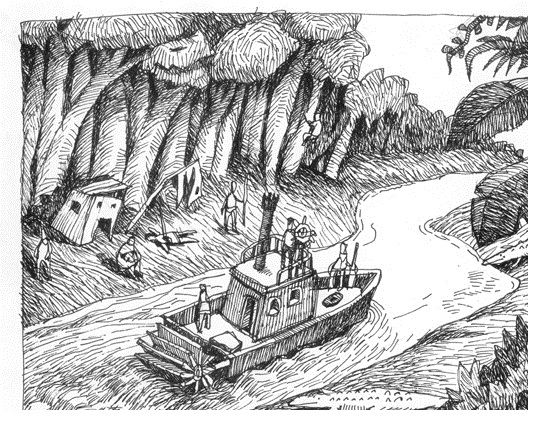
In Joseph Conrad’s Heart of Darkness, we find the protagonist Marlow, a man of adventure having sailed many a sea living in an era of the Victorian explorer David Livingstone who had not long returned from his African expedition in 1890. This is where tales of African exploration were told of different lands; those inquisitive minds couldn’t help but see the attraction of Livingstone’s journeys to this continent. Accompanied with this, is this new found land that is the reverse of Marlowe’s attraction to see Africa, it is where he gets a candid look at the reality of colonisation and imperialism. The journey for him finds the attraction and revulsion of it all.
In the opening scene, we see Marlow as the only one on the boat who still “follows the sea”. This seaman still sees the appeal of the open rivers and seas. He is a “wanderer”. Maps have always fascinated him, the blank spots, and those places yet explored. He wants to explore the inner Africa, the place associated with darkness. He wants to travel further into the long Congo, a captivating and extremely life-threatening river that lies like an immense snake. He remarks of the river that it is like traveling to the earliest beginnings of the world, the brilliant sunlit land offers ‘no joy’ but a “treacherous appeal”.
Even early on we get an idea of the revulsion Marlow experienced as he sits on the boat in London. He allegorises to the Ancient Romans who came to conquer England when it was untamed with Pagan natives running about, how they would have felt with the immense darkness and the abomination of Celtic England. He imagines this making the Romans want to escape. His allegory points to the mess of the Congo where Marlowe sees colonisation as “robbery with violence”.
The Congo is a jungle wilderness, the object of attraction. Ivory is the new gold, hardly a necessary item for survival. A desolate land far removed from the Industrialisation of white man England. Marlow’s view of the people he knows, the white race, those people who should be sophisticated are that of ones insane and pointless. How could people change so much? It is, however ‘reality’ for the men and that is all that civilisation cares about. The wilderness shows the greed and brutality that lie under the noblest of ideals.
On a more personal level, Marlow does see an attraction to the black man. He remarks they wanted no excuse for being there. He shows his attitude towards the black Africans where he says “the worst of it is suspecting they are not being inhuman”. Then there is Kurtz, an ivory trader sent by a Belgium company into the heart of the Congo, who on the other hand succumbs to the savagery of the wilderness. His aspiration is gone and he has “kicked himself loose of the earth”. The wilderness brings out the darkness and brutality in his heart. The natives didn’t invite the imperialists; they just turned up and gave orders.
Marlow continues his journey where some people would have given up; the desolation of it all is strange to see. Here you find the attraction for Marlow, he battles on to the “inner station”, there must be something inside him that wants an answer, that wants to see more, although at the same time repulsed by the sights he sees. Going up the river was like traveling back to the earliest beginnings of the world, a past remembered: “in the shape of an unrestful and noisy dream.” The brilliant sunlit land offers “no joy” but a “treacherous appeal to a hidden evil, to the profound darkness of its heart.” The rape of the land is revulsive to Marlow, as he travels past the settlements of the white man with their inefficiency and brutality.
Marlowe certainly develops a strong purpose up the river, past the native villages and colonial agents in their settlements, to see and talk with Kurtz, the supposed beacon of civilisation, that it becomes somewhat of an obsession with him. He wants to see the darkness in man, which has developed his ardent resolve. Along the way, Conrad’s main purpose in this story is the discovery and analysis of the black and white man. His search is for the inner truth. The black man typifies truth and reality which is an attraction while the revulsion can be pointed at the white people.
Marlow after his long battled journey finds Kurtz, a so-called god at the Inner Station. Kurtz on his deathbed blurts ‘the horror, the horror’. Marlow has achieved his goal, the attraction of it all has reached its peak and the revulsion of the inner station has been seen.
.
Consider the treatment of one or more of the Seven Deadly Sins
(1133 Words)
As seekers of knowledge, individuals may strive relentlessly, employing whatever means they deem necessary to achieve intellectual or spiritual enlightenment. However, the pursuit of knowledge can become excessive when it transgresses moral, theological, or human limitations. Christopher Marlowe’s Doctor Faustus dramatises precisely this tension. Faustus is an intellectual explorer whose desire for knowledge and power exceeds what is considered appropriate or permissible for human beings. His relentless pursuit of forbidden knowledge ultimately becomes an act of transgression: he embraces mortal sin and, within the play’s Christian moral framework, is condemned to Hell.
Marlowe’s Doctor Faustus engages closely with the Renaissance ideal of the ‘aspiring mind’, embodying the period’s fascination with intellectual expansion, individual ambition, and the possibility of transcending established boundaries. Faustus represents this aspiration in its most extreme form. Yet his pursuit of knowledge is characterised by a striking lack of discrimination. Rather than directing his intellectual abilities towards morally or intellectually valuable ends, he becomes fascinated by pleasure, wealth, power, and the supernatural. His response to the personification of the Seven Deadly Sins—“O, this feeds my soul”—is particularly revealing. The statement suggests that Faustus has begun to derive intellectual and emotional gratification from transgression itself. During the twenty-four years granted to him through his pact with Lucifer, he seeks experiences of every kind, seemingly embodying the Renaissance desire for exploration and discovery. Paradoxically, however, the supernatural power he acquires does not produce genuine freedom; instead, it ultimately leads to anxiety, despair, and spiritual destruction.
Foremost among Faustus’s characteristics is his ambitious desire to experience the fullest possible range of human existence. As a figure associated with Renaissance humanism, he seeks to transcend conventional limitations and enter a new intellectual and experiential world. His ambition is ultimately expressed through his desire to approach the status of a deity: “A sound magician is a mighty god.” The statement demonstrates the extent to which his intellectual curiosity has developed into an aspiration for absolute power. Faustus no longer wishes merely to understand the world; he wishes to control it. His desire therefore shifts from knowledge to mastery, revealing the dangerous consequences of an intellect that recognises no ethical boundaries.
Faustus’s declaration, “How am I glutted with conceit,” further illustrates the destructive effects of excessive pride. The language of ‘glutted’ suggests an appetite that has become excessive and insatiable, while his repeated emphasis on the first-person pronoun reinforces his egocentricity. Faustus increasingly imagines himself as autonomous and self-determining, attempting to construct his own destiny independently of conventional religious authority. His ambitions are also explicitly materialistic. He dreams of “flying to India for gold” and “ransacking the ocean for orient pearl,” revealing that his intellectual aspirations are inseparable from greed and acquisitiveness. His pursuit of knowledge therefore becomes corrupted by cupidity: what initially appears to be intellectual curiosity develops into a desire to possess wealth, pleasure, and power without limitation. His apparent liberation from conventional restrictions consequently becomes another form of enslavement—to appetite, pride, and sin.
Faustus’s rejection of human and divine limitations also resonates with the biblical condemnation of pride and covetousness. In this respect, his character can be understood through the moral framework of the Book of Psalms, particularly its association of pride, greed, and the rejection of God with spiritual corruption. Faustus similarly attempts to place himself beyond divine authority. God is effectively displaced from his intellectual universe, while his own desires become the principal measure of value. His tragedy therefore emerges not simply from his possession of supernatural power, but from his refusal to recognise any authority greater than himself. His intellectual independence becomes spiritually destructive because it is accompanied by an unwillingness to accept moral limits.
Furthermore, Faustus can be considered in relation to Aristotle’s conception of the tragic hero. In Poetics, Aristotle argues that tragedy centres upon a figure who is neither wholly virtuous nor wholly corrupt, but whose downfall arises from an error or weakness inherent in human nature. Faustus embodies this model through several interconnected flaws. His pride, his relentless intellectual curiosity, and his desire to transcend the limitations of humanity all contribute to his eventual destruction. His pride constitutes a form of hubris: he seeks to elevate himself beyond the position assigned to human beings. From a Christian perspective, his aspiration to become godlike represents an even more profound transgression, since it challenges the fundamental distinction between the human and the divine. At the same time, his restless intellect and dissatisfaction with ordinary existence prevent him from accepting the boundaries imposed by religion, morality, and mortality. His tragedy consequently emerges from the interaction between intellectual ambition and moral blindness.
Nevertheless, Faustus’s aspirations cannot be dismissed as entirely reprehensible. His desire for knowledge reflects one of the most significant intellectual characteristics of the Renaissance: the elevation of human curiosity, individual potential, and intellectual inquiry. In this respect, Faustus can be interpreted as a representative of the ‘new man’ emerging from the intellectual culture of the Middle Ages. The authority of the medieval Church, which had exercised considerable influence over intellectual and social life, was increasingly challenged by new forms of humanist thought, scientific inquiry, geographical exploration, and political individualism. The Renaissance consequently witnessed a growing emphasis on human agency and the capacity of individuals to investigate and understand the world independently.
Marlowe’s engagement with classical thought is also significant in this context. The classical world offered Renaissance thinkers alternative models of intellectual and cultural authority, while Greek literature frequently presented human beings who challenged established boundaries and confronted the power of the gods. Although Marlowe’s play is ultimately shaped by a Christian moral framework, its protagonist possesses a distinctly Renaissance fascination with inquiry, experience, and self-determination. This creates a fundamental tension at the centre of the drama: Faustus embodies the intellectual freedom of the Renaissance while simultaneously being judged according to the theological values of the medieval Christian worldview.
Ultimately, Marlowe presents Faustus as a quintessentially Renaissance figure whose intellectual ambition develops into an ultimately destructive desire for absolute knowledge and power. He surveys a world whose horizons appear to be expanding through geographical exploration, scientific inquiry, and renewed engagement with classical learning. His aspiration to exceed conventional human limitations is therefore both admirable and dangerous. Faustus represents the possibility of intellectual liberation, but he also demonstrates the consequences of pursuing that liberation without ethical restraint. His tragedy lies precisely in this contradiction: he possesses the curiosity and ambition associated with the Renaissance ‘aspiring mind’, yet his inability to reconcile those aspirations with the moral limitations of his Christian world leads ultimately to his damnation. In this sense, Doctor Faustus concludes with a distinctly medieval warning about the dangers of Renaissance ambition: the desire to know more may be intellectually admirable, but when knowledge becomes indistinguishable from pride, greed, and the desire for godlike power, aspiration becomes transgression.

