Young learners
Teaching Young Learners – Writing Activities
(924 words)
For this writing task, I was asked to give my response to 5 statements about writing activities to support young learners to improve their writing and learn a language. I will answer True or False to statements 1- 5 and explain why.
1. Writing should be developed in isolation from other skillls.
Is this True or False?
2. We should not restrict the age at when children begin to write.
Is this True or False?
3. Handwriting and spelling are only part of the process of writing.
Is this True or False?
4. Attention should be paid to developing good habits in alphabet letter formation.
Is this True or False?
5. Using joined-up writing may help develop the learning of the common letter strings found in English.
Is this True or False?
- Writing should be developed in isolation from other skillls. T/F
I would say this is false. Many concrete experiences such as painting, drawing, using play-doh, dramatic play, or building with blocks help children develop the physical, cognitive, socio-emotional skills and understandings that are the foundations of conventional reading and writing. All these skills should be encouraged at home and at school from early age. It is how the learners use these experiences that are gathered to help with their writing skills. This is how literacy ‘emerges’ in children that is significant and can lead to writing. These skills are used when teachers and parents encourage ‘literacy play’ by adding notepads and pencils to the resources provided to encourage role-play and dialogue. Vocabulary can be built through games and activities that increase the range of words your child will know to write with depth. Children can learn how reading and writing are used to achieve goals. For example, at home a child might see thier grandmother following a recipe in a cookbook or watch his mother reading the directions for putting a toy together. From these observations, children learn that reading and writing are used to carry out daily tasks and to communicate and receive information.
2. We should not restrict the age at when children begin to write. T/F
This is true. From an early age, children start using a pen and pencils. Long before they go to school, before they even know the alphabet, children begin to write. In fact, for most children literacy begins at home such as with crayons. The scribbles of very young children have meaning to them, and scribbling actually helps them to develop and become familiar with holding a pen/pencil with their writing. Young children who are encouraged to draw and scribble stories will learn to write more easily, effectively, and confidently once they head off to school. Young children can learn a lot by watching someone write, imitating adults and older children, exploring, and experimenting. Literacy learning does not begin at a certain age and I think should not be limited to the classroom. It can develop significantly during the pre-school years and be influenced by social contexts as well as individual skills and applications.
3. Handwriting and spelling are only part of the process of writing. T/F
This is true. The one major fact of writing is that of putting a pen to paper. This involves the transcription aspects of writing, combining handwriting and spelling abilities with the choice of the right words, shaping these into the appropriate syntax and general organisation. Other parts of writing include emulating and exploring the different genres of writing. For example, the child can write but how do they organise their writing, and who is the audience. For a younger child chronologically, organised writing may be easier to tackle at first, such as stories and reports where what happened next provides a major prompt. Appreciation of the possibilities of different kinds of non-chronological text is a major part of writing such as descriptions classifications, explanations, and arguments. Teachers and parents can help by pointing out the distinctive features of these types of writing as opportunities arise. Teachers and parents influence the learners writing through wider reading and of being read to highlight the many facets to writing.
4. Attention should be paid to developing good habits in alphabet letter formation. T/F
This is true. It could be assumed that children’s early ‘invented’ spellings will evolve into conventional versions over time. Parents and teachers need to encourage correct hand movements for forming each letter of the alphabet from a very early age. As a learner gets exposed to more literature he will try out new hand movements. The teacher and parent’s role is to show the visually patterned nature of the English spelling system. Letters have starting points and mistakes from the start can be hard to change as time moves on. Words with time will begin to flow into each other.
5. Using joined-up writing may help develop the learning of the common letter strings found in English. T/F
This is true. How a child writes each letter relates to how they can join that letter up to the next letter. When the child makes a writing mistake for instance beginning a g at its tail, forming an e with a clockwise motion, this can quickly become habitual and can be very difficult to change. Such errors also prevent children from developing the sense of ‘flow’ in the formation of commonly occurring letter strings which are spontaneously joined by correct exit strokes leg. in. ly. ch). This kinaesthetic control over written language production is not only more efficient but is also likely to promote success in spelling.
.
Games and puzzles with young learners
It is generally accepted that language teaching not merely can be, but should be enjoyable. This is not to assume that it is easy, but only that there is no need, by excluding enjoyment, to make it more difficult.
Games are enjoyable. The essence of many games lies in out- stripping, in a friendly fashion, someone else’s performance, or (and adult learners often prefer this) in bettering one’s own, as in the world of sport. The goal is visible and stimulating: outdoing others, and improving on oneself, are by and largely enjoyable pursuits. Enjoyable also is the active cooperation with one’s fellows. In a group or team activity, rivalry and cooperation go hand in hand. There are other groups or teams to surpass, and friends to help surpass them. One’s own activity takes on importance in the latter’s eyes.
But in spite of all the effort -and sometimes, when attention is sharply focused and the learner’s energies stretched to the full in a game, it is hard to see any difference between ‘work’ and ‘play’ -there is a pleasant, informal, and often relaxed atmosphere, favourable to language learning.
Nevertheless, the case for language games is not identical with the case for enjoyment in the language lesson. An agreeable although busy atmosphere can be attained by other means, even if games are absent, and games have other and equally important virtues. They banish boredom and so make for willing learners, who look forward to language lessons. But after all, any kind of interesting activity would make them do that. We should ask, therefore, what other advantage language learning games offer than the creation of an enjoyable atmosphere in which to learn.
A language is learnt by using it -and this means using it in situations and communicatively. Disembodied sounds, words, phrases, and sentences, however, wrapped about with rules, do not carry language learning far; although it is helpful up to a point to remove such elements and look at them closely, much as one examines components of a machine, before returning them to the intermingling streams of discourse.
The situations which bring a foreign language to life in the classroom are provided by gestures, by handling and touching things, by incidents and activities, by pictures, by dramatization, by interesting stories spoken or in print -and not least by certain contests and games. In these, the language is linked with action and is no longer a disembodied thing.
(405 Words)

Vocabulary building in young learners
(933 Words)
For this writing task, I was asked to give my response to 5 statements about how young learners can help build their vocabulary. I will answer true or false statements 1- 5 and explain why.
1. In a young child, a single word may constitute a considerable degree of meaning.
Is this True or False?
2. Words categories and concepts normally exist in isolation from each other.
Is this True or False?
3. Vocabulary development comprises at least three stages.
Is this True or False?
4. All languages have the same relationship between time and tense.
Is this True or False?
5. Where possible we should draw upon as many of the senses as possible when teaching vocabulary.
Is this True or False?
1. In a young child, a single word may constitute a considerable degree of meaning. T/F
This is true. The ability to use words is partly tied to the young child’s ongoing cognitive development, so the use of words will have a degree of meaning. Thus, for a child, a word stands for a concept, but that concept is open to interpretation in that they select a category of relatively similar objects and apply the lexical item throughout. A child can learn the word dog or as a young child puts it ‘doggy’. This refers to a four-legged animal. This word can exist for any type of dog either big or small or type of breed. For example, a dog may refer to beagles and scotties, but not to poodles. This aspect of children’s thought associates a word with an object, but they may then, in the future, use that word to describe a number of other similar objects in their environment. The child can also use the word ‘doggy to mean ‘there is a dog’ Notwithstanding, it can mean ‘come here’ said with a rising tone. Young children tend to utilise rising intonation to signal yes-no questions.
2. Words categories and concepts normally exist in isolation from each other. T/F
This is false. Words do not live in isolation, individual words can be categorised in many ways that remove the word from the original meaning or at least a child’s only idea of the meaning. The word ‘game’ can be attached to words such as card (game), ball (game), Olympic (games), and also football (game). As such the Olympic Games conjure up thoughts of many competitors from around the world competing together, although a ball game can involve one person banging a ball against a wall. This looks at two ends of the game spectrum. Winning the Olympic Games has men and women getting gold medals; the ball game respectively has no winner or loser. Furthermore, the game of poker has skills of a different kind compared to kicking a football around the football pitch as well as less physical energy.
3. Vocabulary development comprises of at least three stages. T/F
This is true. Word learning is the product of a set of cognitive and linguistic stages that include the ability to acquire concepts, an appreciation of syntactic cues to meaning, and a rich understanding of the mental states of other people. These capacities are powerful and early emerging. Firstly the child must make sense of new vocabulary. When words are first met by young learners, there are concepts that are given labels in English and may be new to the child, or only partially developed. The teacher or parent may not be merely teaching vocabulary, but teaching concepts. The labels and concepts need to be incorporated into schemas that already exist. The child has to learn this new vocabulary. Learning and retaining new vocabulary is made easier by grouping words together into families. While learning all this new vocabulary the child has to retain and recall this vocabulary for the various situation they will find themselves in. The single most effective way of helping students build vocabulary is by increasing the amount that they read. The child revisits the groups of words; adding to them and reorganising them provide ways of giving learners both the repetition and the development that is needed as they grow into English through the primary years and stages.
4. All languages have the same relationship between time and tense. T/F
This is false. Various countries of different lexis in different parts of the world that have relatively little contact with each other, will have experienced a different environment. Each country will invent words for the things in its environment that matter to it, and naturally, they find words for different things in their country. England has four seasons, other countries have three. Some countries are dark for many months. Learners from different countries don’t have some words in their vocabulary because they have never encountered such aspects of life. Basically, the learners have to develop categories and concepts for the new words they encounter. For this situation, when children encounter new words teachers need to provide support for understanding. New vocabulary needs to be presented in a context that helps the child understand the meanings and associations that help explain time and tense.
5. Where possible we should draw upon as many of the senses as possible when teaching vocabulary. T/F
This is true. Children learn words by seeing, feeling, tasting, listening, enjoying, and experiencing. These various means at a teacher’s disposal bring the reality of words to the fore. For example, a child can know the word ‘apple’ but this does not show the learner every aspect of the object. They can learn that it is a fruit and other fruits are in the same family. They can see pictures of apples so they see the shapes and colours. They can eat an apple then they know the taste and feel. Is it soft? Is it hard? It can be shown that the apple starts going rotten after a while, but it is also good for your health before going rotten. An apple pie can be cooked for the child to show how apples can be used. Granny Smith apples come from England. Other apples come from other countries. They can go on a field trip and see apples growing. The child realizes they grow in trees. They can go shopping at a supermarket and buy apples. They can be shown they are bought in weight.

.
Teaching Young Learners – Working with a Course Book
TASKS
Look at some of the material and state how you would make the lesson interesting by supplementing or expanding upon the content of the page.
- Swimming pool
For this exercise, I would personalize the exercise by giving the characters who say something in the picture names. As an introduction, I would follow the original lesson getting the children to repeat the sentences but each time I moved on to each person I would elicit some more ideas and vocabulary relating to that person.
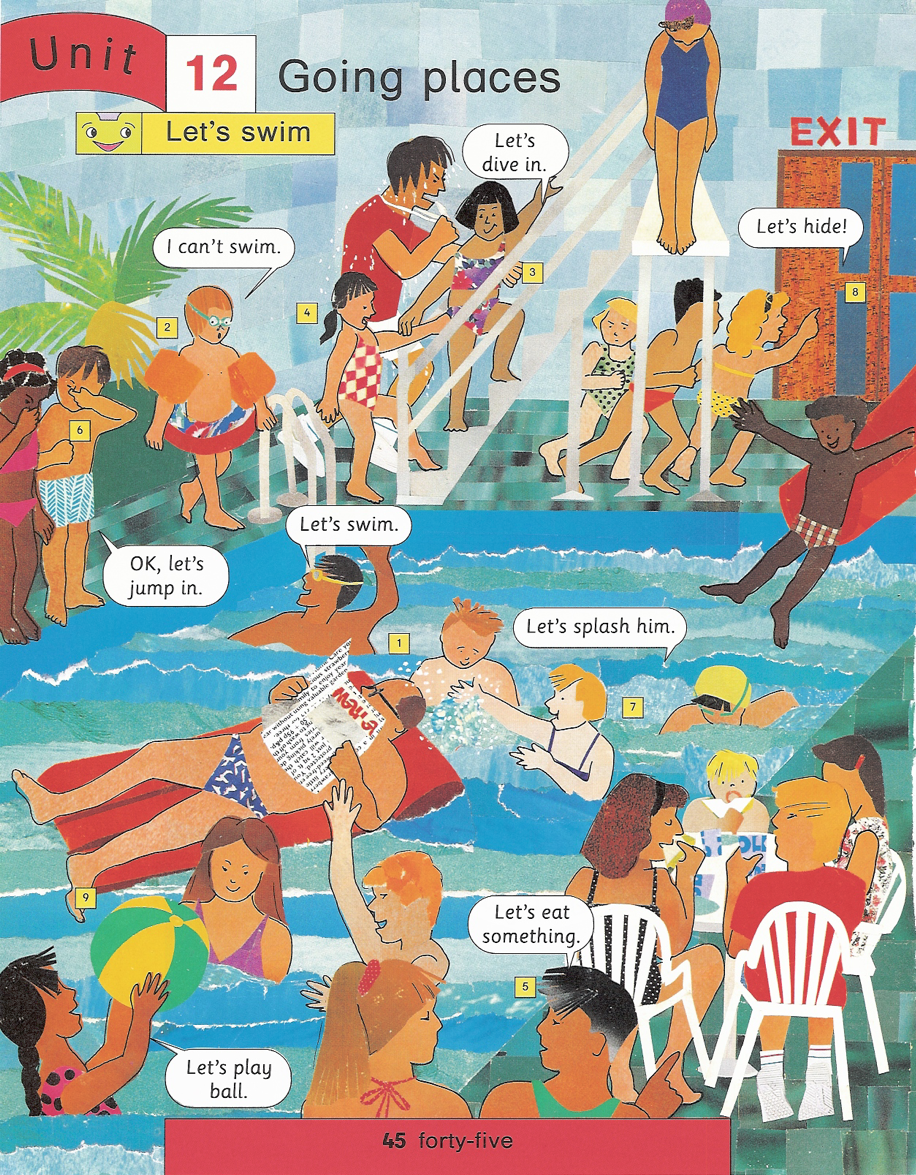
For example, Dave, who says ‘let’s eat something’
Is Dave swimming?
What color hair does he have?
Who is he with?
After completing the exercise, having discussed each person saying something, I would give the learners a freer practice. I would get the learners into groups and get them to look at the pictures and elicit any more information from the picture. I would then get them to write 2 sentences each for 3 people.
For example He is wearing goggles. She is playing with a ball.
I would now take the pictures away from each group
I would then have a quiz where each group has to ask say 2 sentences and then ask two questions. This would be repeated two times.
For example 1. He is wearing goggles. He has ginger hair.
What is his name?
What does he say?
2. She is climbing the stairs. She is with a friend.
What is her name?
What does she say?
The teacher and learners could check all the scores to see who has won the little competition.
2. Objects
For this activity, I would expand it by getting the learners into pairs and giving them identical pictures. These pictures could have a street scene or just objects. Although the pictures and the objects in the picture are the same, each of the learners has some of their objects colored in and others left blank (white). Some of the objects are colored the same. For example, in picture 1 the car is red but in picture 2 the car is blank, but picture 1 has a blue bird and picture 2 has a blue bird. The learners complete the task by sitting opposite each other so they are not able to see each other pictures. The task can be done like the game of battleships where they have a screen to divide themselves. It is up to the learners to work together telling each other the colors of objects in each other’s picture. They complete the drawing by coloring every object until they have identical colored pictures. The teacher can have a feedback session with the learners to check over their work.

