克里斯托弗·马洛
Consider the treatment in one text of one or more of the Seven Deadly Sins
(776 Words)
As knowledge seekers, many people will strive harder or try appropriate means to achieve their goal for further knowledge to the extent that bridges onto excessiveness that reflects one of the Seven Deadly Sins. Doctor Faustus is this seeker of knowledge who wants to find out more than is suitable and appropriate for him to know. Faustus is a disdainer who gets a scorner’s comeuppance. He commits a mortal sin and goes to hell for it.
Dr Faustus deals with the ambition of the Renaissance to cultivate an ‘aspiring mind’. The Renaissance as a time of intense, all-encompassing infinite knowledge is embodied in Faustus. However, he shows little discrimination in his pursuits. He delights, for example, in the Seven Deadly Sins, ironically remarking ‘O thus feeds my soul’. Throughout the twenty-four years, he seeks experience of all kinds in the true Renaissance manner; however, instead of freedom, his knowledge brings him despair.
Nevertheless, Faustus, the Renaissance humanist has the desire to reach the highest peaks of life experience; there lies a quality possessed by this ambitious seeker. To enter the new world where distant shores could be talked about. This is manifested in Faustus, however, in his desire for none other than a God: ‘A sound magician is a demi-god’.
‘How am I glutted with conceit’ shows how his excessive pride is overtaking him. His almost unconcerned use of the words ‘I’ and ‘will’ (‘I’ll’) embodies a man of cupidity. He is a fearless taker of everything for his own greed. In an age of reason, Faustus tries to stand on his own two feet and work out his salvation. He is motivated largely, by his desire for pleasure. He is covetous in his thoughts of ‘flying to India for gold’, ‘ransacking the Orient for Orient pear’. He hedonistically rides on the crest of sin. So blind is the lust of gain.
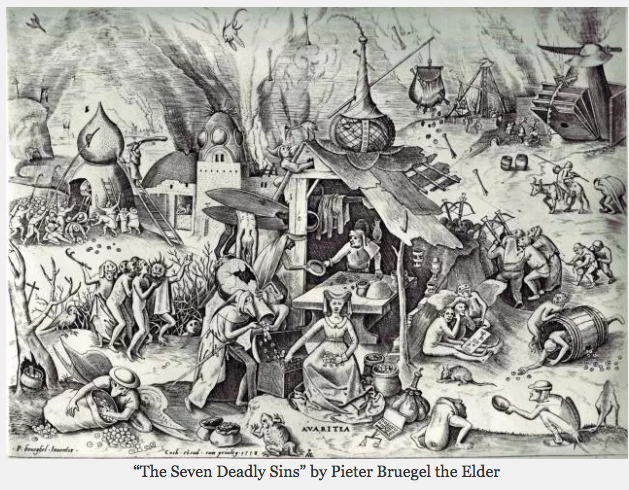
Faustus’ desirous journey is the ‘Perils of the Pilgrim’: ‘For the wicked boasts of his heart’s desire and bless the covetous, of whom the LORD abhorred. The wicked, through the pride of his countenance, will not seek after God: God is not in all his thoughts. His ways are always grievous; their judgments are far above out of his sight: as for all his enemies, he puffs at them. He had said in his heart, I shall not be moved: for I shall never be in adversity. His mouth is full of cursing and deceit and fraud: under his tongue is mischief and vanity’ (Psalm 10, 3-7).
Aristotle stated that a tragic hero is predominately a good man, whose undoing is brought about by some error of human frailty, ‘the stamp of one defect’. The audience sees three such defects in Faustus that lead to his ultimate domination of Mephistopheles: his pride, his relentless intellect, and his desire to be more than man (to possess the power and the insight of a God). Any one of these three defects would have been sufficient to ensure his downfall in terms of the theory of tragedy. In his pride, he is guilty of hubris, a quality that the Greek tragedy was certain to arouse the wrath of the Gods. His desire to be equated with God is a sin in Christian terms as well. His restless intellect and deep dissatisfaction with the normal life inevitably lead to misfortune. Faustus falls to damnation
In some ways, Faustus’ aspirations are admirable. It was the glory and the ambition of the Renaissance man to have an ‘aspiring mind’. Faustus, on the one level, represents the new man emerging from the womb of the Middle Ages. The authority of the Church, which had limited the thought of the Middle Ages, was lessening. There was a movement of power from the Church to the state, which meant to a limited extent, the transfer of power to the individual man. The classical spirit was certainly a source of influence for Marlowe. The Greek attitude to their Gods was very different from that of the Medieval Church. The Greeks encouraged a spirit of inquiry in their thought that was quite foreign to the attitudes of the Medieval Church.
Above all, Marlowe’s story of Dr. Faustus is of a Renaissance figure, adventurously surveying a world whose horizons were widening every day as a result of voyages and explorations that results in a person to aspire to the greater, to hold knowledge over wisdom, to have a desire for material wealth or gain and ignore the authority of the spiritual world. One could well be blind to the ‘Seven Deadly Sins’ where one was on an ardent quest for knowledge and unsatisfied with being mortal.

Political and Philosophical theories place too heavy a burden upon a writer. The inevitable result seems to be texts that are didactic and polemical, rather than imaginative and creative. Discuss any one text, which you believe disproves this assertion.

(706 Words)
Dr. Faustus by Christopher Marlowe can be said to be a didactic text that details the death of the main character; the time leading up to that point and what becomes of his soul. It teaches us about his condemnation, not his salvation. However, contrary to this to disprove this assertion, Dr. Faustus is not just a didactic play. It is a play about Man pushing himself further, trying to have an intoxicating time and dream. He is a man that has been given three wishes and could be said to have found a genie in a bottle. What would the reader do with the wishes/genie? How would the reader strive for more than what they have got? Having the desire to have three wishes or to find a genie in a bottle is found in any person that allows not only them to be imaginative and creative but also the author.
Dr. Faustus wishes for many things and finds his genie in Mephistopheles. Dr. Faustus makes use of his newfound chances. He is a man who is a knowledge seeker. He wants to find out more than is good for him to know. This can not be wrong as a man who wants more than he has been offered. He does not want to plod along in life. He wants to eat, drink, and be merry. It is no accident that he compares himself to Colossus (IV, VII). Faustus is a scholar, books are his trade, philosophy his strength. Dr. Faustus begins by reading about the Greeks, Aristotle and ends up desiring Helen of Troy. His reading also contains maps that show Faustus exotic lands with their promise of new sensations. His study of classical authors has to be commendable as they are immense stories of biblical status.
The reader can, of course, decide to view Faustus through more modern eyes; he strives to better himself, his covetousness is soaring. This is particularly shown through the eyes of those who, in the eighteenth century, used him as an example of a positive thirst for knowledge, as a ‘striver’, as someone who anticipates the Age of Reason and tries to stand on his own two feet and work out his own salvation and try to better himself. He is motivated largely, but perhaps not entirely, by a desire for pleasure. The reader can assume that during most parts of the play, Faustus is a popular character, a great source of fun. Faustus hears renaissance voices who tell him to extend the boundaries of human knowledge, seek wealth and power, live this life because tomorrow you will be dead, such a popular theme is known as ‘carpe diem’ or ‘seize the day’.
In his superhuman aspirations, he mixes a desire for knowledge with no less strong desire for pleasure, power, and rape of overseas provinces, which were beginning to be colonized and exploited at the time. There is something of a rude soldier of fortune of him: ‘As Indian Moors obey their Spanish lords’ 1:121, draws a specific analogy between the quest for hidden knowledge and the brutal activities of their colonial powers. He acts as if he were king, he commands, dictates terms. He wants to be some sort of superhero and why not? Life for him is for living.
Faustus decides to live bravely for his time on earth, a strong man who challenges life, he goes and explores, he does not wait for life to come to him. The play mentions that he does grand things that are useful to his countrymen, but he only feels at peace when he is playing practical jokes. His last two words are ‘Ah Mephastophilis’, he dies in the arms of his deceitful friend with immense relief, also gratitude, surprise, love, forgiveness, and exhaustion. It is the happiest death in drama.
Christopher Marlowe‘s assertion to a modern reader can be very different from those at the time; this is where you can think of Faustus not only as an explorer but also as someone who wants to extend the boundaries of life. This could be a lesson for all which is relayed to the reader from Marlowe’s imaginative and creative text.
.
Consider how criticism might engage with race and religion (through two texts)
(889 Words)
Race and religion can form vital parts of any play or novel; history has proved that tension, be it through different religions/ races of people, has stirred up many conflicts. In this essay, I will refer to two texts namely ‘The Jew of Malta’ by Christopher Marlowe and ‘The Heart of Darkness’ by Joseph Conrad. I would like to show how criticism can engage from a story and that we can see the undertones of the text that shows racial and religious streams of thought and action. These narratives both show the act of colonialism/countries powers, which are true accounts of the Christian colonizers and the Turkish Siege of Malta as well as King Leopold and the Belgium Congo.
Initially, The Jew of Malta resonates with themes of religious tension, which was a parallel to the time, in the sixteenth century. There were not many Jews in England during this time. Jews in England secretly practiced. Many Jews who were born into the Jewish faith either converted or pretended to be Christians. Criticism can be pointed not only towards the non-secular people in England but also where this play tries to deal with the anti-semitic feeling that was rife throughout the whole of Europe. The Jewish people did not believe in Christianity, so they were a threat to social order. English Protestants felt that Jews were outsiders as well as Muslims and Catholics. Marlowe forces the reader to re-examine the factors that were the start of internationalism. It makes the reader comment about the internal affairs at that time. The subject of commerce and internationalism had a role in the unfolding drama that could be equal to the effects of antisemitism.
Furthermore, in 1594 the Queens physician Roderigo Lopez, a Portuguese Jew was tried and executed for treason on charges that included conspiring to poison the queen. The Lopez case inspired a wave of anti-Jewish feeling and was probably responsible for the appearance of several dramas dealing with Jewish characters including the revival of the Jew of Malta. At that time, Marlowe’s story would have assessed the Jewish implication as much as we do now. Barbaras is a Jewish merchant he is angered by the passage of law requiring all Jews to either convert to Christianity or give up one-half of their wealth. Barbaras’ daughter is also in love with a Christian. He commits crimes for revenge because he hates Christian race.
Marlowe wrote it about a Jew, of another religion, and let the reader see Barbaras as someone that is capable of any heinous crime, a factor brought on by other people’s motives. He is a wealthy Jewish man that cannot be trusted. Marlowe shows us a character of a Jew (Barbaras) and gives us that experience and thus forms the reader’s opinion. The main character Barbaras displays the kind of strategic cunning that is at odds with the Christian notions of altruism, but he shares much with Machiavellian self-advancement. There was anti-Machiavellian feeling that was widespread in Elizabethan England. In all do we admire or criticize Barbaras for his fight against the invaders?
In Conrad’s novel, we find a certain racial tension, which is documented throughout the novel, with reference to black and white with the insinuation to bad and good. The white race has the strong hold on the black. We find arguments with the whites who exploit the blacks though the whites are seen as dark souled. You feel pity for the blacks who are taken over. Europe at the time of the late 1900’s was generally thought a place of light or enlightenment and Africa was generally thought as a place of darkness. Conrad finds disparagement with the history of colonialism as it was applied in the Belgium Congo. We find criticism in the ways of the whites. He writes about the sociological investigation of those who conquer and those who are conquered and the complicated way between the two races.
King Leopold founded the ‘International Association for the Suppression of Slavery and the Opening up of Central Africa’ where he attempted to impose civilization and order. This colonial greed just fostered widespread abuse; so much for racial alliance! Conrad’s disparagement not only festered when he visited the Congo but also saw that exploitation suppurate everywhere. Again, we have reason to analyses; we find a race of people with their own motives trying to take over another country. Essentially, we come to evaluate the white race for their love of spreading salvation, religion, culture and commerce and not letting the blacks have their own. Do we admire or criticise the whites invaders for this?
To conclude, we find motivation for criticism because of some heinous acts from people of dissimilar races and religions. The height of racial tension must be thought to come from the colonialists who then thought that they were of superior wealth and knowledge that they would bring great ideas and make everything for the better although we find that they are not of the right knowledge to see the problems that they are causing. Here we have to challenge their motives. Racial and religious tension is made from acts that will not be forgotten with the passage of time, and we see here what mistakes each race of people could have made and the reactions that are born from them.


.

