Bangkok
Memoirs – All For Nothing
(1022 Words)
I had just flown from Bangkok to Amsterdam’s Schiphol airport and was heading for Euro 2000: the European Football competition between neighbouring European countries. Slightly jet-lagged and a lack of sleep, I exited the airport and first went to Amsterdam Central Railway Station. I headed straight for the railway station to throw my bag in storage. It was certainly too bulky and heavy for my next experience. I was soon walking freely away from Amsterdam station, and I could now go off to the Philips Stadion in Eindhoven to see England play Portugal. Beckham and Figo et al head to head. Despite the excitement of this, I had actually booked a ticket to see the rock group Oasis in Hamburg the following day after the match; this initially was really my only plan. I had been a fan since the early days, and they were always worth seeing live anywhere in the world. So, as I strolled around Amsterdam at least I knew now I had to get from Eindhoven to Hamburg somehow.
I spent an interesting night in Amsterdam and then the next day went off down to Landgraaf by train. Talking to someone after a few drinks the night before, I had found out about a music festival; it was the PinkPop rock festival about an hour or so from Amsterdam. To my delight, it actually had Oasis playing and was not far from Eindhoven, I thought. I always remember going to this festival as I never had a ticket. As I got there in the morning, I saw lots of music lovers in a field. Various thoughts came to mind but I spent a good 30 minutes looking at how to jump the fence to get in for free. I made my move and was soon over a fence and in. This was only to find out that it was for tents/camping and the festival was in another field through more security and barriers. Anyway, I got a ticket for a cheap price, so it was not any hassle. The festival finished (I got to see Oasis without Noel Gallagher), and my next move was to think about the football. I ended up getting the train to another town one stop down from Eindhoven as the town was full of what seemed like England football fans who had taken over every hotel. Each hotel I went into to ask for a room in Eindhoven had so many football fans milling around singing and every place had no vacancies. I eventually spent the night in a hotel in the next town albeit it was full of Orange as the Netherlands were playing; the next night was the big match.
Once again, I was without a ticket but somewhere to go. I made my way up on the train from my hotel in the next town. I then spent the day drinking in Eindhoven and generally mixing with the English fans. I put the word out that I was looking for tickets, Fortunately, I found a guy who had tickets for the match. I was a bit wary because this ticket had the owner’s name on it, and match security was going to check tickets and passports/ID too. I was cautious, but I bought it anyway; I was going to chance it. I thought if security takes the ticket away, at least I tried to get in. The buzz of the impending game was growing, ultimately then came my moment of trying to get in without security’s bother. I walked closer and saw there were metal fences stopping fans, I got my ticket out and showed it. The inspector just looked at the ticket, I had made it past. I was buzzing. Yes, I had made it but what was this, it was only to the next fence. There were three of these. However, the stars were shining that night; I made it past all of them, and no real checks. The match was brilliant too, singing the National Anthem, cheering on every move, going crazy to the goals although England lost to Portugal; damn Figo!
Now, it was time to look for somewhere to stay the night. There was nowhere, I was homeless in the Netherlands. All the hotels were full, and it was getting late. What could I do? I ended up sitting in a few bars and restaurants which was not nice for me, as you meet up with many weird people from 11pm to 6am. 6am was the time the train to Hamburg left Eindhoven station. I was actually early and spent an hour waiting still seeing England fans going round singing after a big night out. I needed sleep badly. The Oasis concert in Hamburg was that night, and I had had no sleep. So, it was just my luck when I got on the Eindhoven train, and it was full and this continued through my three changes of train as I crossed from the Netherland to Germany. After a lifetime wait, I actually found a seat, but by that time I was scared of never waking up and ending up in Russia or something.
So, now I was in Hamburg standing at the railway station looking out. I found myself a nearby hotel, had a look around, and made my way to the OASIS concert. I could not believe all that I had done over the last few days. This was the only activity I had originally planned. I actually had a pre-booked ticket, I was legal. There would be no worries over security, no worries about jumping fences, and a nice paid for hotel waiting after the concert for me. I had looked forward to this rock concert for the month, I had the ‘golden’ ticket to get in. As I got to the stadium, I thought it looked a bit quiet and wondered if I had the right place. Where were the crowds of fans? I asked one of the guys there, and he said the Oasis concert had been cancelled. I had made the trip all for nothing due to Liam becoming ill. Nice one Liam!
Thailand Floods: Been There, Done That
(690 words)
On the topic of the recent flooding in 2011 in Thailand, I was able to access the thoughts of ten Bangkok university students to gather enough data to enlighten me as to how best to proceed with putting together my essay. I first questioned what they already knew about the subject and what their attitudes toward the flooding were. I left some guesswork up to such questions as to their general age and cultural status was.
One of the first questions I asked the ten people was whether the flood directly affected them. I wanted to know whether the water got into their houses. Of all the ten answers received, not one was in the affirmative. A unanimous “no” to such a question both surprised and pleased me since it meant my job was that much more straightforward. I knew now I had to bring the flood to them. My essay now had a clearer purpose, namely to make this ongoing crisis more of an urgent reality to be collectively acknowledged as opposed to a distant one as it currently seems to be for the ten people I spoke with.
I elaborated the first question further with another that asked if any of them had seen the floods personally. All but three said ‘no’, and even the first and second of those two had to get out via the train because of where they lived to avoid the water that may or may have not come. The third said there was water surrounding her neighborhood, but not enough to keep her from coming and going as she pleased. We also asked if any of them had trouble finding food. They all said food was easy to get, it was the clean water that people had a hard time getting.
I then conducted three polls, first I gave three choices to the question; Do you think the flood was natural, man-made, or both? Two said it was man-made, three said it was naturally caused, leaving a majority of the remaining five who chose both. Citing the tourism industry, poor management, and global warming as just some of the causes for why the flooding has been worse than it has in the past. The second poll, which asked whether the flooding will happen again, yielded yet another unanimous vote saying ‘yes’. This indicated that the group was well aware that the flooding is going to get worse and more frequent if something does not change very soon. When asked how soon the next major flood will occur, seven said “in the next few years,” with one each saying “within a decade,” “in the next three to four years,” and 5th final one saying, “possibly sooner, next year if the drains are not fixed.”
Additionally, going by observations and some guesswork, the general age varied between the early twenties and thirties; the cultural status, albeit somewhat irrelevant in today’s globalized world, ranges from Chinese to Thai to German; the educational level is college-level; their economic status is likely middle-class on average; their occupations vary; and their attitudes toward me as an interviewer were in all likelihood positive, considering I gave them little reason to feel otherwise.
Looking over the results, I was much more confident than ever about my essay because I was no longer preparing for it blindly. It was all too evident that the flooding had a far less direct impact on the people I interviewed. Although some were greatly affected by this terrible occurrence, I did my best to bring about how this problem happened, what to do to prepare for it, and were things wrong in the first place. I feel most of the audience while fortunate for now will not be so lucky in the future. It tends to give a false sense of security to the people of Bangkok when no clear organization was shown from the beginning of this tragedy. Bangkok is predicted to be underwater in the next few years, within all of our lifetimes. This is a problem that should be addressed and remedied as quickly as possible, something my essay aims to do.
Thailand floods – 2011
(501 words)
The ongoing Thai flooding sucks with almost $50 billion in damages, including another $25 billion needed to get everything back to normal. And all of this is thanks to 20 billion cubic metres of rain. That is a lot of money and a lot of water, earning Thailand the dubious distinction of having suffered the world’s fourth-most-expensive natural disaster. The most expensive one also happened earlier this year, which was…? The Japanese earthquake and tsunami. This sure has been the year for natural disasters, hasn’t it
Moreover, this is to say nothing of the almost 13 million people who have had their lives turned upside down. That is roughly the entire population of Belgium or Greece! Yet, of the ten people I interviewed last week, not one was directly affected by the flood. While that is all very well and good for them, it would not be smart to treat this incredibly fortunate turn of events as anything but temporary… because it is temporary.
I do not want to alarm you, although alarm may be what it takes to get you into action. But we all know there is no stopping the icebergs from melting, which means the sea is getting more and more water, and we all know Bangkok is below sea level. Where we are concerned, that is not a very good combination. And this flooding? It pales in comparison to its predecessors, of which there have been many—six in the last decade alone (!). The worst, in 1942, had water levels twice as high as ours. Hence, “been there, done that…”—which raises the question of just what on earth the government, both old and new, has been doing if not making sure there won’t be another flood. I mean, isn’t that what they’re supposed to be doing?
Instead, they have been reacting to the crisis and, when that did not work, keeping us thoroughly confused. Take all these helpful quotations, for instance, in chronological order: the flood is coming; it is getting better; oh, it is not; but it will soon; not that soon; very soon. Is it any wonder, then, that some people, like myself and my family, decided that it was now every man and woman for themselves?
I live right next to this smelly khlong, which we did not care to have overflowing into our house. It had happened before, in 1995, when the water reached about hip height. With all the contradictions coming from the government, we thought, screw it—we would prepare for the flood first and ask questions later.
We had concrete barriers built around our front and back doors, bought sandbags, and hired the necessary manpower to lift the washing machine and refrigerator above ground level. And we bought a boat, too! All of this came to just about 10,000 baht, including the cost of demolishing the concrete barriers once we figured out the water was not coming.
But I was one of the lucky ones.
For others, the water did come.
Bangkok Pollution
(615 Words)
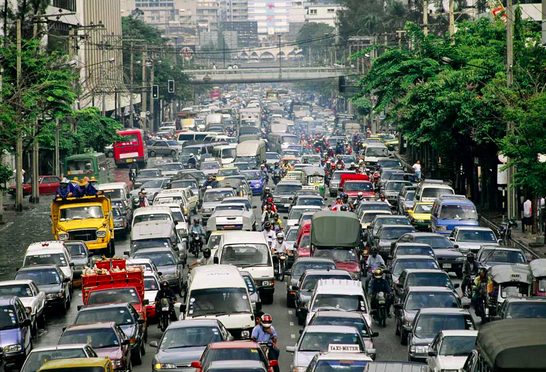
Bangkok is polluted, the smoke filled air from the early morning commuters with their cars, coming from their brand new condos, making their way to work serve to highlight the dramatic contamination levels this city has reached. Recent news from the Pollution Control Department that Bangkok’s air has reached critical levels can only confound worry. Bangkok people have learnt to put up with the pollution and ignore the three main worries associated with it; new high rise buildings, abundance of cars and filthy air. These factors will be classified in this essay.
The first factor is the brand new condos and apartments line every street in Bangkok these days. These new building have sprouted out of the ground to collect more people into a smaller areas of Bangkok. The sad fact is, there are little or no zoning laws. These seductively built premises neatly situated within eyeshot of major thoroughfares maybe appealing for the commuter belt brigade of workers but on already congested toll ways, roads and little sois, there really is no room for 50 or more families in their sparkling new condos. There are definitely signs of an oversupply of condos in Bangkok. The Government has noticed this too and has dropped the bank lending of 100% to only 90% of apartments less than 10 million baht which had made it too enticing for speculators but this will not stop the builders as they change tack and move into other avenues to entice more people into Bangkok.
Another factor is that there is no day off for traffic. Cars and buses clog the city twenty four seven. Benzene levels over Bangkok are well over the general limit. Medical studies have proved that long exposure to benzene exposure brings on cancer but this information must be kept quiet. Euro 4, one of the benzene petrol distributors have said they will try to reduce the levels of benzene emissions from 3.5% to 1%. This in itself is a great idea but what about the past and Bangkok’s contact with the smog that envelopes the city everyday. To compound the problem, these Bangkok people keep buying new cars. The roads are littered with red number plates, even with all the expense car ownership incurs; as long traffic jams every morning still grow larger. Bangkokians still continue to see their motors as prestige items.
One last aspect of pollution is the air which may seem clean to Bangkokians, some of them actually think their level of pollution is normal, but the air is not clean, dust particles lay in the atmosphere. These dust particles which can only be measured in microns of measurement that float around exceed the normal rate of air quality. Ozone levels were also found to be 0.2 percent higher than normal and volatile organic compounds were double the normal rate. Most of the 6.7 million residents are taking this air in. Plants and vegetation should help this but with not that many green areas the plants can’t give off air to cleanse and cool the area while the temperature keep rising. This heat is added to by the concrete building which retain their heat so Bangkok is still hot at night.
To conclude, there are many examples of the ways Bangkok is becoming more polluted. The truth is the Government should wake up to the dangers of air pollution but with the sheer vast amount of traffic on the streets of Bangkok it is going to a hard task. They have started the underground and BTS which unluckily invites construction but expansion of this transportation seems a distant dream and the sad aspect, Bangkok people must have given up on that vision too.
School of International Training – SIT COURSE JOURNAL 2004 – AUA Bangkok
TESOL Reflective Journal
Monday 8th November 2004
Reflection on Reflective Practice
How do you feel about participating in reflective practice?
How do you feel about your ability to reflect?
What challenges might you face?
Morning Session – Reflection
I feel that reflection is an important part of the learning process. I had a great deal to say about everything we did, and I felt that everybody was willing to listen to and consider my points.
Reflection gives me an opportunity to express my views and, perhaps more importantly, to put my thoughts into words. One of the most valuable aspects of this process is that others can agree or disagree with what I have said. Both responses can be useful because I can take something positive from each.
When someone agrees with my point of view, they may add information or insight that I had not previously considered. Equally, when someone disagrees, I can still take their comments on board. I may not necessarily change my opinion, but understanding another perspective can make me think more deeply and improve my learning experience.
One thing I noticed, however, was that not everybody participated in the reflection. I would have liked to hear everyone’s point of view. I believe that hearing from the whole group would have given me a more complete perspective on the experience.
Afternoon Session
German Class 1
Being a new language learner can be a daunting experience. During the twenty-minute class, I felt that, as a beginner, I was a little slow to engage and found some of the lesson rather boring.
Reflecting on this experience requires me to look at it from two perspectives: first, as a student, and second, as a teacher.
As a beginner, I can understand the need for repetition. Basic language learning cannot consist entirely of games and activities. There needs to be a solid foundation, and repetition is an important part of building that foundation.
German Class 2
I found this lesson much easier. I became more involved and actually enjoyed the experience.
I think this was partly because I had already learnt a small amount of the language. I was able to build on what I already knew and use it again while learning something new. There was still repetition, but I felt that it was more purposeful and less noticeable.
The teacher helped by introducing the language gradually. However, I felt that asking three people to come to the front and role-play the dice activity may not have been the best approach. I was asked to stand in front of the class and demonstrate what I had learnt, which made me more aware of how it feels to be placed in that position as a learner.
Reflection
What have you learnt about learning in general?
What have you learnt about FLL in particular?
What have you learnt about yourself as a language learner?
The major issue I took from this experience is that I found learning a new language difficult. Not everything the teacher presents is immediately absorbed, and remembering new information can be a challenge. Although some people may find language learning easier than others, a teacher has to consider the needs of everyone in the group.
In particular, I think that I, and perhaps many other students, need repetition. Choral drilling can help new words become more familiar, while opportunities to practise together allow students to gain confidence in using the new language.
Another important point is that students can be given too much information at once. If there is too much to remember or too much to do, learning can become overwhelming.
I also experienced difficulties with pronunciation. This made me realise that pronunciation is an area that may require considerably more time and focused practice than I initially expected.
A Metaphor for Learning
To begin with, you need a good foundation. By this, I mean that you need to understand what you are undertaking and have some knowledge of its different aspects.
You cannot build a wall too quickly. If you rush the process, the wall may not be straight or stable. It needs to be built gradually, checking that each section is accurate, secure and level before moving on.
Learning is much the same.
If you take your time and use the right materials, the finished product is much more likely to be what you hoped for.
Tuesday 9th November 2004
My Hopes and Expectations for the Course
My hope and expectation for this course is to get as much from it as I possibly can. I believe that undertaking any course is both a challenge and an opportunity for personal development.
One of my strengths is that I already have four years of teaching experience. However, I now need to reflect on those four years and use that experience as a foundation for developing further.
I would like to finish the course with greater knowledge, a better understanding of teaching and a stronger sense of professional discipline.
Group Work – Poster
My experience of the group work was that there was not really a leader or someone who took responsibility for directing the group.
Despite this, I felt that we worked well together and were generally agreeable as a group. Several ideas for names were suggested, and although we did not reach a decision immediately, we eventually arrived at an idea that everyone was happy with.
I felt that each suggestion was discussed fairly and developed where appropriate. Importantly, everyone’s ideas were treated with respect.
However, I did feel that someone needed to take greater responsibility for moving the group forward. We spent a considerable amount of time discussing ideas, and I think some of that time could have been used more effectively. The main objective was to complete the poster, and stronger leadership may have helped us achieve this more efficiently.
TESOL Acronyms
S – Students
T – Teacher
SWBAT – Students Will Be Able To
VAKT – Visual, Auditory, Kinesthetic, Tactile
PDP – Pre, During, Post
PPU – Presentation, Practice, Use
Wednesday 10th November 2004
Planning Teaching and Receiving Feedback
How was the experience of planning teaching and receiving feedback in your group?
My experience was one of knowing what I wanted to do myself, but not necessarily making sure that my partner had the same understanding.
In hindsight, we should have produced a more detailed lesson plan that we had both discussed and agreed upon before beginning the teaching.
The teaching itself went reasonably well, although at times I think I raised my voice too much. I may have been a little too forceful, and I noticed one student looking at me in a way that suggested I might have been making him uncomfortable. This made me reflect on the importance of considering not only what I say, but also how I say it.
Another important point from the feedback was that I had not properly considered the level of the students. They were fluent speakers, and I should have recognised this and adapted my lesson plan accordingly.
Although some of the feedback was critical, I found it constructive. I was told that the lesson was too slow, that I should have made better use of the board and that some aspects had not been modelled clearly enough.
These are areas that I would like to practise and develop further.
Strategies for Future Group Planning
In future, I think we need to spend more time agreeing on the lesson plan before teaching. Each person should understand their role, the aims of the lesson and how the activities will be delivered.
Clear communication at the planning stage should help to prevent confusion during the lesson.
How Can We Overcome These Challenges as a Group?
As a group, we need to make sure that everybody has an opportunity to contribute while also ensuring that someone takes responsibility for keeping the group focused and moving forward.
PPU – Presentation, Practice, Use
Presentation
- The teacher does a great deal.
- Processes are structured.
- Modelling is important.
- Eliciting is used.
Practice
- There is more student action.
- Practice is controlled initially.
- Activities become less controlled.
- Target language is available to students.
Use
- Students present and explain.
- There is less teacher control.
- Students have greater responsibility for using the language.
Reflection on Observation
As always, there are a number of changes I would have made to the class.
I thought the teacher presented himself very well. His voice was clear and at a level that was easy to understand. I also liked the way he organised the students into different group sizes, including groups of three and five.
During the fifty minutes I observed, the students completed a considerable amount of work.
The main area for improvement was that not every student appeared to be actively participating. More concise instructions and clearer time limits may have helped to keep everyone involved. I also felt that limiting the number of questions for discussion could have made the activities more focused.
Friday 12th November 2004
What Significant Things Will You Take from the Speaking Module?
Looking at the module as a whole, I have recognised that there are many different facets to teaching, and that we have only touched the surface.
Each activity has given me enough information to begin building a clearer picture of what effective teaching involves.
Perhaps the most significant lesson for me has been the importance of looking at teaching from the perspective of the students. We experienced many interesting activities ourselves, and I think this will influence my attitude towards teaching in the future.
Monday 15th November 2004
First Day of Teaching
I felt that I had achieved something because the students did what I had asked them to do.
One situation I had anticipated was when the students were writing down their three numbers. I made sure that I went around the class and checked each student’s work to ensure that they were completing the exercise correctly.
A situation I expected to be more difficult was eliciting answers from the students. However, they participated readily and contributed their answers, which made this part of the exercise much easier than I had anticipated.
One of my beliefs that was challenged during my teaching practice was the importance of keeping students attentive and preventing them from losing focus.
Something I want to remember for my next teaching practice is not to repeat what students have just said unnecessarily. I also need to be more conscious of the speed at which I speak.
Tuesday 16th November 2004
Reflection on the Listening Module
The main issue I need to remember is the importance of PDP and PPU.
I need to make sure that I understand and remember the different stages of the PDP approach. In particular, during the post-listening stage, students should have an opportunity to personalise what they have learnt.
I should also remember that as soon as the actual listening begins in a PDP lesson, the Pre stage has finished.
Wednesday 17th November 2004
Using Listening or Reading to Introduce New Language
One advantage of using listening or reading material to introduce new language is that students are exposed to different voices and situations.
For example, listening to two foreign speakers having a conversation can introduce students to a situation and type of language that they may not otherwise encounter in their everyday lives.
What Makes a Good Context?
I think a good context is one that students can relate to.
If the class is younger, school and education may provide a useful context. If the students are older, subjects such as employment and work may be more relevant.
The context should also feel current and meaningful to the students.
Friday 19th November 2004
Error Correction
I think error correction is important, but it must be handled in the right way.
A teacher needs to correct errors without embarrassing or offending students and should provide a clear explanation or answer that helps them understand what they have done incorrectly.
I also think that all students should have the opportunity to participate. When an error or point of language arises, it can sometimes be useful to open the issue up to the whole class so that everyone has the opportunity to think about it and learn from it.
What Will You Take from the Grammar Module?
I think students need their grammar to be checked and developed, but there are many ways of doing this without making lessons boring.
Grammar can be presented in different ways and, with the right approach, it can be made interesting and even enjoyable.
Monday 22nd November 2004
What Is the Relationship Between Culture and Language?
I think language has a great deal to do with culture.
Something that is considered acceptable in one country may be considered rude or inappropriate in another. For example, in Thailand it may be acceptable to ask more personal questions, whereas in England people may be more likely to wait for the other person to volunteer that information before asking.
This highlights the importance of teaching students that language is not simply about vocabulary and grammar. There is also an etiquette associated with how language is used.
Making students aware of this allows them to think carefully about how they communicate before using language in different cultural situations.
What Is Your Definition of Culture?
I would define culture as a system of ways in which people within a particular society relate and respond to one another.
It includes shared values, behaviours and methods of interaction. However, these can vary considerably between countries and cultures.
Tuesday 23rd November 2004
What Do You Want to Take Away from This Discussion?
I want to come away from this discussion with a better understanding of all the issues involved in creating the right learning experience and atmosphere.
I want students to feel relaxed, comfortable and ready to learn.
How Will You Apply This to Your Classroom in the Future?
I will apply these ideas to my classroom by considering everything that contributes to the learning environment, from practical issues such as having the air conditioning at a comfortable temperature to my own manner, posture and attitude.
I want students to feel that I am approachable and that they can communicate with me comfortably.
What Else Do You Want to Take Away?
I think it is important to remember that, as a teacher, you are not simply teaching a language. You are also teaching about the wider culture associated with that language and country.
This means helping students develop a fuller understanding of what it means to communicate within a particular cultural context.
I also think it is important to consider classroom culture. The classroom should be a positive working environment, with clear expectations and rules. These should be consistent, fair and respectful, much like the expectations we encounter in society outside the classroom.
Thursday 25th November 2004
What Does the Skill of Reading Involve?
The skill of reading involves much more than simply recognising and reading words.
It involves extracting meaning from those words and understanding the message the writer is trying to communicate.
What Does It Take to Be a Successful Second-Language Reader?
A successful second-language reader needs to understand that written texts can develop in many different directions and that meaning can change depending on the sentence and the wider context.
Simply knowing the individual words is not enough. A learner may understand every word in a sentence and still fail to understand its overall meaning.
Understanding the text and its context is therefore essential.
Friday 26th November 2004
What Are You Going to Take Away from the Writing Lesson?
Writing can take many different forms, including formal and informal writing.
One of the main considerations is the person or audience being addressed. Certain types of language are appropriate in particular situations and not in others.
Writing is also different from spoken language. When we speak, we can correct ourselves immediately if we make a mistake. Written language is more permanent, so greater care is needed before the words are committed to the page.
How Would You Describe a Successful Piece of Writing?
A successful piece of writing should be clear and logically structured so that it does not confuse the reader.
It should fulfil its purpose and be written in a style appropriate to the particular format and audience.
Ultimately, effective writing is about communicating meaning clearly, appropriately and successfully to the intended reader.

