Comments on Little Black Boy by William Blake

Blake’s poem is dramatic, that is, in the voice of a speaker other than the poet himself. This poem of Blake’s uses the Little Black Boy to narrate the poem in first person. This projects the reader clearly inside the consciousness of the boy in the poem giving us the images from the defined observer. As a result, Blake stands outside innocence and experience in a distance position. The innocence is from ‘Songs of Innocence’, Blake’s first collection of poems, to which Blake’s subject matter shows the innocent, pastoral world of childhood. This was juxtaposed with experience, which was taken from ‘Songs of Experience’, his other collection, which shows the adult world of corruption and repression, therefore, showing the two contrary states of the human soul. The ‘songs of innocence’ dramatise the naive hopes and fears that inform the lives of children, namely the ‘Little Black Boy’ who tells this didactic story about himself in this poem.
England in Crisis – An article review of ‘David Cameron and the London Riots’

(761 Words)

Now that the general election 2015 is looming, I will refer back to David Cameron‘s legacy circa August 2010. Parts of England are ablaze and looters are running amok with wild abandon supposedly venting their anger at the English police and British government. How could a seemingly democratic society and a country that is known to be rich and powerful end up in ashes leaving a nation confused and angry? I will present a review of the article ‘David Cameron and the London Riots (The Conservative-Liberal Democrat Coalition Takes a Hit)’ on the Foreign Affairs website using my thoughts to argue against the article.
As the dust settles on any problem, there are always going to be people throwing accusations around, especially to the London riots that give grounds to the reason why these troubles started. The ‘David Cameron and the London Riots’ article labels all the problems on David Cameron. The article blames all his austerity measures. For example, his 81 billion pounds of cuts over four years. The riots were started by out-of-control hoodlums using the death of a man shot by police as their reason to burn and loot. Then, England saw copycat attacks as word got out that looting can be done and the police will be slow to stop the looters. Many businesses were looted and burnt to the ground. One can only imagine the after-effects on all concerned. The article does not seem to mention any of these mindless acts, and leaves the blame with Cameron who even, as the article mentions, has an ‘increasingly tense relationship between his Conservative Party and the police force’.

Would you select prescriptive or descriptive method of teaching grammar? Give reasons?

There are, of course, different ideas from different people and no method can be thought of as the ultimate for learning. Although this is said, I would certainly lean towards a more descriptive method of teaching. A descriptive method can relate to the abundance of people who speak the language where it is noticed that in the global world mostly everyone needs to speak some sort of English. This also relates to countries which are very multicultural. We can not say that every one of these conversers speaks complete standard English. I will keep away from saying correct English as I think within reason there is no exact or correct way to speak. A descriptive method of teaching can be favored which allows a teacher to extract exact meaning from conversation not extracting from sentences as this could be relating back to a prescriptive form where there is a formal education that does not intrinsically allow for students’ conversational construction. One question would be: does the speaker need to be perfect grammatically to get their message across?
England, you would think after many years of using the language, the population would adhere to a ‘standard’ form of speech, but it is probably spoken natively by about 10% of the population. This was a guesstimate by Peter Trudgill. So, it shows simply being a native speaker of English is not a qualification for setting up as an EFL teacher; however well you speak it. The students, as well as the teacher, need to be aware of the situation they are in and how they should use their language the best. A language teacher can teach the students a prescriptive grammar, but on the whole grammar and language is continually in transgression. The importance of English as the language of communication nationally and internationally must input the importance of meaning. For example, Stephen Krashen wrote,”acquisition requires meaningful interaction in the target language – natural communication – in which speakers are concerned not with the form of their utterances but with the messages they are conveying and understanding.” (S. Krashen, 1981)
Of course, there are a few problems with prescriptive grammar as it only prescribes to one way of speaking. This could well be a model to rely on and teachers would be wrong to ignore the standard grammar, but to say that an English speaking person is wrong in the way they colloquially speak could well lower some learning ability. Descriptive linguistics will tell you that they do not raise questions about who is right and who is wrong, or about who has the right to adjudicate. There will be teachers and parents who will certainly tell you to speak properly, but in most cases, this would be when it is more formal occasions where you must be polite. This does mean that a person will always be in a formal occasion where ‘standard’ English is needed. There is a time and a place for using formal and non-formal language. The students need also to work this out for themselves. They need to be problem solvers. The teacher needs to put them in these social positions through role-play so the students can find out for themselves how to act. This perspective views teaching as a “conversation” in which teachers and students learn together through a process of negotiation with the curriculum to develop a shared view of the world
English is very heavily codified for non-native learners. Prescriptive grammar actually takes away the forms of English that a lot of other people use. Of course, the use of grammar is to get the right point across. For example, if someone is on the phone and they asked for a pencil. An answer could be ‘a pencil is on the table’. Although this answers the question the appropriateness of the answer is not sufficient. This relates to the meaning of grammar and how we use the language. People do use different structures. There is one problem that students will take their dictionary into the class and once they have a problem they will consult it. This does not accept their authority on meaning or grammar. For example, students will learn the ‘dead’ which is the right word for someone who has died. The sentence ‘he is dead’ is correct grammatically but would a policeman say this to the unfortunate person who he has to tell about their unfortunate relative. He, of course, would choose his words carefully as to try to lessen the strength of the sentence using ‘he has passed away’. From this little example, it is very clear that the children must be taught English and when to use it. Students should be taught that language varies. This shows the movement away from the prescriptive grammar. There is certainly a flexibility in the language and the choices of sentences for every occasion and how they and their ideas are perceived by the receiver. It has also to be said that people do not speak in complete sentences and can jump from one subject to another rapidly. Students need to be aware of speaking appropriately in different contexts, adapting their talk for a range of purposes and audiences including variants of English regionally spoken. Pupils should be taught about the variations in written English and how they differ from spoken language, and to distinguish varying degrees of formality, selecting appropriately for a task.
Focusing on communication in the classroom, the interactionist theory of teaching can be mentioned here. Learning a language in the classroom is essentially through interaction and interpersonal activity where the teacher can make sense of and respond to the behaviour of their students. Lessons can still involve using a certain grammar point, but this can be learnt subconsciously. A lot of language acquisition takes place through conversational interaction the students have. The students can work together to achieve a context and meaning to the lesson with the teacher as the facilitator. This communicative approach to learning has interaction as an important factor which supports language learning. The learning strategies for the students are where they use their teacher and their peers to further their language acquisition. This interaction can be vastly beneficial to the students’ natural acquisition. This means that the students can take control of their learning. The teacher can help [1]learners to use communication strategies as a way to negotiate meaning. This will not only help their comprehension but also help them learn new words. The students, then, have an opportunity to talk in their second language. Therefore, this highlights a teacher’s teaching methodology which should provide more chances for students to interact with each other as well as with the teacher. The teacher also has to recognize that while giving the students more freedom, the communicational input is beneficial at a right level that empowers the enthusiasm to work and mix in a group.
To conclude, I would select a descriptive teaching method as it allows the students to communicate in situations that show how they are aware of how to act. This gives the teacher the chance to see the way they are working and learning. It makes the language available to be understood and shown out in the open. This gives the students more opportunity to see the language at work instead of just written on paper.
(1222 Words)
[1] Yule and Tarone, 1991. Yule and Tarone allied with the interactionist theory.


A love of volunteering – Coaching Kids Football
(855 Words)
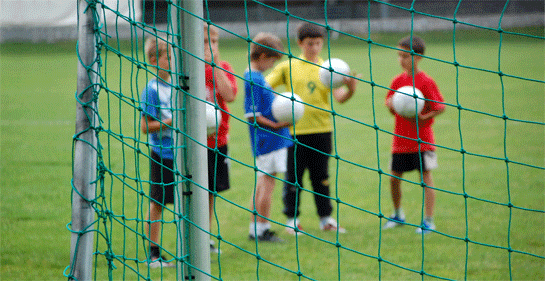
Getting up early on Saturday after a week’s work may be a hard task for many, but when you have the enthusiasm for sport, namely under 8s football, this can be the least of a coach’s worries. Coaching kids’ football can be a most rewarding experience. This is how the story goes…. every Saturday at 8.00am the kids are ready to learn football skills, have fun and meet their friends; the coach has to encapsulate all these factors for them. The challenge of coaching these kids in their football team is fitting in a challenging step by step coaching plan within 90 minutes allocated including a period of warm up and skills training while preparing them for a 30-minute match (against another team) before the end of those 90 minutes.
The first step is the warm up where the muscles are warmed up and stretched a little. After rounding the kids up for an approximate start of 8.00am, it is time for the warm up exercise which also includes the thought of waking up their minds. The little ones can be still a little sleepy! Kids do not want training to be too serious and being 8.00am they are not they to be lectured to. The coach does not want them against him. So, for example, a great game for a warm up for coaching that always works involves the kids dribbling with the ball over a distance of 50 meters, then when the coach shouts a body part, while they are dribbling, the kids have to place that body part on the ball. This gets them familiar with the ball, but also opens their thinking to listen and perform a task. Usually the kid who is last to do the action gets a gentle kick on his bottom. It adds a little humour to proceedings. A careful check on the clock is needed as not starting dead on 8 am and this exercise running for 20 minutes or more can limit time; not forgetting the coach wants the main focus to be on learning more specifics on football.
Next is the chance for the kids to actually learn a few football skills, making sure before this that they might need a break for a drink. Naturally with the skills and warm up there has to be a transition from the last exercise where the process of coaching has to include a part that actually teaches them skills for future use. A major factor of football and coaching is passing so emphasis can be on this. For example, the coach gets the kids into pairs 3 metres apart, first demonstrating the task with a better player by using the inside of their foot to pass the ball. Next, the pairs of kids pass to each other. This can be done for 5 minutes. Then, the coach adds a bit more flavour to the exercise. They then, have to pass the ball through their friend’s legs from their 3 metres gap. Again, another 5 minutes is fine. So, the kids are now a bit more familiar with passing. To follow this is to get the kids into groups of 3s and play ‘piggy in the middle’. Two kids pass between themselves and the other has to touch the ball. Another short period is used for this. Another check of the time should be done as time is running out before the match; so to finish off the skills section the ‘piggy in the middle’ game is played again with everyone. This brings the group together to have a fun ending to this section.
Finally, the real game starts after another drink break. The team now has to be picked for the match and tactics discussed. At this lower age of players, it is not fair to baffle them with football science, so it’s the coach’s job to encourage them to have fun and enjoy playing while still keeping in mind what they have learnt beforehand. Now, the game starts. The coach needs to keep the kids’ minds active, younger kids can lose concentration and think that football is just about kicking the ball while looking at the ground. Minds do wander! Win or lose though the coach should make sure the kids tried. Once the first half is over, the coach directs the kids to their drink, then gets them back for a little positive pep talk, then leads them out for the second half. At the final whistle, both teams shake hands. Hopefully, the coach’s team walks away with a win but priority is that a great morning was had by all.
To conclude, all the warm up, skills and final match may seem a lot to do within 90 minutes but if a little preparation is done, there is never a problem. Enthusiasm for the game and the kids, plus a passion for teaching helps any coach along the way. Any new coach should learn that time spent working out a coaching plan banishes into the background by the satisfaction of a seeing the kids’ faces as they have fun training and having a match.


