Quantitative Research Method
FORMATIVE ASSESSMENT – (Teaching) An Action Research Project
(8900 words)
Table of Contents
- Introduction
- Context
- What is action research?
- Literature Review
- Qualitative Research Methods
- Quantitative Research Methods
- Research Question
- My Research Method
- Ethical Issues
- Analysing the results
- Conclusion
- Reflecting on my research
- Reflecting on the issues
- Action from my research
- References
- Appendices:
- One Sentence Summary
- Four Corners (I’m confused, I’m lost, etc.)
- One Minute Essay
- Four Corners (Agree, disagree, etc.)
- TEFL Practice Teaching Observation (checklist)
- Questionnaire (you as a student)
- Questionnaire (you as a new TEFL teacher)
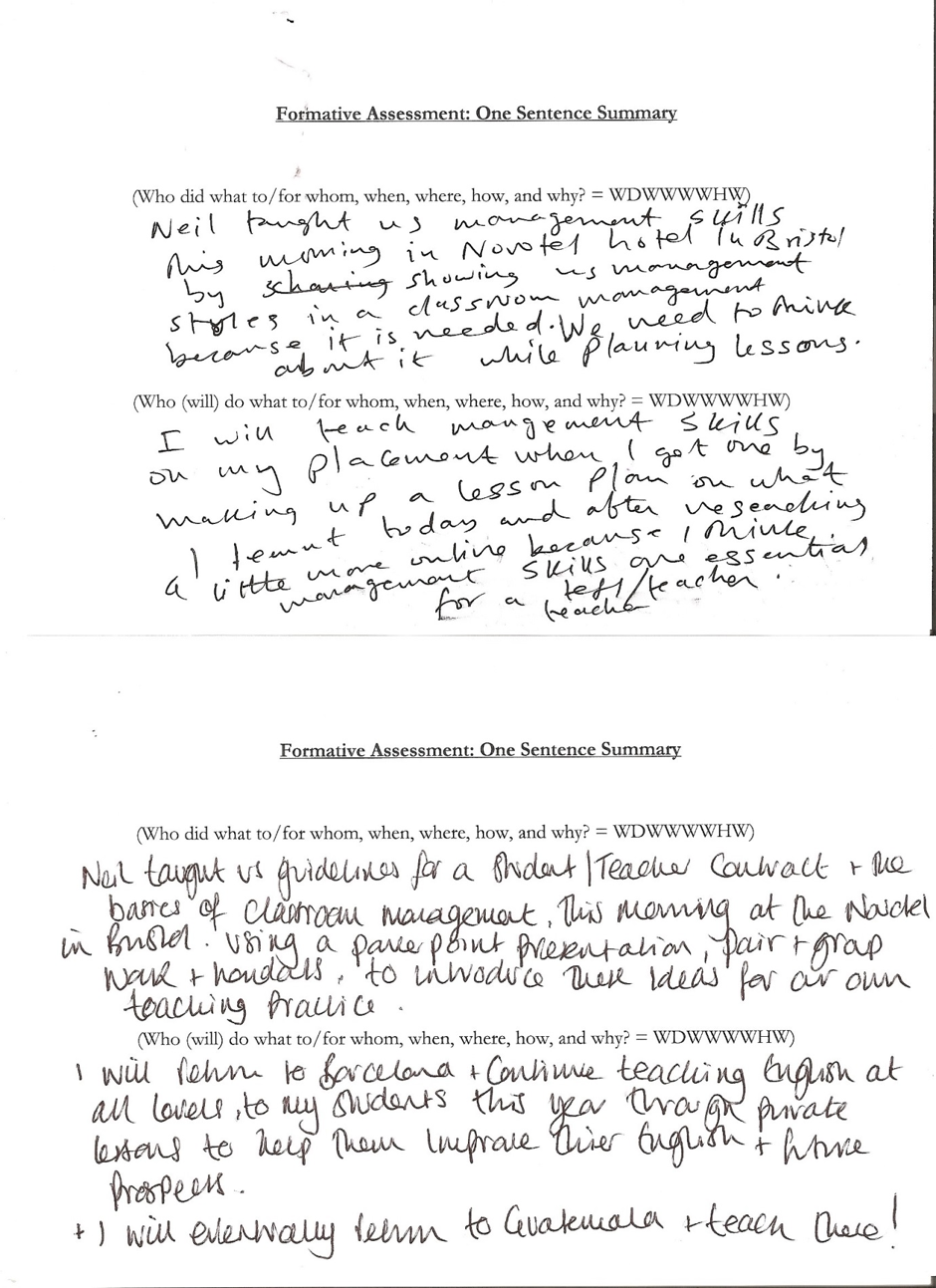
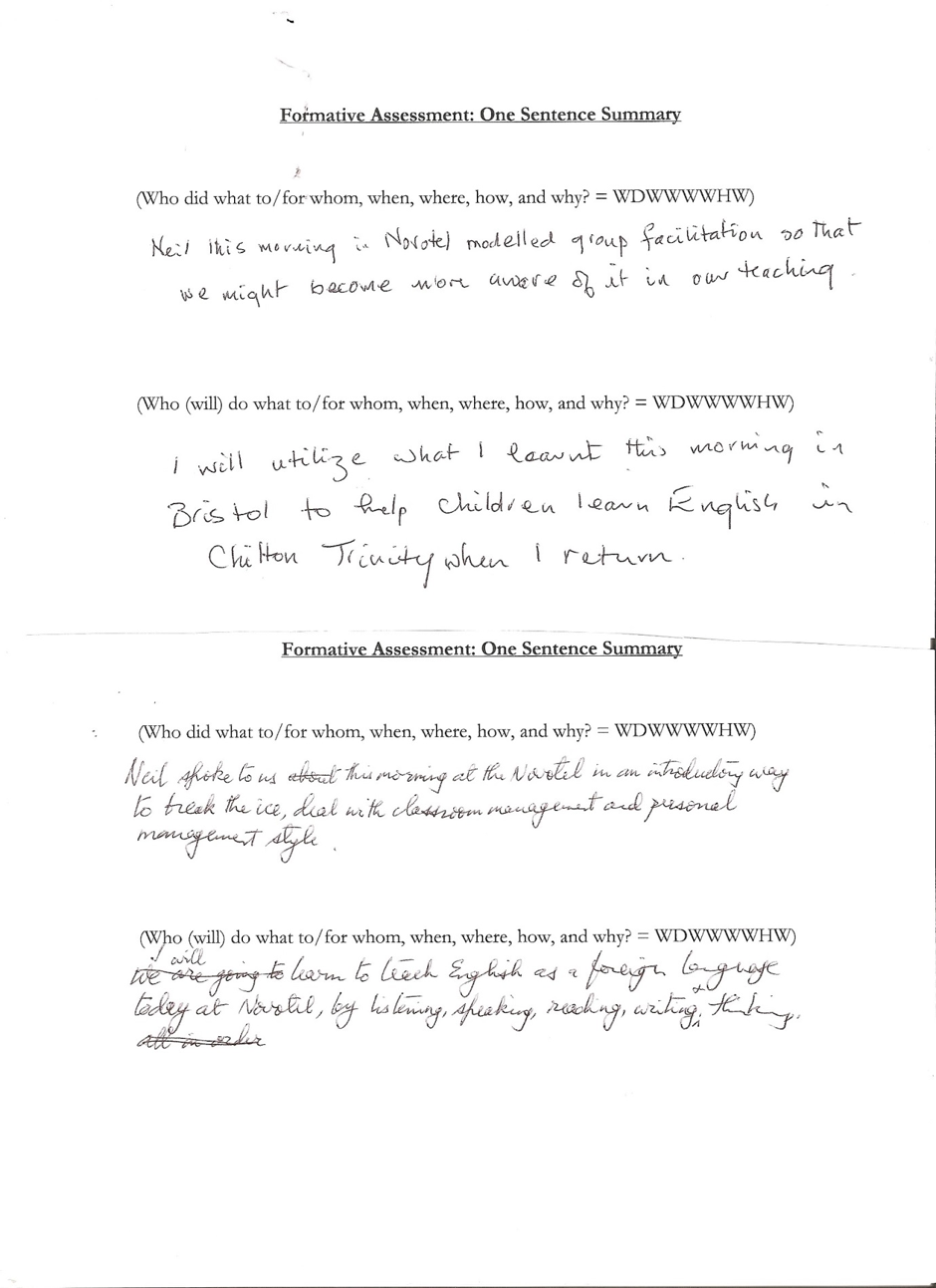
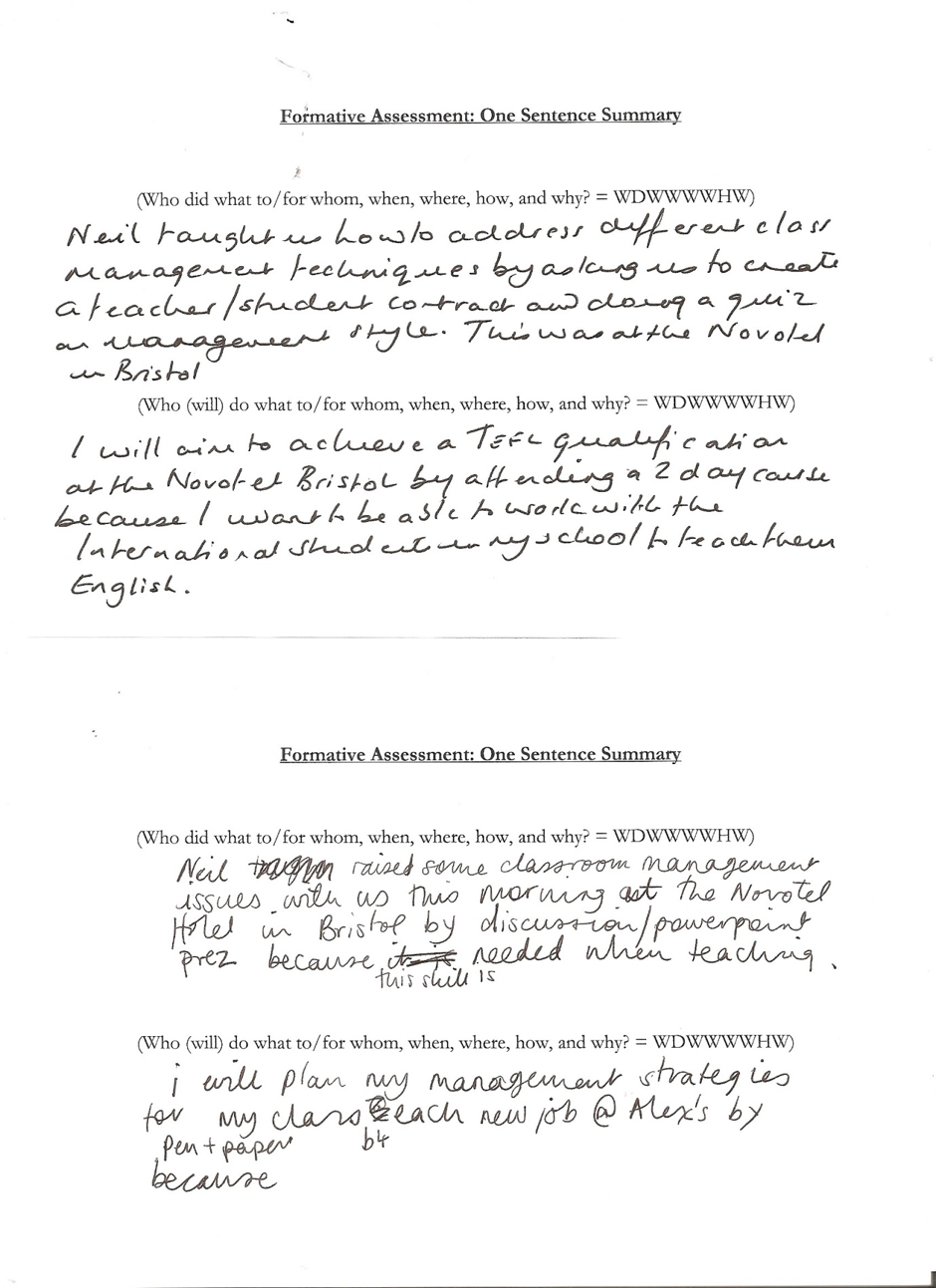
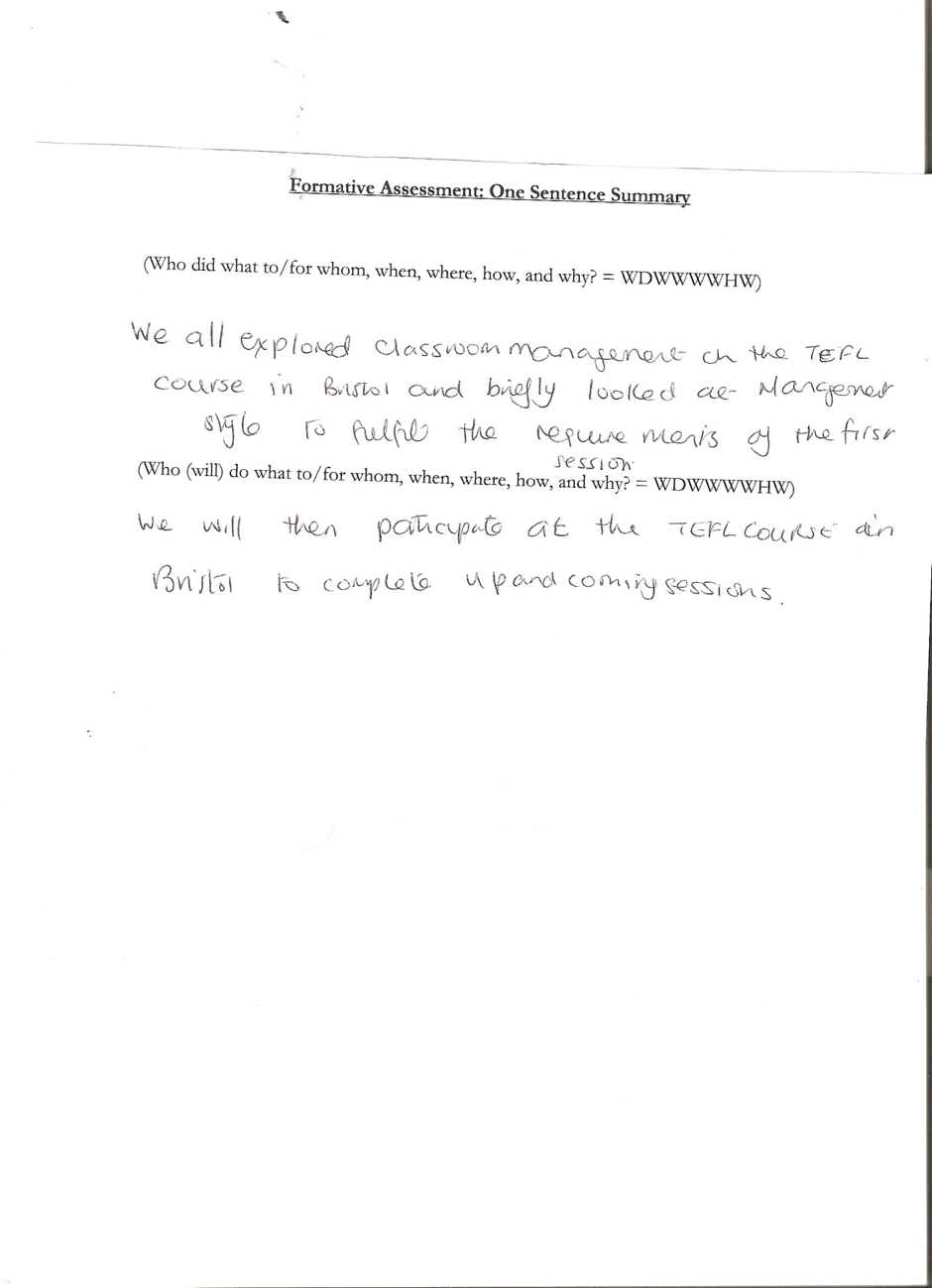
- Completed One Sentence Summary
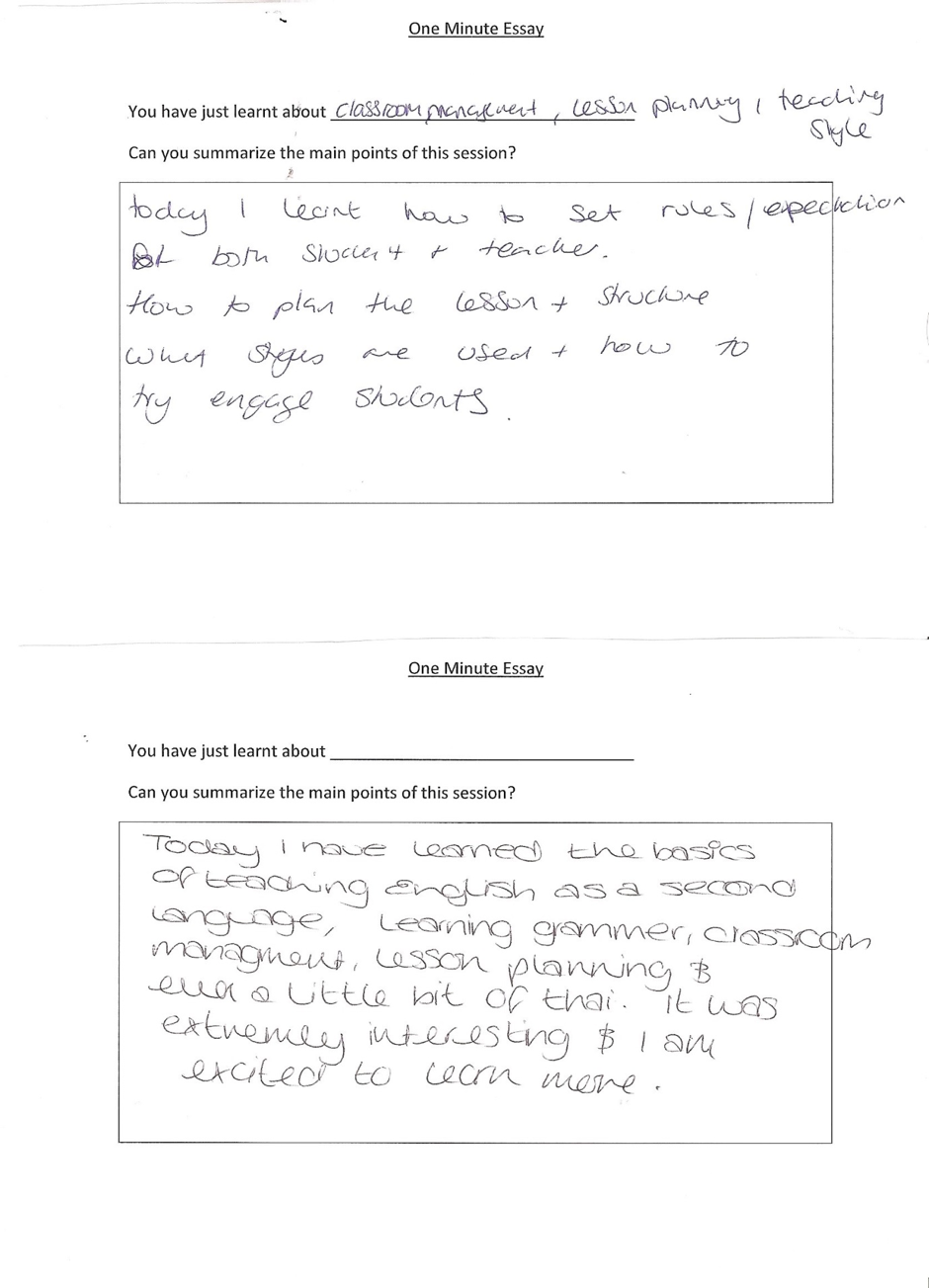
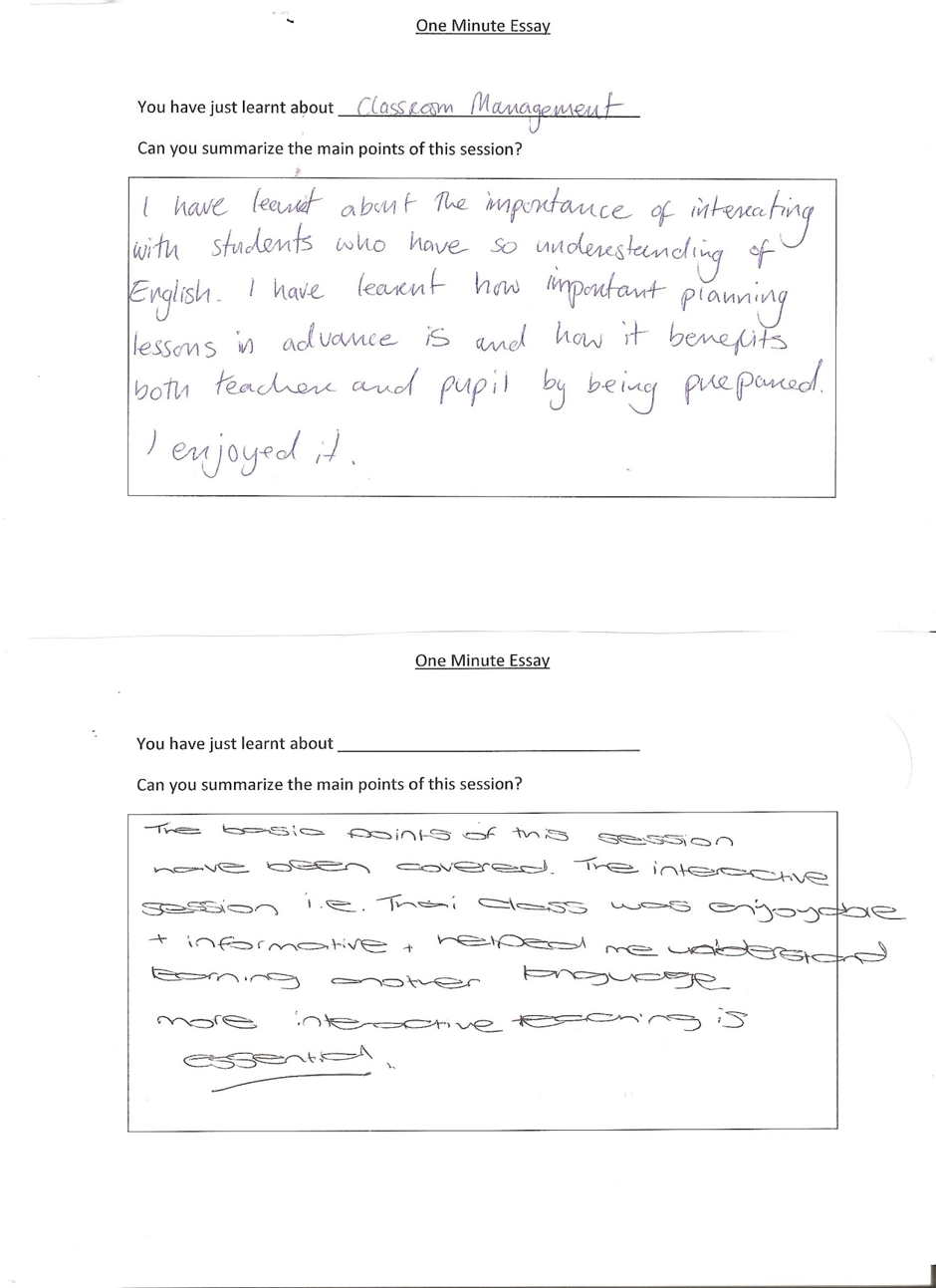
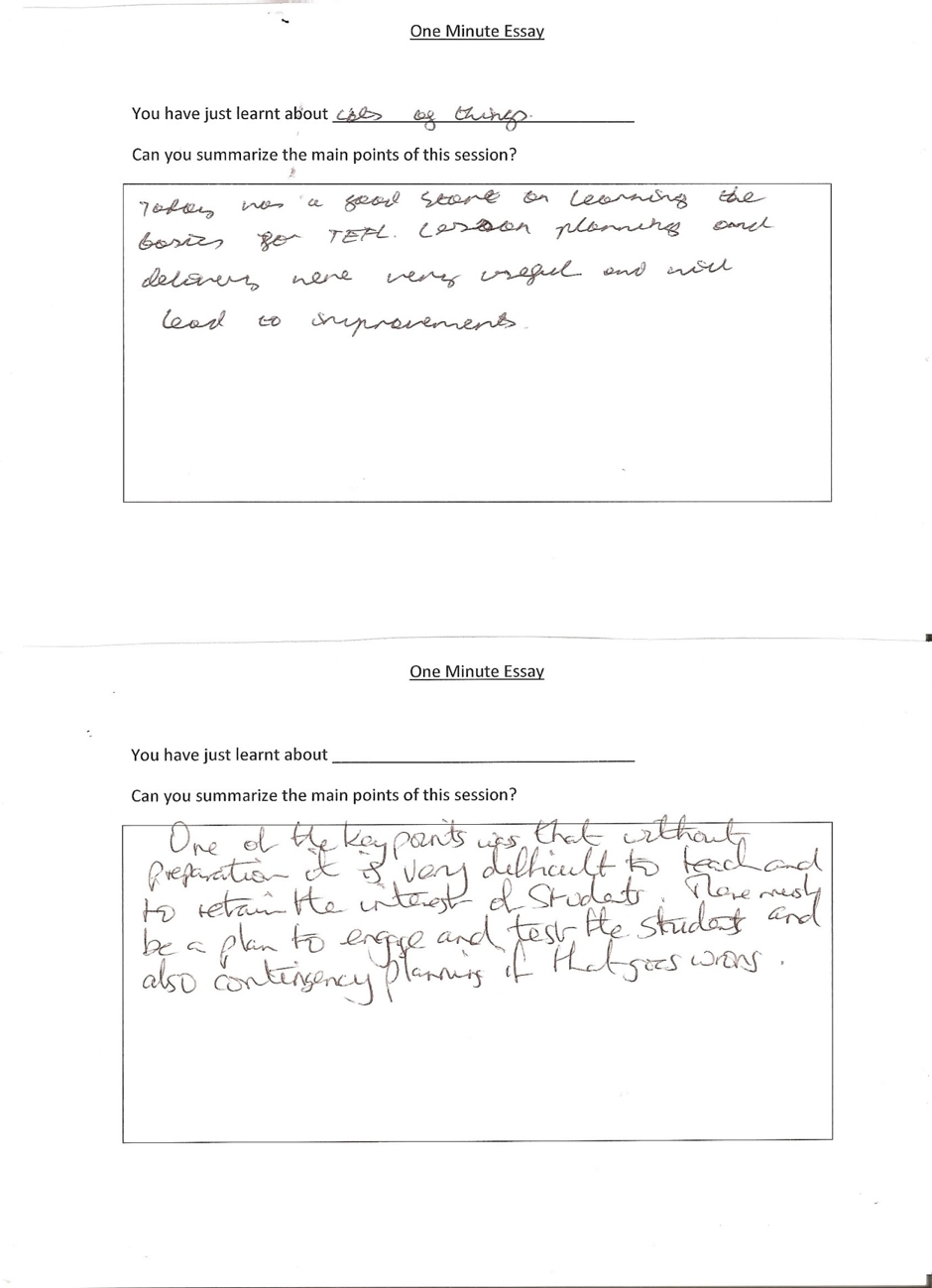
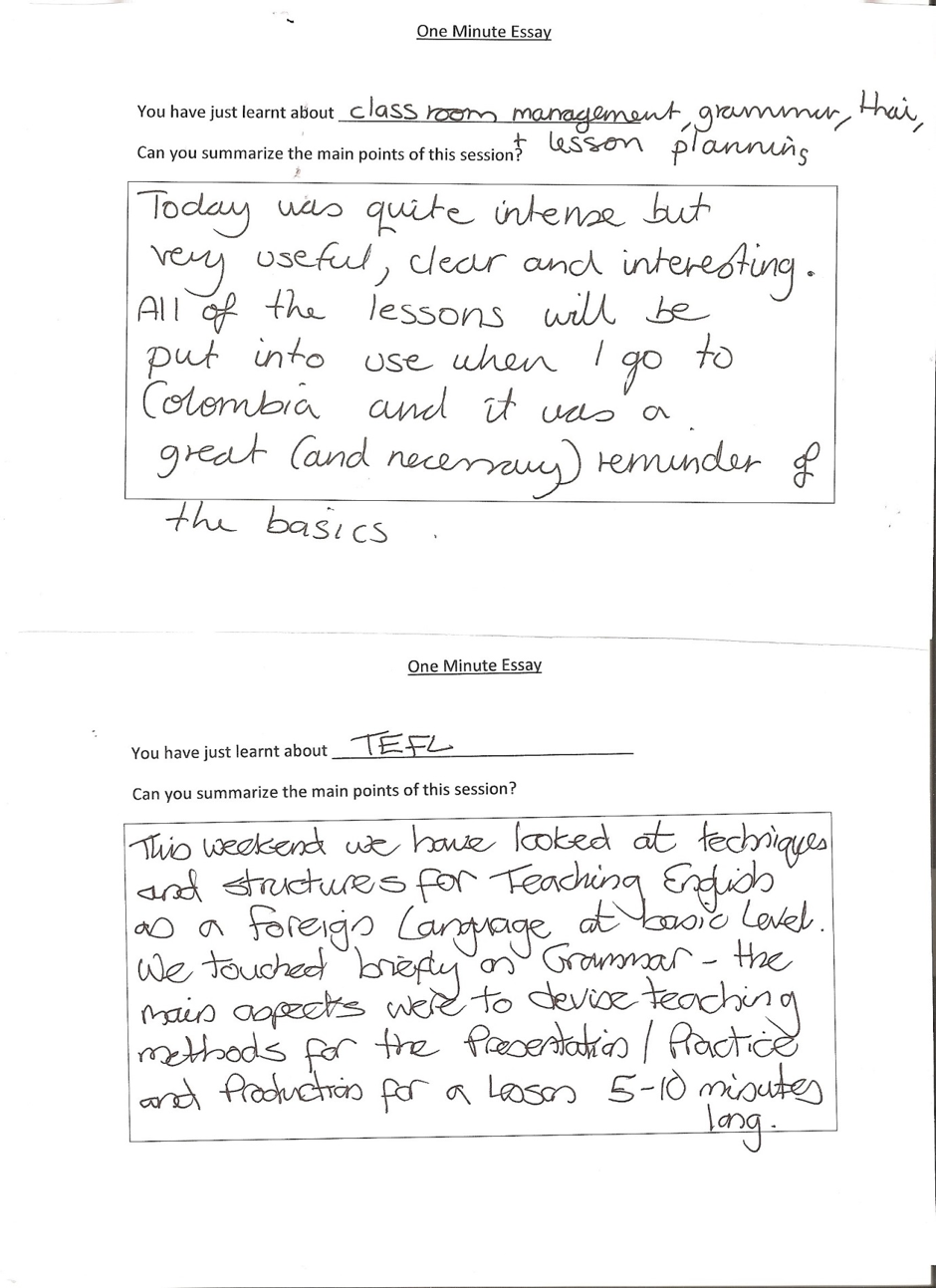
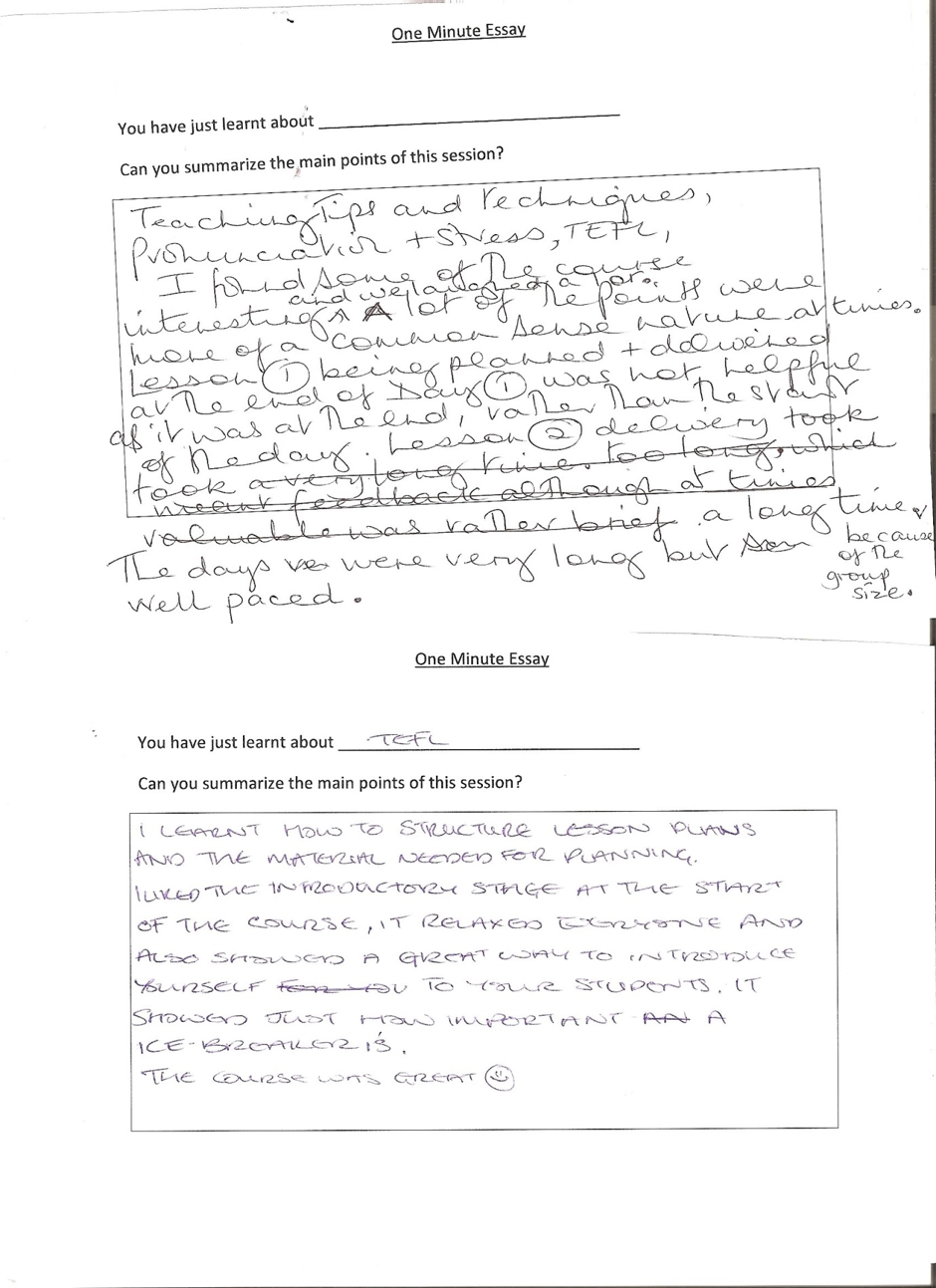
- Completed One Minute Essay
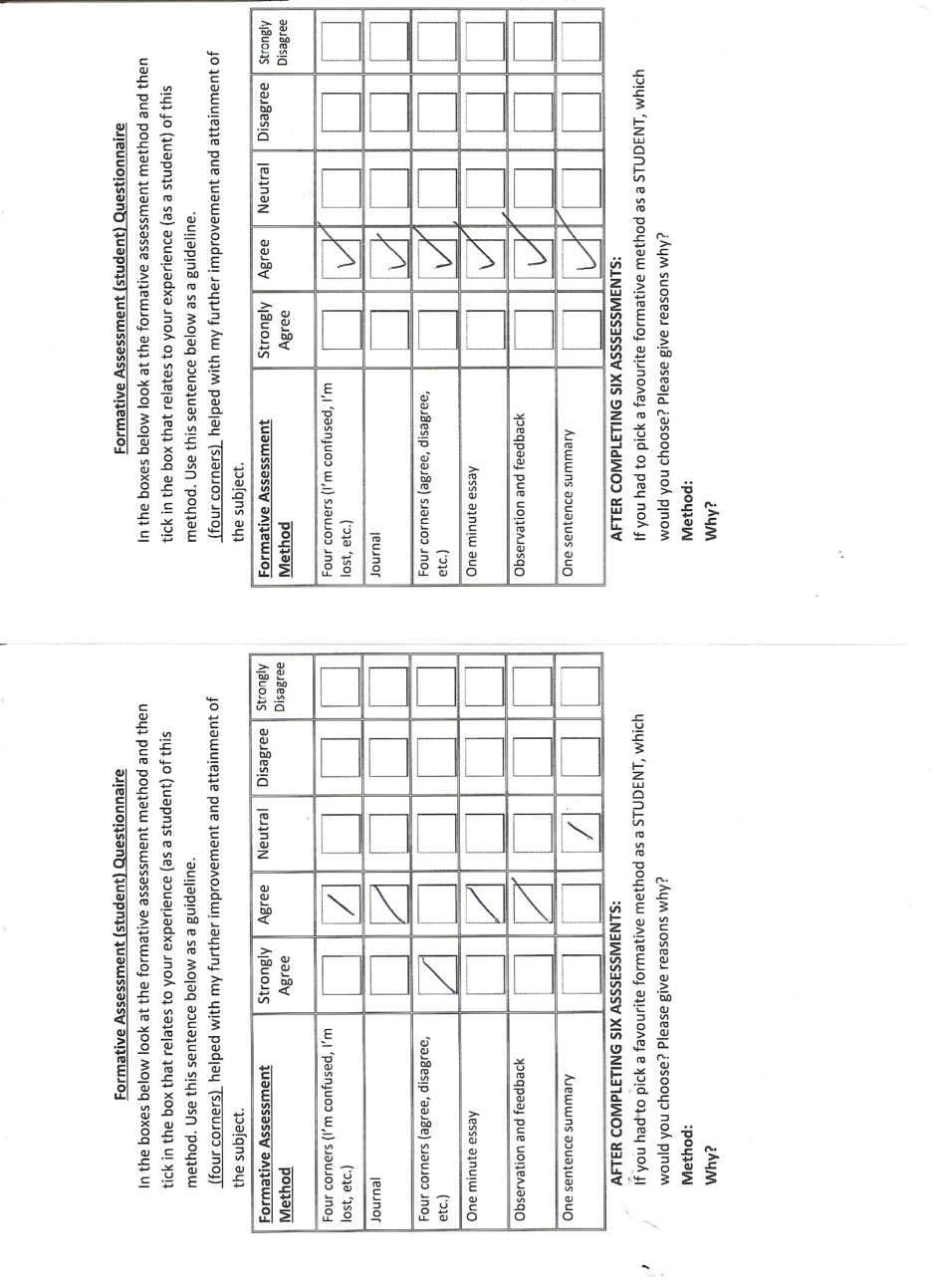
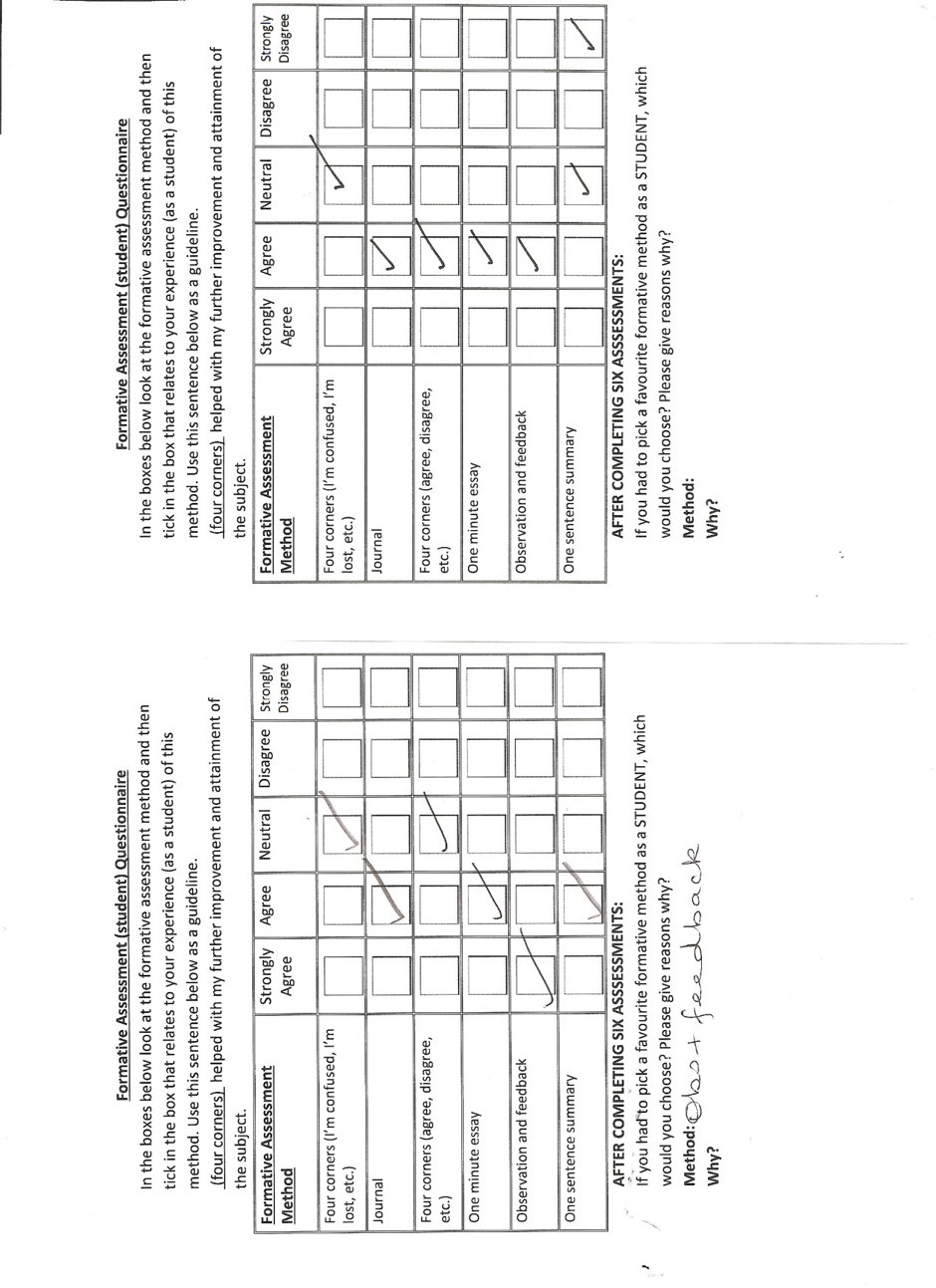
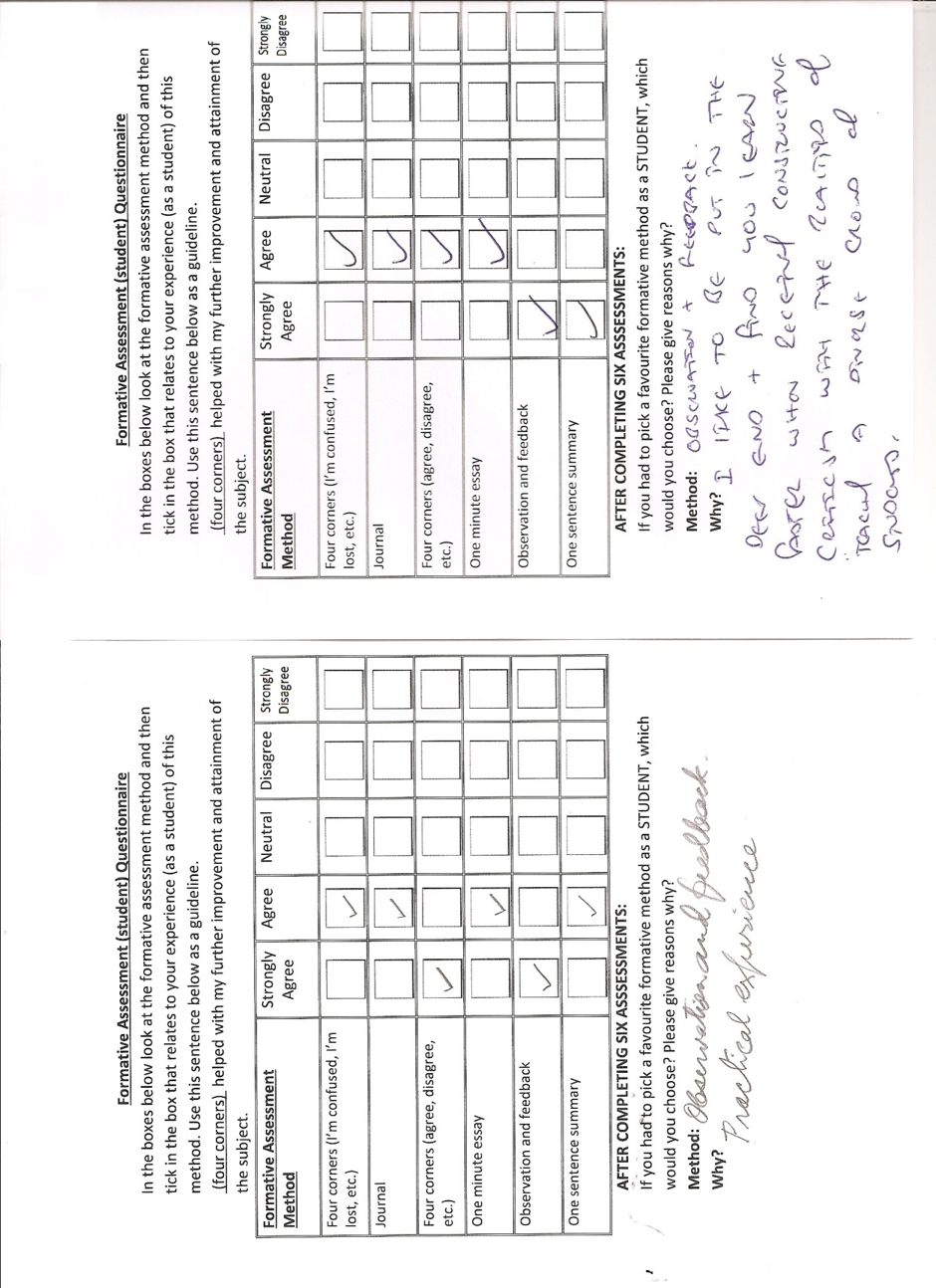
- Completed Questionnaire (you are a student)
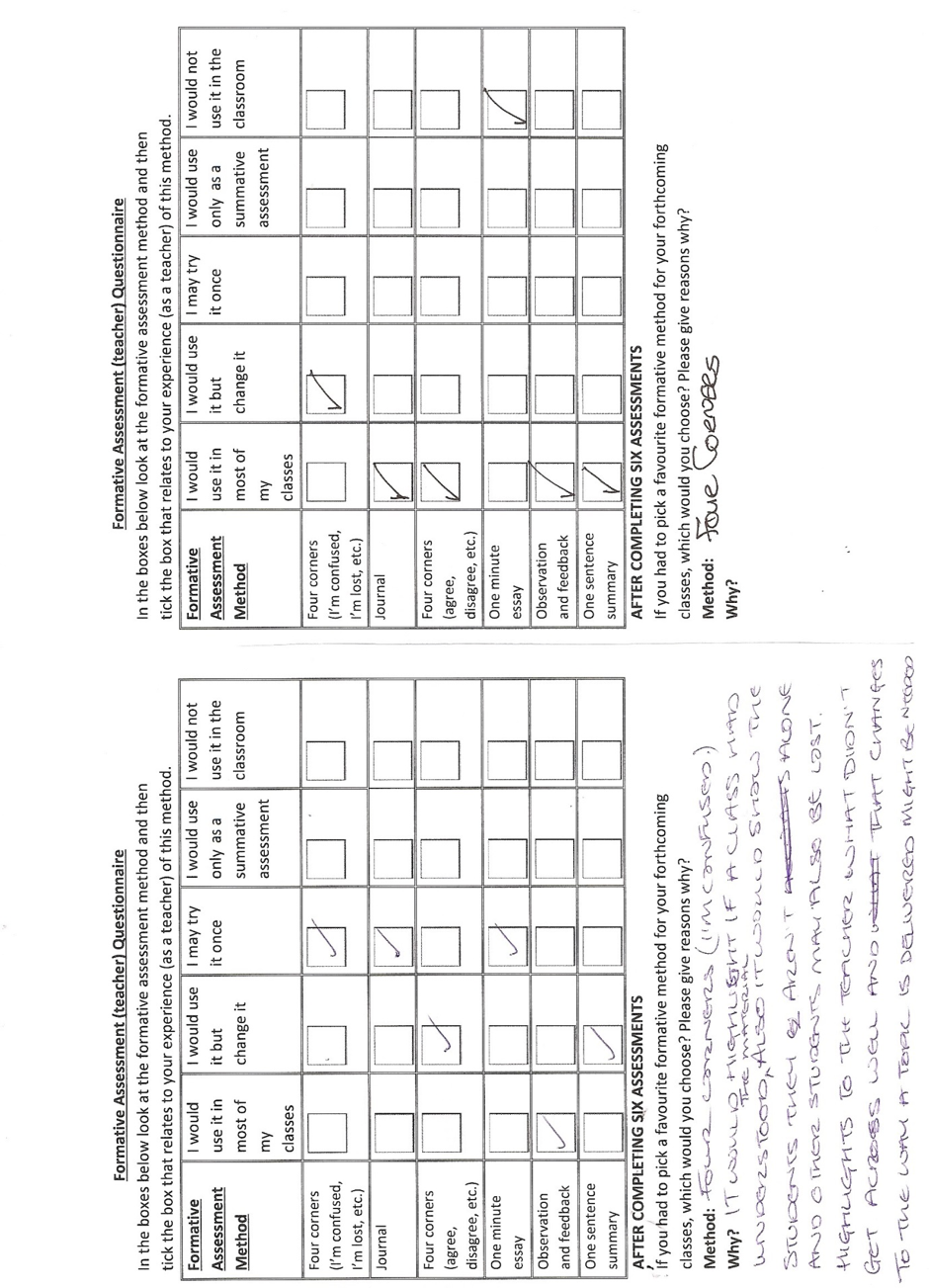
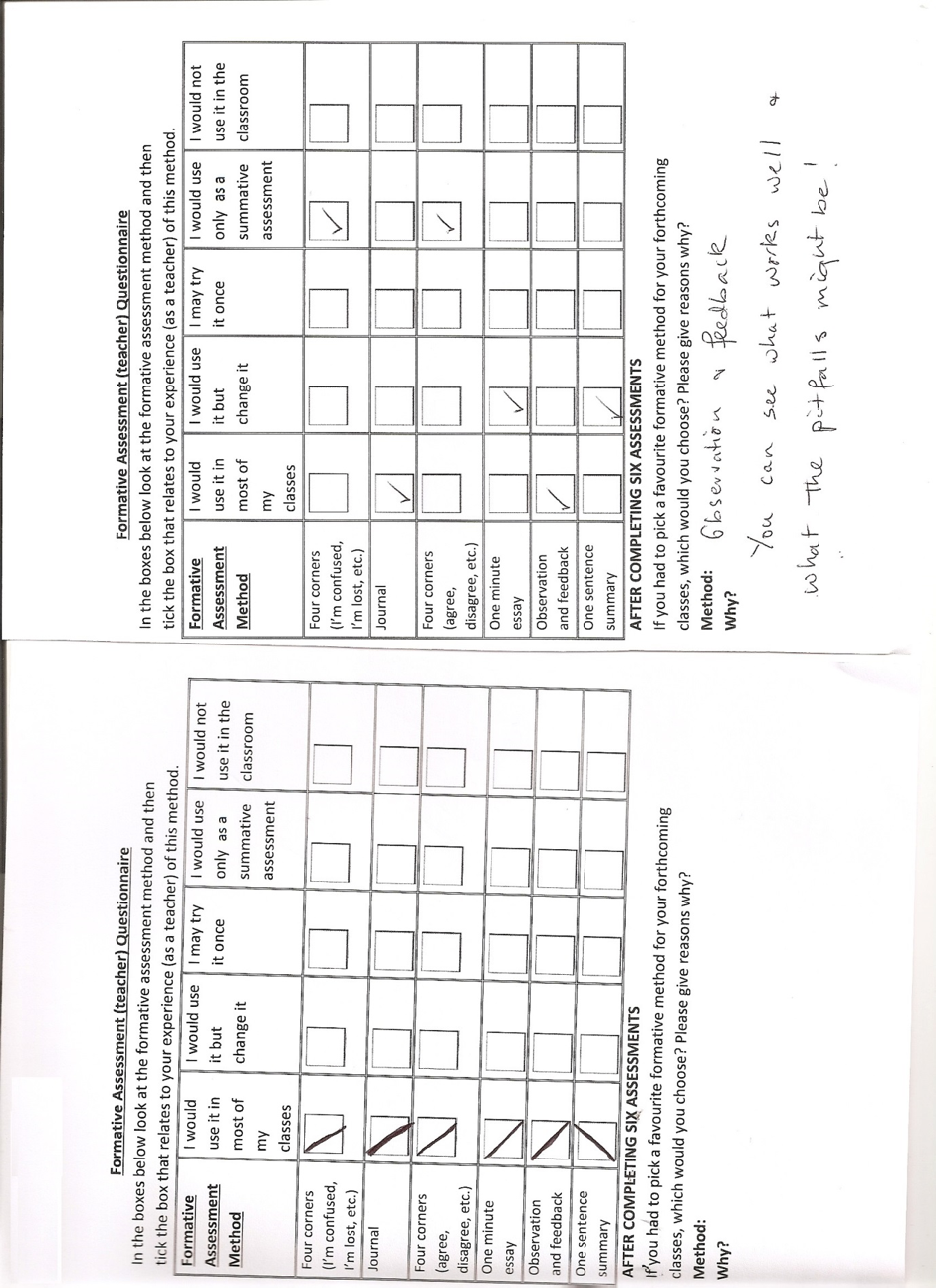
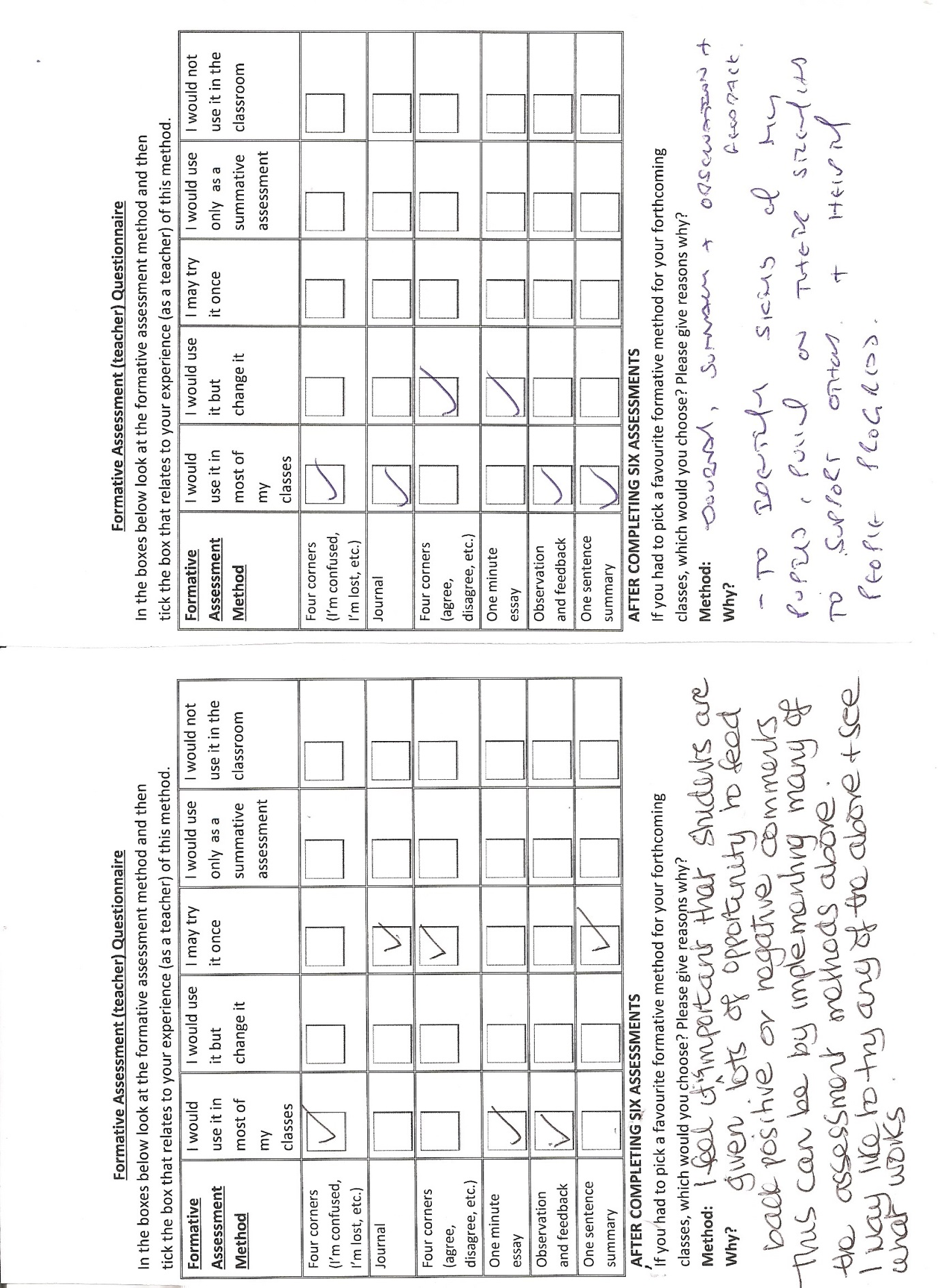
- Completed Questionnaire (you as a new TEFL teacher)
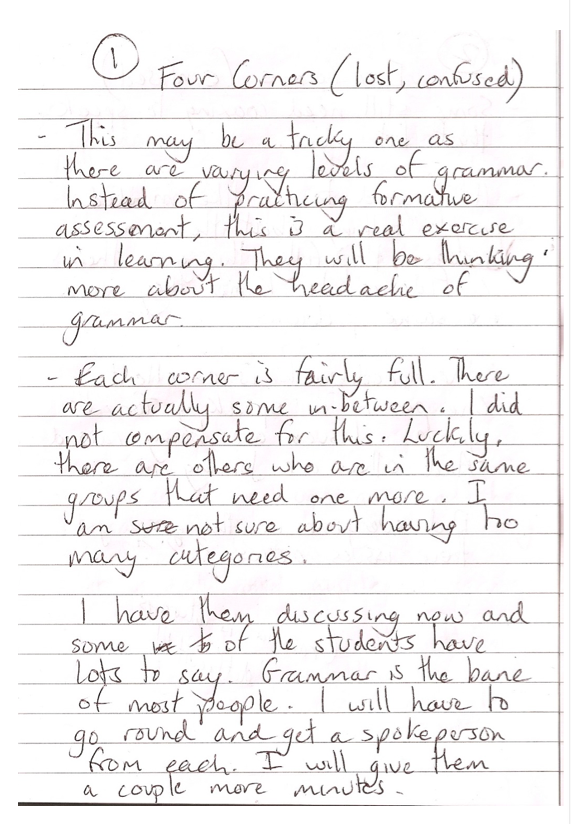
- Completed Field Notes
Introduction
Having used formative assessment in my class before and been given written and verbal feedback on this, I feel this is a great method to check my students’ understanding of the subject matter at various stages of their foreign language teaching course. Of course, my formative assessment procedure needs work, and getting to know how much of the subject matter the students have processed is a major factor of myself succeeding in my class and developing educationally. My course and the modules within it are on a set time limit and students have some difficult days of study absorbing all the information as within their 20 hours of study they have many modules to complete. From this it means that students must be able to comprehend the subject matter; take in all that the teacher offers and be able to show this in their practice teaching. Although I am fundamentally teaching the basics of TEFL and what they essentially need to begin their first teaching experience, I still need to give them more than enough information to achieve this. This leads me to improve on my approach, method, and techniques to enhance the learning experience, so that each and every student has grasped the subject matter of the module, and can walk away after the course feeling they have the confidence and the knowledge to prepare for their first teaching assignment while at the same time the knowledge they have gained will inject that incentive to further their studies and their teaching. As well as improving on my delivery and content, I would like to see the students’ collaboration heightened during the formative assessment. By formative assessment, I not only need to know the content delivered is valuable but also to see students showing others what they have learnt and recognising what others have learnt that they may not have noticed. This I feel can be enhanced by formative assessment of each module during the course.
Context
The first aspect of formative assessment is that it focuses on the feedback received which will then be used to adjust the students’ learning and make positive changes. This puts the focus on meaningful formative assessment such as ‘when students are involved in the process through peer and self-assessment’ (Black & Wiliam,1998). Furthermore, formative assessment will judge the students’ comprehension of each module over the period of study. Important to this research is to collate what concepts and skills the students have found to be most important while showing which ones they should have recognised. This highlights the fact of mastery of learning that by showing that they have identified concepts and skills students can progress which confidence. Various formative assessments will be completed over the students’ course of study; written and verbal feedback will be taken. This will form the bulk of my research.
When it comes to the students’ actual practice teaching, the method of research will be achieved by direct observation. This will observe those aspects of teaching that highlight clear instruction, lesson content, delivery, time, and action. Although this will be reactive observation, no judgments will be made on their teaching but this will be used as a statement of progress. Observation forms will be filled out and given to the students. Paired with each formative assessment are specific “corrective” activities for students to use in correcting their learning difficulties (Guksky, 2005, pg4). This formative assessment research will focus on the students collaborating in group activities to help their development; therefore, I must differentiate the students’ instruction, both in their initial teaching and especially through corrective activities (Bloom, 1976).
What is action research?
‘If you want it done right, do it yourself’ is a seeming generalised way of introducing the subject of Action Research, this may succinctly give an idea of what it is, although as this piece of writing on action research continues I will delve deeper into how this research process relates to what ‘the teacher’ can do to enhance a holistic experience within their classroom. This is echoed by British educational thinker Lawrence Stenhouse who said ‘curriculum research and development ought to belong to the teacher’ (Stenhouse, 1975 p. 142). Stenhouse proposed that the teachers’ work should not be studied; they themselves should be the ones studying it. Additionally, Wilfred Carr, a Professor of Philosophy of Education and Stephen Kemiss, Professor of Education, stress ‘since only the practitioner has access to commitment and practical theories which inform praxis, only the practitioner can study praxis. When teaching is looked at from an outside perspective, it can be seen to be difficult. Action Research as a study of praxis must thus be research into one’s own practice’ (Carr & Kemmis (1986: 191). The focus here is on a world of teaching that is constantly changing and the social situations that teachers find themselves in with their teaching where they can make a social and organisational change. The teacher can then be the one who is in charge of the situation for change whilst with the participation of others, namely the stakeholders, striving for everyone’s well-being in education.
Moreover, Action Research is learning by consulting, daily problem solving, and what the teacher can do to improve on the situation that surfaces through their teaching. Thus within this daily practice, the teacher has to identify a problem they have experienced then imagine how they may change this by putting a plan of action together to overcome it. Once this plan has been instigated, it is to evaluate how the plan effectively succeeded or not. Action Research does not stop there as the focus is on cyclical research, so in this process, once the evaluation’s results have been collated the process can start again where the class is modified on the back of the results. This may well end up as an on-going process as shown in Stephen Kemmis’ diagram below.
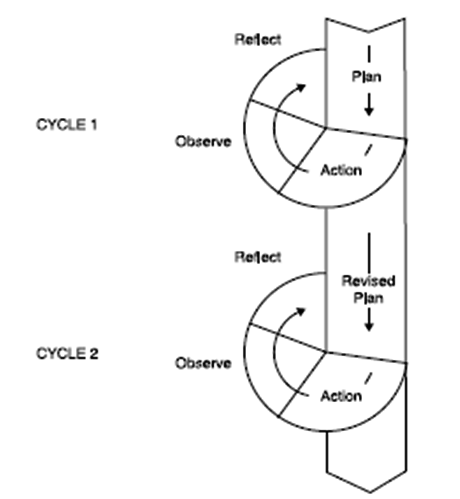
Action Research Model by Stephen Kemmis
Literature Review
1) Inside the Black Box: Raising Standards Through Classroom Assessment
By Paul Black and Dylan Wiliam
Giving an overall picture to students’ learning led me to focus on formative assessment and subsequently in an online article called ‘Inside the Black Box: Raising Standards Through Classroom Assessment’ by Paul Black and Dylan William’ (1998). The first main focus of this article was that outside of the classroom there are many factors that push the teacher. Black and Wiliam (1998: 1) state that ‘learning is driven by what teachers and pupils do in classrooms’. This highlights the classroom as the Black Box and what goes on inside is as important if not more than outside assessment. The teacher is the one who has that direct relationship with the students and that helps deal with progression. The teacher is really the only one that can see what is happening on a day to day basis. For example, Black and Wiliam (1998: 2) suggest ‘how can anyone be sure that a particular set of new inputs will produce better outputs if we don’t at least study what happens inside? Teachers are always looking for ways to improve and formative assessment of on-going learning means that the teacher can change to help suit the needs of the students.
The fact that students have a test at the end of their learning makes room for more formative assessment that can help highlight issues along the path of their learning. Black and Wiliam (1998: 1) state that ‘the practice of formative assessment produce significant and often substantial learning gains’. There is a need for the students to be actively involved and the process of letting the students just complete work and then mark it reinforces underachievement. Students should be allowed to assess their on-going learning as well as the teacher. Black and Wiliam (1998: 4) highlight this as improved formative assessment helps low achievers more than other students and so reduces the range of achievement while raising achievement overall. Thus the teacher can adapt their teaching to fit the needs of the students. This gets away from summative assessment as the vital part of the learning process where the final result is more important than the path getting there. Black and Willams (1998: 5) show that ‘the giving of marks and the grading function are overemphasized, while the giving of useful advice and the learning function are underemphasized. This then gets away from the students competing and puts a focus on them actually looking at personal improvement. It could be said to be true that ‘when the classroom culture focuses on rewards, gold stars, grades, or class ranking, then pupils look for ways to obtain the best marks rather than to improve their learning. (Black and Wiliam, 1998: 7). This puts the focus back on the students to change the culture into one where all the students involved can progress and achieve. The students can understand the main focus of being in the classroom.
2) Characteristics of Effective Instruction, Formative Assessment
By Cari Mathwig
This interesting article sheds more light on the focus of formative assessment. The first interest gained from this piece is that it highlights formative assessment as ‘a process, not an assessment tool or instrument’ (Mathwig, 2009: 1). There was a leaning towards there being on-going assessment where the teacher is collecting information, although I feel this is worthy with embedded questions as their learning is in progression, a formative assessment with peer and self-assessment is better. This on-going process is making the student understand the goals along the way and the teacher can make adjustments. Iowa Core states that ‘Critical attributes of the assessment for learning process include an understanding of the learning progression, clear learning goals’ (Mathwig, 2009: 2) which are the focus of the students’ understanding what is needed. This is where deep learning can be highlighted.
3) Formative Classroom Assessment and Benjamin S. Bloom: Theory, Research, and Implications
This article by Guskey highlights Bloom’s idea of the mastery of learning. The article discusses formative assessment as the method to achieve this mastery by recognising that for any students to master a topic they will have to be guided and assessed along the way. One main focus was on the use of feedback followed by correctives. Correctives give help to the students where feedback has noticed a piece in their students’ learning missing. Of course, this is not the end of it as there is now a process of enrichment by filling that missing piece, but this time not repeating the same procedure that the students missed. The teacher is leading to an instructional alignment where those students left behind are identifying the parts missing in their learning and keeping up with the lesson.
Qualitative Research Methods
Qualitative research methods are inductive. Inductive research is the reasoning that transforms specific observations into a general theory. It looks at the perspectives and issues of the participants and the observer. Qualitative researchers are interested in real life situations. Therefore, qualitative research methods are formed to help researchers to understand human beings and their social and cultural living beds (Danaee Fard, et al, 2007).
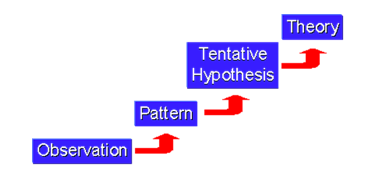
Inductive Method
Below are four ways to gather data.
- Participant observation: As the methods states this research is completed by observing students in the class and their natural behaviours to which data is thus taken. This method is helped by the teacher being part of a group who then extracts information while the students are being observed. This can actually be a long process of observing the same group. This data recovered then become a subjective viewpoint.
- Direct Observation: This method has the observer as an outsider who views the students participating in the class. The observer takes a background view of proceedings. The observer will watch the group in action and take notes that are collated later. This process differs from participant observation as the observer can focus on specific events.
- In-depth interviews: This method involves the researcher conducting one to one interviews on a deeper level. There is usually a direct line of enquiry but not a systematic line of questioning. This method has the interviewer conduct the interview more in conversation.
- Focus Groups: Focus groups tend to be more focused on what are the cultural norms of a situation that can give an overall picture of the issues that the group may have. The researcher can keep the group focus on specific questions.
Quantitative Research Methods
The quantitative research method is deductive and also objective. Deductive research is reasoning that transforms general theory into specific hypothesis suitable for scientific testing. The background to this theory is that the researcher goes from general theories onto more specific. It is an investigation by which a researcher collects numerical data.
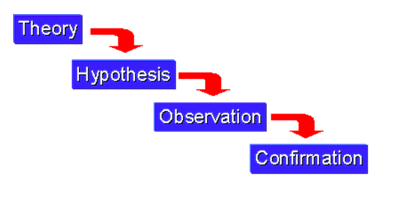
Deductive Method
A. Hypotheses: This is not a question but a statement about the relationship between two variables such as ‘qualities, properties, and or characteristics of persons, things, or situations that change or vary, and that can be manipulated, measured, or controlled in a research study.’ (Burns & Groves 2005:755). The hypothesis starts with an unsure assumption that through research effort a search for the answer is made from the research results.
There can be a relationship among the variables such as:
Cause and effect: a relationship in which we know that change in one variable causes a change in another (the scientific ideal).
Independent variable: the variable that causes the change
Dependent variable: the variable that changes
Correlation: a relationship by which two (or more) variables change together
B. Descriptive Research Question: These are questions that are used to describe the variables that are being tested. Research questions are there for the variables to be quantified. These kinds of questions usually start with: How often? or What percentage?
Research Question
Which methods of formative assessment do trainee foreign language teachers find helps them best with their on-going studies that consequently has a bearing on them using formative assessment as new teachers?
My Research Method
The methods I have chosen for my research involves giving formative assessment. This will be on a medium cycle after each ninety-minute session of the teaching course and at the conclusion of the students’ 20-hour course. There will be 6 formative assessments. The formative approach will initially be used twofold: firstly to make known how each student is progressing and secondly to help develop the curriculum for successive groups. It is hoped that with the active involvement of the students not only myself will benefit but also the students in all our on-going teaching knowledge. Additionally, there will be field notes taken by myself during each formative assessment process to observe how students react to the formative process. Field notes will also be written after as reflection. The students will be informed of the research process and that they will be given questionnaires during and after their studies. It is hoped by informing the students that I need them to participate fully in the process, they will give the relative feedback and informative opinions to further the research project.
I feel the students’ use of teaching techniques, knowledge and ability gathered over the period of 20 hours can be aided by them recognising aspects of foreign language teaching (they had just studied) at the end of 6 sessions. The process of various formative assessments will have the students recognise the factors of their learning post module. There will also be a chance to give feedback after each assessment for myself and their benefit. The list of the 6 formative tasks is shown below. The goal is to build students’ skills for peer and self-assessment where they are not only building their knowledge but also feel they are contributing to others. While the students are being assessed I will take field notes; noting how student behave, collaborate and the level of feedback gathered thereafter. The premise of the research is thus, by the time they arrive at their first practice teaching certain behaviours recognised from their study will be used and be more prevalent in their first practice teaching.
I will be using quantitative data gathered from questionnaires given to the students at the end of each module and at the end of the course. After each module and the formative assessment, the students will fill in the questionnaire relating to that one assessment and make comments. This will continue until the students have completed the question having done the 6 assessments. This questionnaire will be filled in from the experience of them as students and will answer the question:
(this formative assessment) helped with my further improvement and attainment of the subject.
This is compared with their final questionnaire which is filled in from the perspective as of being a foreign language teacher. This questionnaire highlights their forthcoming teaching work once the course is finished. The students will fill in this questionnaire looking at all the 6 formative assessments at once.
I will also use qualitative data gathered from field notes observing the social setting of the students’ peer and self-assessing in order to gain a view of events. The quantitative data will, of course, focus on numbers, but it is hoped with comments made at the time during assessment by the students, the field notes taken by myself, and comments registered on the questionnaires an overall picture can be made of how one or more formative assessments was beneficial for the students’ learning.
My proposed Formative Assessments methods:
- One sentence summary
Once the session is finished students will be given a piece of paper which has written on it “Who did what to whom, when, where, how, and why?”. I will give the students an example of the model sentence that explains the students must review the topic just covered in the session. By way of this review, their one sentence has to answer all the questions on the price of paper given. To add to this I will personalise more by having them write another sentence but this time it has the questions “Who will do what to whom, when, where, how, and why?”. For this, I hope to get the students to think about their initial classes which will include knowledge gained from the previous session.
- Four Corners (I’m confused, I’m lost, etc.)
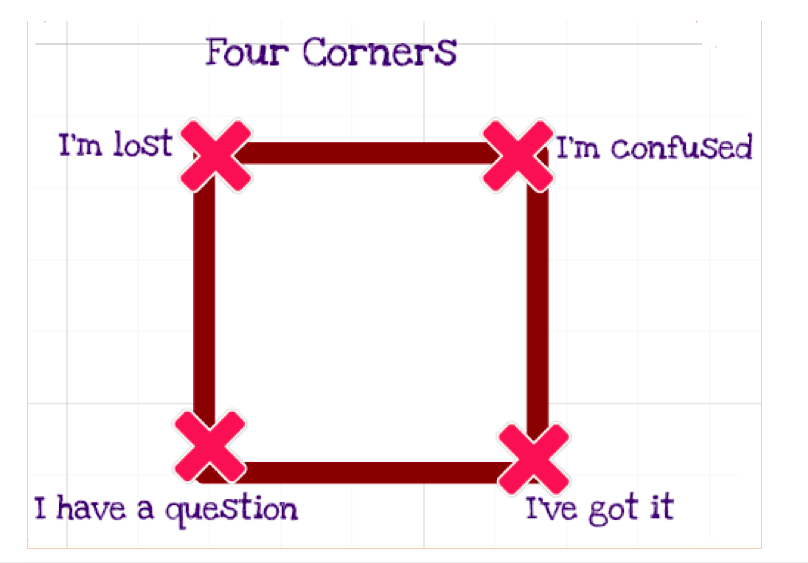
In the four corners of the room will be posted four sentences (I’ve got it. I have one question. I’m confused. I’m lost). I will read some statements relating to the students learning in the past module. The students will then decide which sentence relates to them and go and stand in that corner. Students then briefly discuss what they understand, what their question is, where they got lost or why they are confused. This can be done in their group initially, but then the teacher will open up the debate.
- One Minute Essay
Students will be asked to summarize the main point of the session while adding their thoughts on the process. The writing exercise is for the students to write and think immediately. The students will then exchange their essays with their partners next to them. The teacher will ask for some random example of what their partner said. There will also be eliciting for new information gained.
- Four Corners (Agree, disagree, etc.)
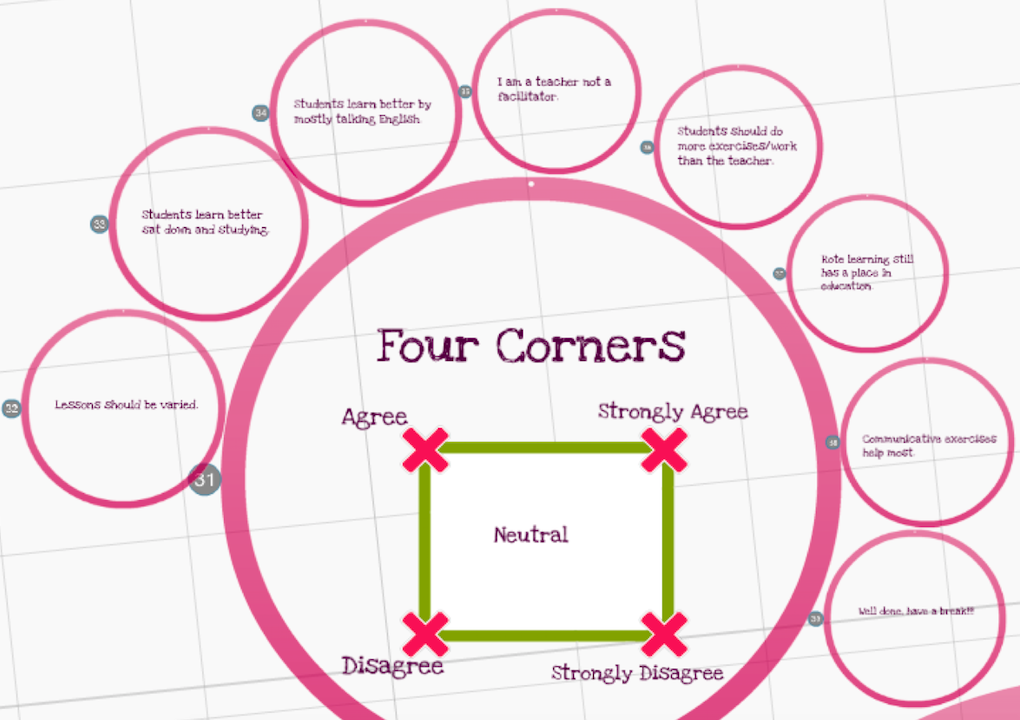
Statements will be given by the teacher relating to the students’ learning post module. These statements will raise opinion in the students. After developing an argument the students will go into one of four corners that relate to their thoughts. The options for their choice include strongly agree, agree, disagree, and strongly disagree. Once they are in the corner they will discuss with whoever is with them. Then the teacher will choose one student to comment on their and other group members ideas.
- Observations and feedback
Students will observe their peers using an observation form. This form highlights what the students have to watch out for when teaching a foreign language. Students will have to acknowledge they observed certain factors of the trainee teacher’s teaching. This is not only ticked off on the form, students will also have to comment on the process they saw. These comments will be discussed in the post-practice teaching.
- Journals
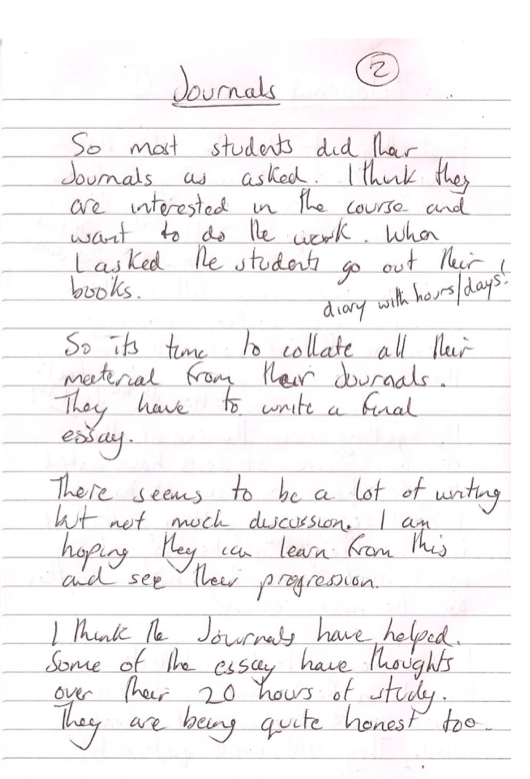
An effective means of formative assessment is by way of a journal. Students are required to periodically write their thoughts and feelings about how they are progressing in the class. I will give them an opportunity to write in their journals. They can write what they liked or did not like about a particular module plus their general feelings of studying. It is hoped through their writing and reflecting on what they have written over the period of studies they can see they progression.
Additionally – Field Notes
I will be taking field notes of all the above formative assessment methods. These notes will highlight how the students have dealt with the assessment methods. As more of a qualitative procedure I will view the students to see how they work their peers as well as the teacher in processing what they have just learnt into meaningful reflection that help form their learning. I will try to recognise that these methods are there to help the students comprehend and supplement their learning with aid of their peers.
Ethical Issues
Formative test perceived tensions: Formatives evaluation may well open up the lack of knowledge gained by an individual in the class. This use of assessment is not meant to highlight weaknesses in the students but rather encourage peer to peer collaboration. The teacher task is use methods to connect students so their learning can be informative and worthy not as a test to see who gained the most from each class.
Research can be harmful as well as helpful to subjects or communities: Acknowledgement is made to the fact that formative evaluation is supposed to expose weaknesses as well as strength. The purpose of this as well as encouraging students to discuss their strength and weakness from the module they have just studied is meant as a collaborative effort that highlights those with strength in a certain area to provide support to those who lack the understanding. It is through encouragement and delivery of the exercise I will show the students this is beneficial for all. Those students educating others will encourage a better working environment in the classroom, and work towards the group effort to complete the course.
Researchers should be technically competent as well as fair-minded: The research method will be investigated thoroughly before commencement and factors within the procedure will be discussed. An understanding of the participants will also be taken into account as recognition of their knowledge of the subject matter is taken into account. Students will have a total of 20 hours to study the material while they come onto the course as beginners.
Researchers must disclose all their findings, without omitting important data: All data retrieved will be placed into my research paper. I will also be taking a field notes to aid my research this will highlight my thoughts on the whole process.
Researchers should inform people about their research when engaging with particular individuals: For my research, I will be taking their notes and evaluation. I will also be taking a diary/field noted. The students will be informed of my purpose of taking their notes off them for further research. If anyone has umbrage to this they are obliged to keep their notes. I will explain the value of their feedback and the use of the feedback is for personal use in my research paper.
The safety and anonymity of the people involved in a project shall be protected: This research is purely for the benefit of the researcher and the college course I am studying on. Full names of the students will not be used as part of the research paper and as such highlighting names does not benefit the content of the research. The research paper confidentiality of the paper will be between myself and the college.
Collaborative Effort by Students: Attached to my research project is the task of the students to be willing members of the group involvement of addressing the subject matter of the class. Thus they will have to either discuss their knowledge or be willing to accept their absence of relevant know-how of what the trainer or peer will discuss in the formative evaluation. The trainer will encourage involvement on all account but is also wary of non-participation by some who are either against the process or inhibited in some way.
Administration of research and modification to the proposal: Students will be given time to complete their task and once the task is complete additional time will be spent where issues and problems regarding their studies will be discussed with their peers and the teacher. The teacher will give the students a questionnaire as to let the students make comment on the whole process of what just happened to them in their formative assessment.
Additionally regarding administration: Students need to be able to complete the task willingly and productively without risk of damaging the effects of the research due to a laboured process. With respect to this, a few pilot attempts of my research were administered prior to the actual inception. It was noticed that the overabundance of paperwork and questions to be answered by the students only prolonged the exercise of gathering data. It was thus proposed to streamline the amount of paperwork and questions needed for the students to answer. For example, instead of choosing their best and worst formative assessment giving reasons, they just had to tick the boxes to rate each formative assessment. There were a few lines for them to make comments if needed. After studying in class and then performing a formative assessment it has to be recognised that the value of the data can be lost if the students are subsequently piled up with too much writing.
Analysing the results
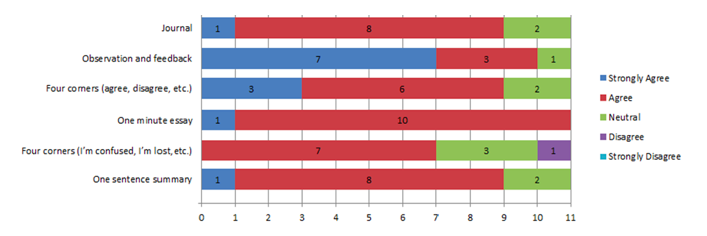
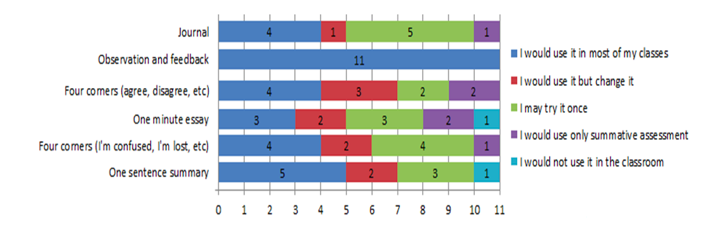
For this analysis, after showing the overall results in the bar charts, I will then assess each individual formative assessment: the data from the questionnaires and the process as it happened from field notes. I will then evaluate and discuss all the data retrieved to give an overall picture of my findings using an area chart.
Overall results from questionnaire (related to those questioned as students on the course)
Overall Results (after experiencing all formative assessments) from Questionnaire (related to those questioned as new teachers)
- One sentence summary
The one sentence summary started off proceedings as it was used after the first session with the 11 students. Results immediately show that the One Sentence Summary was strongly preferred by 5 of the research group as soon to be new teachers. This does not mean as active students that it was ignored as a high proportion of 8 chose to Agree with the One Sentences Summary as helping with their on-going knowledge. Although there was parity beforehand, there is a definite contrast between the view of students and them as new teachers. It can be said that as students there was a consensus that the One Sentence Summary aided their learning with 9 out of 11 Agree while as a new teacher the group had mixed views. The mixed views meant 7 out of the 11 would use it, 3 actually said they would try it once while actually said they would not use it.
(this formative assessment) helped with my further improvement and attainment of the subject
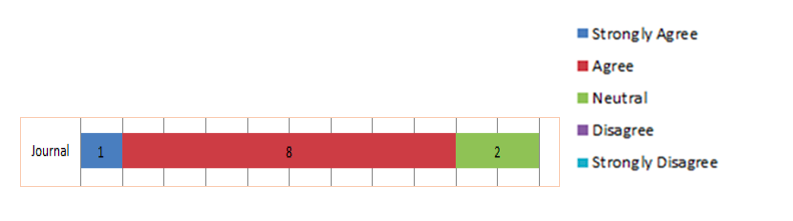
As a student
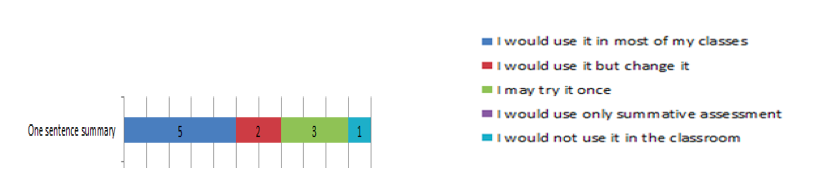
As a new teacher
From my field notes, it was said that this was the group’s initial formative assessment and that they found the concept a little bit daunting. The concept of answering 7 questions that fitted into one sentence knocked a few people back. I had the ones that had finished the exercise early talk to their partners, but some did not finish both sentences and other answers were lacking in some quality. Even though I mentioned that they had just finished a session on classroom management and we were doing a formative assessment on this students still started writing about their breakfast or on getting to the class on the bus. It was noted, time was an essence and I had to go round and help some people with the “Who did what to whom, when, where, how, and why?” However, I wrote that some of the students produced some quality sentences which brought about some discussion about the session and If done again I would get them to talk to 5 people just to make it more communicative.
- Four Corners (I’m confused, I’m lost, etc.)
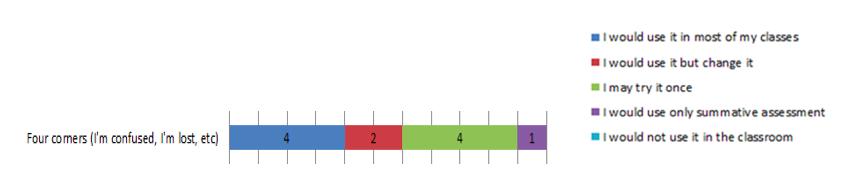
This formative assessment was made after a foreign language, grammar and tense session. Once again it is noticed that as a formative assessment from the student’s perspective that the research group Agree with it. The score of 7 for Agree compares with the One Sentence Summary score of 8 as being helpful for them as students. The first two assessments were also the same with 2 votes for I Would Use It But Change It. So a score of 6 out of 11 for Four Corners was positive for it. There were more of the group this time that were not so enthused by the method. A score of 3 for Neutral and a score of 4 for I May Try It Once is a higher score than the One Sentence Summary score of 2 and 3, respectively. This time I did get a Disagree that it helped the student for this method.
(this formative assessment) helped with my further improvement and attainment of the subject.

As a student
As a new teacher
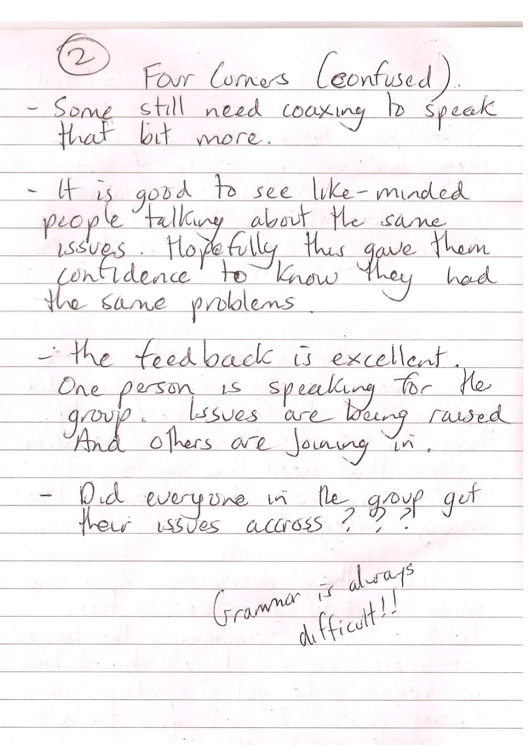
From my notes collated at the time, I felt that they as students were having trouble with the actual learning of grammar and this may have a bearing on the results. I wrote that if they do not understand a subject completely it would seem strange to ask them to write a formative assessment of it. However, I actually got them to stand in their corners and discuss issues they had with their like-minded peers. Then, they had to convey this to the rest of the class regarding the session they had just had. So, my notes showed that from a formative assessment perspective they still had to judge the formative assessment whatever their knowledge of the subject matter had been that far.
It was also noted that by them discussing their similar issues relating to their learning I feel gave the students a positive avenue for building their knowledge and gaining confidence knowing other felt the same. I also wrote that this gave me a great insight in the level of knowledge the students had in this specific content area. I felt this showed the variation in their learning. On the whole, it was noted that issues were being raised and students were joining in.
- One Minute Essay
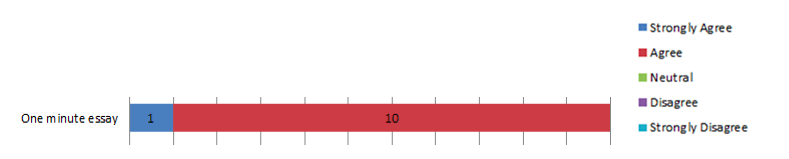
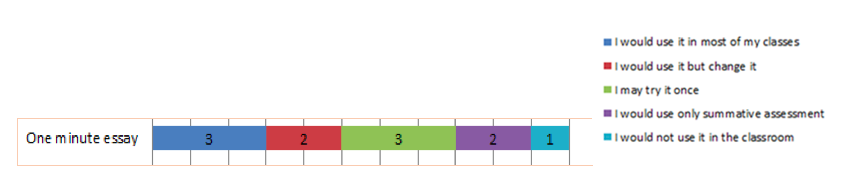
This assessment was actually made at the end of the day and was used as a roundup of all that the students had learnt that day. From the response received and the precise essays, they Agree with the process with 10 people saying this. This is the highest score to Agree so far and with one person saying they Strongly Agree. It would show that this method for the students was the most successful so far. The fact here was that any negative views were totally ignored for them as students. This contrasts with the group as teachers because once again there is not a consensus of opinion that would say they all were ready to use the method in their classes. The scores for them as teachers varied considerably. A score of 2 for I Would Use Only For Summative Assessment and 1 for I Would Not Use It In the Classroom shows as a formative assessment less of the group thought it worked. There was also a score of 3 for I May Try It Once so this, on the whole, this formative method is shown to be less effective for these new teachers.
(this formative assessment) helped with my further improvement and attainment of the subject.
As a student
As a new teacher
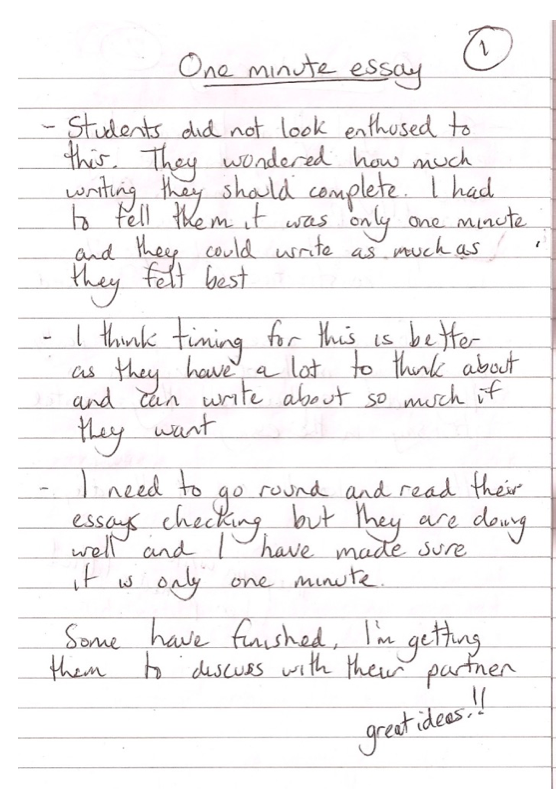
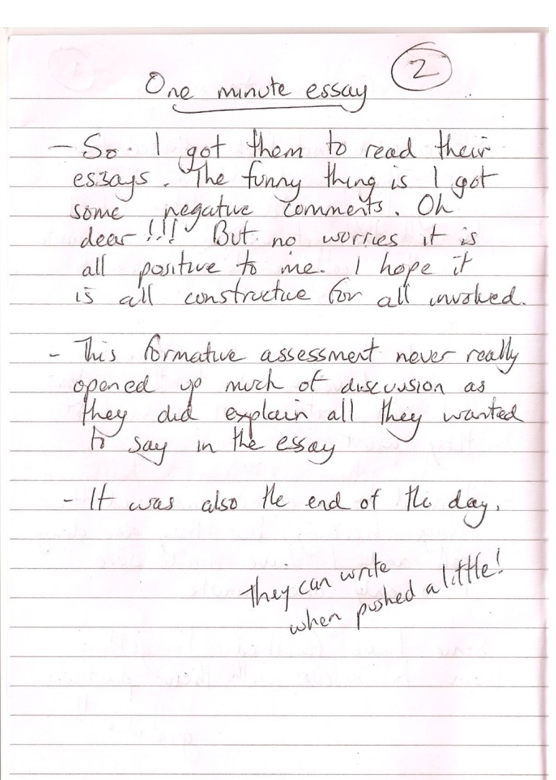
It was noticed from my field notes that students did not really want to write an essay and it was emphasized that this was one minute. I noted that most students had never written a One Minute Essay and were not sure if they could do it. There were a few apprehensive faces looking at each other. However, when they had finished there were some great ideas flowing and some incisive thoughts on the day. I also was aware that not all the comments were positive, so I had to take some criticism. I wrote in my field notes that students by opening up the forum after reading their essays, the rest of the group are exposed to other people’s thoughts that are constructive to the class albeit a few jibes at the teaching. On the exercise, it could have opened up more discussion because it was noted they just read out their essays.
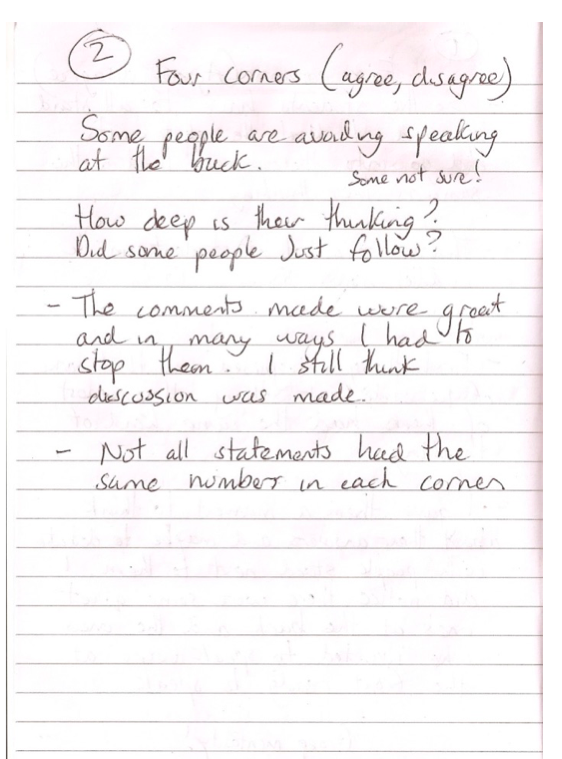
- Four Corners (Agree, disagree, etc.)
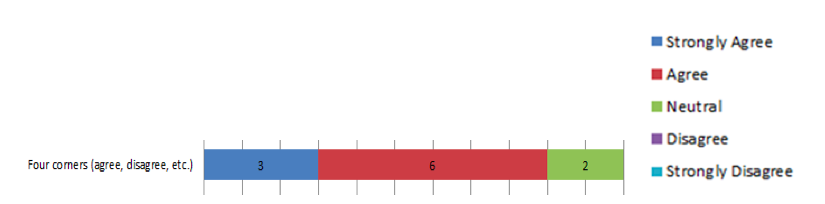
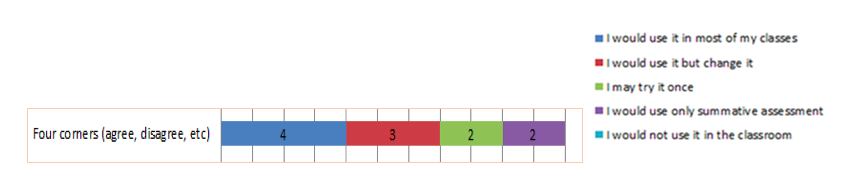
This method has the most for Strongly Agree so far although it is not the same as the totally positive results for the One minute Essay as 2 people were Neutral for its benefit. The results still show that 9 people together Strongly Agree and Agree with the method. It can be said so far that as students the formative assessments were aiding their learning. However, as new teacher data shows from the results, that this method has varying thoughts on it use again with 4 saying they would use it for most of their class and 1 use it but change it. In keeping with other results, there were still four people who were slightly negative to this process with 2 I May Try It Once and 2 I Would Only Use As Summative Assessment.
(this formative assessment) helped with my further improvement and attainment of the subject.
As a student
As a new teacher
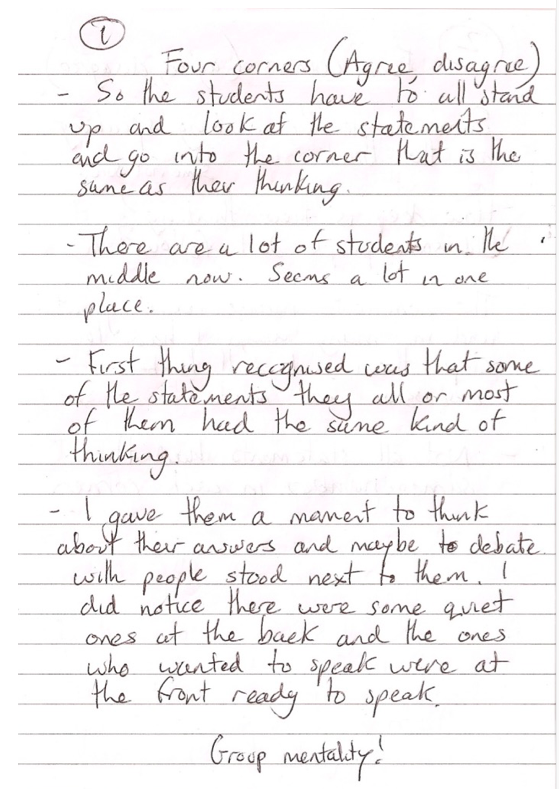
From my field notes, it was observed that the students were bunching for the groups and while moving around it was hard sometimes to get most people to give their opinions. I noted that some of the statements the group had to read, had straightforward answers, so most of the group would go into the corner that was the most probable answer, although not all the statements were like this. There was some genuine feedback given by students, but I felt these ones who were at the front of the group and who looked me in the eye were only the ones ready to give feedback. I also wrote that the quieter ones were stood at the back, so were not seen or heard, but I did encourage them to speak and they did. Furthermore, I made comments that there was debating going on with regard to the statements given. This being said, I still wondered how deep each individual’s thinking was and did some students just follow the crowd.
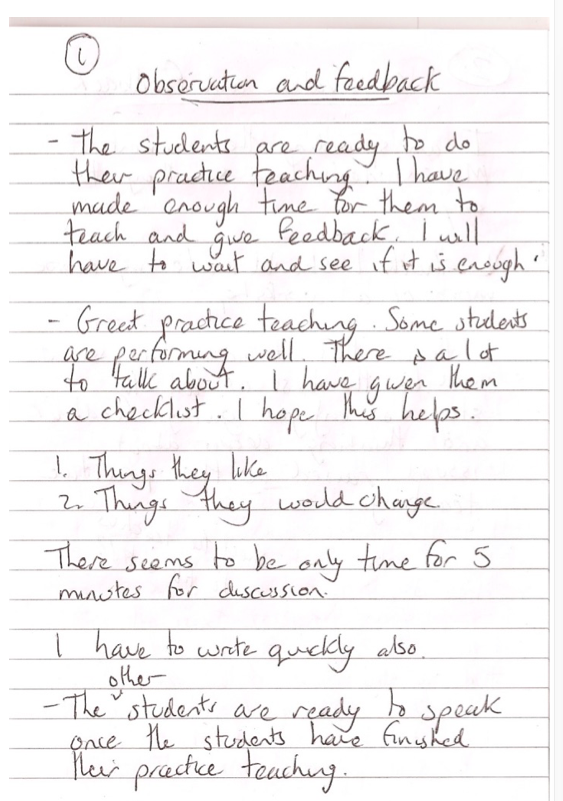
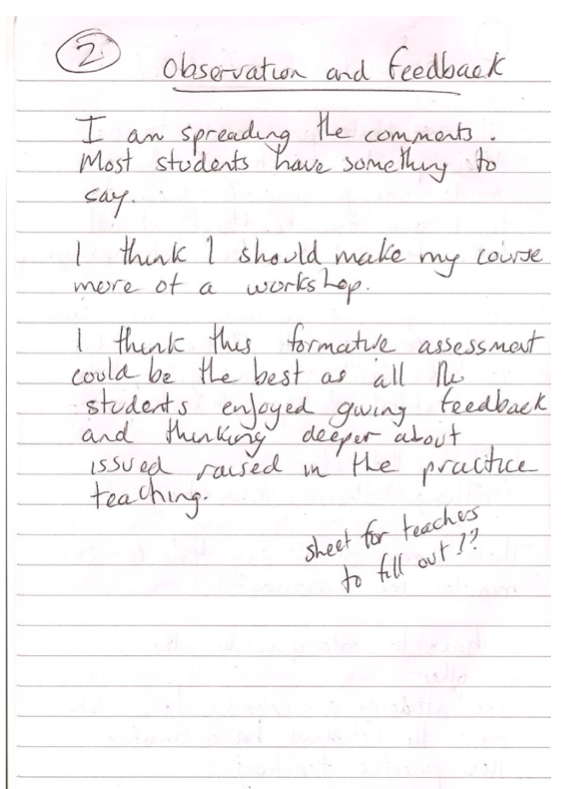
- Observations and feedback
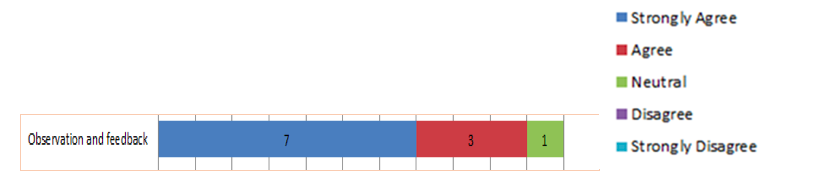
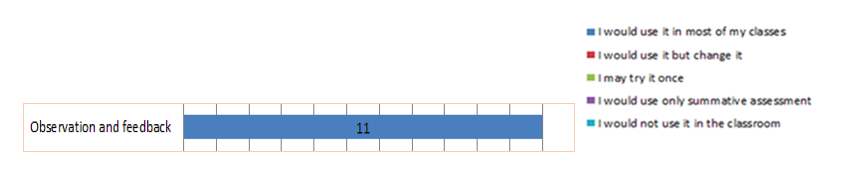
As trainee teachers actually performing and getting feedback from the experienced teacher this method would certainly give the students that vital knowledge. In this respect, the score of 11 for I Would Use It In Most Of My Classes would show this for them as new teachers. As active students also there was a score of 7 for Strongly Agree. This is the highest so far for and was coupled with 3 people Agree. As a combined score for positive response 10 out of 11 thought it helped their learning while there was still 1 Neutral.
(this formative assessment) helped with my further improvement and attainment of the subject.
As a student
As a new teacher
From my field notes, it was noticed that time (an underlying theme of my notes) was an issue for the students during the course and the amount of time allocated for practice teaching could have been more and that the students would need and prefer more feedback. I feel this answers the fact that one student was Neutral about the process. For the observation, I gave the students a checklist for aspects of teaching to look out for, but I feel I should have also given the students performing a feedback sheet so they could fill in and discuss further with myself after. When the students performed there was a different atmosphere and they all liked giving feedback. I made a comment about spreading the comments around the class. I also wrote that having students performing, off their chairs, and other watching them in action was the best exercise for trainee students. I noted that other exercises during the day could have more of a positive outcome if students were made to perform and other give feedback. I made notes that said that having more of a workshop feel to the class give students more chance to see teaching in practice and give more feedback compared to mostly theory.
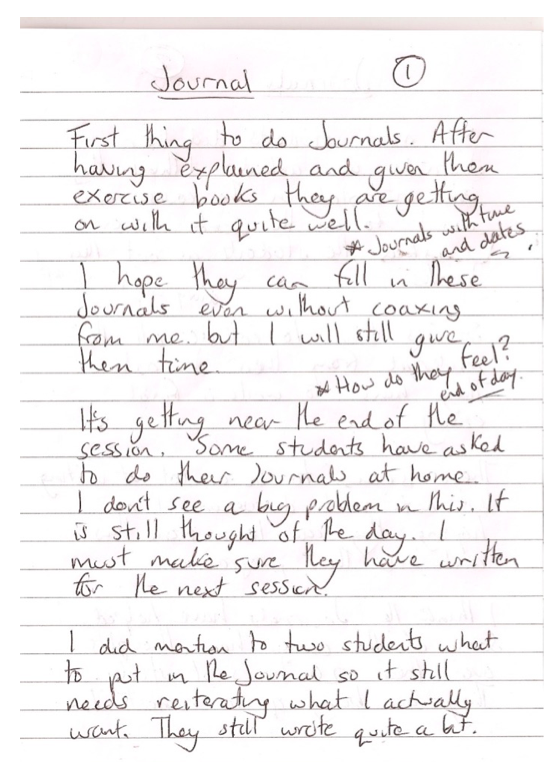
- Journals
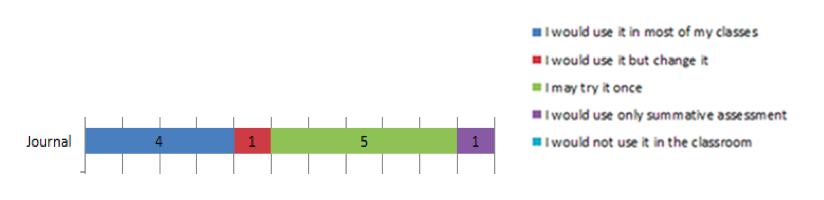
As it has been mostly the case with all the formative assessments as students the group has favoured the formative assessment more than as new teachers. Another high score of 8 for Agree and 1 for Strongly Agree shows that they found the use of it in the classroom for them. The score of 5 for I May try It Once was the highest score so far. This with only using it as a summative assessment leaves a score of 6 out 11 leaving less than positive response as new teachers. Again the group as students has stayed relatively constant.
(this formative assessment) helped with my further improvement and attainment of the subject.
As a student
As a new teacher
From field notes, it was written that there has to be an opportune time to writing their journals. I had them write in the morning and at the end of the day. It was noted that sometimes the exercise of getting the students to write journals was after they had just completed a lot of work, so the exercise of more writing was a little daunting and not as constructive as it could be. I made a comment that the journals could have times and dates like an actual diary, so they could add any comments of their own when they wanted not actually when I gave time for journal writing. I noted that I was pleased they did their journals because as time became less I did ask them to complete them at home. From my notes and observations, I felt this exercise was more personal and there could have been room to discuss more. I actually got them to write a final essay from their notes that they read out to the class. In this exercise, I noted that I hoped it was constructive for all involved.
Student – Overall Area Chart results from questionnaire (related to those questioned as students on the course)
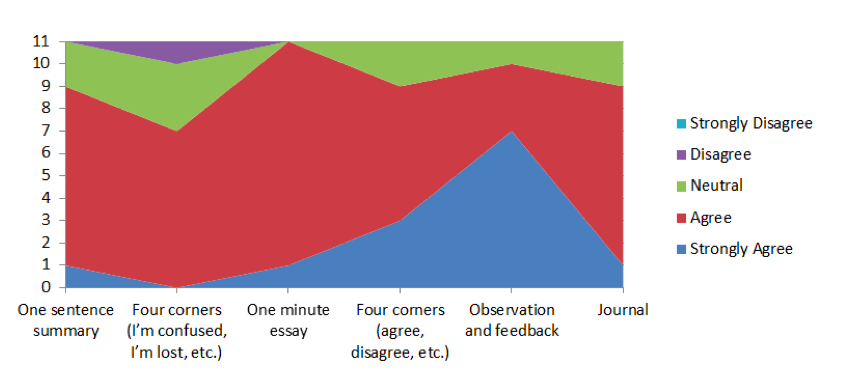
As active students, it is clear to see that formative assessment was, on the whole, a positive experience although not everyone agreed strongly, as most only agreed. The fact here was also that no-one strongly disagreed with the formative assessment. There were few people who felt neutral to the experience. It was seen from field notes that students had to be productive (even after the session had finished) for the assessment so to get a large proportion that still felt it to be positive.
New Teacher – Overall Area Chart Results from Questionnaire (related to those questioned as new teachers)
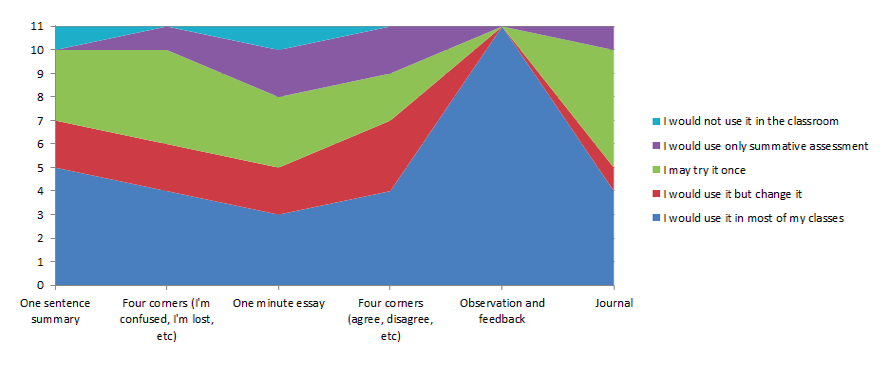
From the area chart immediately above it shows that Observation and Feedback is the obvious choice for these new teachers when they are teaching their foreign language classes. My field notes recognise this fact as the feedback given by myself was invaluable to them as student teachers. The area chart above highlights that using formative assessment albeit tweaking some of the methods in most of their classes was a viable option. This contrasts with the amount shown for not using formative assessment as seen in the shade of light blue for not using right at the top. It has to be said though that a fair amount thought about only trying it once. This could show that initial knowledge and benefits of formative assessment cannot be seen by these new teachers. Above all the picture above has shown as a positive response.
Conclusion
To conclude, I feel the data I retrieved gave a clear picture of opinions of formative assessment in the classroom questioning active students as well as them as soon to be foreign language teachers.
At the outset, from the perspective of being a new teacher, the research group have certainly not professed formative assessment to be valuable in all extents and purposes in on-going development and knowledge of their forthcoming students. In the teacher area chart above proves this fact with varying answers. I would not expect them to be enamoured by the assessment straight away. This I feel echoes a quote from the Black Box article on formative assessment that says ‘fundamental change in education can be achieved only slowly — through programs of professional development that build on existing good practice’ (Black and Wiliam, 1998: 3). I feel the new teachers need to see these processes in action more to get the full benefit. Gusky (2005: 2) called this ‘variation’ which highlights students’ level of achievement. The group, as new teachers, had various scores compared to them as active students which I feel showed their knowledge and forethought for their new teaching challenges. As a new teacher, it would be hard for them to get these formative assessments to work to their fullest, so the results of them as new teachers confirmed this.
From the data retrieved from the perspective of the group as students, it shows that they enjoyed the process and it shows their experience and knowledge of it was better than that of them as new teachers. It is always beneficial to have discussions. Black and Williams (1998: 4) alluded to this when they mentioned that ‘frequent assessment feedback helps both groups enhance their learning’. I feel the students were allowed to discuss issues and thoughts related to what they had just learnt and this certainly enhanced and broadened their insight into their on-going course. In the article by Cari Mathwig (2010: 2), he alluded to this by commenting that ‘regular testing and simply informing the students of their scores does not constitute formative assessment’. This highlights why Observation And Feedback got the highest score. The use of feedback from direct observation immediately after their practice teaching was very constructive, direct and fresh. This was alluded to by Cari Mathwig (2010: 6) where she mentioned ‘appropriate descriptive feedback should provide students with some combination of verification (linked to the learning goal and criteria for success)’ and be ‘goal-directed’. This on-going discussion that once highlighted where the students recognised that others felt the same I feel conclusively gave the students the positive knowledge that would help them achieve which they may not get from other assessment such as testing. I also highlight the fact that discussion has come to the fore. From all my formative assessment students opening up to their on-going knowledge has been at the forefront. This cannot be underestimated. In what by Cari Mathwig (2010: 6) called ‘planned-for interactions’ where ‘structure student discussions so that they will gain insights to student thinking through the course of the discussion’, I feel that this was achieved to the advantage of each student. This was shown in their being on the whole a positive outlook to the whole experience and confirmed the use of formative assessment.
Furthermore, while lesson observation was shown to be valuable for formative development, it has to be mentioned that the others were equally viable. On each occasion of the process of formative assessment, the students were generating language, developing thoughts and completing the task that revolved around the subject matter they had just studied. The student area chart conclusively shows this with the majority of the chart coloured to show Agree and Strongly Agree. Although from the teacher’s perspective this proportion on the teacher area chart was not as positive there still is a fair proportion that gives each formative process their tacit approval. Moreover, as already mentioned the students are not teachers yet and once actively doing that they will see the benefits of formative assessment.
Additionally, it should be shown from the area charts a clearer holistic picture can be seen that especially for students and not far behind them as new teachers formative assessment is right to administer.
Concluding my field notes I would have to say a lot of work went into administering and keeping the process going to help students feel they were getting benefit from the process. I felt many of my notes mentioned a pattern of students’ initial unwillingness. I also worried about giving enough time to make sure they got the full advantage of the formative assessment which would have a bearing on their opinions on the questionnaire. I also had to make sure they were writing what I wanted. It would seem strange to vote on a formative assessment which they did not understand. Because this assessment was new and not a routine for these students after a few times it would be easier. However, I was delighted to see and hear the students discussing issues relating to their on-going development as teachers. Once reading and at other times mentioning their issues in the class other students were quick to add comments. It clearly helped the dynamics of the class. This left me with the theory that they benefited and were interested in the assessment and the thought unearthed.
Reflection on my action research
I must say that it took me a couple of courses to be able to fully integrate my research project. Firstly my question sheets were too big and had too much information on them. The final process at the end of their course to fill in so much information on their ‘as a new teacher’ sheets was not in reality achievable. I was actually trying to get them to pick their best and worst formative assessments and give three sessions for each, so in the time allowed this was not possible. I then had to make the sheets smaller where two would fit on one page (this saved paper as well) and all they had to choose was their favourite assessment and make comment if they wanted. On the whole, before instigating a formal research assessment my pre-assessment was very cyclical.
Looking back I would say that time is so much of an issue. Any teacher has to achieve their targets in the class and hopes to finish the class with a productive stage, so for the students to have to do a little more work after their session can be not as productive as could be within the time limits of each class. Gusky (2005: 3) alluded to this by mentioning that ‘the largest number of students for whom the methods and time were only moderately appropriate learned less well’. However, I think by myself telling the students that I was doing a research project helped with the process, but with a normal class, the students may not see the benefit. However, in hindsight I feel that the processes once administered a few times, the students would see the benefit and start to add more material to their formative assessment.
I must say that the some of the feedback received from the students has been very revealing and I had to take a few knockbacks from the comments the students made. I have to admit that I opened the students to say whatever they wanted about their on-going experience of the course. In many ways, I could stop those students making negative comments. However, the whole process has been beneficial on all accounts for myself which Black and Willam (1998: 2) also mentions that ‘teachers need to know about their pupils’ progress and difficulties with learning so that they can adapt their own work to meet pupils’ needs’. Along these lines, the feedback I received was so much more than I would have got from general discussion with the students. Cari Mathwig (2010 cited Shute 2008: 154) alludes to this when she mentions that feedback is ‘information communicated to the learner that is intended to modify his or her thinking or behaviour for the purpose of improving learning’. This feedback has been twofold as the students have benefitted but the whole picture of all aspects of the classroom experience has been shown to me.
Reflecting on the issues
The main issue has to be students understanding the material I deliver. This is why formative assessment has been a positive experience. I refer to Cari Mathwig comment (2010: 5) that ‘formative assessment must collect quality evidence of learning in order to be effective’. Some of this evidence, I had to accept, had some negative criticism from some students and the fact that they did not acquire the knowledge from what I taught and wanted them to get out of the class, but I feel this ‘quality evidence’ boosted me to create better lessons for the students. I also have recognised that formative has to be delivered correctly that the students feel it is for a positive experience.
I also have to mention that in each of the formative assessments there was a chance for feedback and discussion. I believe that any chance for the students to express themselves can only have positive results and empower the students more. Gusky (2005: 4) suggests that the better approach ‘would be for teachers to use their classroom assessments as learning tools, and then to follow those assessments with a feedback and corrective procedure’. This echoes what I achieved by creating a lot of dialogue in each formative assessment.
Action from my research
I have started a Blog which I hope to be able to stay connected with my students as they go on to their future projects. As student comments are collected I feel I can gather a picture of their on-going development and I hope to be able to make comments on teaching procedures. I am also studying for a TEFL Diploma which I plan to add Blog that highlights my on-going development. Moreover, I plan to make podcasts that will highlight the classes each session they studied. I feel in these podcasts I can go over the material delivered in that lesson. These podcasts can have comments made on them. I hope that students can work together like a forum.
After finishing the course and once in their new teaching positions I would hope to get feedback on them using formative assessment in their new lesson as a way to help them further help their students in their acquisition of a new language. Keeping contact (my work email) with former students will aid my on-going knowledge of what they found positive on the course that they have started using in their new classes.
I will also make sure I allow more time for the students to complete their formative assessment. This means there can be more feedback given so there is more acknowledgement of the process and a better understanding of other people’s issues relating to their on-going learning.
Finally, to mention the evaluation of methods if I was doing the research again, the question is, what would I change? The answer is I would not change the whole process fundamentally. I feel the use of formative assessment opened up many areas of thought not only for myself but also the students where all involved made developments in their on-going studies. One point of issue would be fine tuning the whole process. For instance, this means giving the group more information on formative assessment as helping students with their studies beforehand, so when the research starts they are more aware of how it works, instead of having it done while they are still developing an understanding of it. There is also the factor of time where it would better for all the students to converse with more people in the group which would help each student to have a clearer picture of their level of understanding of the subject matter. It would also benefit them to find a few people that have the same issues which would create a dialogue between them hopefully creating friendships that would assist their learning.
References
Black, P., & Wiliam, D. (1998). Inside the black box: Raising standards through classroom
Bloom, B . S . (1971) . Mastery learning . In J . H . Block (Ed .), Mastery learning: Theory and practice. New York: Holt, Rinehart and Winston
Bloom, B. S. (1976). Human characteristic and school learning. New York: McGraw-Hill.
Guskey, T. R. (2005). Formative classroom assessment and Benjamin S. Bloom: Theory, research, and implications.
Mathwig, C (2010) Assessment for Learning [online] Available at: http://www.gwaea.org/iowacorecurriculum/docs/AssessmentForLearning_LitReviewFinal.pdf, [accessed 15 January 2013]
Stenhouse, L (1975) An introduction to curriculum research and development London: Heinemann
Appendix 1
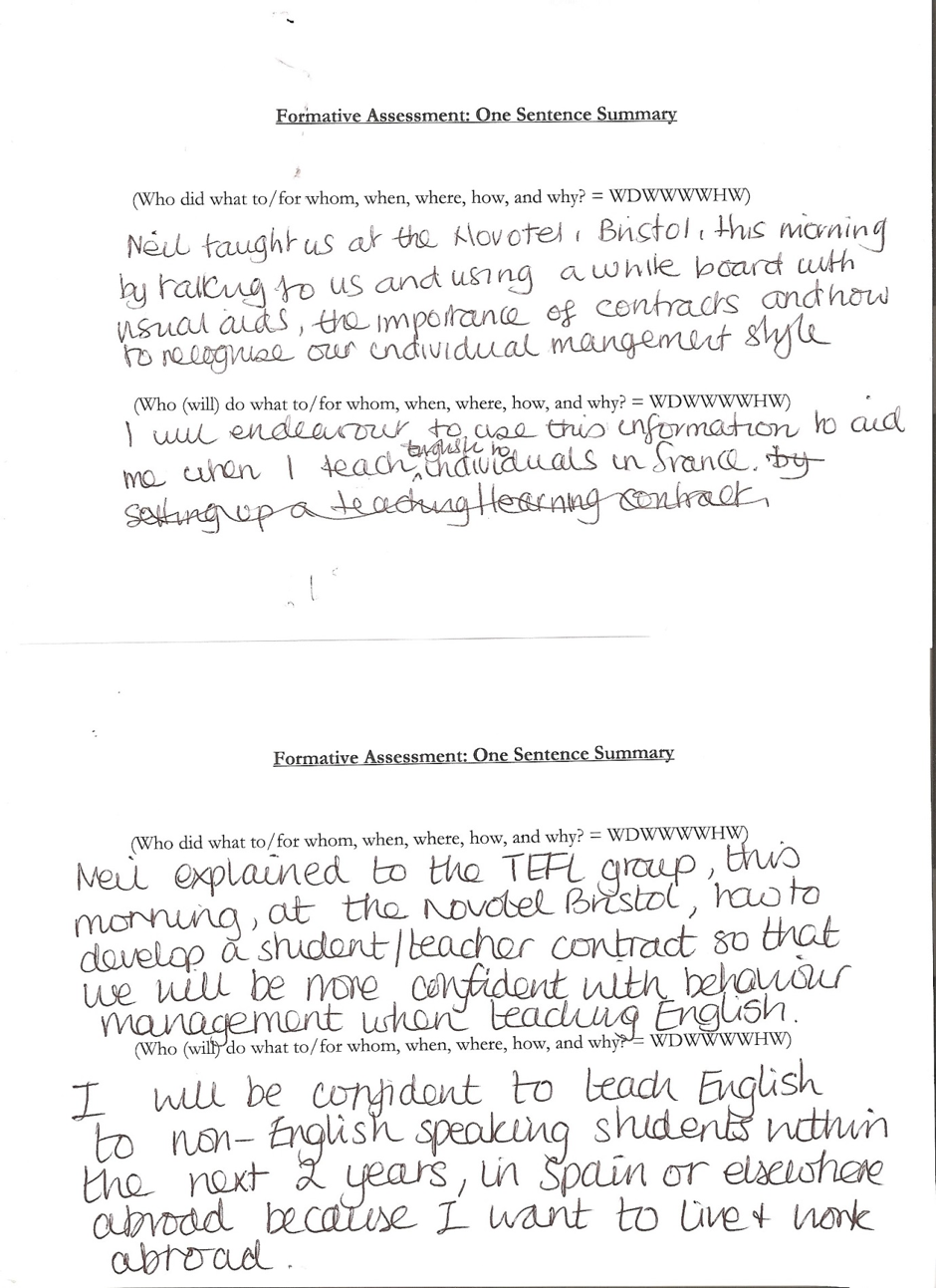
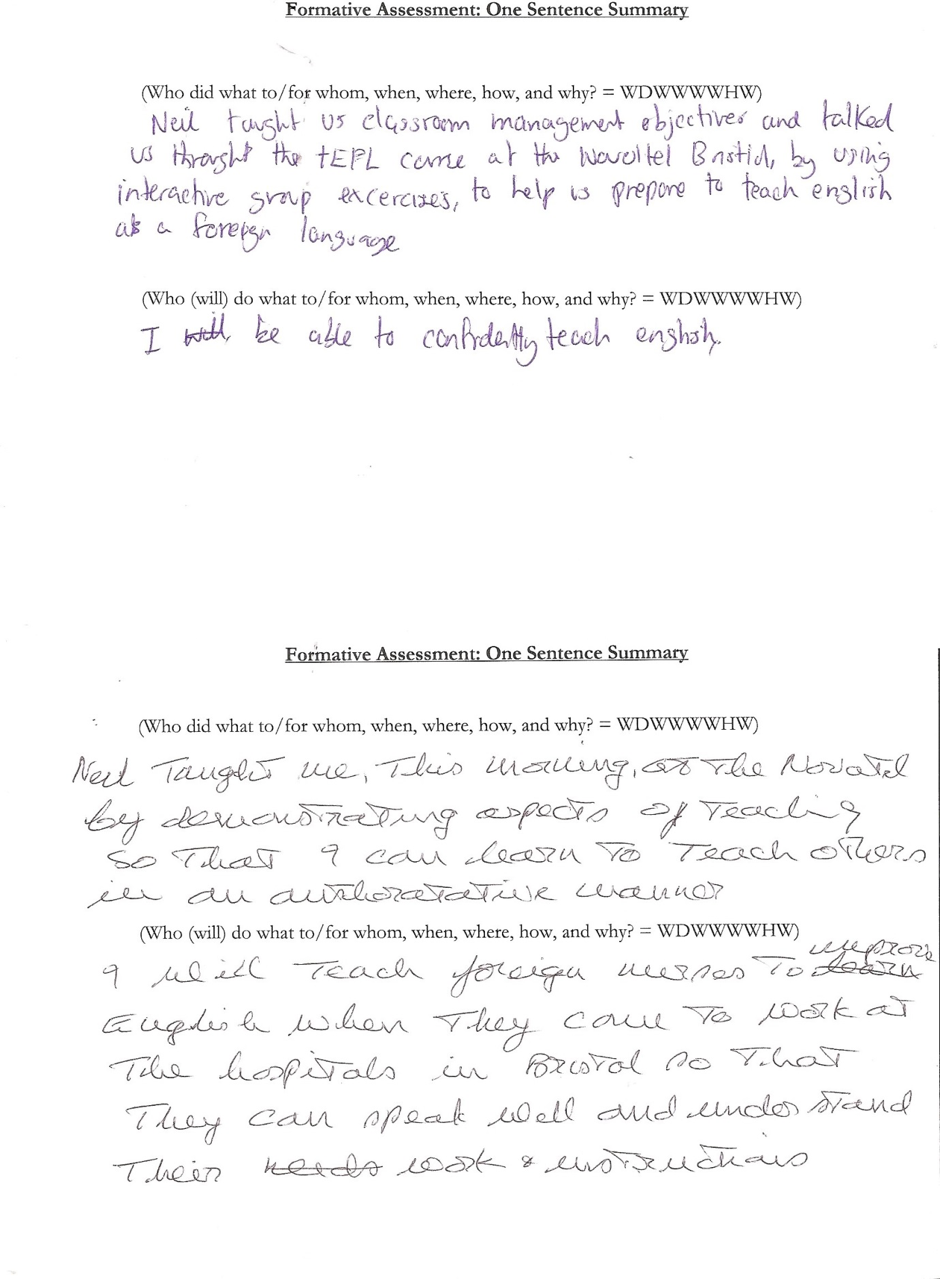
Formative Assessment: One Sentence Summary
(Who did what to/for whom, when, where, how, and why? = WDWWWWHW)
(Who (will) do what to/for whom, when, where, how, and why? = WDWWWWHW)
Formative Assessment: One Sentence Summary
(Who did what to/for whom, when, where, how, and why? = WDWWWWHW)
(Who (will) do what to/for whom, when, where, how, and why? = WDWWWWHW)
Appendix 2
Appendix 3
One Minute Essay
You have just learnt about _________________________________
Can you summarize the main points of this session?
One Minute Essay
You have just learnt about _________________________________
Can you summarize the main points of this session?
Appendix 4
Appendix 5
TEFL Practice Teaching Observation (checklist)
– Goals and objectives
– Different methods
– Variety of activities
– Concept checking
– Checking of students’ development
Teaching Techniques
– Classroom management
– Give time limits for activities
– Start activity with an example
– Wait time for activities and waiting to see if students understand
– Appropriate teacher talk vs. student talk
Language Communication Skills
– Clear Instructions
– Enunciation and Pronunciation
– Speed of speech
– Eye contact
– Volume level
– Active listening
Comments
____________________________________________________________________________________________________________________________________________________________________________________________________________________________________________________________________________________________________________________________________________________________________________________________________________________________________________________________________________
Appendix 6
Formative Assessment (you as a student) Questionnaire
In the boxes below look at the formative assessment method and then tick in the box that relates to your experience (as a student) of this method. Use this sentence below as a guideline.
(four corners) helped with my further improvement and attainment of the subject
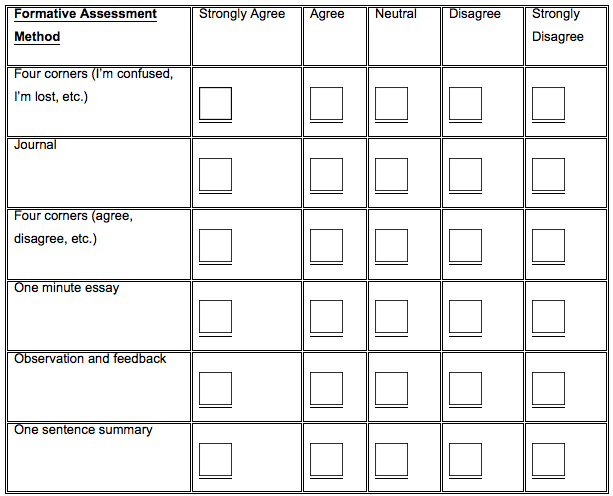
If you had to pick a favourite formative method as a STUDENT, which would you choose? Please give reasons why?AFTER COMPLETING SIX ASSSESSMENTS:
Method:
Why?
Appendix 7
Formative Assessment (you as a new TEFL teacher) Questionnaire
In the boxes below look at the formative assessment method and then tick the box that relates to your experience (as a teacher) of this method.
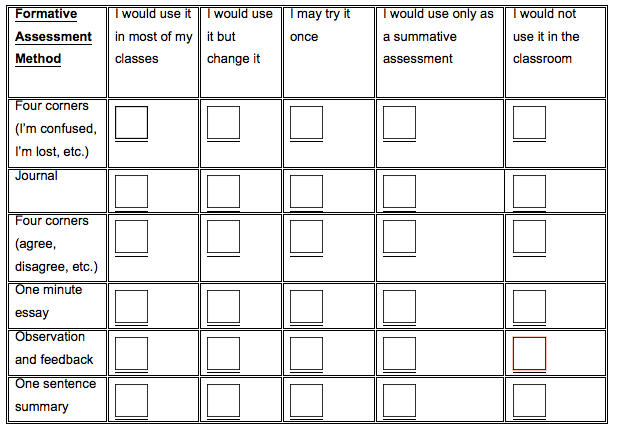
AFTER COMPLETING SIX ASSESSMENTS
If you had to pick a favourite formative method for your forthcoming classes, which would you choose? Please give reasons why?
Method:
Why?
Appendix 8
Appendix 9
Appendix 10
Appendix 11
Appendix 12
.


