Government

Bangkok Pollution
(615 Words)
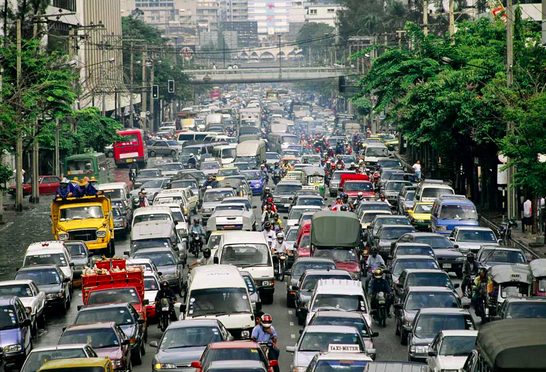
Bangkok is polluted, the smoke filled air from the early morning commuters with their cars, coming from their brand new condos, making their way to work serve to highlight the dramatic contamination levels this city has reached. Recent news from the Pollution Control Department that Bangkok’s air has reached critical levels can only confound worry. Bangkok people have learnt to put up with the pollution and ignore the three main worries associated with it; new high rise buildings, abundance of cars and filthy air. These factors will be classified in this essay.
The first factor is the brand new condos and apartments line every street in Bangkok these days. These new building have sprouted out of the ground to collect more people into a smaller areas of Bangkok. The sad fact is, there are little or no zoning laws. These seductively built premises neatly situated within eyeshot of major thoroughfares maybe appealing for the commuter belt brigade of workers but on already congested toll ways, roads and little sois, there really is no room for 50 or more families in their sparkling new condos. There are definitely signs of an oversupply of condos in Bangkok. The Government has noticed this too and has dropped the bank lending of 100% to only 90% of apartments less than 10 million baht which had made it too enticing for speculators but this will not stop the builders as they change tack and move into other avenues to entice more people into Bangkok.
Another factor is that there is no day off for traffic. Cars and buses clog the city twenty four seven. Benzene levels over Bangkok are well over the general limit. Medical studies have proved that long exposure to benzene exposure brings on cancer but this information must be kept quiet. Euro 4, one of the benzene petrol distributors have said they will try to reduce the levels of benzene emissions from 3.5% to 1%. This in itself is a great idea but what about the past and Bangkok’s contact with the smog that envelopes the city everyday. To compound the problem, these Bangkok people keep buying new cars. The roads are littered with red number plates, even with all the expense car ownership incurs; as long traffic jams every morning still grow larger. Bangkokians still continue to see their motors as prestige items.
One last aspect of pollution is the air which may seem clean to Bangkokians, some of them actually think their level of pollution is normal, but the air is not clean, dust particles lay in the atmosphere. These dust particles which can only be measured in microns of measurement that float around exceed the normal rate of air quality. Ozone levels were also found to be 0.2 percent higher than normal and volatile organic compounds were double the normal rate. Most of the 6.7 million residents are taking this air in. Plants and vegetation should help this but with not that many green areas the plants can’t give off air to cleanse and cool the area while the temperature keep rising. This heat is added to by the concrete building which retain their heat so Bangkok is still hot at night.
To conclude, there are many examples of the ways Bangkok is becoming more polluted. The truth is the Government should wake up to the dangers of air pollution but with the sheer vast amount of traffic on the streets of Bangkok it is going to a hard task. They have started the underground and BTS which unluckily invites construction but expansion of this transportation seems a distant dream and the sad aspect, Bangkok people must have given up on that vision too.
How are laws made in England?
(1049 words)
In an ever-changing society, individuals continually develop new forms of leisure and entertainment. In England, alcohol consumption is a common feature of social and recreational activities, particularly within pubs and clubs. Excessive alcohol consumption, including drinking competitions in which participants consume large quantities of alcohol over short periods, can nevertheless contribute to serious health and social consequences. Although such activities may be regarded by participants as forms of entertainment, the Government has a responsibility to address the risks associated with excessive alcohol consumption, particularly alcohol-related illness and mortality. One mechanism through which the Government seeks to regulate such behaviour is the creation and implementation of legislation.
Laws are established to provide a framework of social order and to regulate behaviour by determining what individuals may or may not lawfully do. The process of creating legislation through Government Bills is, however, neither immediate nor straightforward. A proposed Bill must pass through several stages of parliamentary scrutiny and debate before it can become law. These stages include consideration by both the House of Commons and the House of Lords, followed by Royal Assent from the Monarch.
The first stage in the legislative process is the formulation of the Bill. At this stage, the Government determines the policy objectives and the specific provisions that will eventually be incorporated into the proposed legislation. Ministers and civil servants are involved in developing the policy, while Government lawyers are responsible for drafting the Bill. Prior to the formal introduction of legislation, the Government may publish a Green Paper, which sets out proposals for consultation and allows interested parties and the wider public to consider and comment upon the proposed policy. Following consultation and further development, the Government may produce a more detailed proposal before the legislation is formally introduced to Parliament.
Once the Bill has been approved for introduction, it enters the First Reading in the House of Commons. The First Reading is primarily a formal stage during which the Bill is introduced and its title is read. There is generally little or no substantive debate at this point. The Bill subsequently proceeds to the Second Reading, which represents the first significant opportunity for Members of Parliament to debate its underlying principles and objectives. At this stage, Members consider the purpose and general content of the Bill, and the Government and opposition parties are able to present their respective arguments. The length and intensity of the debate may vary depending upon the significance and controversial nature of the proposed legislation.
Following the Second Reading, the Bill proceeds to the Committee Stage. A Public Bill Committee, consisting of a selected group of Members of Parliament, examines the Bill in considerable detail. Unlike the Second Reading, which focuses primarily on the general principles of the legislation, the Committee Stage considers the individual clauses and provisions of the Bill. Members may propose amendments where they believe changes are necessary. This stage provides an important opportunity for detailed parliamentary scrutiny and may result in significant alterations to the original proposals.
Once the Committee Stage has been completed, the Bill proceeds to the Report Stage. At this stage, the Bill, including any amendments made by the committee, is considered by the wider House of Commons. Members who were not involved in the Committee Stage are therefore able to examine the proposed legislation and suggest further amendments. The length of the Report Stage can vary considerably depending on the complexity and controversial nature of the Bill. This stage ensures that the legislation receives further scrutiny before the final debate in the House of Commons.
The Bill then proceeds to the Third Reading, which represents the final stage of consideration in the House of Commons. Debate at this stage focuses on the Bill as a whole, including any amendments that have been made during the preceding stages. Members of Parliament have the opportunity to consider whether the Bill, in its revised form, should be approved. If the House of Commons agrees to the Bill, it is subsequently passed to the House of Lords for consideration.
The House of Lords undertakes a similar process of parliamentary scrutiny. The Bill is considered through its First Reading, Second Reading, Committee Stage, Report Stage and Third Reading. Members of the House of Lords may propose amendments to the legislation, providing an additional level of scrutiny. If amendments are made, the Bill is returned to the House of Commons, where Members consider whether to accept or reject the proposed changes. This process may result in the Bill moving between the two Houses until agreement is reached on its final wording. The relationship between the two Houses is governed by constitutional principles and parliamentary legislation, including the Parliament Acts, which limit the circumstances in which the House of Lords can prevent legislation from becoming law.
Once both Houses have agreed on the final text of the Bill, it is presented to the Monarch for Royal Assent. Royal Assent is the formal approval required for a Bill to become an Act of Parliament. Although the Monarch formally possesses the power to refuse Royal Assent, this has not occurred in modern constitutional practice and is regarded as a constitutional formality. Following Royal Assent, the legislation becomes law, although the Act may specify a particular date on which its provisions will come into force.
The legislative process demonstrates that the creation of laws in England is not an immediate response to social problems but a structured procedure involving several stages of consideration, debate and scrutiny. Although legislation may originate from concerns about issues such as excessive alcohol consumption and alcohol-related deaths, a proposed solution must undergo extensive parliamentary examination before it can become law. The involvement of the House of Commons, the House of Lords and the Monarch provides a series of constitutional stages intended to ensure that legislation is carefully considered before it takes effect.
Consequently, although individuals affected by new legislation may question its necessity, purpose or effectiveness, the parliamentary process is designed to ensure that proposed laws are subject to democratic debate and scrutiny. Legislation concerning alcohol consumption, for example, may be introduced with the objective of protecting public health and reducing the social and economic consequences associated with excessive drinking. The legislative process therefore seeks to balance individual freedom with the wider interests and well-being of society.

