Pinker
I did not mean it like that! Language at its best (or worst).
(972 Words)
Language works in many ways and what someone says may well not truly get to the core of their true meaning or the point they were trying to get across while at the same time the receiver is stumped or takes offense. In the piece of writing, I will try to explain that the English language has many meanings, descriptions, and stumblings that we wonder how someone was actually trying to make their point and did they (or others)really know what they were saying.
In a famous Bertrand Russell’s sentence construction, we can see that we do not hold consistent opinions on facts. On a BBC program in the 1940s, Russell conjugated an “irregular verb” as “I am firm; you are obstinate; he is a pig-headed fool.” These constructions provide excellent illustrations of the varying emotional associations of words and the empathy of meaning.
What Russell was illustrating was the power of words to convey attitudes (connotations) as well as meanings (denotations).
Moreover, think about the following statements and how they convey their meanings: I am sexually adventurous, you are promiscuous, he is a slut.
We recognise connotation as ‘the emotional implications and associations that a word may carry’ and denotation as ‘the direct or dictionary meaning of a word’.
Dog = man’s best friend (connotation)Dog = four legged animal (denotation)
In an age where people are highly sensitive to what is said about religion, ethnicity, or even sexuality, antiquated stereotypes of someone’s hair colour can still emanate one’s perception of a person. Passing statements are said without true acknowledgement. Epithets to categorise people can be totally unacceptable. You only have to look at the examples below to see this.


But, language can work in reverse where a supposedly openly offensive word like ‘fuck’ cannot actually have the denoted meaning. For example, Bono upon receiving an award at the Golden Globes in 2003 exclaimed that it was ‘fucking brilliant’. Now, was this use of the expletive word offensive, or was it just an exclamation of the excitement at winning the award? It cannot be indecent as what is more than ‘brilliant’ without the punch in the statement he wanted.
So, do we take statements to actually mean what they say? Bono was telling us how excited and thrilled he was to win an award. What he was saying encapsulated that moment and the literal meaning came across clearly. It is strange in that case that the Federal Communication Commission reasoned that the word had no connotation other than referring to the act of fornication, and was therefore always indecent. Go figure! Well, George Callin did.
(If you are easily offended, I would advise you not to watch the George Carlin video)
So, language does not have any connotation we should take it literally all the time. Is that right?
For example, during the final days at Denver’s old Stapleton airport, a crowded United flight was cancelled.
The single agent was re-booking a long line of very inconvenienced and frustrated travellers. Suddenly an angry passenger pushed his way to the desk in front of all the others. He slapped his ticket down on the counter and said, “I HAVE to be on this flight and it has to be FIRST CLASS.”
The agent replied, “I’m sorry sir. I’ll be happy to try to help you, but I’ve got to help these folks first, and I’m sure we’ll be able to work something out.”
The passenger was unimpressed. He asked loudly so that all the passengers behind him could hear, “Do you have any idea who I am?”
Without hesitating, the gate agent smiled warmly and grabbed her public address microphone. “May I have your attention please?” she began, her voice bellowing throughout the entire terminal. “We seem to have a passenger here at the gate WHO DOES NOT KNOW WHO HE IS. If anyone can help him find his identity, please come forward to the gate.”
With the folks behind him in line now laughing hysterically, the man glared at the United agent, gritted his teeth, and spat out the words, “F… you.”
Without flinching in the least, the agent smiled politely and said, “I’m terribly sorry, sir, but I’m afraid that you’ll have to stand in line for that, too.”
We have to understand that language comes at us on multiple levels, rather than as a direct parse of the content of the sentence. In everyday life, we anticipate our interlocutor’s ability to listen between the lines and slip in requests and offers we feel we can’t blurt out directly (Pinker, 2008).
But, one has to be careful. A famous sketch from the Seinfeld show highlights the gravity of taking what someone says too literally.
So why don’t we say what we actually mean? Would it not just get out of the way all this politeness and double meaning? Why spend minutes or hours getting round to the point of the conversation?
Whimpertaives are another example of us going through the motions of being polite and less direct. People prefer to be asked nicely although it does take away the power of the person saying the statement or asking the question. Still, it would be better if a person was on a dinner date to be on their best behaviour where a sense of decorum prevailed. However, statements or questions can be overstretched.
Can you…..? (a stupid question)
I was wondering if… (a pointless rumination)
It would be great if you could… (a gross overstatement)
Politeness keeps people placated. A person can really be too blunt as if they were bossing someone about but what if we came out with what we really meant, would it not expose too much? Ricky Gervais’ Invention of Lying shows us how it is done.
References:


.
Syntax – an indepth look
(6981 words)
Human communication in all its forms almost always uses words. We could say that communication is essentially the expression of thought. Every time we speak or write we are faced with a myriad of choices to explain ourselves. Within this information transmission that uses thought, we use words to express our beliefs and judgments, intentions and desires, etc. The words are used in a combination to make others understand our desired thoughts. Human languages are among several systems of human communication (some others such as gestures, symbol systems), but language has immeasurably greater communicative power than the others. The grammar we use to communicate, the context, the people with whom we are communicating with and whether we are writing or speaking have to be in a form that is fully recognized. Sentences are not unordered strings of words; rather the words and morphemes are grouped into functional constituents such as subject, predicate, direct object, noun phrase, verb phrase, and so on. It means that we take a finite number of discrete elements (words) and combine them to create larger structures that are different in meaning from the original words themselves. The choices for expression make use of many patterns in the English language. All human languages have very similar underlying structures; they all have phrase structure rules and transformational rules. The use of these words is systematized according to syntax. It is Syntax that this paper is concerned with. In this paper, I will take a deeper look at how English language syntax helps us form the complete understandable sentences that help us communicate so well.
It is clear to see that the sentence ‘Man hits animal’ is not the same as ‘Animal hits man’. We know this because we use a code, or set of rules, to translate between orders of words and combinations of thoughts. Generally speaking, this set of rules is called generative grammar. Syntax works on a prescriptive use of grammar although spoken English is not as formal as we think and works along the lines of a more descriptive method. Descriptive syntax is about understanding the rules that a speech community employs by examining the way that the members of that community actually do talk. I will try to show in this paper syntax as comprehensively as possible while recognizing that the coverage of all the details is impossible.
The English language holds rules that can create larger more complex structures. It is by learning phrase and clause structures that give us a clearer picture of syntax. These structures are what make the syntax rules. We find that it is possible to create an infinite number of sentences, all of which can express meaningful thought. Thus it is possible to construct sentences that the speaker has never used before. It can be said that English has a finite number of rules which facilitate an infinite number of sentences. Syntax shows that sentences and the relationship of their component parts works in English. To understand a sentence one cannot merely pay attention to the order of words. Communication is grounded on getting our point across. The study of language is of the formal interrelations that exist between the elements of a language (i.e., sounds, words) themselves. Syntax is the system that speakers and writers use when they combine words into phrases and clauses, ultimately creating meaning in their structures. Thus, the point of us using words is to be comprehended. English speakers show this in their syntax that is used by every English-speaking person. The old definition of a sentence was ‘a complete expression of thought’, although today this may seem a bit vague to be helpful. An English-speaking person may say ‘beautiful day!’ which is not a grammatically complete sentence, but it is our knowledge of the sentence ‘it is a beautiful day!’ that we are able to understand the utterance. So, although a person takes the language and uses it to different extremes it is our fundamental knowledge of the original grammar that allows us to comprehend incomplete sentences.
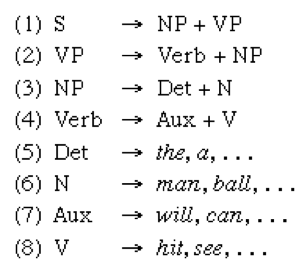
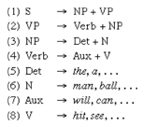
Syntax uses many components that consist of a set of rules operating upon putting into the sentence to achieve and produce an understandable result. These rules are essential language parts of syntax that are used to understand the logic of how it all works. In every sentence, certain groups of words form natural units (the constituents). These units may stand alone, be moved as a unit, or be replaced as a unit by a pronoun. We essentially have here the building blocks of language. The list below gives a few examples of the phrasal categories (noun phrase, verb phrase) and lexical categories (noun, verb, and determiner), that this paper will be using. In the following, we find that S stands for Sentence, NP for Noun Phrase, VP for Verb Phrase, Det for Determiner, Aux for Auxiliary (verb), N for Noun, and V for Verb stem.
In most English schools, they always tell you about the basic rule in the English language which is to have a Subject – Verb – Object combination, but there is much more to it than that. The subject and the object in a sentence can consist of only one word such as ‘boys like girls’, which is a simple declarative sentence. If someone says, “The boy throws the ball,” using the Subject – Verb – Object combination, it is to make whoever speaks the same language comprehend the sentence (S) without confusing him and putting across the wrong meaning. The subject and object in a sentence, name someone or something. The sentence ‘the boy throws the ball’ is known as a clause (a simple sentence) that includes a subject and predicate. The laws of syntax prevail that these words are understood in the position they are. In this initial pattern we can see that the subject comes before the verb (throws) and the object follows the verb. From the simple S-V-O pattern you can get a general picture of how a child acquires their language. There is a distinct pattern. Sentences can consist of a noun phrase either in the subject (the boy) or the object (the ball) position. We recognize a phrase as a small group of words expressing a single concept or entering with some degree of unity into the structure of a sentence, without itself being a sentence. We also find that the subject may consist of a group of words that includes the subject noun and words that modify it, for example ‘’the boy with the black hair’. ‘With the black hair’ modifies the subject ‘the boy’. As a little introduction observe the subjects in the following sentences that give a brief insight into how various subjects in a sentence can be formed.
A. The boy throws the ball. [noun as subject]
B. He throws the ball. [pronoun as subject]
C. What he threw smashed a window. [noun clause as subject]
D. Playing is fun. [gerund as subject]
E. Throwing balls in the park is fun. [gerund phrase as subject]
F. To throw a ball is fun. [infinitive as subject]
G. To be able to throw a ball is exciting. [infinitive phrase as subject]
Syntax assigns to each sentence that it generates a structural description, as are all the sentences A – G above. But before we go too quickly with too many examples, let’s get back to our original sentence ‘the boy throws the ball’. When we look at the whole sentence, we understand that the meaning of the words combined together in this sentence is quite detached from its individual parts (each word). If we arranged the words as ‘the ball throws the boy’ we would have a completely obscure sentence that isn’t the meaning that we had hoped to be put across. If a person knows what ‘ball’ and ‘throw’ mean he instinctively knows that the ball is not doing the action and structure cannot work.
The fact about language is that we want to make it interesting and colorful, a language that has character. How do we do this? We do this by using other elements that can be added to the sentence such as adverbs, phrases, clauses, and adjectives. Looking at adjectives, for example, we see that an adjective is a word designating an attribute and added to a noun, to describe the noun more fully. Adjectives or other single words that modify nouns are usually placed before the noun (the small boy throws the red ball). We can also find whole phrases acting as modifiers in a sentence. These are usually placed after the noun (the small boy in the red shirt). We also see adverbs that are normally more mobile than adjectives occurring either before or after the verb they modify (the small boy in the red shirt wildly throws the red ball), (the small boy in the red shirt throws the red ball wildly). We now get a view of how sentences get a little bit more fascinating.
So, we have words, and these need to be put into a combination to be understood. These combinations we call phrases and clauses. We do not say ‘a day beautiful is it’. We say ‘it is a beautiful day!’ or ‘beautiful day!’ In order for sentences to work with any degree of success, the rules have to be pretty much adhered to. The predominant properties that characterize each phrase and which roles they play in the sentence are determined by the properties of the principal or head word. Using syntax with the example ‘The boy throws the ball’, this sentence (S) consists of two noun phrases (NP ‘the boy’ and ‘the ball’). A noun phrase always contains a head noun. In this case, ‘boy’ and ‘ball’ are what each phrase is about. The subject is ‘the boy’ and is symbolized as:
NP → Det N (Noun Phrase → Determiner Noun)
We can see that the syntactic pattern is a determiner followed by a noun. Looking at the verb we can put it into a verb phrase that includes the noun phrase following after the verb symbolized as:
VP → V NP (VP = ‘throws the ball’).
We see that the predicate is the part of a sentence containing what is said about a subject. ‘Throws the ball’ is called the Verb Phrase/Predicate. This is so-called because it always contains a verb in a specified position. We say that the verb is the head of the Verb Phrase/ Predicate.
To give us a better picture, we can now represent the example sentence as:
S → NP + VP.
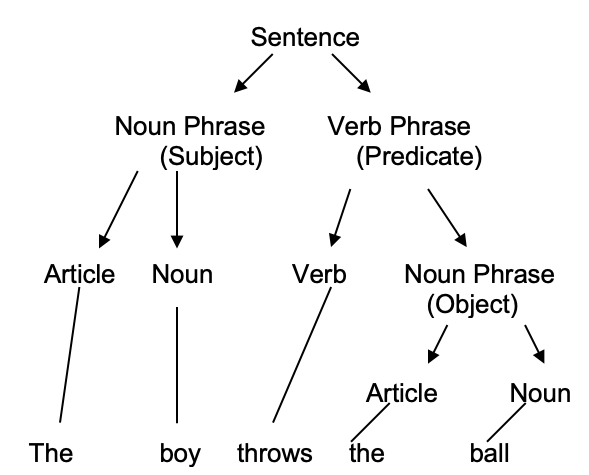
This represents the symbols of grammatical theory. The arrow itself means something like ‘consists of’ or ‘can be rewritten as. After the arrow, you will find the constituents the phrase may consist of. It is important to know in a sentence there are phrase-structure rules that make up the important parts of syntax. Phrase structure rules specify which elements can occur in a phrase, and they also specify in which order these elements (or constituents) may occur. Syntax involves Phrase Structure Rules, which yield trees (see Diagram A) with labels added to indicate the syntactic category of each constituent (e.g. Noun Phrase, Verb Phrase, etc.).
Diagram A
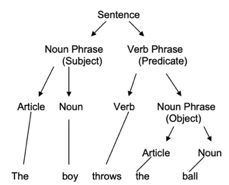
We should not forget that the subject in ‘the boy threw the ball’ sentence includes an article (the), and a concrete noun (boy). These two words together form a noun phrase, as does the noun phrase ‘the ball’. The article in both of these noun phrases is the word ‘the’. In English, the article provides the minimum specification necessary in the noun phrase. The sequence with the article ‘the’ and a noun is that ‘the’ always holds the initial position. In our sentence about ‘the boy’, the function of the article is to provide the type of reference of the Noun Phrase and the information value of what is expressed by the noun phrase. The use of the article ‘the’, makes us think that we are talking about one specific boy and ball.
In learning about syntax, a good starting point is identifying the two basic parts of a sentence: the subject and the predicate. Every predicate in a sentence includes at least one verb. In our example ‘throws the ball’ works as a verb phrase that uses the string of symbols Verb (V) + noun phrase (NP). In our phrase structure we see the symbols:
VP → V NP.
We can also see that the subject (the boy) is put at the initial position in the sentence and the object follows the verb. Looking more closely at the sentence here, we find that the verb is transitive. Transitive means that the verb ‘throws’ must take an object after the verb. The complement after the verb is called the direct object of a transitive verb. It would be an incomplete sentence to use ‘the boy throws’. Using the verb ‘throw’ we understand that it is the action of throwing. The subject is the thrower. The subject must throw something so the object takes the place of the thing thrown. The verb dictates that there must be an object. The object ‘the ball’ becomes the direct object.
Moreover, if I said ‘the boy jumped’ this is a syntactically complete sentence that does not need an object. This sentence has an intransitive verb that requires no object after it. Of course, this does not mean the end of the sentence, using syntax we can add more meaning to it by adding, for example, a prepositional phrase (PP) that makes the sentence ‘the boy jumped on the roof’. The syntactic rule states that a verb phrase consists of a verb and an optional PP. This is of course only true for intransitive verbs, which do not take an object, but this rule can already generate VPs such as the following: ‘the boy jumped’, ‘the boy jumped on the roof’. Verb phrases are a little bit more complex because they allow a fairly wide range of phrases that can modify a verb. So, we have intransitive, one-place verbs that combine only with the subject ‘The boy jumped’ (S-V). There are also ‘two place’ verbs combining with subject and, for example, a following obligatory adverbial after the verb (S – V – A). The adverbial can express time, place, or manner. For example ‘The boy is in the house’, ‘the boy played for two hours’.
Another point just to follow up is, the ‘doer’ and the ‘receiver’ in a sentence, which was shown in ‘the boy throws the ball’. ‘The boy’ is the doer and ‘the ball’ receives the action. This is generally thought to be the rule although we can also see other constructions it varies. If I say ‘She appeared in front of him’ (S → V (PP), we propose that the other person is the doer of the action and ‘she’ received the actions of him appearing. So it follows that different verbs can be followed by different kinds of words and structures. For example ‘I have a bag’ does not involve an action but is a state. We can also show that some subjects do not have an object. For example ‘He was angry’ uses an adjective as a complement after the verb that expresses meaning to the subject (He).
We can propose that within the grammar of a language there is a hierarchy of levels. The sentence is King. At the lower level morphemes are arranged into words to form phrases, and clauses into sentences and we find meaning. As speakers of English, we recognize categories such as nouns, verbs, and adjectives. These parts of speech do not actually form our language. We are more activated by patterns in our language. So, for instance, we have learned the Subject – Verb – Object sequence and we recognize this as a correct syntax pattern, but language is not so simple. For instance, we can add another object to the end of the sentence. This becomes a three-place verb, a so-called dia-transitive verb. We now read the sentence as Subject – Verb – Indirect Object – Direct Object. For example, ‘the boy throws him the ball’. We can show the sentence in these ways:
S → NP(1) + Tran V + NP(2) + NP(3)
NP(1) transitive verb NP(2) NP(3)
(subject) (predicating verb) (indirect object) (direct object)
The boy throws him the ball
As much as we recognize the ‘S – V – O’ and even ‘S – V – iO – dO’ combinations in English syntax, we can make the sentence focus more on one of the other aspects of a sentence other than the subject. Thus, in the case of our sentence, ‘the boy throws the ball’ we can now focus our attention on the ball instead of the boy. In this case, we would end up with the syntactical sentence ‘the ball was thrown by the boy’. Using our constituent S is now separated into sub constituents where we have an active sentence that reads:
S →NP1-V-NP2
(The boy throws the ball). T
The second sentence is called ‘passive’ in grammar that reads:
S →NP2 – be + en V – by + NP1.
This rule explains the grammaticality of ‘the ball is thrown by John’ given that of ‘The boy throws the ball’.
It should be observed that ‘NP1’, ‘V’ and ‘NP2’ are the parts of the context that are treated for the application of the passive rule. The passive rule involves two applications of the ‘Move NP’ rule, one moving the subject ‘NP1’ to the ‘by’ phrase, and another moving the object ‘NP2’ to the subject position. In effect, all the elements that make the passive rule specific to transitive constructions are deleted and a simpler rule (‘Move NP’) replaces it.
The passive structure has gone through syntactic transformational and movement rules, as developed by Noam Chomsky. These rules make us look at the relationship in the hierarchical tree structure into which the words of a sentence are placed. The passive sentence ‘the ball is thrown by the boy’ contains the verb ‘throw’, which as shown before ordinarily requires a direct object. But here the object is missing from its normal position; it has been ‘moved’ to the front of the sentence. This gives us a way of shifting the emphasis and quantification of a given set of participants in an event or state. The sentences ‘The boy throws the ball’ and ‘The ball is thrown by the boy’ both express the same information about who did what to what, but one of them is a comment about the boy and the other is a comment about the ball. Similarly, sentences in which a phrase is replaced by a wh-word and moved to the front of a sentence, such as What did the boy throw?, allow the speaker to seek the identity of one of the participants in a specified event or relationship. It is important for us to recognize the movement in the sentence. Transformations thus provide a layer of meaning beyond who did what to whom; that layer emphasizes or seeks information about one of the participants, while keeping constant the actual.
As shown above we can change the sentence while still leaving the same meaning. There are a number of rule-bound transformations of words in language that can change our original simple sentence into interesting and varied utterances. Because there is an underlying and simple structure to all our sentences, we can understand each other. These are the principles of syntax. Our original mentalese sentences are transformed into something besides the simple sentence. It is our power with language that we make use out of these sentences and make varied articulations. Since those transformations are rule-bound, we can make sense of each other, even with so much creativity happening. We can end with sentence like:
It is the boy who throws the ball.
The boy is the one who throws the ball.
The ball is thrown by the boy
The object thrown by the boy is a ball.
It is the moving of the sentence while adding and taking away that shows syntax at work. At this point, we can highlight case grammar that uses semantic case analysis to find the link between syntactically distinct sentences. We can say:
(A)The boy throws the ball with his left hand.
(B) His left hand throws the ball.
We see in the sentence (A) above that ‘his left hand’ works as a direct object and as a noun in the sentence (B). The fact between these two sentences is that the relationship between ball, throws, and left hand is identical in both sentences. Case grammar allows a word to have the same semantic role, despite having a different syntactic designation.
To get a better view on a sentence, an important factor to syntax is by parsing. We do this with our original sentence, as seen in Diagram A. Parsing generally describes, a word in context, grammatically, by stating the relevant part of speech, inflection, and place within the sentence structure. It resolves (a sentence, phrase, etc.) into component parts of speech for grammatical description. We can view the sentence’s grammatical structure in Diagram A repeated below. When using parsing we find the term tree is popular among linguists. Labels are added to indicate the syntactic category of each constituent. Tree is a popular word used to describe the formation of a sentence although by reading Noam Chomsky you will hear him calling them phrase markers.
Sentence: The boy threw the ball.
Subject Noun phrase: The boy
Verb phrase: Threw the ball
Article: The/The
Noun: Boy/Ball
Object Noun Phrase: The ball
Diagram A
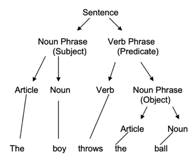
This declarative statement above (Diagram A) can of course be used to make a question. If we look at making this sentence a question we have to run some tests on it to find its constituents. The rules of syntax can look inside a sentence and find the parts we need to form questions. Generally, this is a good way to check our understanding of the question. We can positively say the statement “the boy throws the ball” is related to the corresponding questions, “What does the boy throw?” and “Who throws the ball?” As much as statements give information, questions are sentences that seek information. They fall into two main types, depending on the reply they expect and on how they are constructed. Yes- no questions allow an affirmative or negative reply, often just a yes or no. So, we can run some tests on the sentence ‘the boy throws the ball’ to check its constituents. For example, can a constituent stand on its own? We can ask the questions:
Question: ‘What does the boy throw?’
Possible answers -‘the ball’
but ‘ball’ and ‘the’ fail the test.
We can actually use a substitution test here where we can use ‘the ball’, our noun phrase, and replace it with the pronoun ‘it’. This reveals the answer to the question.
The boy throws the ball – The boy throws it.
We can use the substitution test again on the other noun phrases to test if a pronoun could be used instead of the noun phrase.
Possible questions: ‘What does he throw? Or ‘Who threw the ball?’; ‘Did he throw the ball?’ Or ‘Did he throw it?’, and ‘Did the boy throw it?’
So, by looking at the ‘wh’ type question, from ‘the boy throws the ball’, we can look inside the sentence and see that by moving the phrase corresponding to ‘the ball’ to the front we make the question ‘What does the boy throw?’
Most questions ask for the object of a sentence: ‘The boy throws the ball”
What does the boy throw? ANSWER = OBJECT (the ball).
Regarding the question words WHO, WHAT & WHICH, if the answer is the subject, there is no auxiliary do, does, and did and the word order is the same as a statement.
Who throws the ball? ANSWER = SUBJECT (The boy).
Now let’s look at the declarative sentence from before using two objects, ‘the boy throws him the ball’. If we were to use “Wh-Question Formation Rule” for English sentences with inirect object and direct object, we would have to use a rule like this. This uses the sentence, with a missing item X.
A. The boy throws X a ball.
We need to insert the appropriate Wh-word for the expected lexical category of the answer
B. The boy throws who a ball.
Now we need to change the form of the verb to the appropriate “does X” construction.
C. The boy does throw him a ball.
We must now use Subject-Auxiliary Inversion to form an interrogative.
D. Does the boy throw him a ball?
Finally, we can move Wh-word element to the front of the sentence
E. Who does the boy throw the ball?
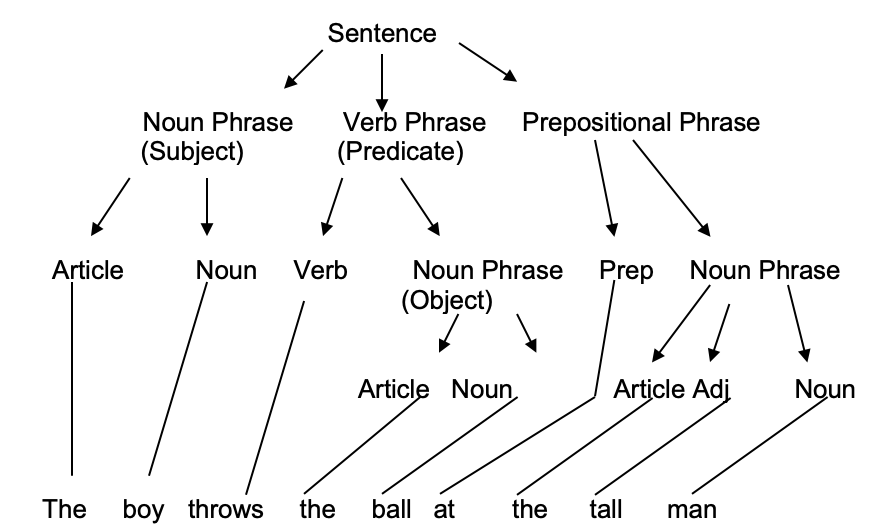
There are many constituents to a sentence and it is our job to notice them. We find that there is a hierarchical structure in a sentence; there is a rank scale where the sentence is at the top then broken down into clauses then phrases and words. Phrases and clauses are what language is made of. It is by joining together these patterns that give us the power to broaden our sentences further. For broadening our sentences, we can use phrases. For example, we can add to our original sentence ‘the boy throws the ball’. If we take this sentence to be complete, we can just add on to the sentence to extend our meaning though still keeping in the confines of a complete sentence. We can now form a new sentence like ‘the boy throws the ball at the tall man’. We have now added a prepositional phrase (PP) that consists of a preposition followed by its object and its object’s modifiers.
We see that PP → P NP, a prepositional phrase consists of a preposition (at) followed by a noun phrase (the tall man). It begins with the preposition and is followed by its object, ‘man’. ‘Man’ is modified by the adjective ‘tall’.
Diagram B
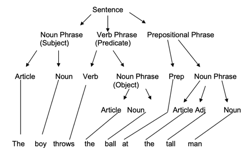
We can look at this sentence and notice the appearance of the prepositional phrase at the final position. The prepositional phrase follows a noun phrase (the ball). We notice that the noun phrase (NP) obligatorily consists of a head (ball), the noun, and additional optional elements, in this case namely a determiner (the), and then followed by a prepositional phrase (PP). In the prepositional phrase in Diagram B, we can see the symbols written as:
PP → P Det A N
We see a pattern of the preposition – determiner – adjective – noun (at the tall man). The noun serves as the object of the preposition. The adjective appears between the post determiner (the) and the head of the phrase (man). Nouns such ‘man’ in Diagram B can take an indefinite number of adjectives in front of it, while keeping the meaning coherent for example, ‘the tall dark fat man’. We must not forget that the adjective usually pre-modifies the noun but also can occur as a complement, for example ‘the ball is big’.
For this sentence, (Diagram B) using syntax, we can have a myriad of prepositional phrases that follow the sentence ‘the boy throws the ball’. If we write a phrase-structure rule to get our Noun Phrase, we need a rule like this:
NP -> (Det) N (PP)
(A noun phrase consists of an optional Determiner followed by a Noun followed by an optional Prepositional Phrase).
And the rule is that a prepositional phrase consists of a preposition followed by a noun phrase. Put these together and we get:
NP -> Det N PP, PP -> P NP
Using this theory we arrive at sentences like:
The boy throws the ball – in the classroom
at the window
with his right hand
on the roof
Now following the rules above we can show how the prepositional phrase is added to the noun we can end up with a myriad of ending to the sentence ‘the boy throws the ball’. Also following our rule NP -> Det N PP, we could be cheeky and have a sentence that goes along the lines of:
‘The boy at the window in the classroom throws the ball with his right hand on the roof’.
After a moment’s thought, we can see infinity here. Specifically, we see that the appearance of the NP within the Prepositional Phrase rule and the appearance of the PP within the Noun Phrase rule will let us make infinitely long Noun Phrases (or PP’s for that matter).
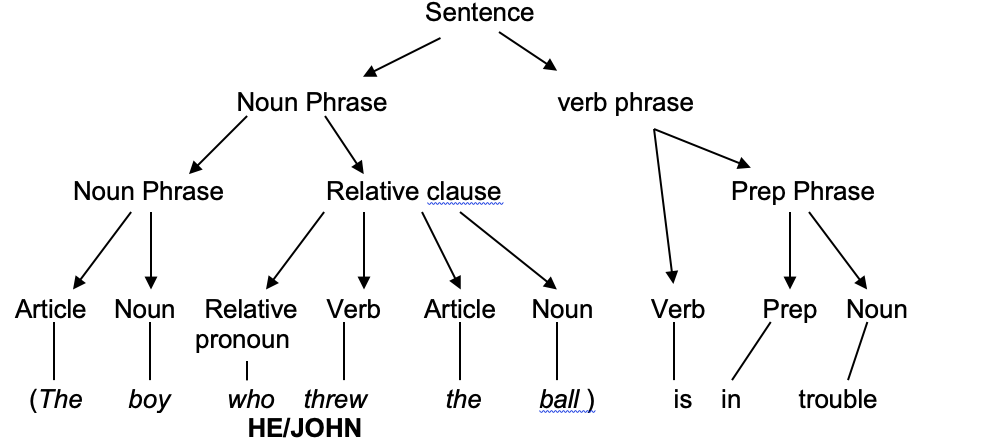
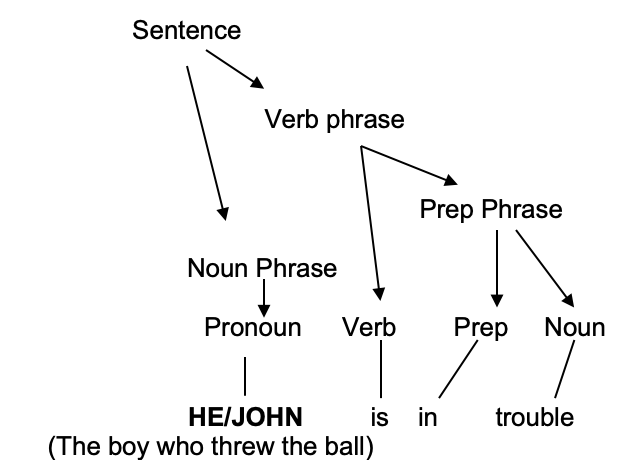
We can now see we are showing syntax working in the sentences and how we are forming longer sentences that have a more complex meaning. Moreover, syntax allows us to add another clause into the sentence and read it as, ‘the boy who threw the ball is in trouble’ (Diagram C below). We have now added a relative clause, adding more information to the sentence which in this case is ‘the boy is in trouble’. If we do not want to get confused we can run some tests on the sentence to check the syntax. First, what we can find out here is; what is the subject of this sentence? In this case it is ‘the boy who threw a ball’. This is the subject of the sentence. Our next job would be to isolate the main verb from the sentence. We actually have two verbs in the sentence ‘is in trouble’ and ‘who threw the ball’. The main verb here would be ‘is’.
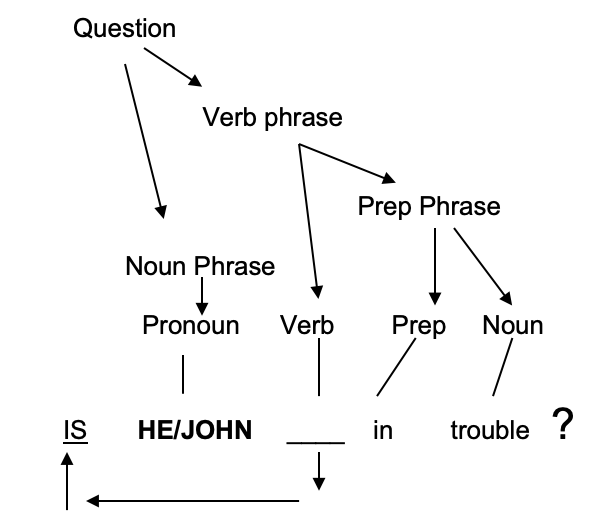
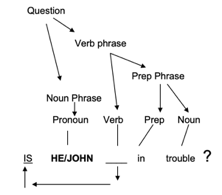
The next question would be to ask syntax to arrange this sentence in an order to make a yes/no question. In slightly more technical terms, we have uncovered constituent structure. Specifically, the whole string of words, the noun phrase, ‘the boy who threw the ball’ is a UNIT’. This happens to be playing the role of the subject in this sentence. “who threw the ball’ is a noun complement which in English typically comes after the head: they are post modifiers. We can recognize the noun phrase more if we replaced ‘the boy who threw the ball’ which is a constituent of the sentence, with a pronoun. In this case, we could replace the noun phrase with the pronoun ‘he’. This structure does not affect the sentence, for example ‘he is in trouble’. By the same rule we could add a real name such as ‘John is in trouble’. We move the “is” that is the main verb and place it to the left of the subject. In simple terms, constituents are groups of words that act as a single unit within a sentence.
Diagram C
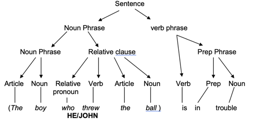
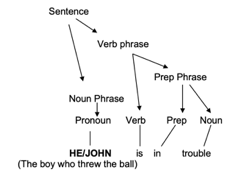
As we see with these sentences we are adding to our original sentence with more information that can be added to the sentence while being kept within the confines of a sentence. We see with the example, the relative pronoun ‘who’ is always placed in the first position in the relative clause. This relative pronoun has a syntactic function as a clause element in the relative clause. The word ‘who’ connects the subject to the verb in the dependant clause. This relative clause post-modifies the noun phrase ‘the boy’. The relative clause is a syntactic construction that allows us to provide more information about the referent of the noun phrase.
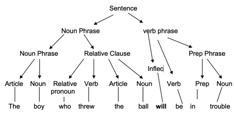
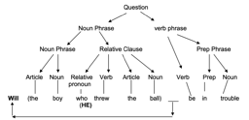
It is by looking at Diagram C that we see three combinations working in the sentence; a noun phrase, a relative clause, and a prep phrase. Now, how do we turn this into a question? Transformational rules help us here and it is by parsing the sentence that we find what we need to know in the sentence. We know that the yes/no question is ‘Is the boy who threw the ball in trouble?’ but why? What we have to find is the hierarchical structure in the sentence. The first exercise to do is find the subject in the sentence. The sentence is the noun phrase with the relative clause post modifying the noun phrase. This leaves us with a noun phrase that is ‘the boy who threw the ball’ which in this sentence is the subject. This leaves us knowing the main verb in the sentence. Once we have extracted the subject we find that the verb ‘is’, is the main verb and this, we place at the front to make the yes/no question in this case.
Diagram C2 (Question)
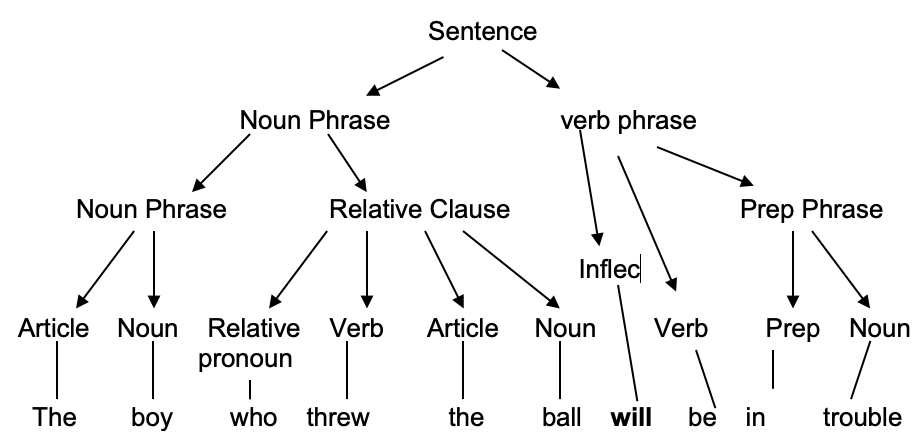
So, our sentence is getting bigger while still keeping within a syntactic structure. We have looked at the noun phrase but now we want to add to the verb phrase (VP). The headword in the VP is the verb but as we will see the verb phrase may contain elements from different verb categories such as modal auxiliaries/inflection can, may, will etc. These inflections are used to convey various types of meaning primarily the speaker’s view in the likelihood that what he says is true. The group (inflection + verb phrase) is called ‘I bar’ to indicate that it contains other things in addition. We also see that the addition of an inflection produces an ‘IP’ (inflectional phrase).
IP → NP I (a sentence consists of a noun phrase followed by an Ibar)
I → I VP (an Ibar consists of an inflection followed by a verb phrase)
Using an inflection with the example Diagram D we can now have a sentence that reads;
The boy who threw the ball will be in trouble.
IP → The boy who threw the ball will
I → Will be in trouble
We can notice that the modal ‘will’ takes an initial position before the verb as in the parsed Diagram D, below.
Diagram D
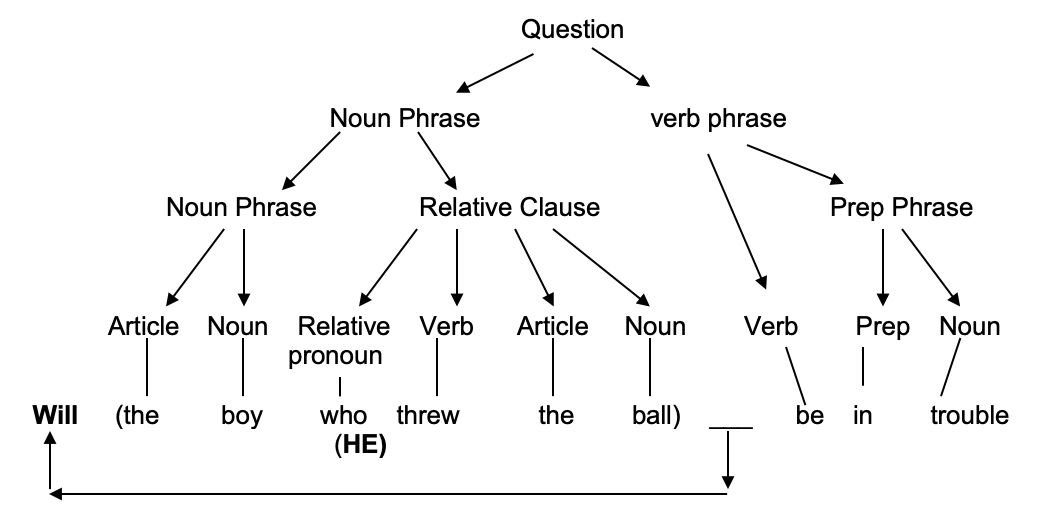
The problem is if we wish to form a question that corresponds to the assertion ‘the boy who threw the ball must be in trouble’, what must we do? We have two verbs working in the sentence. First of all, we must first find the root, which is the subject ‘the boy who threw the ball’. The consistency test we had before shows that we have a single constitute. We could substitute ‘the boy who threw the ball’ for the pronoun ‘he’. The solution is to move the auxiliary which is immediately under the right hand of the root, Diagram E.
Diagram E
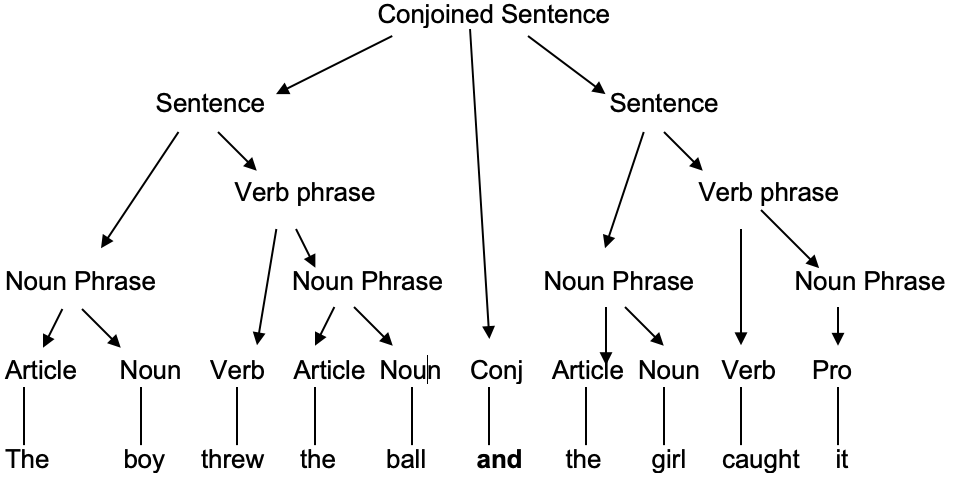
Up to this point, I have been showing complete sentences, but what if we want to join more than one sentence together. What do we do? We find that using syntax; it is also possible to extend sentences by joining together complete structures. We can take our original sentence further and classify it as multiple or compound sentence; containing two or more coordinate clauses. We can use coordination and subordination as a way to do this. Co-ordination is a relation that holds between two units of equal status, two units that are on a structural level for example:
(Clause 1) (Conj) (Clause 2)
‘The boy throws the ball and the girl catches it’.
We can recognize coordinating conjunction such as and and or. This is governed by the rule
S →X Conj X
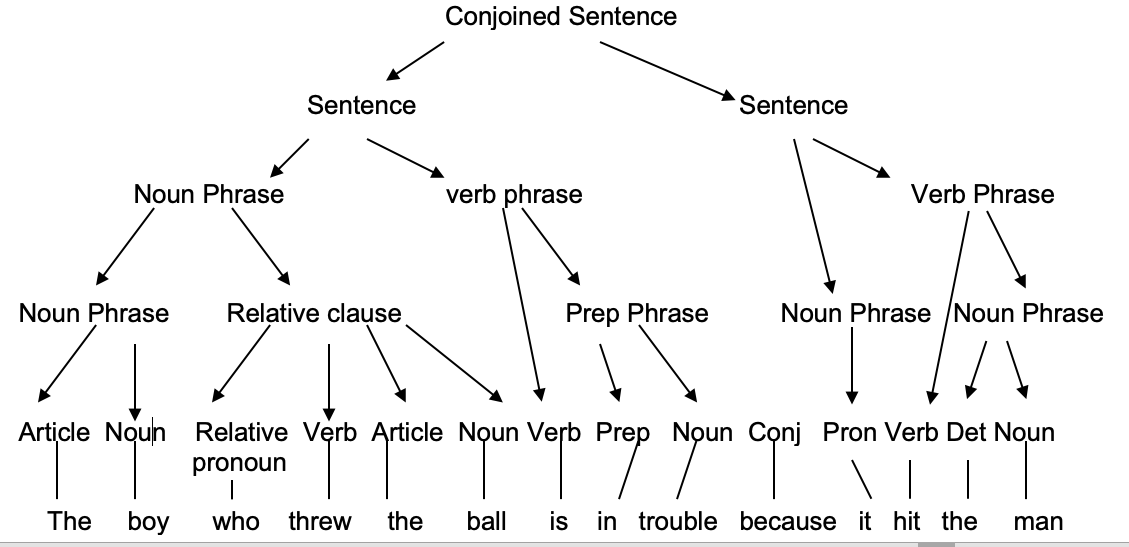
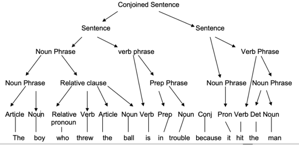
Subordination on the other hand is the relation between two units of unequal status. In this the case of clause subordination, one of the clauses, the subordinate is rank shifted. We would have a sentence that reads:
(Clause 1) (conjunction) (Clause 2)
‘The boy who threw the ball is in trouble because it hit the man’.
Looking at these sentences, we realize that two actions happened. We can look at which came first and which second. For example, we cannot say ‘The ball hit the man and the boy threw it’. Even though this sentence is in correct syntax we are actually saying that the first action was ‘the ball hit the man’ which is not the meaning we wanted. We have recognized that there are two actions even though this does not mean that one action follows another one with the conjunction ‘and’. Take the sentence ‘I sang and I danced’, this has two actions but this could mean that I did both at the same time. This sentence can be changed to say ‘I danced and I sang’ and we would still have the same meaning.
Diagram F
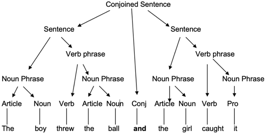
Diagram G
So far we have used the sentence about the boy to make different propositions. Nearly all the sentence types illustrated so far are statements.
The boy threw the ball
The boy throws the ball at the tall man
The boy who threw the ball is in trouble
The boy who threw the ball is in trouble because it hit the man
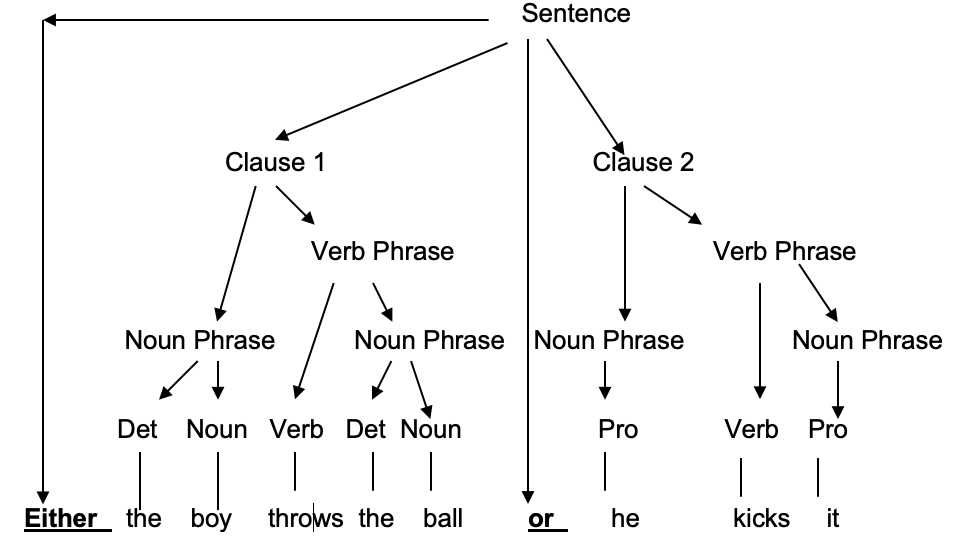
This leads us on to a further combination of syntax by using complex coordination. We can use our complete sentences to propose a different idea. We can apply this by using a marker. This marker is provided for the first and second of the coordinated elements. Correlative conjunctions are used in pairs: either…or; neither….nor; not only….but also. When these conjunctions are employed in a sentence, they must be followed by parallel construction. For instance Diagram H with either … or which show us two alternative clauses in sentences. In the sentence below, we are now talking about a choice between two possibilities.
Diagram H = S → either S1 or S2
This generates a tree such as the following below:
Diagram H
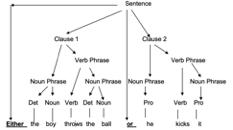
So far I have shown how clauses and phrases work to make a sentence. Then I have shown that we can expand those by adding other sentences, but how are all these words related in the sentence to give the true meaning to be understood? For example, we interpret the sentence ‘the boy throws the ball’ as having only one meaning. The sentence is about a boy who throws a ball. Let’s look at the two new sentences (a) and (b) below. Can you see the difference in meaning?
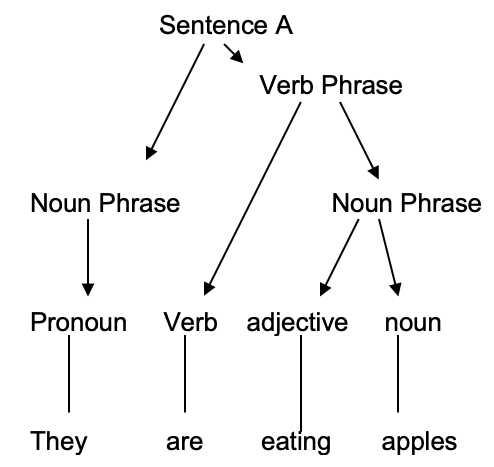
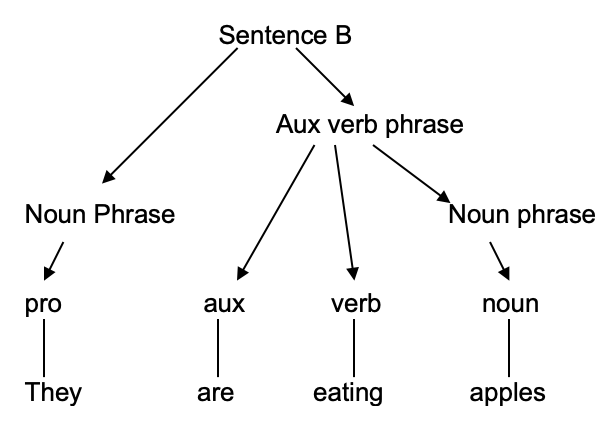
(a) They are eating apples.
(b) They are eating apples
You would not be wrong in thinking that these two are exactly the same in meaning. As you look at each sentence their syntactic structure seems to be identical. It is their surface structure which is the same but it is the deeper structure that reveals their true meaning. It is only by parsing the sentence that we get to see the sentence and how each word is working.
See Diagram I below.
Diagram I
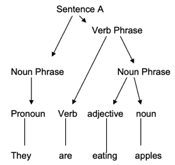
By looking at Diagram I we see that ‘eating’ is an adjective modifying the noun ‘apples’. The noun and adjective work as a noun phrase. It follows that the verb ‘are’ is used in the present tense, this states a fact about the ‘eating apples’. The speaker wants to give the meaning that ‘you can eat those apples because they are not cooking apples’. Now look at Diagram J.
Diagram J
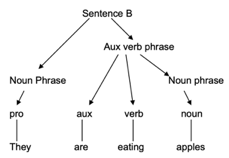
Moreover, ‘eating’ in Diagram J works as a verb denoting an action with the auxiliary verb ‘are’ and is included into the verb phrase. ‘Apples’ works as a single noun phrase. The speaker wants to tell someone that those people are doing an action, which is eating.
In addition, referring back to the use of relative clauses, we can show that there are two ways in which relative clauses relates to the head noun, as can be seen from these two examples below. This is where syntax shows its ambiguities. Can you see the difference?
(C) My brother who’s abroad has sent me a letter
(D) My brother – who’s abroad – has sent me a letter.
These two sentences appear to be the same but have a different meaning (C) means that one brother, who is abroad, sent me a letter but my other brothers did not. (D), on the other hand, means that he is the only brother I have and he is abroad.
Moreover, the two sentences below can be distinguished by the verbs ‘is’ and ‘are’. In (E) we see the plural noun ‘aunts’ is followed by the plural verb ‘are’. We recognize (E) as talking about more than one aunt. Thus we are talking about many aunts that visit. In, (F) we still have the plural noun ‘aunts’ with ‘visiting’ modifying it. Although this time the singular noun ‘is’ is used which gives us a different meaning to do with an activity. ‘Visiting aunts’ is what people do. I visit my aunts and the activity is boring. This is an activity which is singular in form.
(E) Visiting aunts ARE boring.
(F) Visiting aunts IS boring.
To conclude we have seen words working in many ways to complete ideas that we have and want to put into speech. This is shown in complete sentences. I have shown that sentences can be transformed from their original. We can take a sentence and extend it to give it more meaning. I have recognized that we can look at a statement and equate it to its associated question by recognizing the components inside. This is the structure that is built up in sentences. This is shown in phrases and clauses. I feel now, I can think of sentences as a series of slots. I have noticed that all sentences are basic patterns that in most regards begin with a noun phrase in the subject slot, followed by one, two, or three slots in the predicate. I can now say that in many respects there is a mechanical basis in the brain, and all thought has a syntax, or code. So, we see that our utterances represent this internal coding by way of our common syntax. I hope that by reading this paper people will a get a clearer picture of the intricacies of syntax and come to see it in a clearer light that will enlighten the whole language acquisition experience.
References:
Steven Pinker – The Language Instinct
Noam Chomsky – http://www.chomsky.info/
On Wh Movement – http://66.102.7.104/search?q=cache:rQOwKdRZv6EJ:www.ling.udel.edu/bruening/Courses/2001-2/610/Lecture16.pdf+tranformational+syntax&hl=th
More Transformational Grammar – http://www.cc.gatech.edu/computing/classes/cs4344_98_winter/lec06.html
Practical English Usage – Michael Swan
Language Acquisition – http://www.ecs.soton.ac.uk/~harnad/Papers/Py104/pinker.langacq.html
.
Syntax – a Reflective Essay
(589 words)
I see syntax as an important part of language study and reading books like The Language Instinct by Stephen Pinker has inspired me to take a closer look at how we use our language and how a sentence is formed. I hope with this essay I can give a little insight into how syntax is used.


It is clear to see that the sentence ‘Man hits animal’ is not the same as ‘Animal hits man’. We know this because we use a code, or set of rules, to translate between orders of words and combinations of thoughts. Generally speaking, this set of rules is called a generative grammar. Syntax works on a prescriptive use of grammar although spoken English is not as formal as we think and works along the lines of a more descriptive method. Descriptive syntax is about understanding the rules that a speech community employs by examining the way that the members of that community actually do talk.
English language holds rules that can create larger more complex structures. It is by learning phrase and clause structures that gives us a clearer picture of syntax. These structures are what make the syntax rules. We find that it is possible to create an infinite number of sentences, all of which can express meaningful thought. Thus it is possible to construct sentences that the speaker has never used before. It can be said that English has a finite number of rules which facilitate an infinite number of sentences. Syntax shows that sentences and the relationship of their component parts works in English. To understand a sentence one cannot merely pay attention to the order of words. For example, in the class we learnt about complex, compound and simple sentences and components in them.
1. They were the boys who arrived to see and I knew all of them who came.
And = FANBOYS (For, And, Nor, But, Or, Yet, So)
Independent Clause (x2) = They were the boys / I know all of them
Dependent Clause (x2) = who arrived to see / who came
Who arrived = the WHO is subjective case
Infinitive phrase = to see
Sentence type = compound complex
As above, syntax is the system that speakers and writers use when they combine words into phrases and clauses, ultimately creating meaning in their structures.
To conclude I have noticed that all sentences have basic patterns. I can now say that in many respects there is a mechanical basis in the brain, and all thought has a syntax, or code. So, we see that our utterances represent this internal coding by way of our common syntax.

A Study of Phonology/Syntax/Morphology
(4205 Words)
Language is one of man’s greatest abilities. It is a human instinct. Where would we be without language? Language is a complex system that is used in all its complexity in many facets around the world. The function of language is to build symbols for concepts by means of sounds. We can wonder, predict, order, and ask, from the myriad of verbal uses. One language may have various dialects, which is seen by those who use them as languages in their own right. There are about 6,000 languages spoken worldwide. These languages around the world still use the same kinds of grammar although different patterns were formed from the many races of people. This is what we come to recognize, as our own colloquial methods of using language, be it by rules or duplication of others. All known languages have words or word-like elements combined in accordance with certain rules into sentences. Nouns and verbs are the two fundamental grammatical categories that appear in all these language around the globe. Nouns and verbs are used in grammar which is the branch of language study or linguistics. It deals with the means of showing the relationship between words in use. It seems so simple to speak but underneath that simplicity marks rules that show how all the vocal sounds fall into place. It is below the surface of language that I will talk about in this paper. I will focus on syntax (order of words), morphology (the form of words), and phonology (speech sounds) which are some of the specific rules inside of language/grammar. I would like to show how language works in its fascinating way, looking at these three linguistic usages.
There are rules for grammar that, if some of us can remember, were studied at school. This is what we call prescriptive grammar that lays down rules of usage. Such prescriptions amount to a kind of linguistic etiquette that we are supposed to uphold but actually bear little to the underlying grammar that makes communications possible. On the other side, there are descriptive colloquial methods that are characterized in different dialects in conversation. ‘I seen’ or ‘I done’ may not conform to the standard of correctness demanded of cultivated speech, but these expressions cultivate a meaning. This is the study of how people communicate despite the rules. Wherever we live, in each person we are given the ability to say an endless amount of sentences that may never have been said by anyone before. Linguists study this language, their aim is to describe all the permissible patterns of combinations and formulate them as abstract rules that underlie everyday linguistic behavior. These studies notice the language’s syntax, morphology, and phonology. It is noticed that between human individuals, there can be wide differences in cognitive strategies and specifically in modes of perception or action. These differences between individuals, generalized to a language community, provide the basis for differences between the lexicons and syntaxes of different languages.
This paper will try to show how below the surface of our natural English language, lies a myriad of factors that are distinguished by linguists. For example, language was described by ‘Langacker’ who makes three fundamental assumptions: ‘that language is symbolic in nature that a linguistic community creates linguistic conventions, and that grammar is a speaker’s knowledge of linguistic conventions’. It is the linguistic community that creates language and grammar. The speaker uses sentences that are built by selecting appropriate words from their vast lexicon that are learned from his local language community. These are put in an accepted order and shaped according to morphological and phonological usages in their specific language. The rules (grammar) and word sounds (phonology) are common to the speaker and receiver. The term grammar is generally used to include syntax and morphology but may also be used in a wider sense to include rules of phonology. Grammar allows an infinite expression of ideas, makes language itself possible. A grammar is a collection of linguistic rules, which define a language.
It is the use of language that is so fascinating. We can use an infinite number of patterns from a finite amount of words. This is all molded into language. Language is a process of expressing joined and singular phonological sounds that are formulated into a meaningful expression that is understood by another. Each of the sounds is called a word. The baby first learns sounds (phonology) to make noises. Then the baby learns syntax and morphology where the language is formed into understandable words and sentences. The word-learning baby has a brain that forms all the things he sees into mental categories and lumps together objects that are of the same kind. Babies are designed to expect a language to contain words for kinds of objects and kinds of actions – nouns and verbs. There are things and kinds of things and actions out there in the world. Our mind is designed to find them and label them with words. Each person’s brain contains a lexicon of words and the concepts they stand for, in their mental dictionary. The brain stores all these remembered words/phrases. These stored words/phrases are, with time when the child grows, put into an order (syntax) that is interpretable as language.
So, what is inside language? We know it is a system of human communication using words. For people to communicate language must be put into a form that both parties understand. This involves the use of syntax. Syntax is the order of words that convey meaning collectively by their connection and relation in a sentence. Most theories of language syntax assume that words are units combined by certain rules. The simplest illustration of a parameter is the choice of Headfirst or Head last; depending on which choice is made, a language can be either SOV or SVO with many associated orderings in other aspects of syntax. In the Modern English language, the order is SVO (I love you) but in Old English, it was VS (love I). Syntax has a discrete combinatorial system, building clause and phrase structures. A clause in a sentence is a distinct part of a sentence including a subject and predicate, for example, ‘The police arrested the man’. A phrase can be any syntactic unit larger than a word and smaller than a sentence, for example, a prepositional phrase ‘in the morning’. Thus in this case we have a sentence pattern that says ‘The police arrested the man in the morning’. Sentences also have the means of embedding or subordinating one sentence within another as an included clause (e.g., “the man fell” and “we helped him”: “When the man fell we helped him”; “Tony was playing football” and “Tony broke his leg”: “Tony, who was playing football, broke his leg,” or “while he was playing football, Tony broke his leg”. Linguists break these types of sentences down, they study the elements of syntax. This is the study of the rules, or “patterned relations,”. It governs the way the words in a sentence are arranged. A characteristic of a sentence is the subject that is the important word in any sentence. In the sentence ‘the police arrested the man in the morning’, ‘the police’, is the subject of the sentence. ‘The police’ can also be said to be the noun. It is known that all languages distinguish in some way, noun-like and verb-like sentence components. Using parts of speech, we can also add adjective (relieved, dangerous, early) components that are used to designate an attribute and are added to a noun. In addition, we can use adverb (quickly) components that modify the verb. Thus we have the sentence that reads ‘ The relieved police quickly arrested the dangerous man in the early morning’. This underlies the use of syntax of the sentence working in many ways, giving it new meaning. We see in a sentence that words and morphemes are put into functional constituents such as the subject (the police) of the sentence, the predicate (arrested), the direct object (the man), and so on.
Furthermore, in the following example of using syntax, the changes to these two sentences can have different meanings from a statement to a question by simple word order change. By moving the two words you and are, the first sentence says that I am sure that you are from London, but the second show that I do not know:
1. (Statement) You are from London.
2. (Question) Are you from London?
“Syntax` is literally the arrangement of words in sentences as in the example above with the four words in each sentence. It is especially the arrangement of clauses/phrases within a sentence. It specifies the grammatical rules underlying the construction of sentences. A child can make the mistake ‘me go home’ but it is our background awareness of the rules of syntax that helps us decipher and edit out the mistakes in the utterances. Language in all its forms concerns how different words such as nouns, adjectives, and verbs are combined into clauses/phrases. These, in turn, are combined into sentences. For example, a simple sentence like I love you is assembled by the rules of syntax. In English we would not say ‘Love I you’, our rules of grammar do not follow this pattern. Syntax is at the heart of grammar. Syntactic plans require knowledge of grammar rules. A person must be able to understand an utterance from another person’s mouth. The words in the sentence are not unordered they are in a sequence that is familiar to both of them. For instance, definite articles (‘the’) come before a noun, not after (‘the car’, not ‘car the’). This means the structure in the sentence must be interpreted properly. The patterning of sentence structure can also be put in a particular ‘spin’ on reality. The use of passive syntax structure can deflect attention away from other people. For example, read these two sentences;
1. The Police beat the football hooligans.
2. The rioting football hooligans were beaten by the police
In syntax these two sentences above can be symbolized by the rule (1) N1 V N2 → (2) N2 be V + en by N1. In which N stands for any noun or noun phrase, V for any transitive verb, en for the past participle morpheme, and the arrow (→) instructs one to rewrite the construction to its left as the construction to the right. Both sentences seem to say the same information. But most people find the second sentence to be sympathetic to the police. It is the use of a different syntax, not the choice of words themselves, but the syntax that changes the meaning.
To explain these sentences more linguist Noam Chomsky came up with a theory of Transformational Generative Grammar. This is a system of language analysis that recognizes the relationship among the various elements of a sentence and among the possible sentences of a language and uses processes or rules (some of which are called transformations) to express these relationships. For example, transformational grammar relates the active sentence “The police beat the football hooligans” with its corresponding passive, “The rioting football hooligans were beaten by the police.” Although sets such as these active and passive sentences appear to be very different on the surface (i.e., in such things as word order), a transformational grammar tries to show that in the “underlying structure” (i.e., in their deeper relations to one another), the sentences are very similar.
The meaning of a sentence can also be changed by the formation of words. Inside the sentence, sounds are combined into words and parts of words into bigger words that are part of the rule system called morphology. Morphology is a combinatorial system building words. For example, in English, a suffix is used. This element is placed at the end of a word or stem to form a derivative or as an inflection (e.g. want-ed, clever-est, play-ing, kind-ly, fresh-ness). Speakers of a language make morphological changes to words that change the meaning of the sentence. For instance ‘He is the bright student’ (there could be other bright students in the class) is not the same as ‘He is the brightest student’ (he is the best in the class). These examples of building words use an adjective (bright) that can change in forms by using suffixes. They can change their form through comparative (brighter) and as shown superlative (brightest) degrees. The endings -er, -est, denoting degrees of comparison, are better regarded as non-inflectional suffixes. Likewise, we can also refer to the word, prefix, that is an element (e.g. re-write, dis-organised) placed at the beginning of a word or stem to adjust or qualify its meaning or (in some languages) as an inflection. For example ‘He is happy’ to ‘He is unhappy’. By the simple addition of the prefix ‘un’, it makes the two sentences the opposite in meaning. This is morphology at work, making these words.
Furthermore, a common instance of the morphology in practice is the past tense verbs (want+ed) and plural nouns (book+s). The examples in parentheses have morphological word inflection. English inflection indicates, as shown earlier comparatives (big, bigger, biggest), as well as third person singular present tense (I, you, we, they buy; he buys), past tense (we walk, we walked), verbals (called, calling), and plural nouns (cat, cats), Language teachers use the term ‘declension’ that is the variation of form or inflection of a noun, adjective, or pronoun. This constitutes its different cases; each of the classes into which nouns are divided on the basis of these inflections; the action of declining or of setting out in order the different forms of a noun etc. They also use the term ‘conjugation’ which is the scheme of all the inflectional forms belonging to a verb; a division of verbs according to general inflectional differences. In English, verbs can have at least 13 different roles but four forms are used in all of these. English speakers use for example:
Infinitive Verb – work
Work+s
Work+ed
Work+ing
These forms are used in their different forms with:
Present tense with subjects – she, he, it – He work+s
Past tense with all subjects– He work+ed
Present Continuous with all subjects – He is work+ing
Morphology builds complex words for past tense forms (want – wanted). A simple sentence like ‘I loved you’ uses morphological rules because the verb has been inflected to agree with the past tense rule. Inflection is the modification in the form of a word by means of affixation, vowel change, etc. In English, only nouns, pronouns, and verbs are inflected. This is the change in its formation to change the meaning. It was formerly customary to explain these as part of the verb do, as though I worked was originally I work – did. These morphological additions to the verbs and the pronunciations of them are where mistakes can happen. The child who says ‘I knowed’ is trying to form the regular past tense for verbs. The pattern past tense is mistaken because there are so many verbs in English that are inflected with the ‘ed’ ending. The sentence ‘I loved you’ has the ‘ed’ morpheme ending for past tense. The ‘ed’ ending in phonological rules is pronounced with a /d/ sound with the verb ‘love’. Furthermore, the ‘ed’ ending only has two more ways of pronouncing the ‘ed’ ending. These are the sounds /t/ (watched) and /ID/ (wanted). Morphology builds these complex words by adding to the original word.
Mostly all of the endings of verbs (wanted), nouns (cats), and adjectives (friendly) require morphological knowledge. The ‘ed’ ending is associated with regular verbs; this is different to the irregular verbs in past tense that change their form (say – said, go – went). In English, there are only 150 to 180 cases of irregular verbs. A language maven called Richard Lederer highlighted an example of verbs and all their endless pronunciation and morphological changes that sometimes do not follow patterns. He wrote a poem entitled ‘Tense Times with Verbs’:
The verbs in English are a fright.
How can we learn to read and write?
Today we speak, but first we spoke;
Some faucets leak, but never loke.
Today we write, but first we wrote;
We bite our tongues, but never bote.
Each day I teach, for years I taught,
And preachers preach, but never praught.
This tale I tell; this tale I told;
I smell the flowers, but never smold.
If knights still slay, as once they slew,
Then do we play, as once we plew?
If I still do as once I did,
Then do cows moo, as they once mid?
So, it is true that words are composed of many parts (suffix, prefix, inflection) including sound changes, some complicated as above. Words are basic units of language. A person’s brain memorizes words in all their forms in their mental lexicon. All the assembled morphological words and phrases and sentences are massaged by a set of rules into a sound pattern using pronunciation. There is an interface between the language and the mouth and ear that is called phonology. A phonological component describes the sound structure of the sentences generated by the syntactical component. Any word can be broken down into sound chunks. For instance the word ‘book’ can be broken down to a consonant phoneme in the initial position such as the /b/ in this case (i.e., what is described more technically as bilabial stop), Phonetically speaking this consonant will be at least partially voiced (i.e., there will be some vibration of the vocal cords). It will be without aspiration (i.e., there will be no accompanying slight puff of air. Following is a vowel /oo/ which can be classed as a diphthong. We then end the word with another consonant /k/ (i.e., what is described more technically as voiceless velar plosive consonant). A plosive is a stop consonant pronounced with a sudden release of air. Linguists look at all these parts of a word and find distinctions.
Moreover, In English for instance, we do not find the sound /n/ followed immediately by /g/ at the beginning of a word which is opposed to Thai which has the consonant sound /ng/ to start a word. In the English language, we can distinguish one thing from more than one, such as 1 dog (singular) and 2 dog+s (plural). Most plural nouns in English differ from the corresponding singular forms in that they have an additional final segment (2 dog+s). In the written forms of these words, it is either -s or -es (e.g., “cat” : “cats”; “dog” : “dogs”; “fish” : “fishes”). This is where the phonology of the final consonant is different. The noun+s ‘dogs’ has an /s/, at the end, the phonetic sound spoken would be a /Z/ like the initial letter in the word zoo. The plural noun actually has three phonetic sounds. The /iz/ for plural nouns like ‘bridges’ and /s/ for ‘rats’. The plural noun rule for /s/ is also seen in verbs where the 3rd person singular present simple verbs take an /s/ sound. We see verbs with /s/ like; He bats (/s/) for the cricket team, He jogs (/z/) everyday, He fishes (/iz) in the sea. But staying with nouns, there are other plural nouns in English that differ from their corresponding singular forms in other ways (e.g., “mouse” : “mice”; “criterion” : “criteria”; and so on) or not at all (e.g., “this sheep” : “these sheep”). These are examples of morphology as well as phonology change.
The combinations of sounds are put into words and then sentences. Looking at sentences, they are concerned with how different words categorized as nouns (cat), adjectives (good), verbs (go), etc are combined into clauses, which, in turn, are combined into sentences. A speaker assembles all the words and phrases and sentences that are massaged by a set of rules into a sound pattern using pronunciation. A word is a pure symbol; the relation between its sound and meaning is utterly arbitrary, a wholly conventional pairing of a sound with a meaning. ‘Dog’ means dog only because every English speaker has undergone an identical act of rote learning in childhood that links the sound to the meaning. Words are in the family of phonology; phonological objects comprise units or segments called phonemes. Phonemes are idealized units of speech in that they stand-alone and need to be combined with certain effort.
The combination of a word is usually represented as a ‘sequence’ or ‘chain’ of phonemes. Some variation in the pronunciation of these sequences could be attributed to a difference of dialect or accent. Also due to the fact that the first utterances of an English language were spoken some 5000 years ago by the nomads that roamed the South Eastern European plains. After all those years it is now spoken or learnt in nearly every country in the world. This goes to show how phonology works by looking at how words have changed over the 1000’s of years of use. For example, the short vowel /e/ under certain conditions has remained since Old English times; bedd is now bed today. On the other hand, to take a fairly simple case, the /a/ in Old English stan (stone) became about 1100 a sound like /or/ in law, in central and southern England. This is all different to the present day English ‘stone’ which uses the /o/ sound as in the word ‘go’. These days the English language is a global language and phonological changes are salient from country to country where one word can have many phonological changes. A good example is the American pronunciation as compared with that of London that is noticed to be at times somewhat old-fashioned. It has qualities that were characteristic of English speech in the seventeenth and eighteenth centuries. The preservation of the /r/ in general American and flat /a/ in fast, path etc. were abandoned in southern England at the end of the eighteenth century. In many little ways, standard American English is reminiscent of an older period in the language due to its phonological characteristics. Most Americans pronounce either and neither with the vowel of teeth or beneath, while in Britain an alternate pronunciation is now with an initial diphthong /ai/. These words still have meaning and are understood by the people using them. There is a gradual change in word phonology that cannot be noticed as it is spoken by the masses.
So, phonology can change a word in many ways. Second language students always make the mistake of saying the past participle ‘driven’ with the /i/ from the word ‘five’. They just follow on from the pronunciation of the verb drive. So in English, we have rules but they do not always follow what we think is right. For example looking at the strangeness of phonology in practice, George Bernard Shaw showed how phonological sounds vary in the English language. You can certainly see how some students get confused.
English spelling poem
A moth is not a moth in mother
Nor both in bother, broth or brother,
And here is not a match for there,
Nor dear and fear for bear and pear.
And then there’s dose and rose and lose
Just look them up – and goose and choose,
And cork and work and card and ward,
And font and front and word and sword,
And do and go and thwart and cart
A dreadful language? Man alive!
I’d mastered it when I was five.
And yet to write it, the more I tried,
I hadn’t learned at fifty-five.
To conclude, it has been shown that under the surface of the English language, there is a myriad of factors. It is true that new sentences are created from all these words into syntactic processes for communication. We can see that there is a universal grammar underlying language, with auxiliaries and inversion rules, nouns and verbs, subjects and objects, phrases and clauses, cases and agreement, and so on. It seems to suggest a commonality in the brains of speakers. It is reasonable to ask if changes in English can be predicted, there will doubtless be modifications in phonology. New words will enter the lexicon. These will take forms of verbs, nouns etc. The more people talk the more we come to realize that there are many differences even in the one language that we call English. Remember, we do not all speak like the Queen of England. The global influence will also contribute toward the narrowing of the gap in languages: advanced technological education, computer programming, machine translation, and expanding mass media. Will this alter our language? I have touched on the American influence on English. This is a scratch on the surface of one variation of the English language that has millions of other English speakers around the globe. They all have their way of speaking English, using their own syntactic, phonological characteristics. The English language is no mere historical document like the bible to be religiously preserved as a relic of the past. The English language is a living entity, not constantly buried. Shakespeare and Chaucer transformed it in their time, we may fairly hope, a future still greater than its glorious past.
BIBLIOGRAPHY
Phonological constraints and morphological development
Joseph Paul Stemberger, University of Minnesota, Barbara Bernhardt, University of British Columbia
Chomsky’s Revolution in Linguistics
John R. Searle – The New York Review of Books, June 29, 1972
Vowel dominance and morphological processing
Joseph Paul Stemberger – University of British Columbia
Christine Setchell Middleton
Lind, Jensen, Sullivan & Peterson, P.A.
Short Title: Vowel Dominance and Morphology
Contact Address: Department of Linguistics
University of British Columbia
E270-1866 Main Mall
Vancouver, British Columbia
Canada V6T 1Z1
E-mail: stemberg@interchange.ubc.ca
Grammar Puss
Steven Pinker
http://pinker.wjh.harvard.edu/articles/media/1994_01_24_thenewrepublic.html
Universal Grammar and Linguistics
by Michael Albert
Words and Rules – The Ingredient of Language
Steven Pinker
Weidenfeld and Nicolson
.
Language Acquisition
(6348 Words)
Language Acquisition
Language is a unique medium by which speakers, once it has been acquired, can communicate their thoughts and feelings to others. This powerful tool with which people can conduct their business or the government of millions of people, the vehicle by which science and philosophy has been transmitted, is truly remarkable. This sui generic verbal expression used by humankind is surely worth studying, I will try in this essay to put forward with ideas, about the study and mastery of English language focusing on first language acquisition. English language has in its time gone through many diversities of cultures. The expression is a reminder that the history of English language is a story of cultures in contact during the past 1500 years of communication between people. This amalgamation of the English language must be considered through the mixed character of its vocabulary. This lexis is prominent among the assets of the English language. Most notably this modeling makes for a language that has been acquired through various means, including borrowing from other languages, the words that it needs. The English language is forever changing as the years go by. The English language we arrive at today is distinctly different from the days of Geoffrey Chaucer’s English and Latin is all but forgotten.
To begin with, scholars in the field of language acquisition, work on many theories in their theoretical basis, as being a child’s language acquisition process. Two notable theories are that language is just like any other behavior, the child acquires. The behavior, which is mostly under the control of, forces acting on external stimulations. The child’s personal character is molded with the language. Also other scholars assume that language is innate and that no real learning situation is there. We can certainly take for granted that a child’s language acquisition appears to develop in mostly all children under normal circumstances, either as a unilingual or multilingual skill, crucially between the ages of one and five and a necessary interplay of innate and environmental factors. Their new language is acquired through no actual official training; any child can learn any language, under suitable conditions that allow the child to develop embracing voice and kinesthetic stimulation. The child will also follow facial movements. A certain innateness can be seen in a new born baby’s character, for example a baby will happily suckle the mum breast for milk on the first day, which shows that a child has a natural tendency to do specific behavioral tasks. The connection between the significant physiological and cognitive stages in the maturational history of a child lead several scholars to argue that there might be biological ability in man that make the human form of communication uniquely possible for our species and in this sense language is innate. From the moment they enter the world to eight weeks babies start the process of language acquisition. They begin to cry and make little sounds; this exercises the vocal organs and gives them practice in controlling the flow of air through their mouth and nose. These movements are the preliminary steps towards speech. Right-minded parents will help their child with their initial language even though the child will spontaneously acquire language himself while progressively developing his motor coordination.
The acquisition of language is processed by the body’s most powerful asset; the brain. It has grown in man over millions of years and through natural selection engineered a complex design, which has adapted to language and communication problems. This process is studied in evolution psychology, which often investigates the adaptive functions of cognitive and emotional systems. This follows that the brain adapted and developed in order to find the answers to survive and exist while furthering the species. This is the brain that wakes up every morning ready to use new combinations of syntax that have never been used before. As Noam Chomsky stated ‘children are born with a universal grammar’, that allows any child to pick up the flow of language and decipher it to create ownership. The brain is not fixed to one specific language, the proposition of universal language means that every language has the same universal traits. This universal grammar that Chomsky proposes, is that any child, whose parents are from a certain country (i.e. Japan), can be brought up in another country (i.e. America) and learn its language as if that child’s parents were native language speakers of that country. The child will learn language from the environment he is in, which provides specific inputs to cognitive processes. It is his linguistic experience that molds his language. The fixed network in the brain is the system of principles of universal grammar, that a young child uses when in that new country. The switches in the child’s brain are the parameters. When these switches are set, the child has command of a particular language and knows the facts of that language. It has particular expression, has a particular meaning, and so on. Each permissible array of switch settings determines a particular language. In this case American English. It just says that if we characterize the knowledge that a person has when he knows a possible human language, we find that some things recur in every case (Italian, Arabic, Russian, etc.) and we call these ubiquitous things universal grammar.
Furthermore Noam Chomsky’s theory is a catalyst to language acquisition. He proposed a theory of transformational generative grammar, which attracted widespread interest because of the claims it made about the relationship between language and the mind and the universality of an underlying language structure. The transformations of a particular language are in general idiosyncratic. Chomsky distinguished between knowledge and behavior and maintained that the focus of scientific enquiry should be on knowledge. In order to define and describe linguistic knowledge, he assumed a set of abstract principles of grammar that appear to be universal and may have a biological basis. The historical catalyst was Chomsky’s review of Skinner’s Verbal Behavior. The mind consisted of sensor motor abilities plus a few simple laws of learning governing gradual changes in an organism’s behavioral repertoire. Therefore language must be learned, it cannot be a module, and thinking must be a form of verbal behavior, since verbal behavior is the prime manifestation of “thought” that can be observed externally. Chomsky argued that language acquisition falsified these beliefs in a single stroke: children learn languages that are governed by highly subtle and abstract principles, and they do so without explicit instruction or any other environmental clues to the nature of such principles. Hence language acquisition depends on an innate, species-specific module that is distinct from general intelligence.
One of the questions that is salient, regarding ‘language acquisition’, has to be what constitutes knowledge of language? This is the knowledge of language, which is broken down into sounds, words and sentences. The general character of a child has to be thought of as the connection with language. The temperament of the child allows him to acquire that early knowledge which is beneficial for future learning. During the initial language acquisition stage children have to deal with the seemingly overwhelming difficulty of the acquisition of language but most overcome the task. Language can be said to be a progression of the process, which means that there is progressive emergence. That learning is intimately linked with the progressive surfacing of a child vocabulary and syntax. It can also be said that language comes with age and with the form of the body, where the child grows and his cognitive senses form. As time passes and after all the babble, the single-word stage gives place to the two-word stage and this enables us to speculate about the child’s underlying grammatical knowledge to see if there are any regular patterns in the structure of expression. The knowledge of the adult system can be linked here. Children’s speech could be taken to be a model of the speech that he is exposed to. This can give us a picture of the general character of the child to see what the capacity of that child has to acquire language to its fullest extent. Language acquisition is intimately connected with the acquisition of early knowledge. ‘The general form of a system of knowledge is fixed in advance as a disposition of the mind and the function of experience is to cause this general schematic structure to be realized and more fully differentiated’. The concepts and knowledge are assumed to be acquired by the application of the available inductive principles.
Generative grammarians take up the theory of language acquisition. These theorists take the position that a child is born with an innate structure. This allows the child to be able to learn a language and speak it. This follows that the acquisition process is just a matter of extracting, that which is inherent in the mind. Language acquisition, from the point of view of the generative grammar, is considered as a process of implicit theory construction. It shows that the child is not exposed to some intellectual capacity that makes him acquire language. Junctures are there to be made for the child language; it is up to him to recognize those places where language can develop. The child proposes linguistic theories suggesting rules for sentences he is hearing. He makes predictions from these hypotheses’ about the possible sentence patterns in the language to which he is exposed. He verifies these hypotheses against the new sentences he encounters.
The real life situations that a child finds himself in, makes him aware of language and his need to speak, which is prevalent even at an early age. The child’s language acquisition does not, like what was mentioned earlier, actually need any prescribed training. This is because the child is learning in real settings, which influence the development and implementation of cognition for the child. Our lives are filled with those million and one scenarios that occur every day. These real scenarios are the experience that makes language what it is, as opposed to sitting down in a classroom staring at a teacher. The child needs to speak to get by in his world. For example, when the child wants milk, he will point and mutter something but the mother will tell him that is milk. The boy will try and mutter the same word; not exactly the same but somewhere near it. Here the mother is helping develop the language and make junctures for the child. This release of this child’s voice is the start of the use of their language to get somewhere, to be heard. This word, if said many times, would be locked into the child memory.
There is a power of retention that also isn’t taught formally, but from morning to night the child is being bombarded with references, symbols, meaning, and realia that highlight the environment that child is living in. This develops the child, if it is stimulating and gets his interest. This is where motivation plays a very crucial role in all learning behaviour This is the environment that is filled with the communication that has untold permutations of language meaning, ranging from lectures on Isaac Newton’s ‘Principia Mathematica’, to somebody singing in the shower. These are the vocal sounds that fill our world. There are so many factors to consider, including cultural understanding that we teach our children. Culture, for an essential part of language acquisition, is both an effect and a manifestation of human cognitive abilities. Culture can be very complex for every country; kids in the countryside of Thailand, are certainly brought up different to a kids in central New York. The mother and father will help bring this culture to the child. They can teach the child so much by just being with him. Culture allows people to go beyond physical and cognitive limitations through the development and use of acquired skills. The child’s brain is like a sponge to these constant expressions and meanings. This will help him with his language acquisition and allow for his language and natural curiosity to flourish. This endless stream of words that exist in our lives is made up of complex ideas. The idea is that we live in world where babble only exists in children. People have to explain themselves to be understood and use their knowledge of words and structures to express themselves. So if people/kid’s talk is to be understood they must be real or existing, they must in some degree conform to the ideas to the things men would speak of; ‘or else men’s language will be like that of Babel; and every man’s words, being intelligible only to himself, would no longer serve to conversation and the ordinary affairs of life, if the ideas they stand for be not some way answering the common appearances’.
The passage of time has brought us on from The Bible’s infamous Tower of Babel, along the path of evolutionary psychology to a relative understanding of language. We have adapted ourselves to attaining empirical factual knowledge as well as building an emotional system. Darwin’s natural selection has shown how we develop as a means to survive in this world. This development of the species changed our body to suit the needs of the race, and to develop those sounds that we call language. The development of the brain and body to compensate for the new forms in the body, makes for a language that is innate in a newborn baby. This passing from generation to generation the new forms of speech, has made the language more powerful and more extreme. Man’s urge to develop has far exceeded any animal capabilities. Human genes make this passage, so as a newborn baby, their inherent screams mean that they are hungry and the mother follows suit and give the baby the milk because she knows her duty. This is the way, in the baby’s own vocabulary albeit only sounds, is to say ‘I want some milk’. This innateness allows the child to try and form his own language. When the parents speak, it helps form those sounds into language thus it becomes knowledge. The child must learn to put those sound into meaning to fit into this world, The synapses in the brain grow and the child makes haste of the vocabulary given to him but it is a selective process, not all children will learn at the same rate. New vocabulary to a child may be so appealing that his subconscious brain links the words with meaning. If those words and phrases are continually said, they remember the words because they sound exciting to them. That is why mothers use mother-ese because the child thinks that the language is exciting and enjoys learning and communicating. Even though for the parents’ speech to their child, an essential requirement for language acquisition needs to be that the meaning of utterances to which a child is exposed be obvious and clear as not to confuse.
Within this communication, one underlying factor for consideration is, how can a baby start to acquire this language that intelligent adult learners learning the equivalent, as a second language, have so much trouble with? It is true that a child brought into this world lives in a surrounding that is language filled by people (family), TVs, stereos, and whatever that lets out verbal sounds. It goes to say once the newborn is hungry, that infant knows exactly what to do, to get attention. One of the words my child certainly started saying was ‘ go’ which was a consequence of his parents saying ‘Let’s go’ every time they exited the house. Now he always says this word, because he always wants to go out, and it usually follows that as we put our shoes on ready to leave, he will say the word. It is his way of saying I am excited and he shows his excitement in his intonation. The imitation of intonation/word patterns continues. All the same in the early years children naturally take on new words and babble, they will sit with their toys making noises to themselves and happily play away. Their natural instinct to mutter can be heard everyday, just like the children who sit with toy animals and play away as if it could talk. So language acquisition through those first years is just the babies chance to form different sounds. It is common knowledge, however, that children understand more than what they can speak in the beginning. This forming of sounds is same as how man first constructed his language from utterances that he made and so his voice developed. As humans went through the gradual process different sounds were made for different entities, thus we arrive at, after millions of years, the language we hear now. This is the same passage that children go through when they hear the different sounds for different things.
Children are learning an art and as with any subject if you practice everyday for many years, it will be finely tuned. That does not mean to say every English speaking person is an eloquent speaker far from it. The child must have the motivation to learn and develop to identity himself with the people who speak the language. There has to be a certain amount of concentration and understanding in learning the new language that does not compensate for every child. The structure of language that these children learn is a unique system for humans to communicate with. It has proceeded through the passages of time. Over that time a formulaic pattern of sound has been built that people can decipher into meaning. Man’s instinct to create a language, is as much a matter of urgency, as a bird needing to have a beak and tongue to get insects. This need, relates to man’s instinctive tendency to want to speak, but with anybody learning a new art they have to start at the beginning. This means playing around and producing different sounds. This natural instinct to make those sounds can be seen through the babble of a child. This babble of children’s language as a sound that resonates from the vocal cords, even though unclear, still can be professed to have a certain character to it. It shows that children understand the way certain scenarios happen. The child’s story telling starts before the actual first distinguishable sounds come out of the child’s mouth. Referring to those first enunciations by the child. The child who babbles, it is his natural instinct to make himself heard. His parents recognize this and listen to the child. Even though the child’s language is not distinguishable he is still trying to say something. He can’t be just repeating the same phrase over and over again. He is trying to say something. It is only when he gets older and learns the art of language that these sound are made into recognizable patterns. Every hour of everyday he practices with his voice, he is tuning that art. This is more touching, as your can hear the sound of intonation as the child raises his voice as with anger or pain. This in itself shows certain innateness that before the parent has even given the child that skill to tell a story or explain/express his feelings, the child is displaying his personality already. Above all he is showing skills that for that short period of time of learning language could not have been learnt from his parents or any other person who came into verbal contact with the child.
The communication and relationship the child has with his parents brings me to ‘feedback’ from them, as the way for the child to put his sounds into words. As any deceptive parents, they would help their child. For example their child falls over and hurts his knee and he has a gash. The mother will instinctively tell him what has happened, telling him that ‘oh, have you hurt you knee?’ The acting out of this scenario leads the child to know how his mother feels about the situation like this, and what she might say. Moreover a child who cannot speak defined words, can tell you in his verbal sounds that the dog, their family has, has gone out side. This utterance may just be just a few grunts but significantly the point of it is; is that the child is telling you the dog has exited the house. Now, if the parent was to put words to this motion of the dog, and as with learning a language the phrase is said again and again that child realizes a pattern. He will gather some of the wording from the phrase ‘the does has gone out’. Even if the child says ‘out’ there is an acknowledgment of the meaning of the phrase and the feedback from their parents. Every time that dog goes out the child is more than likely to say ‘out’. In theory with time when he recognizes the scenario, he could well start saying ‘dog out’. Hopefully still with the parents able to acknowledge the child efforts to speak. This hypothetical observation of my own goes along with the language acquisition theory that language is innate and the parents as fluent vocal users somehow fill the void in the language gap. The parent’s language input to the child starts by the child observing the world going by and the situations that happen every minute of the day and verbalizing them. Stephen Krashen highlighted that a student (or a child) of language will acquire phrases and sentences when exposed to a comprehensible input of the target language, which is finely tuned to his language proficiency. This theory is achieved with the insight of the parent or the language teacher in school. The constant chattering from the child and instruction from others is shown in the child learning new phrases and words. It has been shown that children are learning words before their first birthday. By the time they enter school, children command about 13000 words (Pinker 1999). The effect of those early years of babbling certainly pays off. Language acquisition can be achieved by learning from a parent’s mouth. This doesn’t mean to say that they are the sole provider of the language.
For language to work there must be words for a specific matter you are talking about. There is a universal language that can be shown by people having a word for every conceivable thing. Those first enunciations have changed from language’s origin and the creolization of it, is exhibited now over many languages. We can arrange the phrases in a sentence different, but the design features are all found in any language. Language has changed because people want to be different and be one as opposed to following by definition. Take American English for instance, an unworldly person could say it is exactly the same as English, but why do Americans say ‘elevator’ and the English ‘lift’? American English if it is studied, you could find many differences that go past wording and intonation. English say ‘can’t’ with the vowel sound like the vowel in word in ‘car’, contrasting with the equivalent word in American English; ‘can’t’ with sound like the vowel in word in ‘cat’. English is classed a Germanic language. It shares similar grammatical structures and common words with many other languages. Half of the English language is derived from Latin. An English speaking person thinks nothing of saying ‘measles’ or ‘umbrella’ that are borrowed from Dutch and Spanish respectively.
The building of the language and the borrowing from other languages expresses the diversity of English. It is a changing language. These factors have to be included in the language acquisition process. A difference can be seen between a stasis part of language that being the units of speech nouns, verbs etc which make up the words and rules, and a dynamic language emphasizing the multitude of scenarios language can work in. Linguist Paul Hoper alluded to the point that grammar is a phenomenon ‘whose status is constantly being reorganized in speech and which cannot be distinguished in principle from strategies for building discourses’. Above all, the fact that language has changed so much over the centuries makes for a rule system, all though stasis at the core, it does see changes. Nouns are becoming verbs. For example: fish as a noun, which refers to ‘any of a large and varied group of cold-blooded aquatic vertebrates possessing gills and fins’, and ‘fish’ as a verb, which refers to ‘an act of fishing’. The rules change which is exemplified by rap a musical phenomenon that uses slang and rhyme. Kids will not feel out of place saying ‘Yo bro’ as a way of acknowledging a friend. ‘Yo bro’ can be translated as ‘Hello, my friend’. It could also be said that writers in there hast to develop a style that is new will transform language which does not conform to the standard route. For a non-conformist example, I would choose the book “Trainspotting’ by the author Irvin Welsh who is Scottish. He wrote the whole of this novel using the own Scottish dialect, so the words were written as he would says them in his own colloquial way. This goes to show the dynamism of language with these uses of the language. The fundamental rules still do not prepare you for meeting another person from another culture who speaks the same language as you, or a person from different generation (i.e. grandfather and grandson).
As a newborn child, language acquisition is by the dynamic approach. The face-to-face encounters are the exchanges that build a language and character. Children learn in different situations. Their parent’s voice is used in different interchanges. There are distinct changes due to mood and feeling. These changes for every situation are along a structure of words and rules but these rules do not work for the accentuation of the speech. Notwithstanding that a dynamic switch from the knowledge of grammar is taken. The two have to work together. The words and rules system still has the fundamentals that are the foundation of the language. Clearly as children are spoken to by their parents rules are being shown, but conjugated with this is the dynamism that the parent shows in each language scenario. For instance, a child does something naughty. The sentence ‘you shouldn’t do that’ can be said in many ways depending on how much the parent needs to make the point. It involves the way the parents behave in the situation. One father might be aggressive and shout at the child, another father could be more caring and say the sentence as if he is giving advice to the child. The caring father realizes that children are naughty. It is normal, not every child is perfect. Children vocabulary and their response to such language from a parent, show dynamism working, because as such a young age they have not yet learned to react in the proper manner to their parents’ outburst of advice or shouting. They end up quiet with nothing to say. Children must learn the combinatorial tools of their language across many different combinations. This helps form their character and language. Every time two or more people meet they are using language that has new combinations. These combinations appear for the first time.
The dynamism of language is shown by its continual growth, thus words come more to the fore than others. Now in the days of electronic equipment, science, mobile phones and computer games, the children of today are using new fangled words. The decay of language is always happening and old-fashioned words go out of use. This is the constant growth and decay that characterizes all forms of life. It is true to say that when a language does not change it ceases to be alive. Nowadays classical Latin is not used. A dead language like Latin dies because it has not changed in hundreds of years. This is what gives English language that vibrant edge to it. A mother cannot teach her kids every single word. Firstly the parent has a problem because there are so many words in English to learn, and some are new, gaining entry into the language every year. Old words die out, new words are added and existing words change their meaning for example ‘Nice’ in Shakespeare’s day meant ‘foolish’ and in Old English ‘Stan’ became ‘stone’. But today, we still say ‘to be or not to be’.
After all the changes, English with its structures and rules has propelled itself forward, and of the 6000 languages spoken in the world, it is one of the most used. We can fill encyclopedias with the rules of English grammar. Grammarians have specific names for all the words in sentences. For example the word ‘walk’ is a verb that explains an action, that being the ‘an act of walking’. We have ‘ship’ which is a noun that refers to ‘large seagoing vessel propelled by sail or engine’. So as we see these words in themselves ‘walk and ‘ship’ have specific meanings outside the letters you see, they do not stand-alone. These words both perform functions in a sentence, that far from being babble are formed in to constructed uniform patterns. This also includes information about how each word behaves syntactically (for example, that a verb is transitive or intransitive). For nouns, if you have more than one ship, you must add ‘s’. This use of inflection is prominent in the English language; it is used to express a particular grammatical function or attribute, as number, case, gender, tense, and mood. Another example using the verb ‘walk’, would be ‘walked’. The inflection ‘ed’ shows that the tense has changed and we are talking about the past. This rule makes English distinct from other languages as some do not mark tense.
Furthermore there are also patterns in the English language. The most recognizable pattern in English is Subject Verb Object. Although we see this pattern in different countries, it is moved around from (SVO) Subject Verb Object in English, to where we see it in Irish Gaelic language as (VSO) Verb Subject Object. Each complies with universal grammar but makes a different choice from allowable options regarding this particular principle. Italian allows a subject to be suppressed. French does not. Again each complies with universal grammar but makes a different choice regarding another principle option. Also, it can be seen that almost never does the object precede the subject a universal that goes across many languages. An example would be Thai versus English where I say ‘I went to Tesco’s yesterday’ using ‘went’, and ‘yesterday’, as past English tense markers. In Thai they would use near enough the same structure saying ‘Yesterday I go Tesco’s’. Now you have the same Subject (i) – Verb (go/went) – Object (Tesco’s) structure. As you see ‘yesterday is moved between the languages but as applies in English this can be moved to the front position i.e. ‘Yesterday I went to Tesco’s’. In Thai the verb does not change for tense, they use ‘yesterday as a tense maker. ‘Yesterday’ is used to make the sentence that bit more specific. Also in Thai the preposition is missing. In English we use preposition before nouns, in this case being ‘to’ as in ‘to Tesco’. English is head-first, for this instance ‘to Tesco’s’ which has its preposition first. There is still a certain universal grammar that shows matches in these two languages.
Once a certain amount of acquisition and possession of empirical factual knowledge of English language is accomplished, then the acquisition of the rest, should come a little easier. It is amazing to think how articulate a child is with no real linguistic experience. In such a short time on the earth, a child attains vast array of knowledge of the English language. There is a point when a child will grow wings and start using the ‘wh question’ for everything. Thus the parents find themselves having to answer questions that are unanswerable (i.e. why don’t monkeys turn into people no more?’). Getting the language off the ground has to be the biggest problem. This follows with the universal grammar that falls into a specific structure within the study of markedness of the language. There is an exterior that is forever changing but the core stays the same. This peripheral evolvement of the English language is shown by there being every year a new buzzword (“a word or expression from a particular subject area that has become fashionable because it has been used a lot especially on television and in the newspapers”). The process of acknowledging a new buzzword has been going on since 1904. The list provides people of today’s hot new word and includes words that have and may not stand the test of time. Some, like tiddly-om-pom-pom (1909), have gone into a tailspin (1917), while cheerio (1914) has largely been demobbed (1920) from hip (1904) conversations. Last year’s buzzword Chav (2004)is a noun which describes young men who wear cheap gold jewellery and baseball caps and hang around in shopping centres all over Britain. The word is thought to have come from the mid-19th century Romany word chavi, meaning child, an explanation that seems unlikely if undeniably cool (1948). It is quite a good example of a word that has burst out on to the scene. It is quite surprising in a way. It is one of quite a few social class labels that have emerged in the English language. It also fair to say that popular culture has played a huge part in the construct of children lives, especially the TV. As we reach the year 2005, video games seem to be one of the biggest markets for children, so much so that many children education is formed playing these games for many hours. I expect for some children, that more time is spent playing on the computer, than actual concentrated study time at school.
To conclude, in this essay I think I have shown how we come to acquire (English) language in such a relative short time. Also I have shown what a diverse language, English is. We have to remember that the formation of (English) language has been going on for millions of years and we are still not finished building it. I have tried to show that there are many factors to take into considerations during the language acquisition. We have to understand how the brain is formed and how certain parts of the brain are constructed for language. The surroundings play a part, that being the speech community that the child is brought up in. The child’s character and behavior are built from his environment. The child generally grows up speaking a colloquial language. That is his close verbal community. If he is brought up in inner London, he will more than likely have a cockney accent. He will also learn the slang that is easily misunderstood by other people not from London. His cockney language has special characteristics that some grammars do not recognize but the language is still understood by the people using it. This is the diversity of language. This is the point I have been making. Language is a medium to express ideas, attitudes and thoughts as well as to tell people to do things, amongst others. As long as this is understood they will be no complications. But all the same we are still misunderstood by people. The marvelous fact about language acquisition as I have said, is that a child picks up all this knowledge without you feeling that you are teaching him. It also must be said how the language available to a child is finite. Yet they still attain a grammatical competence. Another factor that has to be said, is that after attaining this grammatical competence; do you still think that child is completely fluent? A mother may think that just because the child is at school he is learning. He may be able to talk and use the language properly but all the same he still could be better. I say this because a parent will not sit down with the child and properly teach him. The same that the parent will not always use complete grammatical sentences. There is a certain common ground between people who know each other. This means that they understand each other pretty well. The parent – child conversations are about things they know or have talked about before. The point is; how does this compensate for when the child meets someone new and he has to use complete grammatical sentences to be understood? Talking to his mother, a child can be understood but if there is completely different woman; does he treat her the same and will he be understood?
So, the logical answer could be that we should be articulate so everybody can understand each other, not just those closest friends and family that are used to us. Many theorists have their ideas of how we acquire language. But, It goes to say that a good parent/teacher should treat the child properly, be polite and not use broken and incomplete sentences to set the foundations for language acquisition while actively stimulating the child’s mind with ideas to further his thoughts and language. There should be an enunciation from the parent that respects the child as a new learner in the acquisition of language. It is also could be said for every other person the child meets, which includes learning at school. This could well help that child in his future life in the real world. I hope with this essay I have shown that language is complex but exciting to learn. Language acquisition is easy in some respects although to achieve what I suppose every person would like, which is to have an eloquent diction, you need to challenge yourself. I hope that I have opened that avenue of thought to study more.
Selected Bibliography
AN ESSAY CONCERNING HUMAN UNDERSTANDING (1690)
– By John Locke
TEACHING LANGUAGE – FROM GRAMMAR TO GRAMMARING
– By Dianne Larsen Freeman
WORDS AND RULES
– By Steven Pinker
THE LANGAUGE INSTINCT
– By Steven Pinker
LANGUAGE, LANGUAGE DEVELOPMENT and READING
– Noam Chomsky Interviewed by Lillian R. Putman
– Reading Instruction Journal Fall 1987
Noam Chomsky
– By Robert Horstien