Teaching
Group Work: An Exploration of Its Effectiveness in Language Learning
Classroom Research
Abstract
This paper explores issues that arise when teachers do not receive the responses or levels of participation they expect from students. It considers ways in which teachers can develop greater awareness of their students’ learning needs, while also encouraging students to become more aware of their own learning position, responsibilities and objectives.
A particular focus of the research is the use of group work as a means of encouraging students to work collaboratively towards shared language-learning goals. The paper considers how teachers can best support group work within the classroom and, in doing so, encourage students to become more active and increasingly self-directed learners.
Introduction
There is widespread agreement among researchers that cooperative methods can have a positive effect on student achievement (Slavin, 1989). Group work is one pedagogical strategy that promotes participation and interaction between students. By allowing students to participate more actively, teachers can create opportunities for a wider range of ideas and responses to emerge.
Group work can also encourage a deeper and more active learning process. Students are exposed to different approaches, opinions and ways of thinking, while working collaboratively can create a stronger sense of belonging. This may help to reduce the anonymity, isolation and shyness that some students experience within a traditional classroom environment.
Working together also provides students with opportunities to learn from, and teach, one another. Classroom research suggests that students can often learn effectively from their peers because they are able to explain ideas and concepts to one another in ways that may be different from those used by the teacher.
For the language teacher, failing to recognise the potential of the whole class can result in a narrow approach to learning. Teachers can, sometimes unintentionally, create barriers that restrict the development of both themselves and their students. Students may become increasingly removed from the learning process if they are not active participants.
This research therefore aims to explore how group work can strengthen the classroom as a community of active learners. In a one-hour lesson involving twenty learners, for example, the opportunities for each student to use English individually are inevitably limited. Group activities can substantially increase these opportunities by allowing students to communicate with several other learners and use English for meaningful purposes.
More Hands Make Lighter Work
Group assignments can easily be planned or implemented poorly, and when this happens they may fail to produce the intended benefits. However, when group work is carefully designed and appropriately implemented, its benefits within the classroom have been well documented.
The following discussion considers some of the benefits of group learning before examining the conditions necessary for effective group functioning. It then considers practical approaches to using groups in the classroom. If appropriately applied, these approaches can make group work a satisfying and productive experience for students and may even become one of the most valuable elements of a course.
Benefits of Group Learning
The benefits of group learning identified in the literature can broadly be divided into three categories: cognitive gains, affective gains and professional gains.
Cognitive Gains
Michaelson (1983) suggests that group learning can result in students becoming actively involved in the learning process. Students receive immediate feedback, have access to individual help and are given opportunities to work on challenging problems. Group learning has also been associated with the development of higher-level problem-solving skills.
Other researchers have suggested that group work encourages students to take greater ownership of their learning (Bouton & Rice, 1983). This sense of ownership can contribute to a more positive attitude towards education and learning (Slavin, 1989).
Affective Gains
Although the cognitive benefits of group learning are important, the affective benefits should also be considered. Davis (1993), for example, notes that group work can be particularly effective in influencing the attitudes of group members.
Slavin (1989) identifies evidence suggesting that group learning can improve attitudes towards diversity. When students work with people from different racial, ethnic or cultural backgrounds, opportunities arise for them to develop greater understanding, liking and respect for others.
This is particularly relevant to language learning, where communication involves not only the acquisition of linguistic knowledge but also interaction with people who may have different experiences and perspectives.
Professional Gains
The benefits of group learning can also extend beyond the classroom. Millis (1995) suggests that group learning can help prepare students for an increasingly team-oriented and culturally diverse workplace.
Kraft (1985) identified several characteristics that employers desired in college graduates. These included:
- Reasoning and problem-solving abilities.
- The ability to read and interpret written materials.
- The ability to write clearly and concisely.
- Oral communication skills.
- The ability to work effectively with others.
Many of these abilities are directly encouraged through group learning. If one of the purposes of education is to prepare students to function effectively in the workplace, then learning to work collaboratively would appear to be an important part of the classroom experience.
Group work is likely to be most effective when assessment recognises both individual and group contributions, potentially including an element of peer evaluation.
Group discussion can also be strengthened when students recognise that misinformation exists and accept responsibility for questioning and correcting it rather than simply repeating it. Most students do not necessarily want to express their opinions without purpose; they want to leave the classroom feeling that they have learned something from the discussion.
Creating a classroom atmosphere in which students work collectively to discover and evaluate information can therefore shift the focus away from personal disagreement and towards the shared objective of developing better understanding and critical thinking.
Hypothesis: Getting Students Working
Students’ awareness of their learning goals can be questioned, as can their motivation and general attitude towards learning. My hypothesis is that the more aware students become of what they are doing and why they are doing it, the clearer their goals may become. Increased awareness may therefore lead to greater attention and engagement.
Active learning may be particularly important in language classrooms. However, there are several difficulties that need to be considered.
Firstly, where students have little genuine need to communicate in English, communication in the target language may appear artificial or unnecessary. Secondly, where learners share a common culture and are often of a similar age, there may be limited curiosity about what other members of the class think or do. This can reduce the usefulness of activities that depend upon students discovering new information about one another.
Thirdly, there is an interesting paradox in language learning: the more interesting or motivating an activity is, particularly when it contains a competitive element, the more likely students may be to use their mother tongue in order to complete the task successfully or quickly.
Finally, communicating in a foreign language requires greater effort than communicating in one’s mother tongue. Students may therefore naturally revert to their first language when they believe this will enable them to complete a task more efficiently.
Active learning can broadly be understood as anything students do in the classroom beyond passively listening to a teacher’s lecture. It can include listening activities, short writing exercises, responses to teaching material and more complex group activities in which students apply course material to real-life situations or unfamiliar problems.
Cooperative learning represents a particular form of active learning in which students work in groups, often involving three or more learners. Cooperative learning activities are generally more formally structured, with students being given complex tasks such as multi-stage exercises, research projects or presentations.
Collaborative learning is related but can be distinguished from cooperative learning. Collaborative learning places the teacher and students on a more equal footing, with students potentially becoming involved in designing assignments, selecting texts or presenting material to the class.
For the purposes of this research, the focus is primarily on active and cooperative learning techniques that can be incorporated into the existing classroom structure.
The Theory of Group Work
When considering group work, it is important to recognise that a group is more than simply a number of students sitting together. The structure, development, behaviour and relationships within the group can all influence its effectiveness.
The Structural Approach
When establishing the structure of a group, several factors need to be considered:
- The patterns of relationships that appear to exist between members of the group.
- The sub-groups operating within the larger group and the relationships between them.
- Whether members are constrained by the way in which the group has been established or structured.
- Whether a particular model or pattern is influencing the structure of the group.
Processes and Stages
It is also important to consider:
- The stage of development that the group has reached.
- How far the group has progressed towards its objectives.
- Whether the natural lifespan of the group is approaching its conclusion.
Group Behaviour
The behaviour of the group can provide useful information. This includes:
- Changes in group behaviour following the achievement of early objectives.
- Problems arising from interactions between group members.
- Distractions introduced into the group process by one or more members.
- The contributions made by individual members and what these contributions reveal about the roles they have adopted.
Rules and Functions
The teacher should also consider how the group:
- Accepts and operates within the boundaries established for it.
- Develops a hierarchy of members and whether some members have greater influence over existing rules.
- Develops and adapts over time.
- Responds to the need to accept agreed rules and carry out its functions.
- Recognises and fulfils the roles allocated to individual members.
Group Dynamics
The dynamics of the group should also be observed. For example:
- Is one member dominating normal interaction?
- Is the agreed agenda being followed, or is pressure developing to change it?
- Is the group becoming focused on the immediate situation or on what has already happened rather than on its objectives?
- Is there any reduction in the group’s shared sense of purpose?
Interactions
Finally, it is important to consider whether the group is functioning in a way that:
- Keeps interactions directly related to the purpose of the group.
- Encourages functional rather than dysfunctional interaction.
- Allows emotions and thoughts to be expressed.
- Prevents emotions and thoughts from becoming unnecessarily repressed.
Parameters of the Study
For my research, I used a group of intermediate-level students consisting of fourteen learners. There were ten female students and four male students, ranging in age from approximately sixteen to thirty-five.
I taught the group for thirty hours over one term of study. The research reported here focused on approximately ten hours of teaching, covering four lessons over a two-week period within the six-week course.
For the inquiry, I used triangulation, involving a variety of techniques to collect the data required to address my research question (Freeman, Doing Teacher Research, p. 96).
Setting Ground Rules
In many classroom situations, teachers can reduce the likelihood of students making hurtful or inappropriate statements by establishing ground rules at an early stage of the course. This can be particularly important where controversial or sensitive topics may arise.
Ground rules can be introduced during the first days of a course and should provide a framework for discussion that everyone is expected to follow. Students should be given the opportunity to review the rules and contribute to the agreement by clarifying them or suggesting additional guidelines.
When problems arise later in the course, both teachers and students can refer back to the ground rules that were collectively established. Involving students in the creation of these rules also encourages them to consider what constitutes a productive discussion and how a classroom can become a safe environment in which everyone feels able to participate.
Ground rules do more than prevent students from making potentially harmful statements. They can also encourage fruitful discussion and critical thinking. Even when the subject matter is not controversial, such guidelines can help students understand that speaking in class should contribute to learning rather than simply provide an opportunity to express personal opinions.
Establishing a “Zone”
Establishing a safe classroom atmosphere is important in increasing students’ confidence and comfort. As discussed above, this can begin with clear ground rules for controversial, emotional or potentially offensive topics.
Introducing these expectations at the beginning of a course can prevent some problems from developing later. However, there is also a possibility that overly formal rules may inhibit the free flow of ideas. The approach therefore needs to be compatible with the objectives of the course and with the teacher’s personality and teaching style.
The challenge for the teacher is to establish sufficient structure to support productive interaction without creating so many restrictions that students become reluctant to communicate freely.
Research Method
For group work to be successful, there needs to be an environment in which students want to participate and can learn from one another. This became an important focus of my research.
There are many aspects of teaching that require reflection. In my experience, active student involvement in learning can increase what students remember, how effectively information is assimilated and how successfully learning can subsequently be applied in new situations.
When students explain their thoughts about a class topic to their peers, they are required to articulate those thoughts clearly and make them available for examination by others. At the same time, listening to their peers exposes students to different ways of interpreting and applying classroom material.
This can provide students with a wider range of examples of how information can be used. In a course that emphasises the application of knowledge, therefore, participation in classroom discussions can become an important part of learning.
For this reason, I attempted to vary the organisation of the class and move students around so that they had opportunities to work with different people. From my observations, this appeared to be an effective way of gaining students’ attention.
One approach involved the whole class working together as one large group. My perception was that students generally enjoyed working together, and the arrangement allowed them to ask more people for help when they encountered difficulties.
A further approach was to arrange students in a complete circle so that they could see and listen to one another more easily. I also used smaller groups for reading tasks in which students had to identify positive and negative aspects of a text.
While observing the students, I began to recognise that the size of the group was important. If groups became too large, the intended teamwork could be weakened because students might become less directly involved in the discussion.
One method I developed during the second lesson was to nominate one person in each group of four as a secretary. This student was responsible for writing while the other members concentrated on speaking and discussing their ideas.
I felt that this small group arrangement worked well because the students had to ensure that the secretary recorded their information accurately. I also asked all students to speak at the end, so their ideas were represented both verbally and in writing.
The size of the group appeared to be particularly important. With four students, there was sufficient opportunity for everyone to contribute without the group becoming too large.
Getting the group to speak also meant that other students could hear different points of view and question them. Their ideas were therefore expressed twice: first within the smaller group and then to the whole class. I regarded this as a useful test of participation because it provided each student with an opportunity to speak.
I also observed some students negotiating over who would speak first. I interpreted this as evidence that the activity presented them with a genuine challenge and required them to take responsibility for their contribution.
Student Responses
The students’ comments were critical to this inquiry because they provided an opportunity to compare my observations with their own perceptions of group work.
When I questioned the students about the group format, there was strong agreement that group work was an effective form of learning. Most students identified group work as a useful way to share ideas and opinions, including opportunities to develop an understanding of new vocabulary.
For me, an important aspect of this was the opportunity for students to share their English and demonstrate their ability within the class in response to the tasks set by the teacher.
Only one student specifically identified enjoyment as a benefit. However, I believe that enjoyment has an important place within learning. Students may be physically present in groups, but if they are not interested in the activity, they may be less willing to engage with the task.
A lack of interest may also affect students who are susceptible to peer pressure, potentially preventing some learners from participating fully.
My observations also highlighted the importance of the physical arrangement of the classroom. For example, I noticed that Steve recognised the value of a group format but did not arrange the students in a circle. As a result, students were not always facing one another, which may have reduced opportunities for communication and made it more difficult to hear other speakers.
In one group, I observed a student writing the answers while another student appeared to lose interest. This reinforced my view that the physical organisation of a group can influence participation.
I also concluded that students need clear and precise instructions. During Steve’s introduction to one activity, students were asked to write about cars, but the initial explanation was not sufficiently clear. Individual students appeared to be trying to interpret what they were expected to do and several were uncertain about where to begin.
Steve recognised this difficulty and rephrased the task, eventually writing on the board: “What do you use a car for?” At this point, the students began producing the expected material.
In retrospect, I felt that this activity could also have been introduced through group work, allowing students to help one another understand the task. Approximately five or six minutes passed before the students became fully engaged in the learning activity.
This observation reinforced my view that group work can be a valuable element of teaching, but that it requires careful planning. The students appeared to value groups partly because they provided opportunities to meet other people, exchange ideas and use language collaboratively.
Evaluation of Results
One effective format appeared to be arranging students in a complete circle so that they could listen to one another more easily. I also used groups for a reading task in which students were asked to identify positive and negative aspects of an email.
Initially, I noticed that the students were largely working individually, with their heads down and focused on their own work. This led me to question whether the group was too large or whether the task itself was sufficiently collaborative.
This observation reinforced my belief that large groups can sometimes hamper effective teamwork. In response, I used the secretary system described above, with one student responsible for writing while the other members concentrated on discussion.
The group of four appeared to work effectively because students needed to communicate their ideas clearly enough for the secretary to record them accurately. I then asked all students to contribute verbally so that the information was communicated both through writing and speech.
Again, the relatively small size of the group appeared to support participation. Asking students to present their ideas also provided an opportunity for others to hear and question their points of view.
The ideas were therefore communicated first within the group and subsequently to the wider class. This gave students repeated opportunities to use the language they had been learning.
Group Awareness
Sample Lesson Plan
Aims
By the end of these stages, students will have developed an awareness of direct and indirect questions through a series of activities.
Materials
Sentence strips.
Stage 1
The teacher asks students to examine a series of questions and identify what makes the questions polite.
The teacher then explains the difference between direct and indirect questions and checks whether students can identify the differences between the two forms.
Stage 2
Students change direct questions into indirect questions.
Stage 3
The teacher provides students with questions and asks them to interview five friends. The activity is then followed by whole-class feedback.
Stage 4
The teacher explains that students are going to take part in a general knowledge quiz and provides several examples, such as:
- Could you tell me who the President of the United States is?
- Do you know which team won the Premier League in England this season?
- Do you know how much one pound is worth in Thailand?
Stage 5
The teacher divides the students into two groups. Each group is asked to develop questions and then ask them to the other group.
Evaluation of Results
My initial view was that group work could be an effective way of supporting learning, but I wanted to examine the students’ data to determine whether their responses supported my observations.
Rather than focusing on one specific question, such as which seating arrangement students preferred, I examined the responses to all six questions that I asked the students.
I organised the data into two categories: “ways of understanding” and “problems”. I placed these headings at the top of the page and organised the responses beneath them.
When reviewing the data, I found that students frequently referred to group work as a “way of understanding”. Responses included comments such as “some people to help me” and “I like debating”. These responses appeared to emphasise the value of having more people with whom to use language and discuss ideas.
This was particularly evident during the fourth and final lesson, when I was teaching indirect questions.
Initially, we worked through how the sentences were formed, and the students changed five direct questions into indirect questions. This was a relatively steady progression through the grammar point.
I then gave the students sentence strips containing indirect questions. Once the students were given the opportunity to stand up and use the questions with their peers, I was struck by the change in their reaction.
The students appeared relieved to be standing and actively using the language. The whole class was initially working together, before naturally developing into smaller groups and pairs. This created a much more active classroom environment.
I felt that the activity was successful because the students appeared enthusiastic about communicating with one another. They became absorbed in the task and began asking me questions about how particular questions should be answered.
This suggested to me that their learning and language acquisition were becoming active processes rather than simply something they received from the teacher.
It could be argued that some of the students’ reaction resulted from the simple fact that they were no longer sitting down. However, I believe that the previous grammatical preparation was also important. Once the groundwork had been established, the students were given an opportunity to experiment with and use their new language.
Again, the central theme was the whole class working together as a group, while also allowing students to move between smaller groups and pairs.
Summary of Results
The data collected showed that 12 out of the 14 students questioned identified group work as their favourite approach to learning.
The students’ responses also indicated that group work was valued as a way of sharing ideas, receiving help from others, debating and developing an understanding of new vocabulary.
The findings therefore broadly supported my initial observations that group work could increase opportunities for communication and encourage students to become more active participants in the learning process.
Discussion
The findings from this research have encouraged me to think more carefully about what happens when students are given responsibility for communicating with one another.
My observations suggest that group work does not automatically produce effective learning simply because students are placed together. The size of the group, the physical arrangement of the classroom, the clarity of instructions and the structure of the task all appear to influence the extent to which students participate.
The use of smaller groups, particularly groups of four, appeared to provide a useful balance between having enough students to generate ideas and keeping the group small enough for everyone to participate.
The role of the secretary was particularly useful because it separated the processes of writing and speaking. This encouraged the other students to concentrate on communication rather than spending much of the activity writing individually.
The research also demonstrated the importance of movement and classroom organisation. When students were able to stand, move around and speak to different classmates, their level of apparent engagement increased.
This was particularly noticeable during the indirect-question activity. The students appeared to enjoy the opportunity to use the language they had been practising in a more natural and communicative situation.
However, the research also showed that group work needs to be carefully supported by the teacher. Clear instructions are essential. Where instructions are unclear, valuable learning time can be lost while students try to establish what they are supposed to do.
The teacher therefore has an important role, not necessarily as the person who provides all the information, but as the person who creates the conditions in which students can learn from one another.
Conclusion
To conclude, the weeks I spent working in the classroom and analysing the data have given me a clearer perspective on many aspects of teaching and learning. In particular, the research has changed the way I think about students’ acquisition of language.
I have come to understand the students to a much greater extent. Before undertaking this research, it was possible for me, as a teacher, to become absorbed in delivering a lesson and consequently lose sight of how students were actually acquiring the language.
This research has reminded me that teaching should not simply be about delivering the planned lesson. Students need opportunities to be tested, challenged and, importantly, to enjoy their learning without being unnecessarily restricted by the teacher.
The teacher needs to be there to support students and to act as a means of facilitating their acquisition of a second language. I have also come to recognise that the teacher needs to remain relaxed and responsive.
Although lesson planning and objectives remain important, I believe that the teacher should not become so concerned with delivering the lesson perfectly that they lose sight of the students’ actual learning.
The most important lesson I have taken from this research is that teaching involves paying attention to the students as much as to the lesson itself. There are many different aspects to teaching, and I recognise that I am still developing my understanding of the wider teaching process.
This research has, however, opened up many possibilities for further investigation. I would like to continue researching group work because every class is different, teaching methods continue to change, and students themselves bring different needs, experiences and expectations to the classroom.
For me, this is perhaps the most important conclusion from the research: effective teaching requires the teacher to remain observant, reflective and willing to adapt. Group work has shown me that students can contribute significantly to one another’s learning when the classroom environment gives them the opportunity to do so.
Classroom-Based Research Project Aspects of Language Acquisition
(8591 Words)
For this project, I have focused my inquiry on the way students acquire language. The question that I would like answered is: How do students acquire language in the classroom environment and what best techniques fit their style of learning? This includes styles that I think do/did not fit in the classroom environment and could actually hamper students’ learning and their acquisition of a language. The classroom data that I used for this essay comes from the teacher (me) and the students that I was teaching. To add to this data in the inquiry, I also observed another teacher, who for one period taught the same class of students. For this essay, I wanted to work out, through analysis, how certain commands such as asking the students to do tasks, either work or not. A few subset questions came to mind such as: how do the teacher’s concise instructions alter students’ concentration or understanding in the acquisition of their language? In what way does the lesson move ahead through controlled teaching? What gives students that drive to a better understanding? I would like, through analysis, to delve deeper into the teaching methods and come to realize for myself, that much more, how the students’ minds work. This better understanding means that my methods of teaching, hopefully, make those students speak more fluently, without hesitation, or worry about their mistakes and aids their learning. I have, through this essay, tried to equally use my thoughts as well as the students. I hope that this essay gives a clearer picture for the reader, as well as myself, on helping students acquire language.
I would just like to add that, apart from studying/researching the class, the most intriguing and challenging part of this classroom research for me, was the research that occurred in the privacy of the staff room. There was a lot of material to be sifted through and connections to be made. This made me make sure that the students provided me with the best possible information untainted by fears of evaluation and embarrassment. I had to analyze the information I received: “How were they thinking about this subject? Why? What shall I do next?” Classroom research for me was intellectually very demanding and at times, quite perplexing. Also, I had to take criticism from some of the tasks that maybe didn’t work in class. The advantages for me as a teacher of using self-evaluation for this research are hugely beneficial for my deeper understanding of the students’ acquisition of language. The scrutinizing of a teacher’s instructions and seeing their students’ reaction to extra instruction, where it is realized that the students don’t get the meaning, is enlightening in respect to the analysis of the teacher’s methods. A teacher can often see their mistakes with a bit more thought. I found that it made me think more about my techniques.
I also think for many reasons my students benefited immensely from my research. Firstly in the act of self-assessment, I think the students developed some knowledge/abilities to see themselves more clearly as learners in relation to their course objectives. Secondly, students who were in small group discussions got to compare and contrast their experiences with others and through large group discussion they developed a sense of the whole class learning and where it’s moving. Thirdly, I not only got insights into how this group of students were doing, but it also opened up channels of collaboration for me to work with individual students on their progress in the course. I think for the students, in hearing what their peers thought, students were able to overcome the isolated, individual student/teacher relationship. They could see themselves as part of a group (including myself) that was marked not by competition, but by solidarity in a common enterprise of understanding and using the subject matter with competence and confidence. For me, I think the students were not used to evaluating their learning or the teacher’s teaching, so it was an enlightening experience, I think for us both. And a process I will continue with the same students as I feel we have a better understanding, now.
For my research, I used a group of intermediate-level students. There were fourteen in the class. There were ten girls/ladies and four men. Their ages ranged from about sixteen to thirty-five. I had them for thirty hours, which is one term of study. This report was focused on ten hours (four lessons) during two weeks of the six-week period. For the inquiry, I used a method of triangulation, which involved using various techniques to acquire the required data to answer my research question.
To begin with, I followed a plan of noting all the instructions and activities I did during the class. I drew up a report form which had headings such as instruction, time, my understanding of students learning, fluency, visual images, classroom setting and extra instruction. The extra instruction, I thought would be a good idea as I have noticed that sometimes I can give an instruction, only to have to repeat it or show it in another way. This exercise I did for each of the parts/stages of the lesson. This plan of my instructions was also a great focus for me as I come to realize after; how I could have done certain stages of the lesson better. For example, I used some yes/no questions after a reading stage about the ‘Internet’ that finished the lesson off just before the break. The questions were about ‘e-mail’. I got the two groups I had formed earlier to ask each other four questions. I helped them form the questions to ask and wrote them on the whiteboard, but I used ‘do you’ questions. Thus, when it came to the answers, there were answers like ‘most students in our group use e-mail and none use the postal mail’. I wrote under the heading of ‘fluency for the students’ in my plan that I realized that this task was hampered by the closed questions. I noted that the process was over quickly and the students’ deeper thoughts were not exercised and the mundane ‘question – answers’ relay had happened. The process seemed to be over very quickly and I didn’t have a chance to listen to many people speak in their groups. I think more information could have been gotten from the students with an open question such as ‘Why do you think your results are like this?’ I would also have got the students’ to give examples. I think these students I was teaching had the ability to use difficult questions/answers, but if the teacher makes it easy with ‘yes/no’ questions it seems to be nondescript.
To add, I also had a scenario in my fourth lesson where I asked some basic questions that for the Intermediate students did not test them to their fullest. There was a picture of a child and a parent and I asked ‘what is their relationship?’ and ‘How is their relationship?’ This was an easy task for the students to do but didn’t actually tax their minds. I was highlighted to this by a student’s comments in the questionnaire, I gave, that ‘it was easy looking’ and all four pictures had ‘parent/child’. This opens another chain of thought for me that of testing the students’ English skills and knowledge. If they are not tested to a certain degree they will become bored and feel as though it is easy and they are not learning. My fourth lesson about the Internet certainly gave the students a harder task. I asked two groups, one group for each subject to write about the advantages and disadvantages of the Internet. This generated a lot of language in their group. I wrote in my plan that they were getting a good understanding of the subject in their group. I had the chance to sit with the students, help them and get more vocabulary. This made some students a little nervous that I was there, but it was hands on and got them working. I told them also that they would have to explain their examples to the other group. I had two students stand up and show their examples that they had written on the board and explain them. I sat in the middle of the two groups and helped proceeding along. I also wrote on the board ‘I don’t understand’, ‘can you speak louder?’, ‘can you explain more?’. I think these questions helped the process work. I mentioned in my notes that they were having fun with the questions, even getting the students to speak more. I noted in my plan that the whole process gave the students chance to speak while also getting more language/vocabulary.
Apart from the hands-on plan, I did for my teaching, I also drew out a questionnaire form for the students to answer. This had each stage of the lesson on it giving an example of what we had done. There were questions about each stage and an example answer for the students to help them. I did this because feel sometimes they don’t answer questions, as a questioner would like them to. I have found that they give an answer about their general idea of their English; for this report, I wanted specific information about the lesson and how it helped them acquire language. I got the students to do the process in the class; I helped this along with the students in a half-circle, around me in the middle. This created an environment where the students could hear each other’s questions and answers which made for some positive feedback.
Additionally, I thought for a good idea to help this report, I would take a look at the group of students from their point of view. For this, I observed my students for one lesson. This was the first lesson; the start of my research. I sat with a group of students, but I could also view the rest of the class. The teacher I observed happened to be new to our school (for the purpose of this essay I will call him Steve). Steve was a little inexperienced to English language teaching methods, especially my teaching methods, although this to me seemed an ideal opportunity, as I could get a picture of the students from a completely different angle. The observing of the teacher was great for me because I could see their reactions to certain situations and commands which were a focus for me. Their reactions were some of the data I was looking for in my research. I was looking for structure, meaning, objectives and mainly the students proving they are learning and understanding with the teacher’s help. My main focus was on the students and their reactions to the teacher. I could see the way students were receiving Steve’s instructions. I observed the class for two and half hours and took notes for myself about the reactions from the students when they were told to do some activity. I also checked for the time of each activity.
The lesson Steve took was about technology. He walked in all calm. I thought he greeted the students well. I must say though, normally once I get started, I like to write the subject on the board to help the students. I feel it is a starting point. Steve did not do this. Steve’s methods even from the start contradicted mine. I was already getting valuable data for myself. The subject for the day, ‘technology /cars’ was clearly not mentioned at the start of Steve’s class. I am sure he said so, but it was embedded in between a lot of other talk. I think the students were not focused at the start of the lesson when the teacher wanted them to understand he was going to talk about ‘cars’. The showing of the subject of the lesson, I noted, would have told the students what the next few hours were going to be about. I feel it would have been better to also ask some concept-checking questions on the subject, which could have made sure Steve did not teach too fast. I felt that the students were not sure if he was talking or giving instructions. I feel a teacher should make sure all students are with them when they are highlighting a point. Steve’s instruction carried on. I think the talk and instructions were too much to be said and a few simple words or questions written on the board could have made it easier for the students to understand. I think this would not have taxed the students too much as there was more to come. I wrote down that the students seemed confused. The girl sitting next to me started talking to her friend. It was a sign that they would wait until someone understood or started doing something and then ask them in their own language ‘What are we doing?’ At the time I felt as though he should start with a title on the board, even getting them to repeat it as a way of focusing their attention. Then, Steve could have done a game with A to Z written on the board where two teams try and write as many names of cars from A to Z. This would get them thinking about cars. I think also it could be a way to get them warmed up but also thinking about the subject of the lesson. Then, once they finished sit them down and write on the board or say “do you/does your father have a car” and get them to ask their partner. Then, get them to ask ‘what do you/does he use it for?’ Steve could have done a model answer to aid their understanding. I feel this is a good lead in to the lesson. Anyway Steve’s instructions were long-winded and he actually had to rephrase his instructions to make sure the students knew what to do. He said the same instructions using different vocabulary. A lot of time was wasted where students didn’t understand. This was still followed by more talk then finally he wrote on the board ‘what do you use your car for?’ I calculated that he spent about six minutes performing this task until the students finally started to do something productive. This actually got them started; this simple question gave them a focus and off they went. I knew this because I was sitting next to a group of girls. I presume from my observations that without a subject and focus question the students are just writing without a true path to follow. I say this because one girl thought she knew what she was doing and proceeded to write something. There was one girl who I would say was a stronger student, said to the teacher what she thought Steve wanted them to do. She was close to the mark. I wrote down at the time that if he was unsure everybody didn’t understand Steve could have used this student to let the other students understand with her. It is good to have all the students with you from the start or they could be lost all the way through and start disturbing the class.
The real scenario I noticed in the class is that the students are very willing and follow the instructions from the teacher. Even if they are confused the students will actually write something instead of checking properly with the teacher. This is where I always notice a certain unwillingness from some students to ask the teacher even though they are not sure. I think one of the reasons is that they are shy. This is not always the case. I say this because I saw some students in Steve’s class start writing at times when I was confused about what Steve had actually told them what to do. This has to be the teacher’s priority to get the whole class to understand. I must add here though for the three lessons I taught I asked my students ‘what was the most important thing you learned today?’ Half of the students actually said in their answers to the questionnaire that the subject of the lesson was the most important thing for them. I know there was a lot of material that went around the main subject, but it goes to show that by putting up the title of the lesson certainly gives the students a focus. I think also that keeping within that subject allows the students to hone in. I think this helps their acquisition, as the new vocabulary can be used within the limits of the subject. That doesn’t mean to say no other conversations are allowed, just that in building the lesson through stages, the teacher would like to hear the students saying the words and talking about the subject towards the end of the lesson. This gives the teacher the satisfaction of knowing he/she has succeeded in getting the students to speak their new language/vocabulary.
In my second class about ‘communication’ after establishing the title and checking the student’s understanding, I wrote two examples in a spider web with ‘communication’ as the title in the middle on the web. I then said to the student I want everybody to write one word about communication. I gave the whiteboard pens out and stood back. I wrote in my notes ‘ I think when the teacher gives a few examples the students get the meaning’. This also got the whole class moving. I also added some more examples myself just to expand their vocabulary. To finish this little exercise, I went through the words and made sure that every student understood. If they did not understand I got the students who wrote the word to explain while I helped if they needed it. I feel we should not move on if some students have any problems. I indeed added the subject theory to my inquiry and thought about the effect of using it to start. The answers I got were all on the theme of an understanding of the title and of what they realize is to follow. Nearly all students used the words ‘it helps’, which was positive. It is this understanding I want to get across as not to confuse the students from the start. The lesson can change direction but a teacher still wants to end up highlighting their original subject and using that at the end with the new language, they must stick to a fairly straight path. For example, my third class on relationships and communication (the title for that lesson), ended up doing a role-play about families and them communicating together. This role-play used all the material in that class. The role-play was great for me because I could look at their role-plays to check they focused on material learnt in that class. If I did not think they were using the vocabulary or they were losing the meaning I got them to think more about it by using concept-checking questions. For example, for ‘relationship’ we talked about stress and the important words in a conversation. I reminded them when I saw their conversation and asked them ‘how is this person feeling?’ to emphasize the emotion in their voice. This I noted made the students’ practice their lines more’ and created a livelier atmosphere.
Students need to speak their newly acquired language which helps them to express themselves more in the classroom without worry. The teacher gets a clearer picture of the stage of language development. I feel once the teacher allows the students to express themselves he can be a sounding board instead of doing most of the talking. I say this to refer to Steve’s class. I found that in his lesson, it was peppered with him finding new words and then spending five minutes explaining to the students who were already doing something. He also made sure they were all listening when he was talking; making a point of dragging some away from their work he had already set. At one time he drew this great drawing, for five minutes, of a 4×4 car just to explain ‘four-wheel drive’ to the students. I noted that it ‘did not assist the class’ in their English acquisition that much and made the lesson drag a little. It was a waste of time and I think more time could have been spent helping each group with what he had set in the first place. I also noted in my data about Steve’s class that if the teacher has given the students a task he ‘should stick to it’. I watched the students and once he had finished all his talking about a single word they just carried on as if nothing had really happened. I think with specific instructions the students can get on with the task. I think leaving them to get on with the task is important because they are concentrating on it. For example, in the third lesson, I gave the students three questions to ask their partner, each separately. “Do you have a close friend?’ then ‘What do you like about him/her? ‘And Why?’ Before I let the students start I modeled the answers myself to give the students an example of the sort of language needed without using short boring answers. These questions, I then sporadically asked some students. I let pairs of students go with the questions and walked around monitoring the students. For the last question, after letting the students talk for four minutes I got them to go around and ask five people the same questions. I then got the students to write the words up on the whiteboard, words they used to describe their close friends. I monitored these to make sure they were the kind of answers I wanted. Once everybody had written something, we checked the words and I added a few more, to expand their vocabulary a little. I made a point of saying all the words and checking pronunciation. I think this helps with their acquisition. Once we established all the vocabulary on the board and the students understood, I then asked what all these words for characters/personalities meant. I asked them “is there a category for these words?’ Once we established these were ‘qualities’ I went on to say there were good and bad qualities. I think all of this teaching was an example of sticking to the task. I gave them an example of my friend being honest but he is sometimes late for meetings. For this exercise, I was trying to open up their thoughts, showing that people are not perfect. My line of thinking and a fact I noted was that sometimes students will just give short answers. This is because in their mind they have completed the task, so in a way the teacher cannot argue, they have done what he said. Some students do not show initiative to speak as much as they can. Actually, for my example, a few students agreed with me. I think they had friends like that. I was trying to get them to understand all that was on the whiteboard. These were the positive and negative aspects of character. I then gave each student some new ‘character/quality’ words. Each of these words was written on paper using a computer. I asked the students to look at the words and write them on the board as either good or bad under the heading. Once we finished I got all the students to check to see if they thought these words were in the right column. We then checked through the words while establishing verbs to go with them. I then got the students into three groups. I followed this by telling the three groups that for every positive quality there was an opposite negative quality and got them to match the words. I watched the groups working together in a positive and very focused manner in what they were doing. The other positive aspect was I could hear them using the words which were part of the lesson. The acquisition process was working as I felt they were happily using these words like they knew them. I tried to circle the groups to check any problems, but I found them working hard together. I think this was good exercise an example of my theory of keeping within the boundaries of the subject.
The availability of the teacher is another focal point in the students’ acquisition. I got a few remarks in my questionnaire about certain parts of the class. I noticed a theme of the students making comments about ‘native speakers’ and how they do not understand them. I think these comments I got from the students certainly put my inquiry into a different perspective. I feel as though in this essay I am trying to make my teaching better through better instruction. I must say though If I do not help the students by personally showing myself more as a natural speaker than just a teacher who tells instructions I will lose their interest because that is why they come to learn English. English is a lot more than just doing exercises from a student’s book. They come to learn English to speak like the native speaker. The teacher being interactive with the students helps this. I scanned through my data and read each comment from the students. After reading each of the student’s comments I wrote a word on the right-hand side of the paper, opposite the comment, that I thought best described what the students had said. After going through the data I noticed a pattern that involved problems with getting the same voice as the native speaker. Looking from a different perspective, I now come to realize that some students know a lot about English but have never had the chance to actually get down and really listen and understand a native speaker. One student’s comment was ‘I need more times to listening from original speaker’. Apart from the grammar in the answer, I understood what she meant. Also, I found a lot of answers to do with their listening which I noted through the answers as the word ‘clear’. I think here, explaining ‘clear’, it means that the students want the native speaker to show them how the words should be said so they are sure. Also, another point that I caught onto through my scanning was culture. I found that quite a few students were a bit worried about how they were saying the words and what was appropriate or not in certain countries. I think this goes back to what I said about the teacher just saying his instructions and being stand-offish with the students that do not allow the students to feel a connection. Through my data, I noticed in a few lessons that the more I got into the lesson, the more feedback and comments from the students, I got. I mean that I think the students like it when the teacher is in with them helping their learning and not just giving instructions and letting the students get on with it. I take this from one student who mentioned that the teacher ‘could have checked their role play’. Maybe I was letting them get on with their writing but all the same, the students still deserve to have their teacher give them some advice and help.
For my threes classes, I wanted to create an environment where students wanted to participate so they could learn from each other. This was a focus of mine. I had a lot of aspects of my teaching to reflect on. I know as a teacher an active involvement from students in the learning increases what is remembered by them, how well it is assimilated, and how the learning is used in new situations. In making statements to peers about their own thoughts on a class topic, students must articulate those thoughts and also submit them to (hopefully constructive) examination by others. In listening to their peers, students hear many different ways of interpreting and applying class material, and thus are able to integrate many examples of how to use the information. Especially in a course that stresses the application of material, extensive participation in class discussions is an essential element of students’ learning. For this reason, I try to vary my class, which involves moving the students around, so they get to work with others. From my observation, this seems a good way of getting attention. This involves pairs, individual, group work and all the class working as one. From the data I collected, it was found that twelve of the fourteen students questioned said that group work was their favorite. My perception of this is that students like to work together. This actually allows them to ask more people when they have a problem. I normally like to have the students round in a complete circle to be able to listen to each other speak. In the fourth class, I had a group of six students working together and it was a reading task. They had to find the positive and negative aspects of e-mail in the text. I did notice that they all had their heads down doing their own work. I guess it was obvious what the students might do but it dawned on me that maybe the group was too big. It makes me think that if the groups are too big it actually hampers the teamwork scenario. One way I thought of creating teamwork was during one of the parts of my second lesson, I used one person from the four in the group, as a secretary. This one person was the only one writing. This made the others in the group speak instead of using their time spent with writing. I think this small group of four worked well as the group because they had to make sure the secretary wrote their information correctly. I think this is a positive arrangement as I made all students speak at the end so their information was written as well as spoken. Also, I think the number was not too big in the group. Getting the group to speak leads to others being able to hear their point of view and maybe question it. Their ideas were actually spoken twice, once to the group then to the class. This is a good test as I see the students all having a chance to speak. I observed the students fussing about who was speaking first. I feel this shows that it is a challenge to them.
From my viewpoint on group work that is one where I think the process works, I wanted to focus on the data from the students to see if they agreed with my thoughts. I chose two categories to think about while I checked through the data. This wasn’t just a specific question about what seating arrangement they liked or something like that. This was a focus on the answers given through the whole of the six questions I asked the students. The two categories were ‘ways of understanding’ and ‘problems’. I wrote these two headings at the top of the page and had two columns down the page. And to continue on the theme of group work, as above, I mostly found when scanning the data that in the class, they mentioned group work as a ‘way of understanding’. I also found examples like ‘some people to help me’, ‘I like debating’. This all seemed to focus around using more people to use their language with during the class. I must add here, concerning group work, at a certain stage in my fourth and last lesson where I had been teaching about indirect questions. We went through how the sentence is formed and the students changed five direct sentences into indirect ones. It was a steady plod through the grammar point. To follow this I gave them some sentence strips with an indirect question on them. Once I gave the students these sentence strips with indirect questions, and they stood up to ask their peers, I was amazed at the reaction. The students were in a way relieved to be standing and using the language. This was the whole class working as one group and the students getting into their own little groups and pairs. It made me feel good that the task was working. I think the students loved the chance to talk to each other and basically speak without worry. They got into the task. Many of the students queried me about some of the questions such as how to answer them properly. I felt as though their learning and ‘acquisitional powers’ were working. You could say it was a reaction to them being sat down, but I think after having the groundwork done it was a good chance to try and use the new language. Again the theme was the whole class working together as a group.
Furthermore, the other category I analyzed was ‘problems. This was interesting as I found that students, as what was mentioned earlier, were expressing their need to listen to foreigners. Such things as ‘hearing clearly’, ‘can’t understand native speaker’, even ‘emotion in language’. I am sure they have never had enough practice with the language although they have learned it from a young age. One big problem is the CD where students forever have problems. I had many comments like ‘it is so difficult. I checked the results of my listening questions from one questionnaire to which the question read ‘Was the listening difficult? Why? Why not? I found that thirteen out of the fourteen students found it complicated. Although they said they found the actual exercise tough going, there were varying answers to do with actual understanding of the listening, ranging from ‘I didn’t understand at all’ to ‘I could get the concept but not all the sentences’. From these results, it makes me feel that a lot can be made of these listening tasks such as practicing new vocabulary beforehand, giving questions during and after, showing the dialogue then letting the students practice the conversation emphasizing intonation. It may seem long-winded, but I have noted the students’ comments.
The students’ comments were critical to this inquiry. I questioned the students about the group format. There was a resounding agreement from the students I questioned that group work is the best form of learning. I found most students thought so. For me, I would hope that this was a way of sharing their English and using this to prove their worth in the class as regards to what is set them by the teacher. Most students said that group work was a good way to share ideas and get opinions. This included understanding new vocabulary. Only one student actually said it was more enjoyable. I must agree with this student’s thought because enjoyment has to come into the class. It is all right for students to be in groups, but if they are not interested they will not want to do specific tasks set and be a bit lackadaisical. This will hold back some students who sometimes bow to peer pressure. From my observations, I noticed with Steve, was that he acknowledged a group format but didn’t actually make them get into a circle that would have had them facing each other. This would have given them more chance to communicate and less bending of their necks to hear the other person. I noticed that one student wrote the answers in one group and because the group format was not in a circle another student lost a little interest. I think also students should be given clear instructions on what to do. I noticed that with Steve’s opening to the class, he just waffled on and said that the students should write about cars. Each student was individually trying to understand but having problems. I noted that the students were a bit lost where to start. They started writing and trying things out. Steve noticed this and rephrased his starting speech which went on until he wrote on the board “what do you use a car for?’. This is when the students started writing the correct material. This could have been done in a group format, and the students at least could have helped each other to understand. This I thought was a long time to be messing around I calculated that it was nearly five or six minutes before the students actually were into the pattern of learning and creating. I think that the group format is an interesting part for the students and an aspect of teaching that was acknowledged by me from my research. The students have good reason to like groups which were to meet new people and share ideas.
I also asked in the questionnaire. Did the students have enough time to complete the tasks? This included ‘what more information would they have needed?’ Now myself as a teacher, I try and have a good lesson plan and make sure that the students have enough chances to speak. There is a point in every lesson where I must go through the student book because they bought them. This means that at times they are studying instead of using their language. To refer back to the question which asked the students about time. I had seven out of the fourteen saying that they had enough time and no more information was needed but they just wanted to be speaking and listening more. I think that there should be time to let the students focus on their learning goals during the lesson. If the teacher has set a specific task then they should give the students a certain amount of time and should keep to that time. It does help students if they are given a specific time because if no time is given they will take longer than is actually needed. My focus as a teacher is to be there to help. I write on the board questions like ‘what does this mean/” ‘I don’t understand ‘to provoke the students to ask me questions. I think these questions highlight a certain way the students learn. I have students who use talking dictionaries or ask their friends when they don’t know. I think this doesn’t work as much as it could because their friends or dictionaries explain it in their language. I would prefer them to ask me to get into the method of querying me about words and grammar. One student did mention that a sheet I had used had some words she did not understand. As a teacher, I feel it was my job to go through all the words but all the same, I should have highlighted that students should be prepared to tell the teacher when they do not understand. The teacher sometimes cannot get around all the class. Maybe here I feel as though the start of the first lesson of a term should be taken up with a synopsis of the term and goals to be set as well as classroom talk including what questions to ask if you do not understand.
Time is always a factor in the classroom so it was good to hear that there was a resounding agreement with the question about time. The students all seemed to be happy with their learning with regard to the time allowed for them to understand. I think this is okay but although they understand there is sometimes when I have a certain feeling with the students that it could be too much for them to ask a question. They might feel a little nervous to ask. They might feel scared they are slowing the class down. This is where the peer group is good, but all the same, it does not get them to enquire with the native speaker. This questioning is as much to the fore as the simple language they learn. Myself as a native speaker, I still have to ask questions to other native speakers when I do not understand the meaning. I think the lesson plan helps in the class as it can show where the students could have problems. I think the teacher should be aware and work with the class as one to highlight certain language problems.
For Steve’s class, I did speak to him during his break and mentioned to him that I thought he had done a lot of work with the students and used a lot of time up. He had also generated a lot of vocabulary. I mentioned to him that he should think of using the student’s work they had already done up to then. I think that students can generate so much that you do not want to overload them with too much which makes it hard for them to let all of it sink in. I think he had done the groundwork and I am sure no student was going to say could we do a role-play to use this vocabulary. I did have a feedback session with them to talk about Steve’s lesson and they immediately said to me’ don’t give us lots of work today!’ One student actually showed me her book and it had lots of work in it. She must have written a lot but not actually had time to use it during Steve’s lesson.
After reviewing the questionnaire that I gave to the students I found a recurring theme that the students liked communication between the group, class, and teacher. A teacher could think they are shy and let them be like that but this is maybe foolish. The students liked to express their thoughts. This went along with the group work theme that working together made them talk. Thus they would be able to express their idea to the class. I found that the togetherness of their group made for a comfortable working environment. I got this feeling from the class as I taught them and also from the feedback in the questionnaire. The answers that were given referred to friendship, ideas, talking, discussion, and sharing. I feel that this is positive and that the students are focused on their work. The prevailing juncture now is to let the students be able to speak their minds. I refer back to Steve’s class where he had them working on the subject of cars and problems in the city due to pollution. He asked them about solutions and got them writing about them. When break time arrived I asked him what he was going to do with all their material and he wasn’t really sure. If anything he was going to continue. So I told him that he should have some sort of way of letting them express their thoughts. I told him that a good way would be to say ‘that each group is going to be government ministers of Thailand and they have to show their ideas to a panel of judges (students) who work for the Prime Minister’. The speech would be about how to stop pollution in Bangkok from vehicles. Then each group has to prepare a speech incorporating what they have written already and at the end do a speech to the panel of judges and the rest of the class. Whoever does the best speech is the winner. This game would have incorporated a bit of competition among the students too. Also, it would have given Steve a chance to help the students/groups with their understanding of all the vocabulary so far in the class. Looking back on what I said to Steve after watching his class I think this was a good idea. I say this because, through the analysis of the student’s answers in the questionnaire, this is what they want to do. They want to talk and communicate their ideas. They want to share their thoughts with the class. I feel that sometimes towards the end of class the students should have an opportunity to show what they have learned or at least try to put it into practice. This is done with a role-play that incorporates all the language used that day. I feel that after working for two hours the students should have a fun part of the class. My inquiry into role-plays actually brought up many different ideas than maybe I had thought of. I was pleasantly surprised to read students like to practice thinking and speaking which is used doing the role-play. One student actually said that ‘it helps him with understanding relationships’. Most students added in their answers that it was fun, which goes with what I thought. All the same, it does test the students, as they have to produce an effort that doesn’t make them look silly in front of the class.
From my inquiries with the students in my class, the students said they understood everything. I am not sure if I believe this completely. So, this is not the time to think I am perfect. The only reason I can give is that I methodically went through the lesson giving the students specific task and time limits. I am sure they didn’t understand everything but it shows that they are learning. I understand that there should be more material to aid their learning. I asked the students about pictures I had given them and they answered that it gave them chance to give an educated guess. It was said that it was a clear picture. The same goes to say with grammar as more examples give for a better understanding.
What must be said in this report, is the important question that I feel needed to be asked, which was ‘which way of learning best helped you during the class?’ Most students said that listening and responding to the teacher was the best way of learning. Some students said that listening to the teacher showing questions and explaining vocabulary helped them. Steve’s way I would say was too much talking. He waffled a bit. I think for a student to fully understand the instructions need to be kept clear and precise. After your instructions, you can go to a student if they ask a specific question. But if you asked the students to do something then it doesn’t seem right if you start talking about something else that might distract them. I say this because Steve started explaining to the students about one word and took a 6 or 7 minutes explaining it. He actually got everybody’s attention which took them away from the initial instruction. It seemed funny that after he finished he said ‘okay, carry on’ what you were doing which some students had forgotten. The girls I was sitting next to, never actually listened to the start of Steve’s explaining, so once they watched him I was sure they didn’t know what it was all about. I am sure if Steve had a better understanding of the students and maybe not so focused on getting his point over, the students would understand him. In realizing that the students cannot absorb too much information at one time, you can keep it at their speed. If you are rephrasing your language and using the same instruction with different vocabulary you should make sure they are with you. All the same in one class I had some students who were looking at their talking dictionary and not concentrating. For this, I made sure I had their attention before I started off my instructions. I also made sure they had understood me by asking some concept-checking questions.
I have wondered how students continue the learning process during the lesson and feel as though they have achieved during that time and come to the end of the class. There is a feeling of mine that students’ acquisition is built up in stages. I have already mentioned the first stage of putting the title on the board. For instance, I taught the third lesson which had a listening part. The listening part was filled with polite language, which took the form of ‘indirect questions’. After the listening, we reviewed some of the questions used in the listening. I explained that these were ‘indirect questions’. We established that the form of them and showed it was a way of distancing yourself to seem less direct. We recognized ‘direct questions’ to show the different forms. This was more the teacher showing examples and asking questions to test the students even though they were a little unsure. We then had some direct questions in the book that they had to change to ‘indirect questions’. This was done in groups of three. While this was going on I was circling them checking and answering questions. We went through the answers and I underlined the structures to highlight the sentences. I then gave out sentence strips with indirect questions on them. The students then had to ask each other and get an answer. This was done and gave the students a chance to use the sentences for real. I got the students to tell me which person had given them the best answer. After the feedback from this exercise, I said some more indirect sentences to the students. For example ‘could you tell me who the president of America is?’ I gave another example. This worked very well and I then got them into two teams. We then had a little competition asking general knowledge questions using indirect questions. I feel these tasks given in stages on the same subject gave the students a good education in polite questions and relaxed atmosphere to practice their English.
To conclude I think in the past weeks where I have spent many hours in the classroom and many hours sifting through data, this report has given me a clearer perspective on every aspect in the classroom. I say this with regard to the student’s acquisition of language. I have come to understand them that much better. I feel as though they are more in my mind than before. It could be said that a teacher can be busy doing his lesson and lose touch with the student’s acquisition of language and focus on his teaching. For this point, I would like to say that I fully appreciate that the students need to be tested and enjoy their learning without being hampered by the teacher. The teacher needs to be there for the students and be their window to the acquisition of their second language. I have come to realize also that the teacher should be relaxed and although I have come to realize a lot more factors in my teaching the one factor I see is that you should not be too worried about your lesson and be more focused on your students’ acquisition of the language. There are many aspects to teaching and I am sure I am not even anywhere near the core of the teaching sphere. I feel that this research has opened up many doors for me. I would like to continue the research because I know that not every class is the same and teaching methods are forever changing and so are the students.
Selected Bibliography
Doing Teacher Research – Donald Freeman
How Young Learners Learn Languages – True or False
(960 words)
For this writing task, I was asked to give my response to 5 statements about how young learners learn languages. I will answer true or false statements 1- 5 and explain why.
1) Babies are unable to respond until they are at least 6 months old.
Is this True or False?
2) Babbling has an element of the meaning of which the young child is aware.
Is this True or False?
3) Children may sometimes use words in a way different from an adult’s understanding of the language item.
Is this True or False?
4) Grammar rules cannot usually be taught to young children.
Is this True or False?
5) Repetition plays an important part in first language acquisition.
Is this True or False?
1) Babies are unable to respond until they are at least 6 months old. T/F
This is false. From the moment a baby enters the world to eight weeks, the process of language acquisition is in motion. They begin to cry and make little sounds; this exercises the vocal organs and gives them practice in controlling the flow of air through their mouth and nose. They respond to their mother by looking at her when she speaks. If a stranger speaks, the baby will respond differently than to their mother’s voice. The tone, pitch, volume, and intonation of a speaker’s voice make the baby respond differently. The baby shows a response by crying, body movements, babbling, and laughing.
2) Babbling has an element of the meaning of which the young child is aware. T/F
This is true. Language can be said to be a progression of the process which means that there is progressive emergence. Babbling plays a part in this. It can be said that language comes with age and with the form of the body where the child grows and their cognitive senses form. For instance, at 6-7 weeks the baby will be experimenting with coos and chuckles. Then at 3-4 months, the child will start to babble; making rough speech sounds. Most babbling consists of a small number of sounds, which suggests the child is preparing the sounds they will need to speak the language it is exposed to. The baby is aware as the babbling noises tend to closely approximate the language spoken in their environment. When they imitate adult sounds they are scaffolding their language for later development. Learning is intimately linked with the progressive surfacing of a child’s vocabulary and syntax.
3) Children may sometimes use words in a way different from an adult’s understanding of the language item. T/F
This is true. Younger children do not have an adult’s understanding of language; they have their own way of saying things as far as they approximate them. They are born with a special ability to discover for themselves the underlying rules for their language system. For example, a child can tell you in his verbal sounds that the dog their family has, has gone outside. He may say ‘doggie’ and point or say ‘doggie out’. This utterance may just be a few grunts but significantly the point of it is; is that the child is telling you the dog has exited the house. Speech in children can be recognised by the way a child generally uses one pivot word plus one or two additional words, such as ‘Mummy go shops’, ‘Give dolly’. Telegraphic speech as it is known like this is marked by its own grammar, especially in terms of structure. These pivot words tend to occupy a consistent position in the sentence and the word order reflects the order of adult utterances, the only difference being that in telegraphic speech the less semantically important words disappear.
4) Grammar rules cannot usually be taught to young children. T/F
This is true if we were to say that a teacher or parent tries to formally teach a child grammar. Grammar is acquired naturally; it doesn’t need to be taught so formally especially to younger students. Grammar rules taught formally can be just too hard for some children to comprehend. Learning can be modeled on the natural environment although learning needs to accentuate the rate of language acquisition. Role-play, games that highlight interesting and thought-provoking activities can have grammar subconsciously delivered where the learner is using the appropriate language without realizing that the teacher is teaching a specific grammar point. The child will gradually pick up the grammar rules by interaction. They are not pressured. Grammar becomes secondary to the learners actually trying to speak. Their language can be facilitated by the teacher. There is the fact that if the teacher tries to the child’s sentence to the correct version, it often fails. For example:
A child looks at their dolly and says question and answer.
Child: What colour?
Mother: (You mean) what colour IS IT?
Child: Red
Grammar is a progressive discovery. It seems that the child can only learn when the time is right.
5) Repetition plays an important part in first language acquisition. T/F
This is true. This does not mean a child will learn a language by repetition. Repetition helps by the way of the instructor, be that the mother or teacher who replies to the learner’s comments. The child speaks differently from a normal adult. The repetition is done when the child speaks and the mother or teacher repeats and reinforces the child’s speech with their way of saying the utterance.
Child: Daddy come
Mother: Yes, here’s Daddy
Child: Nice doggie
Mother: Yes, he’s a nice doggie isn’t he?
With this type of repetition, encouraging responsiveness, the child will develop. She will keep the child’s word order and add on the rest. The emphasis is on the child’s meaning and not on grammatical structures.
.
Unconscious Acts
It’s all well and good teaching language in conversation, but have you ever noticed you open your mouth when you are about to ask a question, or raise your eyebrows when surprised or expecting a question, or even rapidly inhale when you are ready to speak? It all adds to the flavour of practicing conversation and students’ nonverbal actions.
Classroom based report on Second Language Learning
(11970 Words)
Abstract
Learning any second language can be challenging. Lower level students, who are new to learning, are those students that need all the support and understanding for their acquisition of a new language. For this paper, I have produced a research plan for a new class of lower-level students. This was devised to create thinking on how students were learning their second language. I wondered how I could facilitate their learning and their classroom experience that would help make the English language easier for them to comprehend. My initial thoughts were on using as many different ways to reinforce a language point. My thinking was that if the students get to look at a specific grammar/language point, whilst using it and thinking about it, in different ways, the language will stay in their memory that much easier. I felt that if you used the language in various ways such as activities, methods of teaching, and games, their possession of the language could be helped.
I looked at my ideas for lesson plans and checked how I planned to use the time in class to vary my methods. I also looked on the internet for any information that would correspond with my area of interest. I tried reading as much material that honed in on my specific area of interest. This was the material that was related to different methods and activities. It was while I was acquiring my new knowledge that I got to read about an interesting theory where different activities were used regarding multiple intelligences. This I found on a website called ‘developingteachers.com’. The article in question that took my interest was called ‘Starting with multiple intelligences – activities for foreign language teachers’ by Rolf Palmberg. I immediately realised this article was very much linked in with my ideas, that I had proposed. I did a lot of preliminary reading on the subject until I felt that I should put my old and new ideas about how to get the students speaking more into effect. This paper and the theories within is helped by what I found from the initial article by Rolf Palmberg and increasingly by reading about American psychologist Howard Gardner who developed ‘The Theory of Multiple Intelligences’ documented in his book Frames of Mind: Theory of Multiple Intelligences.
Howard Gardner proposed that at least seven distinct intelligences exist and that individuals/students possess all seven intelligences at different levels. I was interested in finding more ways to enhance the students’ aquisitional powers of language. I realized that Gardner’s ideas suggested that all individuals have personal intelligence profiles that consist of combinations of seven different intelligence types. It had a notable resemblance to my original idea of different methods to help the students’ study of language. This is in such a way that some students are just not suited to logical learning while some prefer to be taught more kinesthically. Gardner actually speaks of eight intelligences. These include verbal-linguistic, mathematical-logical, visual-spatial, bodily-kinaesthetic, musical-rhythmic, interpersonal, and intrapersonal (Gardner 1983, 1993), all of which are used in my research and further explained later.
This leads me to different methods I wanted to utilize in the classroom related to multiple intelligences. This involved pictures, actions, writing, listening, talking, and group work to name a few. I wanted to see if this theory actually produced more results in the classroom. This theory could also see if more results were still needed in my teaching studies, post research. At least from this overall plan, I could figure out how it helped my teaching. I also thought this idea would be suitable for a lower-level group. Notwithstanding, when you teach a lower-level group at least you can judge their English level because in all respects I would be starting afresh.
Rationale
So, from my initial inquiry into Gardner’s theory and how different formats for the students would help their language acquisition, I increasingly become encouraged by cognitive-contextual theories. This theory deals with the way that cognitive processes operate in various environmental contexts. There are two of the major theories of this type. They are that of the American psychologists Howard Gardner and Robert J. Sternberg. To explain Gardner’s theories a little more in detail, if we presume that each student has different learning abilities and each can acquire language but in different ways, we can say that intelligence comprises multiple abilities. Each individual has their way of studying. We can break down these abilities/intelligences, into categories that a teacher can be manipulated into their lesson plans as helping to achieve more from the individual students. Gardener’s ideas are far-reaching but from the perspective of the classroom for my classes, I was trying to nurture the talents that each student holds helping to produce better language acquisition. It is and was my focus to exploit these talents that will and would rise to the surface. This, of course, means using differing structures in the class that will in time show the teacher how students are developing as a group and individuals.
A ‘multiple intelligence (MI)’ example is bodily / kinesthetic. This is the theory that can be used to encourage students to prepare role-plays or dramatic plays. It gets them off their seats mixing with other students. Some students will excel with this format. These kinesthetic types of people are strong in acting, using tools, athletics. They like to move around, touch and talk. This, when used in class, gives the students social interaction. This is especially good for the Thai students, I had, who loved getting up and being active. It gives them a chance to present language material to their peers while appreciating the use of this language. The students can take any conversation and use the essence of it to translate the ideas into movement.
It is hoped with this theory as a teacher I can use the knowledge gained about intelligences to spark some students into getting an understanding of language, which he or she might not get from other mundane methods. This will in turn help develop students’ language proficiency. It is true that some students can go through a lesson not realizing that they are leading somewhere. If the point is reminded to them in certain processes that encourage their talents to come to the surface, during the class they will hopefully come to realize and figure the lesson out. Hopefully, the additional stages of the lesson will be clearer to the student. It is up to the teacher to be capable of making these methods available for the students and recognizing when they comprehend the language. The teacher is trying to get the students to process all the information he has given, as for the students to formulate it and understand in his or her own way. The goal is to get the students to acquire language with the theory of multiple intelligences as a powerful support. It is a classic model by which to understand many aspects of human intelligence.
Furthermore, to give an example of a student’s intelligence, a student does poorly on the type of correlation question in a test. You could find that a possible conclusion is that the student does not reason well. Some teachers might think that the student is not capable. An equally plausible interpretation, however, is that the student does not understand the words or is unable to read them in the first place. A student seeing the analogy, valiant, faint-hearted, mollified, might be unable to solve it because of a lack of reasoning ability, but a more likely possibility is that the student does not know the meanings of the words. A cognitive analysis enables the interpreter of the test score to determine both the degree to which the poor score is due to low reasoning ability and the degree to which it is a result of not understanding the words. It is important to distinguish between the two interpretations of the low score because they have different implications for understanding the intelligence of the student. A student might be excellent at reasoning but have only a modest vocabulary or vice versa. This is how I propose to base my research on finding how the students react to certain classroom techniques. I want to see how they raise their understanding through certain tasks. Then you can see that every student does have a talent and is capable of learning their second language.
The school systems for these students often focus on a narrow range of intelligence that involves primarily verbal/linguistic and logical/mathematical skills. Most academic knowledge is presented for learning by means of an extremely limited (or limiting) methodology and the acquisition of that knowledge is evaluated by means of rote tests, whereby the best grades are assigned to students who demonstrate the greatest ability for memorization. It is the idea that there is single intelligence. It is this narrow-mindedness that teachers should come to realize. Multiple Intelligence theory should expand lessons to new places with experimenting. This experimenting with students’ inner intelligence can be multiple. This can include at a minimum linguistic, logical-mathematical, spatial, musical, bodily-kinesthetic, interpersonal, and intrapersonal intelligences. The teacher will come to realize that each individual has their own talents that can shine in the classroom and other students will come to respect.
Hypothesis
My initial thoughts were on expressing, in this paper, the lessons I had taught over a six-week period. This would show how through my lesson plans that the lesson flowed with various techniques used in many activities to help the students’ second language progress further. My ideas, as mentioned, changed more to expressing the potential in each student in the many activities and especially how the activities were managed in what format. The question was: how does each student react to the different methods of teaching? Also, I wanted to know: what cognitive capabilities do the students show during different formats of teaching? The premise was that all the students in the class have certain intelligence; it is the teacher’s job to find that potential intelligence. It was recognized that no two students in the class are the same and study the same; they all have strengths and weaknesses. These strengths and weaknesses were what I had to be aware of when trying to relate Howard Gardner’s MI theory to their language acquisition in class. I realized that my paper would move onto looking at the multiple intelligences of students during studying and my logical conclusions from my observations of them.
I hope to show in this paper that by expressing each activity and noting its use related to MI, I can show that Howard Gardner’s theory of intelligence can relate to teaching and education in a positive way. The methods learnt from studying Gardener’s theories will heighten any teacher’s teaching skills. I think that varying activities in the class call on the students to use different intelligences. My only worry was the students coming from the school system might not fully appreciate my methods and the research may take longer.
The time I had for the research showed me that I must look at my knowledge I had of the class to be taught. I had taught this level of class before so the norms of teaching came from what I had already known from my teaching of this level beforehand. The idea for this level was that I was going to teach and research. The criterion for this level of students can be judged by methodically going through their English student’s book making sure you have at least done the best to get the students to speak and cover certain topics. This may overlook the potential in some students. It could be true to say that a teacher can get caught in a trap of teaching the same material as before while not expanding and changing teaching skills to suit each student in the class. This is not to say that the lessons before were nondescript, the potential of this new idea, is that through the methods related to MI, a teacher can see the students’ language development advancement clearer. The underlying question is: how well does using Gardner’s theory help to make the teacher see their lesson planning and students’ productivity expand? This proposition will challenge and expand the teacher’s knowledge and give a broader outlook on teaching and the students being taught. The problem is: will the students actually show their hidden talents that these activities will hope to bring out? I am pursuing a meaningful understanding of each student and their talents. This is to see that a student who, for example, is shy. Each student will show the teacher or his or her peers that they are trying and succeeding. The student is also proving to the teacher that he or she is worth worrying about and there is a talent waiting to come to fruition. So, my objective was that I wanted to use the MI theory as a tool to help my students speak their chosen second language and not to be used as the overall goal.
Parameters of study
My inquiry was over a period of 6 weeks. This included six units of study material that I wanted to cover to give the students a comparatively introductory look at the workings of the English language. This would be done with the imperative notion that they would acquire basic language knowledge. My goal was to see how the student’s language proficiency improved over the term period, due to the theory associated with multiple intelligences. One of my main concerns was actually getting the students in the class to try to express their newly acquired language. I wanted to use a system where they were not bombarded with facts. I felt that they should only learn so much, which would be used in different ways in the class. This would stick in the memory more than being overloaded with material that would hamper their acquisition of their second language.
I have noticed sometimes that basic level students can be a bit reserved to show their language to its fullest. This is how the parameters of study were involved in the research project. I had to make use of my knowledge of multiple intelligences in the classroom in which the students’ intellectual leanings had an opportunity to be utilized and practiced. Only then could some kind of meaningful assessment become possible. I not only wanted to observe each individual student, but also the group as a whole. I wanted to monitor how the students used their new language with the different methods of teaching referring to the eight intelligences. Remember that it is not only one bright student that will help the class but also different students in the class who exceed the norm in different areas of their knowledge. I wanted to see how students worked on their own, in pairs, and in group work while expressing their language. An objective was to get the whole group to work together as one, this would help make the class proceed and generally help others reach the same language goals. This certainly involved their Intrapersonal, Interpersonal skills. My idea for the class was that all these objectives would aid me in easily creating more personalized and diversified instructional experiences. The use of multiple intelligences idea in this class was used for more effective pedagogy. I feel that the educational power of multiple intelligences will be exhibited when intelligences are used to master disciplinary material.
The students in this research class were, as said, of a lower level of English language. This, of course, does not mean that they entered the classroom completely new to English, They already had learnt some English and were familiar with some grammar. The only thing that hampered the research project was that they had to get used to the way that they were taught by a foreign teacher. Usually, the case is that they were taught English at high school and are not used to speaking their second language. This could be a completely new environment for them. For this inquiry, their studies involved getting the basics of the study of English.
Normally at our school, we start them off with the verb ‘to be’ using questions and statements. We then go onto the present simple verb that is also used with the questions with do or does. Various structures are used around the present simple tense. The focus over the six weeks was to have them become as familiar to this grammar as could be done. This also considered the fact that they must become relaxed with using this new material, which means becoming relaxed with the teacher as well as their peers. There were 12 students in the class. The ages ranged from 16 to about 35.
Furthermore, in the class, there were mostly students from 16 to 20 years old. The class had the usual groups of friends that come together. My ideas were that I wanted them all to work together and to bring them together instead of these little groups sticking together. This would hopefully let the students become more relaxed that would help them show their talents. There were, of course, different characters in the class. There was a group of 4 boys about 16-17 who came together; their names were Jack, Donut, Pal, and Te. There were 3 rather quiet girls who came together their names were Nam, Gem, and Dream. There were 3 older people, a man, and two women, who came alone; their names were Sommai, Peuan, and Sai. There were also 2 girls who were about 22 – 25 years old, their names were June and Jeab. They came alone but grouped up.
The initial thoughts were of getting the students doing certain tasks that would get them to know each other better. This was straight away coupled with the need to get them to concentrate with the teacher’s instructions. It can be a good idea to get the students to do group bonding activities at first but you can forget that you are dealing with a group of students that are maybe not conversant with the way your school or you do your teaching. I immediately noticed the group of four boys who sat together. They were innocent enough but had that bit of street attitude. Nam, Gem, and Dream were the group of three quiet girls who I found out came from a school that I also taught at. This school was a bit out in the country so their exposure to native speakers and other learning groups may have been hampered. Anyway, they were kind of shy. There were some others that showed signs that they were capable and looked ready to learn. Peuan certainly showed signs that she was ready to learn. She sat upright and smile as she said ‘hello’ with vigor. Sai was one lady who was a bit older but showed signs of being a little puzzled. Sommai I found at first a little reserved. Jeab and June gave that look like they were ready to learn. Mostly all the students were not used to the native speaker and lacked talking regularly with one. I appreciated the fact that this could have been their first time with a native speaker. This was no discredit to their language.
At first, they all acknowledged me with a grin and a hello. There were the ones who showed they knew something and were not scared to prove it. Jeab and June started speaking their second language, trying to show they already knew something. So my job was to bring these characters and personalities all together
The target language to be used during the six weeks was the Present Simple tense, which included third person singular. Students were expected by the end of the six weeks to have the basic knowledge of English through the present tense.
Research plan
To begin the research plan, I first beforehand drew up a checklist that showed the eight intelligences I was working with, on it. This was a guide for helping me with each lesson plan. I added the meaning of the intelligence just to help me make sure I was heading in the right direction. It was not as if every intelligence has to be used in each class. It was important that I used them all over the six-week period. It highlighted for me a major point regarding which certain multiple intelligence I was trying to adhere to, during the class. I also kept a diary that I had with me for most of the six weeks. I found that ideas would pop into my head at irregular times and I needed to write them down.
1. MULTIPLE INTELLIGENCE: Logical Mathematical
MEANING OF INTELlIGENCE : Problem solving: logical thinking, detecting patterns analyze problems, understands relationship between cause and effect towards an actual outcome or result
ACTIVITY (Plan – do what?)
2. MULTIPLE INTELLIGENCE: Visual Spatial
MEANING OF INTELlIGENCE: Visual aids, pictures, flashcards: visual and spatial perception; interpretation and creation of visual images; pictorial imagination and expression; understand relationship between images and meanings
ACTIVITY (Plan – do what?)
3. MULTIPLE INTELLIGENCE: Musical
MEANING OF INTELLIGENCE: Songs, rhythmic patterns, poetry: musical ability, awareness, appreciation and use of sound; recognition of tonal and rhythmic patterns, understands relationship between sound and feeling
ACTIVITY (Plan – do what?)
4. MULTIPLE INTELLIGENCE: Verbal
MEANING OF INTELLIGENCE: Linguistic Reading, writing, speaking, and Conversing: words and language, written and spoken; retention, interpretation and explanation of ideas and information via language, understand relationship between communication and meaninG
ACTIVITY (Plan – do what?)
5. MULTIPLE INTELLIGENCE: Bodily Kinesthetic
MEANING OF INTELLIGENCE: Physical coordination: body movement control, manual dexterity, physical agility and balance; eye and body coordination
ACTIVITY (Plan – do what?)
6. MULTIPLE INTELLIGNECE: Naturalistic
MEANING OF INTELLIGENCE: Understanding the natural world: Observing the natural environment, interpretation of the world
ACTIVITY (Plan – do what?)
7. MULTIPLE INTELLIGENCE: Interpersonal
MEANING OF INTELLIGENCE: Pair work, group work, peer sharing, discussions: perception of other people’s feelings; ability to relate to others; interpretation of behaviour and communications; understands the relationships between people and their situations, including other people
ACTIVITY (Plan – do what?)
8. MULTIPLE INTELLIGENCE: Intrapersonal
MEANING OF INTELLIGENCE: self-awareness, personal cognisance, personal objectivity, the capability to understand oneself, one’s relationship to others and the world, and one’s own need for, and reaction to change
ACTIVITY (Plan – do what?)
I also made up a feedback list for each activity I did in class. I wrote in this when I had a chance. This was either during the break, after class, or making little notes during class.
Lesson: Subject:
Multiple Intelligence How did they react? Students names
Logical Mathematical
Visual Spatial
Musical
Verbal Linguistic
Bodily Kinesthetic
Naturalistic
Interpersonal
Intrapersonal
These two checklists above were referred to during every lesson preparation. The goal was to highlight the areas I was working in. This was to find out how the students reacted to the techniques I was using in relation to Gardner’s theory. I kept a diary of each lesson and tried jotting down notes as I went through each class. I set up my lesson plans where students would be able to express themselves in each activity.
To begin I knew that the students were of a lower level so I wanted to have an initial test for the students at the start of the class. This could give me an idea of their interests. This involved using pictures to gain some insight into their preferences. I numbered each picture from 1 to 35 and spread them over the table. I got the students to pick the photos they liked. I had a sheet of paper for each student with the numbers 1 to 35 on it and I got them to tick the box number that corresponded with the picture they liked. I got them to add up the items within each intelligence and record it as a total for each intelligence. This below was my way of scoring.
5 items per intelligence.
1-5 Logic
6-10 Linguistic
11-15 Musical
16-20 Kinesthetic
21-25 Interpersonal/Intrapersonal
26-30 Naturalistic
31-35 Spatial

WEEK 1
This lesson focused mostly on using their second language to introduce themselves and ask general questions when first meeting someone.
We started with a name call (Verbal Linguistic) and each student went along the row saying their name and another student’s name and the following students had to remember more names as we went further along the row. The grammar that was used entailed: His name is john, Her name is Jane, my name is James, etc. We also went back along the line with their name plus an action such as: my name is john + (action) scratch my head. Again the students had to remember names and actions as we went along the row (Logical Mathematical). It was a fun start to the term
Of course, the first weekend, where no one really knew each other, was a good way to take an initial look at the student’s intrapersonal and interpersonal skills. The students can be a little reticent, with this lesson being their first day, although with an interpersonal theme to start the term, the students do have it in them to join in with the group.
The theme of the first unit was introductions so this was a great way to start with new learners. I had a task where students could have questions and answers to do with introductions.
My first idea was to give them each a picture of a famous person (Visual/Spatial). These were pictures of famous Thai as well as international stars. I wrote on the board, age, job, name, and country and elicited the questions from them and wrote them on the whiteboard (Visual/Spatial). Of course, these were practiced and pronunciation checked. I tried to set up the class where their intelligence was being used. I made them use notebooks I wanted them all to have something to refer to. The whiteboard had all the grammar/vocabulary needed so far, for the task. I had first given them the pictures of famous people to create curiosity. I questioned the students using a picture example of my own. I initially used a picture that was obvious to the students, one that they would know the answers.
The teacher’s job now was to try and elicit the grammar/answers from the students and not present it to them. There is the logic (logical) that if you make it a little difficult for them and let them try to find the answers you can gauge some of their knowledge. So I asked the question and they tried to answer. This, of course, did not get everybody joining in but once the grammar was established and written on the whiteboard; it was chorally identified and repeated by the students. I was methodical in my process checking every student was at least saying something. I remembered that we were at the initial stage of the term. I then got the whole group to ask me about my picture and I answered them. We had now set up a pattern. I then got the students to write their answers to their famous face pictures in their notebooks. I went round checking their answers. This took a few minutes and I checked for any mistakes. Once this was finished I set up a pair work exercise where they used the questions and answers highlighted before to ask and answer each other. This gave them practice with their new vocabulary and a new process to try their language. Once again I watched the students in action and helped with any problems.
My plan was that I would try and develop their language by using a different process. So, I got the students off their seats and into two rows. The process involved the students asking the same questions from the whiteboard but having different answers from the different people (Verbal/Linguistic) in the rows. I was still trying to give them practice with the initial grammar I wrote on the board. This certainly got them off their seats and having to use the grammar I taught them so far. You will find that some are not sure but others will help them as they go along the rows. Every student got to talk with every student. They then returned to their seats. I then got them to change the photos and said to them we would have a little party and got them to be the person in their photo. I modeled the conversation using an introduction and goodbye. I then got them to say their information (Verbal/Linguistic) about the famous person while they also asked me about the famous person I was being for this role -play
A logical continuation was added to this lesson that would show the students the use of statements that could turn into yes/no questions. “He is from Thailand’ – ‘Is he from Thailand?’ I wanted to use the grammar already learnt from the exercise before and expand on it. I was trying for the students to get the meaning on their own at first. I set an example on the board and asked them to think about it in pairs. I looked to see if they could get it in their pairs. This new grammar point I got them to write in their notebook. There are always a few brighter students that for a lower level still seem quicker than the rest. But I let them have their say while checking that the weaker ones at least tried. There are of course students that get your meaning and the flow of your class but also there were weaker ones this was realized and noted down with their names.
I used the initial pictures of famous people and the new material to establish the new yes/no question clearer. This, of course, showed me how well certain students had acquired the language so far. This process was repeated. I now put all the pictures into an envelope and got one student out to the front of the class to secretly pick a photograph out. I actually took each student outside to check he or she knew the answers. I now wanted the others to ask yes/no questions (using ‘is he/she?’) to find out who the famous person was. If the teacher has methodically checked the processes so far this question answer should not be a problem. I got them to work in groups of three (Interpersonal) to ask one person a question about the photograph they had. This made them start using this new language and allowed them to recognize the switch of subject and verb that can make a yes/no question with the verb to be.
This process can go on until the teacher sees fit that the students have recognized the grammar and vocabulary. Of course, it could have been a little easy but all the same, there were a lot of faces to remember (Logical), This stage is bettered by the work they put into the initial stages where they get information from their peers’ pictures. This is, of course, the idea that all these stages will be interwoven and able to help them acquire the language quicker and easier. And such they had to use grammar (Verbal/Linguistic).
To conclude this lesson I made the students write about themselves using the same initial questions name, nickname, age, country, job. Once again I got them to ask their partner then the whole group. I had a feedback session at the end to see if the students had remembered their new classmates’ names.
Week 2 Describing People
In this lesson I wanted the students to work in groups. I was looking for their skills of working together to reach an objective.
My first thoughts are always to get the students thinking about English to see how much vocabulary I can get from them. It is an initial way to get them thinking instead of giving them the answers straight away.
For this lesson I got the students to try and describe myself, the teacher. I used hand movements to help describe tall, thin, handsome, and strong. This helped the students. I made a spider’s web on the board and elicited as many characters or personalities adjectives as I could. I wrote some more adjectives on the whiteboard to describe people for the students to think about. I then arranged the class into four groups (Interpersonal). I handed out a worksheet that I had made, to each student with different pictures of people (Visual/Spatial). This worksheet showed six people: a friendly person, a tall person, a handsome man, a fat man, a serious man, and a shy girl. I got each group to work together (Interpersonal ) using the words that were already on the whiteboard. I then had them choose which adjective best described each picture. After that, they had to write an adjective under each person on the worksheet. They had to work as a group to come up with the adjectives for the pictures of the people. I gave them a certain amount of time and then we went through the answers using the question: What is he/she like? This gave each student practice with their new words (Verbal/Linguistic).
The grammar and vocabulary used was:
What is he/she like? He is nice, friendly, handsome, etc.
To add weight to the acquisition of the adjectives for describing people I told the four groups to write about three people in their class, using the personality and characteristics adjectives (Interpersonal). I first used one student to highlight what I wanted them to write. This gave it a personal feel; it gave the students a chance to interpret the moods of other people, their facial expressions. It gave them a chance to demonstrate feelings. It also affected the feelings of others in a planned way when they read out their descriptions. I played a game with them that when the description was read out by one of the groups the other groups had to listen and think who the person was. This gave them some listening practice. Of course, when they read out the descriptions there was a certain understanding (Verbal Linguistic) of what is being said.
Furthermore to their clarification of adjectives to describe people, a recreative approach was used. Playing charades was this lighter side to the learning of these adjectives and a generally less formal way to emphasize the character and personality words. I organized the students into two teams and brought one student at a time out to act (Bodily/Kinesthetic) the adjectives in front of their chosen group. I allowed each student 1 minute to act/demonstrate as many adjectives as they could without speaking. The group had to understand the acting and work together (Interpersonal) to get the correct answers. Once they knew the answer they shouted out. This was a fun way to learn and the game got the students off their seats. The process was repeated and used, as some students did not possess the ability to act that well, a fact that was noted. This is not a problem as the students enjoy the other students trying. All the same, the group still shouts out what they think what the adjective might be. This process was repeated as it took a bit of time for them to comprehend the acting but the further the activity moved on they learnt the body movements and facial expressions for each adjective much better. This gave them the power as they moved on to shout the correct answer (Verbal Linguistic) quicker and this was the game. I calculated the scores for each team at the end and had a winner.
Week 3 Nouns
This lesson focused on the students using their skills to recognize objects and be able to refer to them by name. There were three stages to this lesson. First I wanted them to recognize pictures of objects, and then I had them up off their seats working in a team. To finish I had them draw and present their ideas.
The theme of this class was to teach the students about nouns (singular and plural). I got the lesson underway by writing on the board ‘what is this?’ I had a picture of an object in my hand and I asked the class ‘what is this?’ I made it easy at first so as I try to elicit the initial vocabulary to write on the board. I then showed them a picture of something I knew they would not comprehend, this of course had a few of them saying in their own language ‘ I don’t know’. So I wrote, in English, on the board ‘I don’t know’ to help. I then handed out to each student a picture of an object (visual spatial). Then I instructed the students to ask their partner the questions from the whiteboard and get the answers to what object they were holding (Verbal Linguistic). I went round the pairs of students checking they were using the correct grammar. I then got them to stand up and ask and answer all the people in the class (verbal linguistics). A few students did not know the answers and I showed them the grammar on the board and got them to say ‘I don’t know’. This is a good exercise that gets them to mix with their peers and the teacher (interpersonal). There were going to be some pictures that the students did not discern, this gave the students a chance to ask me, the teacher which was useful for getting familiar with their second language speaking while getting accustomed to the teacher as a helper. I went through the words and checked pronunciation and spelling. I then got them to swap their picture with another student. I then had them up again asking and answering their peer about their pictures. I gave them 1 minute then they swapped again. This process went on for 5 minutes that included five changes of pictures.
I wanted them to remember the nouns we were studying so I made up three sets of the letters, which had all the letters of the alphabet on them including some blank cards that were used for words with more than one of the same letter (book). I then got 4 groups on the floor (Bodily/Kinesthetic). And then I proceeded to show them the nouns we had already distinguished in the exercise beforehand. The object of the game was for the group to spell out the noun with the letters they had. They worked together and the quickest group got the points.
The final stage for expressing the nouns they had learnt, involved a role-play (Bodily/Kinesthetic). I had a conversation from a book that had two people giving presents to someone on his birthday. I went through the picture they had, eliciting names of objects and what was happening, to help the students grasp the topic. Then, we had a listening task where I gave them a copy of the conversation with some words missing. They had to listen and fill in the words. We went through the answers and practiced the conversation.
I then found out whose birthday it was next in the class and then said we would have a birthday party. I said to them that they would be giving presents. I gave them a sheet of paper and got them to draw (Visual Spatial) their present, which related to the nouns already studied. I went around the class checking their drawings. I then had the students up in from of the class, giving their present (picture) to the one whose birthday it was. I had them use their new language learnt from the conversation (verbal linguistics) that included nouns.
To finish the lesson off I had all the class singing ‘happy birthday’ to the girl.
Week 4 How much
This weekend we were doing materials, colours, and sizes to do with shopping. The theme of the unit was using ‘how much?’ to do with shopping. This mixed in with nouns we had used the weekend before. This time I wanted them to go outside and look at the world around them (naturalistic approach).
Referring to my checklist I thought a good idea for them to find some materials that would be best observed in the natural environment. I proposed a treasure hunt kind of game. The idea of the game was that the students had to find 15 items. I gave them a list of words for materials, colours, shapes, and quality. I told them to get the items outside the classroom (naturalistic approach). This again was not taxing for them and an element of fun. The students broke into 4 groups then I sent them outside to work together to find the 15 items (Interpersonal). We had started on objects (nouns) the week before.
This outdoor method of teaching is a good exercise for the teacher to be a facilitator with the students. The teacher can circulate and use the specific grammar (and more) for this lesson while the students do not feel as though they are being rigidly taught their second language rather they feel less restricted. The exercise was relaxed and the students did not feel discouraged from using their language, in fact, they enjoyed being outside the classroom and spoke more.
The grammar and vocabulary used during was:
What (shape/quality/color)/size) is this? It is………
What (shape/quality/color)/size) are these? They are……….
What is this made of? It is made of ………..
What are these made of? They are made of ………..
Including: Shapes, sizes, materials, and colors.
Once the students finished collecting the objects. I got each group to present their objects to the class. This first involved writing about each object in their notebook. When they were ready two students from the group presented to the class. One student was speaking the other holding the objects for the class to see and understand. Example sentences (verbal linguistics) were: This is a leaf, It is green, This is a bottle, it is made of plastic.
The progression from objects was onto using nouns involved with shopping. I also felt for this subject the students should get used to prices. I found some newspapers, magazines, and door-to-door fliers that were filled with adverts for shops. So I proposed that the students go through the newspapers, magazines, and door-to-door fliers and cut out 8 objects and stick them on a large sheet of paper but the pictures had the prices missing (Bodily/Kinesthetic). The object the exercise was for each group to get the other groups to guess the answer to the price of the object. The students had to work in their group to guess the price this meant they had to work in their group to come up with answers.
The grammar and vocabulary used was:
How much is the …….(noun)? The ……(noun) is ……..(baht)
How much are the ……..(noun+s)? They are ………(baht)
Including: Nouns
Week 5 Adjectives
So, this week it was adjectives to be studied. The class at this level can be a bit hard to get started and also not used to getting down and learning. So, I proposed a good way to start the lesson off and also a good way to get them off their seats. It was interesting to see who were the quick starters in this game. This was a ‘find the adjective’ game (Bodily Kinesthetic). I gave a text with the adjectives missing from it. They had to find the adjectives that were posted around the room and fit them into the correct place in the text. This was a warmer to help them get the feeling of adjectives. This is a great lead into describing the subject of the day.
Once they had finished I wrote a number on their text. This was to say if they had finished first, second, third etc. Once they had all finished, I got some students each to read a line of the text (verbal linguistics). After this, It is good to get all the facts established regarding the text. I showed them that the adjectives describe the nouns. In the text, the adjectives describe one thing (the old grandfather) but I was leading onto comparatives. In the text, it said ‘the boy is young but his grandfather is old’. This led on to me showing the boy and the grandfather being compared. This got the students asking questions. They were thinking about the subject. The use of concept-checking questions is always good here. What is the noun, adjective, verb, and how many objects/things are we talking about? I showed them the comparative and showed the relation with an adjective to comparative. So, we had ‘the boy is younger than his grandfather’. I then used some famous things in their country to compare. I got them to ask each other ‘what do you prefer?’ For example ‘KFC is more delicious than Som Tam (Thai national dish)’.
To cement the idea of comparing I gave them a sheet with animal facts on it (Visual/Spatial) which could be compared with each animal. For example, there was a cheetah, which could run at 80kmh, and a Gazelle, which could run at 50kmh. The answer was a cheetah is faster than a gazelle. I got them to write out their comparative facts. This was good and the process ratified the use of two objects (animals) with the use of verb and comparative adjective between it. The sheet had enough animals so it allows the teacher to go around checking. It is great because I the teacher can notice mistakes and see which students really are showing some initiative to learn and understand. I actually got them to each read one out one sentence at the end and we all checked.
I then wrote on the board some example sentences like: Manchester United are better than Arsenal, Brittany is more beautiful than Tatayung and I am more handsome than Brad Pitt. I wrote on the whiteboard ‘what do you think?’ I then got them into groups and had them write 3 sentences about anything they wanted using comparatives. They then had to read them out to the other group. After they were read I asked ‘what do you think?’ I had already written on the board ‘I agree’, I don’t agree’. This gets them airing their views.
Week 6 Telling time and routines
This week I wanted the students to look at English in another way this involved watching a video.
The theme of the unit was telling time and daily routines. I thought I would have them watch a video (Visual Spatial). It was a Mr. Bean video of him going to the dentist. I said to the students you are going to the dentist, what do you do in the morning? I demonstrated with an example of cleaning my teeth. I had the students try and guess the acting I was doing (Verbal Linguistic). I then put all this vocabulary on the whiteboard making sure they also had the vocabulary needed for the video. I got them in groups and got them to put the ‘things you do in the morning’ in the correct order using the words from the whiteboard. For example the students said, #1 alarm goes off, #2 wake up. I then gave them sentence strips with all the actions Mr. Bean does in the morning. These sentence strips I made the students put into the order they thought was correct. During this whole process so far the students were using the language and becoming familiar with using it.
The exercise was a challenge for them because Mr. Bean does everything in the wrong order. They watched the video and checked what he does and what order he does it in. I got them to work together in their group to put the order of sentence strips in the order that Mr. Bean does it (Interpersonal). In the video, Mr. Bean also does actions at a certain time that I also got from the students. This set up the grammar and vocabulary for the class, for example, ‘Mr. Bean gets up at 8.00am’. To finish off the video I collected everything and then asked each group about Mr. Bean and what he does in the morning. This was just for checking.
To relate to telling the time I got them to draw a clock on the board and then two groups played a game where one student from each group had to run up to the whiteboard and write the time after I had said it. I continued the game with the 12 students and two groups (6 in each group). I cleaned the whiteboard and I got them all to go up to the whiteboard and write something they do in a day. I gave them each a time from 1pm to 6pm. I then said a sentence like ‘I get up at 6 o’clock’ and the people who are ‘6 o’clock’ have to run (Bodily Kinesthetic) and ring ‘get up’ with a pen.
Evaluation of results
The introductory task was to choose the pictures the students most liked. The results were recorded like this:
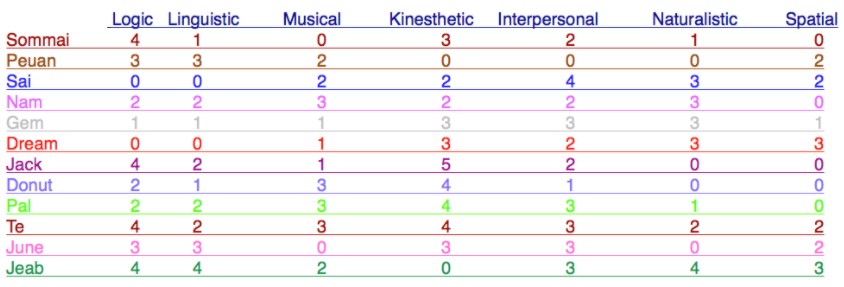
According to the number of pictures chosen in each category, it was possible to produce an initial intelligence profile for each student and of course an overall view of the differences between the students. However, it should be emphasized that this kind of method was only used as a starting point for the process of getting to know the students in the classroom. I found that constant observation and evaluation were regarded as two of the most important factors for my teaching-learning process. These factors were essential to my attitude in the classroom at all times.
To commence the evaluation of my research I must say after some observing of the class I changed my initial thoughts that I had had for the lessons. I had planned to find out about my students learning traits during the class. I must say now that there can be too much information to take in. I was observing the students and trying to take in their distinct attitudes to do with studying. I realized that during the lesson and every lesson following that it would be better to try and concentrate on one intelligence so I could get information easier. This is different to my initial thoughts that were in a way observing most intelligences during the class. There are a lot of features in the classroom and also from the students during the lesson. This can overload a teacher and result in the teacher not following the research path to its accurate conclusion.
The first weekend with the class was a good way to get to know the students to see how my research plan would work. Even at the start, I got an idea of how the students were, not only the reserved ones but also the confident ones. Their interpersonal skills were already showing because I generally just say ‘hello’ and ‘nice to meet you’ and some students did not want to say anything but others happily spoke to me in their limited English. I noted that they already had shown me some strengths in their character. I noted the reserved students’ names to check for a change during the duration of the term. The lesson already made me well aware of the fact that the classroom was full of students who were different from each other in many ways. I soon come to realize that constant observation and evaluation was going to be the most important factors in the teaching-learning process. These factors were essential to my attitude in the classroom at all times.
At the beginning of the class, the students grouped together, either they already knew each other already or the age groups was the same and they generally stuck together for the duration of the course. The age range of the individual groups was the same. I realized that each student had different areas of interest, different ways of expressing themselves, different strengths and weaknesses. I found that during the research I had to look at each lesson from many perspectives (teacher, observer, facilitator, researcher). I become aware that I was very much trying to perceive how each of the pupils’ knowledge of and skill in literacy and speaking became salient. Peuan, certainly showed me a change in her language that was brought on by her strong character. She was a polite lady and showed she could concentrate on the facts being shown to her. She was very logical in her ways. Her interpersonal skills were highlighted when she imparted her knowledge to others during the group work.
I tried over the weeks to get the class working together to help those not so confident individuals as well as other students to feel less inhibited to speak. I wanted each student to share his or her knowledge. Jeab certainly used her language when a student misunderstood a grammar point. She was one girl who enjoyed showing her knowledge. She was very verbal in the class. When we did the famous faces games some students did not hear the answers properly, Jeab assisted them with the correct answer. I did use her from time to time as a reference. Jeab was not alone, over the weeks I got a general feeling that the students were working together using their interpersonal and intrapersonal skills while using their new language. They were mixing with each other and generally seeing certain characteristics of each other that I observed. Jack, Donut, Pal, and Te showed their interpersonal skills. I was pleased that they did because it made the others feel relaxed and not intimidated. One time we talked about music and Jack did a hip-hop dance in front of the class that made everyone laugh. Jack was certainly physical and liked to be up doing activities. I could feel that the four boys were having fun with their English. A few times when I did a game that encouraged students to use their voice in front of the class they were vocal. June and Jeab took over at times they had a strong character. Jeab helped June but June still showed some well-presented language. They both worked out the objective of each task very quickly. I also noticed their verbal skills were excellent for this lower level. I put them into different groups after this to make the stronger ones help the others in their group.
Some of the students liked the games due to the fact that there was some logic. Sommai had a go at answering questions in front of the class. He was a little weak but he got the answers in the end. He was pleased he succeeded. He also lacked a bit of interpersonal skill so I had him sit next to Peaun, they together got the questions right in some of the games. I felt the need to be patient with him because he knew in the end. I observed some students enjoying realizing that they had the right answer after working it out from the facts said. For example, they had to work out who the famous person was by asking yes/no questions. Peuan, one of the older ladies impressed me because I had written the grammar on the bored and done all the vocabulary, and she asked perfect questions. She systematically went through all I said and gave the correct answer. I was inspired to help her and realize that she would be good for the class in such activities as a demonstration of conversations. I noticed her awareness of all that was said. She was logically minded and methodically followed all my teaching. On the other hand, Sommai got a little confused at one point. He did not know all famous people. Even people like Tom Cruise who you would think everybody knew Sommai did not. This was why it was good to have the pictures of the people because Sommai noticed a few faces with the help of the picture. This is definitely worth thinking about that not everybody in your class is as worldly as you may think. All the same, it is good for him to learn new things.
The overriding teaching approach I saw was the bodily/kinesthetic approach. This certainly gets the students’ interest. I tried to make these tasks as language orientated as possible not just a fun time. I noticed with Nam, the quieter girl liked the games and getting off her seat. She was a little weak and needed the practice. I noticed the first time she was in front of the class she made some mistakes and looked a little embarrassed but as the class moved on she became more confident. Her verbal skills also became more noticeable. I had her in front of the class a few times and she impressed me with her English. I think this was an inspiration for her friends.
One student, that my initial view of, changed, was Sommai. He was one of the older people in the class. He was a quiet guy and I felt as though he was a little unnerved that there were a lot of kids in the class and he was that bit older. He was a bit slower than the rest but would do all the work you asked of him. I worked out that he enjoyed the logical aspect of the lessons. The difficulty for me was the first few lessons I felt he did not understand and it was hard for him to follow. I persevered with my thought that there was a talent there and I come to realize after observations of him that he was enjoying the course I found that when he was tested logically he was pleased that he succeeded. His enthusiasm to be tested was not only one aspect that I noticed during the term, but also his second language usage.
The four younger guys, Jack, Donut, Pal and Te certainly become more moved to learn when their friends were up doing something such as a role-play. I also noticed when I put them on the spot and asked a question they were intrigued to know if their friend knew it. Of course, if their friend knew it they were happy but they weren’t unhappy if it was wrong. This showed their intrapersonal skills, as they had to overcome personal objectivity. I presumed that from their attitudes the guys were in the class to have some fun. I could have become a bit annoyed at their lack of willingness to study every detail but I found myself trying to find how they worked in class. For them, it was an awareness of their friends doing something. It certainly made them more conscious of their learning. The activities were language orientated so it made them learn better. I think they were more moved by the kinesthetic stages of the class. I certainly felt at times when I was doing board work that they were not showing as much attention as I would have wanted. Pal was a little bit more attentive than the other three boys; when I gave him something to do he was better. When we did the pictures for the birthday party, Pal’s drawing skills were better than the other guys. I became aware of these facts and tried highlighting them to his friends. When we were outside getting material he worked well and also when we stuck objects onto the paper he joined in. This I felt at times facilitated his friends’ awareness of learning.
I noticed Nam, Gem, and Dream were moved by games even though they certainly did not let their voices be heard. I found that in the naturalistic part of the class where we went outside they were very attentive. I did get a chance to have a longer chat with them and they certainly showed they were capable but they still grouped together. I felt they were a little pressured in class. I wondered at the time if I broke them up it would hamper or progress each one. It also makes me think that the class can be a bit intimidating for the students. They have to get used to new people and then they have to speak a foreign language, which for some scares them. I certainly had to help them a little with their interpersonal and intrapersonal skills. I noticed that with some students they were scared to make mistakes. When the students were in little groups they seemed to be able to say more.
This interpersonal contact was a definite plus to the class. I noticed a few students working well in groups. Peuan’s attitude in a group showed her skills of relating to other people. I observed that she understood the task and worked with others to achieve the goal. I put her with Sai a few times and they worked together very well. I observed them laughing a few times when Sai finally understood after Peuan told her. Sai certainly needed all the help she could get which very much included the visual aspect. I also noticed when I had the students in two rows talking to the person opposite; Sai, Nam, and Gem used their verbal Linguistic skills. This was made easier by having to talk to more people as the row moved. I noticed that they saw that the other students were not finding it easy and they realized that. I think it could be said that their perception of other students’ language may have not been right. They certainly had the inclination in them to use and learn English.
I observed Sai who I noticed was having trouble keeping up at times in the class. I listened to her a lot and she was trying but the wrong words were coming out. She seemed to struggle in most methods I tried. I felt as though she needed more verbal Linguistic practice. She was helped by the visual aspect (picture and whiteboard work) though and showed she needed lots of material to help her understand. In this case, the research made it easier for me to discover which areas of intelligence needed to be developed during the course
I think with this research I got a better appreciation of my students. I feel as though I have a lot to write about with the students and how they behaved in the class. It seems as though I was interested in all the classes, not just the ones who showed some interest and were noticeable. I felt as if I was trying to find each individual talent to get them motivated. Even Nam, Gem, and Dream who was challenging, I had faith in. I knew they would show me somewhere along the line that they would join in and show us me they could prove themselves. Outside, in the natural environment, they proved that point.
I certainly found out that all my Thai students were certainly not actors, but were willing to take part. This is something that is good to see. The energy from the students in certain activities was commendable. We played charades and they were a little shy, but they still attempted some of the adjectives. I must say to see the class work together and having fun was enjoyable to watch and of course, use their new language to try and guess the answer. For instance, the letters game where they had to make the word (noun) with the letters on a card, certainly had them battling away with a heightened need to learn. They were shouting the letters at times with their eagerness to get the answer. To have the groups working as one was an example of an Interpersonal skill that helps build character and stresses the importance of group work. They became actively engaged in the learning experiences that were pleasurable. The main factor was that I observed them using their second language plus the grammar and vocabulary that was part each of the lessons. I come to appreciate that the exchange of knowledge not only helps the students but also the teacher. I also found that when they went outside to find the materials, shapes, and color, their approach to learning was more aware and there was less of a focus on studying hard, it seemed to come more naturally. The attitude between teacher and students was actively engaged on the task at hand. They asked more questions and I felt as though I could approach them all easier when we were outside than in the confines of the classroom.
I also found that when I invited them out in front of the class they certainly felt excited to watch people trying. I think again it is the interpersonal aspect that is important in the class. A teacher needs the class to bond. I spotted a few students, for example, Peuan and Jeab who were not shy and very ambitious with their learning. These ladies were good to focus on when demonstrating a language point.
Regarding the game, I played where they had famous people to ask about. I certainly saw the students using the grammar I had taught them. The only thing was that the stronger students were trying to take over. Students like Peuan, June, and Jeab were notably verbally stronger. I got them into groups and got each group to ask. There were about 20 famous faces to remember. They certainly remembered all of them. At times they found that they knew the answers a bit quickly but I was listening to their grammar and vocabulary. As soon as they knew they would ask questions that related to that person. This showed the initiative of some students.They enjoyed it when they suddenly realized who the person was. I noticed the ones who were quick to listen to the questions and figure out the famous person from the yes/no answers. You can say that there was a bit of logic in remembering all the correct information and placing it against one famous face. You can also say the verbal linguistics were helped with all the questions and answers that they said and heard.
The video certainly made them laugh which made the experience enjoyable for all the students. It also helped the group enjoy working together. One person in their group wrote the answers so all the students were joining in. I noticed Sommai was writing the answers for his group that I was encouraged by. I remember I mixed up the groups so they were with new people. This made it more satisfying because they did not have a problem with it. The use of video with the students certainly was interesting for them. They had to watch while they were logically working out the sequence of events. It certainly showed how some students can work. Donut enjoyed the video and read out the answers for his group. This was him at his best. I was enlightened by the group’s learning capacities during this process and the language they acquired from it. It was also fascinating to watch the interpersonal contact. I noticed the groups making sure that they were doing the process right. I think the bonding of the group makes the learning experience better.
It was also the individual characteristics that I noticed in all the students that could be said to be the most fascinating. You could see how each student was acquiring their new language. For example, Peuan would methodically go through everything I did, and precisely tell me what I wanted to hear. It was this strength that I tried to encourage. Then there were other students such as the group of lads who would just try without really getting the grasp. All the same, they were both trying
I think it was the language proficiency goal they had. They had an objective. I think their language acquisition would not have been achieved if they did not have an objective to reach. I think that the bonding and generally relaxed atmosphere during my observations certainly helped to bring out the best in the students. Once the students saw individual students trying they had more admiration for them.
Summary of results
I certainly found, through the results taken which were fundamentally to see an expression in the student’s character and talent, that I became more aware of my students over the research period. The activities I used, I can say that I saw the students in a different light. For example, I found that the logical games where they had to ask questions to find out who the person was, certainly showed how much they had learnt with regard to their intelligences. It showed the teacher which students had the positive learning aspect. This, in turn, showed me they were learning their new language.
On the other side, I also can say that the research highlighted students’ weaknesses. Of course, there were some students who were good at using their voice, which is paramount in class, but these students seemed to fail on other aspects, such as acting. This, of course, made me more aware that I needed to blend in the strong students who showed promise in one intelligence area with the weaker ones in that intelligence. The grouping, of course, was changed when we had a different activity that was related to another intelligence. The reason for this was that it might end up dividing the class or getting groups sticking together if we had the weaker ones together. The research helped me this way because I found that I could see some students’ weaknesses easier. For this, I found time to help them with their problem while making them aware of their peers who could help. Of course, some students found some activities hard but with practice, there was no reason to say they would not improve.
I found the theory of intelligences allowed the students to view themselves and others differently, often from deeper, multiple perspectives. This, of course, resulted in the students seeing qualities of their peers that may be a normal lesson might not have. I feel I had resulting levels of heightened understanding. My goal was to build self-esteem and self-efficacy levels that could rise as learners become more aware of their own intrinsic gifts and talent. I feel that the students have developed a deeper understanding of the complexity of their talents as well as for the talents of peers, friends. It was shown that they worked together to complete a task. These were not only completed but also expanded on during the activity.
An overriding factor is that as a teacher I got to see the students with greater enthusiasm because I knew they wanted to learn but found studying hard sometimes. The students, for me, are now potential talented people instead of another group of students. This thought, I feel will be my priority to have better confidence in the student’s abilities. This can result in their latent endowment empowering them to succeed in their second language where their belief could have been dampened due to ordinary teaching techniques. It is my opinion that MI can be used in school studies and can be used for worthy second language education.
References
http://www.developingteachers.com/articles_tchtraining/multi_intell_rolf.htm
Starting with multiple intelligences – activities for foreign language teachers
by Rolf Palmberg
http://www.howardgardner.com
A Multiplicity of Intelligences: In tribute to Professor Luigi Vignolo
© Howard Gardner, 1998/2004
An earlier version of this article was published in the SCEINTIFIC AMERICAN, 1998.
http://www.pzweb.harvard.edu/
How Education Changes: Considerations of History, Science, and Values
Howard Gardner
http://www.pzweb.harvard.edu
HG Interview w/SN Larsen, Version May 20, 2002 1
HG Interview w/Steen Nepper Larsen on January 30, 2002
Version June 5, 2002
http://www.pzweb.harvard.edu
MI After Twenty Years
Howard Gardner
http://www.pzweb.harvard.edu
Howard Gardner
Mind and Brain: Only the Right Connections
Review of What Makes Us Think?
Jean-Pierre Changeux and Paul Ricoeur
Princeton University Press, 2000
By Howard Gardner
Draft: July 2000
© Howard Gardner, 2000
http://www.howardgardner.com
The three faces of intelligence
By Howard Gardner
http://www.newhorizons.org
My Experience Using the Multiple Intelligences
by Nelly Ribot
http://www.pzweb.harvard.edu
The Ethical Responsibilities of Scientists
Howard Gardner
http://www.newhorizons.org
Multiplying Intelligence in the Classroom
This article was previously published in New Horizons for Learning’s On The Beam, Vol. IX No. 2 Winter, 1989 p. 7 :167
by Bruce Campbell
http://www.newhorizons.org
INTELLIGENCE IN SEVEN STEPS
Howard Gardner, Ph.D.


