Second Language Teaching
Classroom based report on Second Language Learning
(11970 Words)
Abstract
Learning any second language can be challenging. Lower level students, who are new to learning, are those students that need all the support and understanding for their acquisition of a new language. For this paper, I have produced a research plan for a new class of lower-level students. This was devised to create thinking on how students were learning their second language. I wondered how I could facilitate their learning and their classroom experience that would help make the English language easier for them to comprehend. My initial thoughts were on using as many different ways to reinforce a language point. My thinking was that if the students get to look at a specific grammar/language point, whilst using it and thinking about it, in different ways, the language will stay in their memory that much easier. I felt that if you used the language in various ways such as activities, methods of teaching, and games, their possession of the language could be helped.
I looked at my ideas for lesson plans and checked how I planned to use the time in class to vary my methods. I also looked on the internet for any information that would correspond with my area of interest. I tried reading as much material that honed in on my specific area of interest. This was the material that was related to different methods and activities. It was while I was acquiring my new knowledge that I got to read about an interesting theory where different activities were used regarding multiple intelligences. This I found on a website called ‘developingteachers.com’. The article in question that took my interest was called ‘Starting with multiple intelligences – activities for foreign language teachers’ by Rolf Palmberg. I immediately realised this article was very much linked in with my ideas, that I had proposed. I did a lot of preliminary reading on the subject until I felt that I should put my old and new ideas about how to get the students speaking more into effect. This paper and the theories within is helped by what I found from the initial article by Rolf Palmberg and increasingly by reading about American psychologist Howard Gardner who developed ‘The Theory of Multiple Intelligences’ documented in his book Frames of Mind: Theory of Multiple Intelligences.
Howard Gardner proposed that at least seven distinct intelligences exist and that individuals/students possess all seven intelligences at different levels. I was interested in finding more ways to enhance the students’ aquisitional powers of language. I realized that Gardner’s ideas suggested that all individuals have personal intelligence profiles that consist of combinations of seven different intelligence types. It had a notable resemblance to my original idea of different methods to help the students’ study of language. This is in such a way that some students are just not suited to logical learning while some prefer to be taught more kinesthically. Gardner actually speaks of eight intelligences. These include verbal-linguistic, mathematical-logical, visual-spatial, bodily-kinaesthetic, musical-rhythmic, interpersonal, and intrapersonal (Gardner 1983, 1993), all of which are used in my research and further explained later.
This leads me to different methods I wanted to utilize in the classroom related to multiple intelligences. This involved pictures, actions, writing, listening, talking, and group work to name a few. I wanted to see if this theory actually produced more results in the classroom. This theory could also see if more results were still needed in my teaching studies, post research. At least from this overall plan, I could figure out how it helped my teaching. I also thought this idea would be suitable for a lower-level group. Notwithstanding, when you teach a lower-level group at least you can judge their English level because in all respects I would be starting afresh.
Rationale
So, from my initial inquiry into Gardner’s theory and how different formats for the students would help their language acquisition, I increasingly become encouraged by cognitive-contextual theories. This theory deals with the way that cognitive processes operate in various environmental contexts. There are two of the major theories of this type. They are that of the American psychologists Howard Gardner and Robert J. Sternberg. To explain Gardner’s theories a little more in detail, if we presume that each student has different learning abilities and each can acquire language but in different ways, we can say that intelligence comprises multiple abilities. Each individual has their way of studying. We can break down these abilities/intelligences, into categories that a teacher can be manipulated into their lesson plans as helping to achieve more from the individual students. Gardener’s ideas are far-reaching but from the perspective of the classroom for my classes, I was trying to nurture the talents that each student holds helping to produce better language acquisition. It is and was my focus to exploit these talents that will and would rise to the surface. This, of course, means using differing structures in the class that will in time show the teacher how students are developing as a group and individuals.
A ‘multiple intelligence (MI)’ example is bodily / kinesthetic. This is the theory that can be used to encourage students to prepare role-plays or dramatic plays. It gets them off their seats mixing with other students. Some students will excel with this format. These kinesthetic types of people are strong in acting, using tools, athletics. They like to move around, touch and talk. This, when used in class, gives the students social interaction. This is especially good for the Thai students, I had, who loved getting up and being active. It gives them a chance to present language material to their peers while appreciating the use of this language. The students can take any conversation and use the essence of it to translate the ideas into movement.
It is hoped with this theory as a teacher I can use the knowledge gained about intelligences to spark some students into getting an understanding of language, which he or she might not get from other mundane methods. This will in turn help develop students’ language proficiency. It is true that some students can go through a lesson not realizing that they are leading somewhere. If the point is reminded to them in certain processes that encourage their talents to come to the surface, during the class they will hopefully come to realize and figure the lesson out. Hopefully, the additional stages of the lesson will be clearer to the student. It is up to the teacher to be capable of making these methods available for the students and recognizing when they comprehend the language. The teacher is trying to get the students to process all the information he has given, as for the students to formulate it and understand in his or her own way. The goal is to get the students to acquire language with the theory of multiple intelligences as a powerful support. It is a classic model by which to understand many aspects of human intelligence.
Furthermore, to give an example of a student’s intelligence, a student does poorly on the type of correlation question in a test. You could find that a possible conclusion is that the student does not reason well. Some teachers might think that the student is not capable. An equally plausible interpretation, however, is that the student does not understand the words or is unable to read them in the first place. A student seeing the analogy, valiant, faint-hearted, mollified, might be unable to solve it because of a lack of reasoning ability, but a more likely possibility is that the student does not know the meanings of the words. A cognitive analysis enables the interpreter of the test score to determine both the degree to which the poor score is due to low reasoning ability and the degree to which it is a result of not understanding the words. It is important to distinguish between the two interpretations of the low score because they have different implications for understanding the intelligence of the student. A student might be excellent at reasoning but have only a modest vocabulary or vice versa. This is how I propose to base my research on finding how the students react to certain classroom techniques. I want to see how they raise their understanding through certain tasks. Then you can see that every student does have a talent and is capable of learning their second language.
The school systems for these students often focus on a narrow range of intelligence that involves primarily verbal/linguistic and logical/mathematical skills. Most academic knowledge is presented for learning by means of an extremely limited (or limiting) methodology and the acquisition of that knowledge is evaluated by means of rote tests, whereby the best grades are assigned to students who demonstrate the greatest ability for memorization. It is the idea that there is single intelligence. It is this narrow-mindedness that teachers should come to realize. Multiple Intelligence theory should expand lessons to new places with experimenting. This experimenting with students’ inner intelligence can be multiple. This can include at a minimum linguistic, logical-mathematical, spatial, musical, bodily-kinesthetic, interpersonal, and intrapersonal intelligences. The teacher will come to realize that each individual has their own talents that can shine in the classroom and other students will come to respect.
Hypothesis
My initial thoughts were on expressing, in this paper, the lessons I had taught over a six-week period. This would show how through my lesson plans that the lesson flowed with various techniques used in many activities to help the students’ second language progress further. My ideas, as mentioned, changed more to expressing the potential in each student in the many activities and especially how the activities were managed in what format. The question was: how does each student react to the different methods of teaching? Also, I wanted to know: what cognitive capabilities do the students show during different formats of teaching? The premise was that all the students in the class have certain intelligence; it is the teacher’s job to find that potential intelligence. It was recognized that no two students in the class are the same and study the same; they all have strengths and weaknesses. These strengths and weaknesses were what I had to be aware of when trying to relate Howard Gardner’s MI theory to their language acquisition in class. I realized that my paper would move onto looking at the multiple intelligences of students during studying and my logical conclusions from my observations of them.
I hope to show in this paper that by expressing each activity and noting its use related to MI, I can show that Howard Gardner’s theory of intelligence can relate to teaching and education in a positive way. The methods learnt from studying Gardener’s theories will heighten any teacher’s teaching skills. I think that varying activities in the class call on the students to use different intelligences. My only worry was the students coming from the school system might not fully appreciate my methods and the research may take longer.
The time I had for the research showed me that I must look at my knowledge I had of the class to be taught. I had taught this level of class before so the norms of teaching came from what I had already known from my teaching of this level beforehand. The idea for this level was that I was going to teach and research. The criterion for this level of students can be judged by methodically going through their English student’s book making sure you have at least done the best to get the students to speak and cover certain topics. This may overlook the potential in some students. It could be true to say that a teacher can get caught in a trap of teaching the same material as before while not expanding and changing teaching skills to suit each student in the class. This is not to say that the lessons before were nondescript, the potential of this new idea, is that through the methods related to MI, a teacher can see the students’ language development advancement clearer. The underlying question is: how well does using Gardner’s theory help to make the teacher see their lesson planning and students’ productivity expand? This proposition will challenge and expand the teacher’s knowledge and give a broader outlook on teaching and the students being taught. The problem is: will the students actually show their hidden talents that these activities will hope to bring out? I am pursuing a meaningful understanding of each student and their talents. This is to see that a student who, for example, is shy. Each student will show the teacher or his or her peers that they are trying and succeeding. The student is also proving to the teacher that he or she is worth worrying about and there is a talent waiting to come to fruition. So, my objective was that I wanted to use the MI theory as a tool to help my students speak their chosen second language and not to be used as the overall goal.
Parameters of study
My inquiry was over a period of 6 weeks. This included six units of study material that I wanted to cover to give the students a comparatively introductory look at the workings of the English language. This would be done with the imperative notion that they would acquire basic language knowledge. My goal was to see how the student’s language proficiency improved over the term period, due to the theory associated with multiple intelligences. One of my main concerns was actually getting the students in the class to try to express their newly acquired language. I wanted to use a system where they were not bombarded with facts. I felt that they should only learn so much, which would be used in different ways in the class. This would stick in the memory more than being overloaded with material that would hamper their acquisition of their second language.
I have noticed sometimes that basic level students can be a bit reserved to show their language to its fullest. This is how the parameters of study were involved in the research project. I had to make use of my knowledge of multiple intelligences in the classroom in which the students’ intellectual leanings had an opportunity to be utilized and practiced. Only then could some kind of meaningful assessment become possible. I not only wanted to observe each individual student, but also the group as a whole. I wanted to monitor how the students used their new language with the different methods of teaching referring to the eight intelligences. Remember that it is not only one bright student that will help the class but also different students in the class who exceed the norm in different areas of their knowledge. I wanted to see how students worked on their own, in pairs, and in group work while expressing their language. An objective was to get the whole group to work together as one, this would help make the class proceed and generally help others reach the same language goals. This certainly involved their Intrapersonal, Interpersonal skills. My idea for the class was that all these objectives would aid me in easily creating more personalized and diversified instructional experiences. The use of multiple intelligences idea in this class was used for more effective pedagogy. I feel that the educational power of multiple intelligences will be exhibited when intelligences are used to master disciplinary material.
The students in this research class were, as said, of a lower level of English language. This, of course, does not mean that they entered the classroom completely new to English, They already had learnt some English and were familiar with some grammar. The only thing that hampered the research project was that they had to get used to the way that they were taught by a foreign teacher. Usually, the case is that they were taught English at high school and are not used to speaking their second language. This could be a completely new environment for them. For this inquiry, their studies involved getting the basics of the study of English.
Normally at our school, we start them off with the verb ‘to be’ using questions and statements. We then go onto the present simple verb that is also used with the questions with do or does. Various structures are used around the present simple tense. The focus over the six weeks was to have them become as familiar to this grammar as could be done. This also considered the fact that they must become relaxed with using this new material, which means becoming relaxed with the teacher as well as their peers. There were 12 students in the class. The ages ranged from 16 to about 35.
Furthermore, in the class, there were mostly students from 16 to 20 years old. The class had the usual groups of friends that come together. My ideas were that I wanted them all to work together and to bring them together instead of these little groups sticking together. This would hopefully let the students become more relaxed that would help them show their talents. There were, of course, different characters in the class. There was a group of 4 boys about 16-17 who came together; their names were Jack, Donut, Pal, and Te. There were 3 rather quiet girls who came together their names were Nam, Gem, and Dream. There were 3 older people, a man, and two women, who came alone; their names were Sommai, Peuan, and Sai. There were also 2 girls who were about 22 – 25 years old, their names were June and Jeab. They came alone but grouped up.
The initial thoughts were of getting the students doing certain tasks that would get them to know each other better. This was straight away coupled with the need to get them to concentrate with the teacher’s instructions. It can be a good idea to get the students to do group bonding activities at first but you can forget that you are dealing with a group of students that are maybe not conversant with the way your school or you do your teaching. I immediately noticed the group of four boys who sat together. They were innocent enough but had that bit of street attitude. Nam, Gem, and Dream were the group of three quiet girls who I found out came from a school that I also taught at. This school was a bit out in the country so their exposure to native speakers and other learning groups may have been hampered. Anyway, they were kind of shy. There were some others that showed signs that they were capable and looked ready to learn. Peuan certainly showed signs that she was ready to learn. She sat upright and smile as she said ‘hello’ with vigor. Sai was one lady who was a bit older but showed signs of being a little puzzled. Sommai I found at first a little reserved. Jeab and June gave that look like they were ready to learn. Mostly all the students were not used to the native speaker and lacked talking regularly with one. I appreciated the fact that this could have been their first time with a native speaker. This was no discredit to their language.
At first, they all acknowledged me with a grin and a hello. There were the ones who showed they knew something and were not scared to prove it. Jeab and June started speaking their second language, trying to show they already knew something. So my job was to bring these characters and personalities all together
The target language to be used during the six weeks was the Present Simple tense, which included third person singular. Students were expected by the end of the six weeks to have the basic knowledge of English through the present tense.
Research plan
To begin the research plan, I first beforehand drew up a checklist that showed the eight intelligences I was working with, on it. This was a guide for helping me with each lesson plan. I added the meaning of the intelligence just to help me make sure I was heading in the right direction. It was not as if every intelligence has to be used in each class. It was important that I used them all over the six-week period. It highlighted for me a major point regarding which certain multiple intelligence I was trying to adhere to, during the class. I also kept a diary that I had with me for most of the six weeks. I found that ideas would pop into my head at irregular times and I needed to write them down.
1. MULTIPLE INTELLIGENCE: Logical Mathematical
MEANING OF INTELlIGENCE : Problem solving: logical thinking, detecting patterns analyze problems, understands relationship between cause and effect towards an actual outcome or result
ACTIVITY (Plan – do what?)
2. MULTIPLE INTELLIGENCE: Visual Spatial
MEANING OF INTELlIGENCE: Visual aids, pictures, flashcards: visual and spatial perception; interpretation and creation of visual images; pictorial imagination and expression; understand relationship between images and meanings
ACTIVITY (Plan – do what?)
3. MULTIPLE INTELLIGENCE: Musical
MEANING OF INTELLIGENCE: Songs, rhythmic patterns, poetry: musical ability, awareness, appreciation and use of sound; recognition of tonal and rhythmic patterns, understands relationship between sound and feeling
ACTIVITY (Plan – do what?)
4. MULTIPLE INTELLIGENCE: Verbal
MEANING OF INTELLIGENCE: Linguistic Reading, writing, speaking, and Conversing: words and language, written and spoken; retention, interpretation and explanation of ideas and information via language, understand relationship between communication and meaninG
ACTIVITY (Plan – do what?)
5. MULTIPLE INTELLIGENCE: Bodily Kinesthetic
MEANING OF INTELLIGENCE: Physical coordination: body movement control, manual dexterity, physical agility and balance; eye and body coordination
ACTIVITY (Plan – do what?)
6. MULTIPLE INTELLIGNECE: Naturalistic
MEANING OF INTELLIGENCE: Understanding the natural world: Observing the natural environment, interpretation of the world
ACTIVITY (Plan – do what?)
7. MULTIPLE INTELLIGENCE: Interpersonal
MEANING OF INTELLIGENCE: Pair work, group work, peer sharing, discussions: perception of other people’s feelings; ability to relate to others; interpretation of behaviour and communications; understands the relationships between people and their situations, including other people
ACTIVITY (Plan – do what?)
8. MULTIPLE INTELLIGENCE: Intrapersonal
MEANING OF INTELLIGENCE: self-awareness, personal cognisance, personal objectivity, the capability to understand oneself, one’s relationship to others and the world, and one’s own need for, and reaction to change
ACTIVITY (Plan – do what?)
I also made up a feedback list for each activity I did in class. I wrote in this when I had a chance. This was either during the break, after class, or making little notes during class.
Lesson: Subject:
Multiple Intelligence How did they react? Students names
Logical Mathematical
Visual Spatial
Musical
Verbal Linguistic
Bodily Kinesthetic
Naturalistic
Interpersonal
Intrapersonal
These two checklists above were referred to during every lesson preparation. The goal was to highlight the areas I was working in. This was to find out how the students reacted to the techniques I was using in relation to Gardner’s theory. I kept a diary of each lesson and tried jotting down notes as I went through each class. I set up my lesson plans where students would be able to express themselves in each activity.
To begin I knew that the students were of a lower level so I wanted to have an initial test for the students at the start of the class. This could give me an idea of their interests. This involved using pictures to gain some insight into their preferences. I numbered each picture from 1 to 35 and spread them over the table. I got the students to pick the photos they liked. I had a sheet of paper for each student with the numbers 1 to 35 on it and I got them to tick the box number that corresponded with the picture they liked. I got them to add up the items within each intelligence and record it as a total for each intelligence. This below was my way of scoring.
5 items per intelligence.
1-5 Logic
6-10 Linguistic
11-15 Musical
16-20 Kinesthetic
21-25 Interpersonal/Intrapersonal
26-30 Naturalistic
31-35 Spatial

WEEK 1
This lesson focused mostly on using their second language to introduce themselves and ask general questions when first meeting someone.
We started with a name call (Verbal Linguistic) and each student went along the row saying their name and another student’s name and the following students had to remember more names as we went further along the row. The grammar that was used entailed: His name is john, Her name is Jane, my name is James, etc. We also went back along the line with their name plus an action such as: my name is john + (action) scratch my head. Again the students had to remember names and actions as we went along the row (Logical Mathematical). It was a fun start to the term
Of course, the first weekend, where no one really knew each other, was a good way to take an initial look at the student’s intrapersonal and interpersonal skills. The students can be a little reticent, with this lesson being their first day, although with an interpersonal theme to start the term, the students do have it in them to join in with the group.
The theme of the first unit was introductions so this was a great way to start with new learners. I had a task where students could have questions and answers to do with introductions.
My first idea was to give them each a picture of a famous person (Visual/Spatial). These were pictures of famous Thai as well as international stars. I wrote on the board, age, job, name, and country and elicited the questions from them and wrote them on the whiteboard (Visual/Spatial). Of course, these were practiced and pronunciation checked. I tried to set up the class where their intelligence was being used. I made them use notebooks I wanted them all to have something to refer to. The whiteboard had all the grammar/vocabulary needed so far, for the task. I had first given them the pictures of famous people to create curiosity. I questioned the students using a picture example of my own. I initially used a picture that was obvious to the students, one that they would know the answers.
The teacher’s job now was to try and elicit the grammar/answers from the students and not present it to them. There is the logic (logical) that if you make it a little difficult for them and let them try to find the answers you can gauge some of their knowledge. So I asked the question and they tried to answer. This, of course, did not get everybody joining in but once the grammar was established and written on the whiteboard; it was chorally identified and repeated by the students. I was methodical in my process checking every student was at least saying something. I remembered that we were at the initial stage of the term. I then got the whole group to ask me about my picture and I answered them. We had now set up a pattern. I then got the students to write their answers to their famous face pictures in their notebooks. I went round checking their answers. This took a few minutes and I checked for any mistakes. Once this was finished I set up a pair work exercise where they used the questions and answers highlighted before to ask and answer each other. This gave them practice with their new vocabulary and a new process to try their language. Once again I watched the students in action and helped with any problems.
My plan was that I would try and develop their language by using a different process. So, I got the students off their seats and into two rows. The process involved the students asking the same questions from the whiteboard but having different answers from the different people (Verbal/Linguistic) in the rows. I was still trying to give them practice with the initial grammar I wrote on the board. This certainly got them off their seats and having to use the grammar I taught them so far. You will find that some are not sure but others will help them as they go along the rows. Every student got to talk with every student. They then returned to their seats. I then got them to change the photos and said to them we would have a little party and got them to be the person in their photo. I modeled the conversation using an introduction and goodbye. I then got them to say their information (Verbal/Linguistic) about the famous person while they also asked me about the famous person I was being for this role -play
A logical continuation was added to this lesson that would show the students the use of statements that could turn into yes/no questions. “He is from Thailand’ – ‘Is he from Thailand?’ I wanted to use the grammar already learnt from the exercise before and expand on it. I was trying for the students to get the meaning on their own at first. I set an example on the board and asked them to think about it in pairs. I looked to see if they could get it in their pairs. This new grammar point I got them to write in their notebook. There are always a few brighter students that for a lower level still seem quicker than the rest. But I let them have their say while checking that the weaker ones at least tried. There are of course students that get your meaning and the flow of your class but also there were weaker ones this was realized and noted down with their names.
I used the initial pictures of famous people and the new material to establish the new yes/no question clearer. This, of course, showed me how well certain students had acquired the language so far. This process was repeated. I now put all the pictures into an envelope and got one student out to the front of the class to secretly pick a photograph out. I actually took each student outside to check he or she knew the answers. I now wanted the others to ask yes/no questions (using ‘is he/she?’) to find out who the famous person was. If the teacher has methodically checked the processes so far this question answer should not be a problem. I got them to work in groups of three (Interpersonal) to ask one person a question about the photograph they had. This made them start using this new language and allowed them to recognize the switch of subject and verb that can make a yes/no question with the verb to be.
This process can go on until the teacher sees fit that the students have recognized the grammar and vocabulary. Of course, it could have been a little easy but all the same, there were a lot of faces to remember (Logical), This stage is bettered by the work they put into the initial stages where they get information from their peers’ pictures. This is, of course, the idea that all these stages will be interwoven and able to help them acquire the language quicker and easier. And such they had to use grammar (Verbal/Linguistic).
To conclude this lesson I made the students write about themselves using the same initial questions name, nickname, age, country, job. Once again I got them to ask their partner then the whole group. I had a feedback session at the end to see if the students had remembered their new classmates’ names.
Week 2 Describing People
In this lesson I wanted the students to work in groups. I was looking for their skills of working together to reach an objective.
My first thoughts are always to get the students thinking about English to see how much vocabulary I can get from them. It is an initial way to get them thinking instead of giving them the answers straight away.
For this lesson I got the students to try and describe myself, the teacher. I used hand movements to help describe tall, thin, handsome, and strong. This helped the students. I made a spider’s web on the board and elicited as many characters or personalities adjectives as I could. I wrote some more adjectives on the whiteboard to describe people for the students to think about. I then arranged the class into four groups (Interpersonal). I handed out a worksheet that I had made, to each student with different pictures of people (Visual/Spatial). This worksheet showed six people: a friendly person, a tall person, a handsome man, a fat man, a serious man, and a shy girl. I got each group to work together (Interpersonal ) using the words that were already on the whiteboard. I then had them choose which adjective best described each picture. After that, they had to write an adjective under each person on the worksheet. They had to work as a group to come up with the adjectives for the pictures of the people. I gave them a certain amount of time and then we went through the answers using the question: What is he/she like? This gave each student practice with their new words (Verbal/Linguistic).
The grammar and vocabulary used was:
What is he/she like? He is nice, friendly, handsome, etc.
To add weight to the acquisition of the adjectives for describing people I told the four groups to write about three people in their class, using the personality and characteristics adjectives (Interpersonal). I first used one student to highlight what I wanted them to write. This gave it a personal feel; it gave the students a chance to interpret the moods of other people, their facial expressions. It gave them a chance to demonstrate feelings. It also affected the feelings of others in a planned way when they read out their descriptions. I played a game with them that when the description was read out by one of the groups the other groups had to listen and think who the person was. This gave them some listening practice. Of course, when they read out the descriptions there was a certain understanding (Verbal Linguistic) of what is being said.
Furthermore to their clarification of adjectives to describe people, a recreative approach was used. Playing charades was this lighter side to the learning of these adjectives and a generally less formal way to emphasize the character and personality words. I organized the students into two teams and brought one student at a time out to act (Bodily/Kinesthetic) the adjectives in front of their chosen group. I allowed each student 1 minute to act/demonstrate as many adjectives as they could without speaking. The group had to understand the acting and work together (Interpersonal) to get the correct answers. Once they knew the answer they shouted out. This was a fun way to learn and the game got the students off their seats. The process was repeated and used, as some students did not possess the ability to act that well, a fact that was noted. This is not a problem as the students enjoy the other students trying. All the same, the group still shouts out what they think what the adjective might be. This process was repeated as it took a bit of time for them to comprehend the acting but the further the activity moved on they learnt the body movements and facial expressions for each adjective much better. This gave them the power as they moved on to shout the correct answer (Verbal Linguistic) quicker and this was the game. I calculated the scores for each team at the end and had a winner.
Week 3 Nouns
This lesson focused on the students using their skills to recognize objects and be able to refer to them by name. There were three stages to this lesson. First I wanted them to recognize pictures of objects, and then I had them up off their seats working in a team. To finish I had them draw and present their ideas.
The theme of this class was to teach the students about nouns (singular and plural). I got the lesson underway by writing on the board ‘what is this?’ I had a picture of an object in my hand and I asked the class ‘what is this?’ I made it easy at first so as I try to elicit the initial vocabulary to write on the board. I then showed them a picture of something I knew they would not comprehend, this of course had a few of them saying in their own language ‘ I don’t know’. So I wrote, in English, on the board ‘I don’t know’ to help. I then handed out to each student a picture of an object (visual spatial). Then I instructed the students to ask their partner the questions from the whiteboard and get the answers to what object they were holding (Verbal Linguistic). I went round the pairs of students checking they were using the correct grammar. I then got them to stand up and ask and answer all the people in the class (verbal linguistics). A few students did not know the answers and I showed them the grammar on the board and got them to say ‘I don’t know’. This is a good exercise that gets them to mix with their peers and the teacher (interpersonal). There were going to be some pictures that the students did not discern, this gave the students a chance to ask me, the teacher which was useful for getting familiar with their second language speaking while getting accustomed to the teacher as a helper. I went through the words and checked pronunciation and spelling. I then got them to swap their picture with another student. I then had them up again asking and answering their peer about their pictures. I gave them 1 minute then they swapped again. This process went on for 5 minutes that included five changes of pictures.
I wanted them to remember the nouns we were studying so I made up three sets of the letters, which had all the letters of the alphabet on them including some blank cards that were used for words with more than one of the same letter (book). I then got 4 groups on the floor (Bodily/Kinesthetic). And then I proceeded to show them the nouns we had already distinguished in the exercise beforehand. The object of the game was for the group to spell out the noun with the letters they had. They worked together and the quickest group got the points.
The final stage for expressing the nouns they had learnt, involved a role-play (Bodily/Kinesthetic). I had a conversation from a book that had two people giving presents to someone on his birthday. I went through the picture they had, eliciting names of objects and what was happening, to help the students grasp the topic. Then, we had a listening task where I gave them a copy of the conversation with some words missing. They had to listen and fill in the words. We went through the answers and practiced the conversation.
I then found out whose birthday it was next in the class and then said we would have a birthday party. I said to them that they would be giving presents. I gave them a sheet of paper and got them to draw (Visual Spatial) their present, which related to the nouns already studied. I went around the class checking their drawings. I then had the students up in from of the class, giving their present (picture) to the one whose birthday it was. I had them use their new language learnt from the conversation (verbal linguistics) that included nouns.
To finish the lesson off I had all the class singing ‘happy birthday’ to the girl.
Week 4 How much
This weekend we were doing materials, colours, and sizes to do with shopping. The theme of the unit was using ‘how much?’ to do with shopping. This mixed in with nouns we had used the weekend before. This time I wanted them to go outside and look at the world around them (naturalistic approach).
Referring to my checklist I thought a good idea for them to find some materials that would be best observed in the natural environment. I proposed a treasure hunt kind of game. The idea of the game was that the students had to find 15 items. I gave them a list of words for materials, colours, shapes, and quality. I told them to get the items outside the classroom (naturalistic approach). This again was not taxing for them and an element of fun. The students broke into 4 groups then I sent them outside to work together to find the 15 items (Interpersonal). We had started on objects (nouns) the week before.
This outdoor method of teaching is a good exercise for the teacher to be a facilitator with the students. The teacher can circulate and use the specific grammar (and more) for this lesson while the students do not feel as though they are being rigidly taught their second language rather they feel less restricted. The exercise was relaxed and the students did not feel discouraged from using their language, in fact, they enjoyed being outside the classroom and spoke more.
The grammar and vocabulary used during was:
What (shape/quality/color)/size) is this? It is………
What (shape/quality/color)/size) are these? They are……….
What is this made of? It is made of ………..
What are these made of? They are made of ………..
Including: Shapes, sizes, materials, and colors.
Once the students finished collecting the objects. I got each group to present their objects to the class. This first involved writing about each object in their notebook. When they were ready two students from the group presented to the class. One student was speaking the other holding the objects for the class to see and understand. Example sentences (verbal linguistics) were: This is a leaf, It is green, This is a bottle, it is made of plastic.
The progression from objects was onto using nouns involved with shopping. I also felt for this subject the students should get used to prices. I found some newspapers, magazines, and door-to-door fliers that were filled with adverts for shops. So I proposed that the students go through the newspapers, magazines, and door-to-door fliers and cut out 8 objects and stick them on a large sheet of paper but the pictures had the prices missing (Bodily/Kinesthetic). The object the exercise was for each group to get the other groups to guess the answer to the price of the object. The students had to work in their group to guess the price this meant they had to work in their group to come up with answers.
The grammar and vocabulary used was:
How much is the …….(noun)? The ……(noun) is ……..(baht)
How much are the ……..(noun+s)? They are ………(baht)
Including: Nouns
Week 5 Adjectives
So, this week it was adjectives to be studied. The class at this level can be a bit hard to get started and also not used to getting down and learning. So, I proposed a good way to start the lesson off and also a good way to get them off their seats. It was interesting to see who were the quick starters in this game. This was a ‘find the adjective’ game (Bodily Kinesthetic). I gave a text with the adjectives missing from it. They had to find the adjectives that were posted around the room and fit them into the correct place in the text. This was a warmer to help them get the feeling of adjectives. This is a great lead into describing the subject of the day.
Once they had finished I wrote a number on their text. This was to say if they had finished first, second, third etc. Once they had all finished, I got some students each to read a line of the text (verbal linguistics). After this, It is good to get all the facts established regarding the text. I showed them that the adjectives describe the nouns. In the text, the adjectives describe one thing (the old grandfather) but I was leading onto comparatives. In the text, it said ‘the boy is young but his grandfather is old’. This led on to me showing the boy and the grandfather being compared. This got the students asking questions. They were thinking about the subject. The use of concept-checking questions is always good here. What is the noun, adjective, verb, and how many objects/things are we talking about? I showed them the comparative and showed the relation with an adjective to comparative. So, we had ‘the boy is younger than his grandfather’. I then used some famous things in their country to compare. I got them to ask each other ‘what do you prefer?’ For example ‘KFC is more delicious than Som Tam (Thai national dish)’.
To cement the idea of comparing I gave them a sheet with animal facts on it (Visual/Spatial) which could be compared with each animal. For example, there was a cheetah, which could run at 80kmh, and a Gazelle, which could run at 50kmh. The answer was a cheetah is faster than a gazelle. I got them to write out their comparative facts. This was good and the process ratified the use of two objects (animals) with the use of verb and comparative adjective between it. The sheet had enough animals so it allows the teacher to go around checking. It is great because I the teacher can notice mistakes and see which students really are showing some initiative to learn and understand. I actually got them to each read one out one sentence at the end and we all checked.
I then wrote on the board some example sentences like: Manchester United are better than Arsenal, Brittany is more beautiful than Tatayung and I am more handsome than Brad Pitt. I wrote on the whiteboard ‘what do you think?’ I then got them into groups and had them write 3 sentences about anything they wanted using comparatives. They then had to read them out to the other group. After they were read I asked ‘what do you think?’ I had already written on the board ‘I agree’, I don’t agree’. This gets them airing their views.
Week 6 Telling time and routines
This week I wanted the students to look at English in another way this involved watching a video.
The theme of the unit was telling time and daily routines. I thought I would have them watch a video (Visual Spatial). It was a Mr. Bean video of him going to the dentist. I said to the students you are going to the dentist, what do you do in the morning? I demonstrated with an example of cleaning my teeth. I had the students try and guess the acting I was doing (Verbal Linguistic). I then put all this vocabulary on the whiteboard making sure they also had the vocabulary needed for the video. I got them in groups and got them to put the ‘things you do in the morning’ in the correct order using the words from the whiteboard. For example the students said, #1 alarm goes off, #2 wake up. I then gave them sentence strips with all the actions Mr. Bean does in the morning. These sentence strips I made the students put into the order they thought was correct. During this whole process so far the students were using the language and becoming familiar with using it.
The exercise was a challenge for them because Mr. Bean does everything in the wrong order. They watched the video and checked what he does and what order he does it in. I got them to work together in their group to put the order of sentence strips in the order that Mr. Bean does it (Interpersonal). In the video, Mr. Bean also does actions at a certain time that I also got from the students. This set up the grammar and vocabulary for the class, for example, ‘Mr. Bean gets up at 8.00am’. To finish off the video I collected everything and then asked each group about Mr. Bean and what he does in the morning. This was just for checking.
To relate to telling the time I got them to draw a clock on the board and then two groups played a game where one student from each group had to run up to the whiteboard and write the time after I had said it. I continued the game with the 12 students and two groups (6 in each group). I cleaned the whiteboard and I got them all to go up to the whiteboard and write something they do in a day. I gave them each a time from 1pm to 6pm. I then said a sentence like ‘I get up at 6 o’clock’ and the people who are ‘6 o’clock’ have to run (Bodily Kinesthetic) and ring ‘get up’ with a pen.
Evaluation of results
The introductory task was to choose the pictures the students most liked. The results were recorded like this:
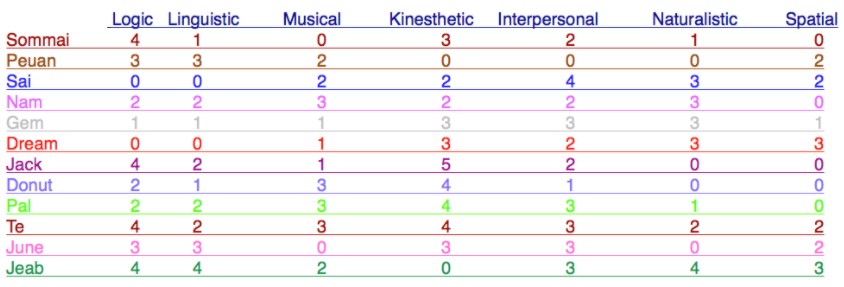
According to the number of pictures chosen in each category, it was possible to produce an initial intelligence profile for each student and of course an overall view of the differences between the students. However, it should be emphasized that this kind of method was only used as a starting point for the process of getting to know the students in the classroom. I found that constant observation and evaluation were regarded as two of the most important factors for my teaching-learning process. These factors were essential to my attitude in the classroom at all times.
To commence the evaluation of my research I must say after some observing of the class I changed my initial thoughts that I had had for the lessons. I had planned to find out about my students learning traits during the class. I must say now that there can be too much information to take in. I was observing the students and trying to take in their distinct attitudes to do with studying. I realized that during the lesson and every lesson following that it would be better to try and concentrate on one intelligence so I could get information easier. This is different to my initial thoughts that were in a way observing most intelligences during the class. There are a lot of features in the classroom and also from the students during the lesson. This can overload a teacher and result in the teacher not following the research path to its accurate conclusion.
The first weekend with the class was a good way to get to know the students to see how my research plan would work. Even at the start, I got an idea of how the students were, not only the reserved ones but also the confident ones. Their interpersonal skills were already showing because I generally just say ‘hello’ and ‘nice to meet you’ and some students did not want to say anything but others happily spoke to me in their limited English. I noted that they already had shown me some strengths in their character. I noted the reserved students’ names to check for a change during the duration of the term. The lesson already made me well aware of the fact that the classroom was full of students who were different from each other in many ways. I soon come to realize that constant observation and evaluation was going to be the most important factors in the teaching-learning process. These factors were essential to my attitude in the classroom at all times.
At the beginning of the class, the students grouped together, either they already knew each other already or the age groups was the same and they generally stuck together for the duration of the course. The age range of the individual groups was the same. I realized that each student had different areas of interest, different ways of expressing themselves, different strengths and weaknesses. I found that during the research I had to look at each lesson from many perspectives (teacher, observer, facilitator, researcher). I become aware that I was very much trying to perceive how each of the pupils’ knowledge of and skill in literacy and speaking became salient. Peuan, certainly showed me a change in her language that was brought on by her strong character. She was a polite lady and showed she could concentrate on the facts being shown to her. She was very logical in her ways. Her interpersonal skills were highlighted when she imparted her knowledge to others during the group work.
I tried over the weeks to get the class working together to help those not so confident individuals as well as other students to feel less inhibited to speak. I wanted each student to share his or her knowledge. Jeab certainly used her language when a student misunderstood a grammar point. She was one girl who enjoyed showing her knowledge. She was very verbal in the class. When we did the famous faces games some students did not hear the answers properly, Jeab assisted them with the correct answer. I did use her from time to time as a reference. Jeab was not alone, over the weeks I got a general feeling that the students were working together using their interpersonal and intrapersonal skills while using their new language. They were mixing with each other and generally seeing certain characteristics of each other that I observed. Jack, Donut, Pal, and Te showed their interpersonal skills. I was pleased that they did because it made the others feel relaxed and not intimidated. One time we talked about music and Jack did a hip-hop dance in front of the class that made everyone laugh. Jack was certainly physical and liked to be up doing activities. I could feel that the four boys were having fun with their English. A few times when I did a game that encouraged students to use their voice in front of the class they were vocal. June and Jeab took over at times they had a strong character. Jeab helped June but June still showed some well-presented language. They both worked out the objective of each task very quickly. I also noticed their verbal skills were excellent for this lower level. I put them into different groups after this to make the stronger ones help the others in their group.
Some of the students liked the games due to the fact that there was some logic. Sommai had a go at answering questions in front of the class. He was a little weak but he got the answers in the end. He was pleased he succeeded. He also lacked a bit of interpersonal skill so I had him sit next to Peaun, they together got the questions right in some of the games. I felt the need to be patient with him because he knew in the end. I observed some students enjoying realizing that they had the right answer after working it out from the facts said. For example, they had to work out who the famous person was by asking yes/no questions. Peuan, one of the older ladies impressed me because I had written the grammar on the bored and done all the vocabulary, and she asked perfect questions. She systematically went through all I said and gave the correct answer. I was inspired to help her and realize that she would be good for the class in such activities as a demonstration of conversations. I noticed her awareness of all that was said. She was logically minded and methodically followed all my teaching. On the other hand, Sommai got a little confused at one point. He did not know all famous people. Even people like Tom Cruise who you would think everybody knew Sommai did not. This was why it was good to have the pictures of the people because Sommai noticed a few faces with the help of the picture. This is definitely worth thinking about that not everybody in your class is as worldly as you may think. All the same, it is good for him to learn new things.
The overriding teaching approach I saw was the bodily/kinesthetic approach. This certainly gets the students’ interest. I tried to make these tasks as language orientated as possible not just a fun time. I noticed with Nam, the quieter girl liked the games and getting off her seat. She was a little weak and needed the practice. I noticed the first time she was in front of the class she made some mistakes and looked a little embarrassed but as the class moved on she became more confident. Her verbal skills also became more noticeable. I had her in front of the class a few times and she impressed me with her English. I think this was an inspiration for her friends.
One student, that my initial view of, changed, was Sommai. He was one of the older people in the class. He was a quiet guy and I felt as though he was a little unnerved that there were a lot of kids in the class and he was that bit older. He was a bit slower than the rest but would do all the work you asked of him. I worked out that he enjoyed the logical aspect of the lessons. The difficulty for me was the first few lessons I felt he did not understand and it was hard for him to follow. I persevered with my thought that there was a talent there and I come to realize after observations of him that he was enjoying the course I found that when he was tested logically he was pleased that he succeeded. His enthusiasm to be tested was not only one aspect that I noticed during the term, but also his second language usage.
The four younger guys, Jack, Donut, Pal and Te certainly become more moved to learn when their friends were up doing something such as a role-play. I also noticed when I put them on the spot and asked a question they were intrigued to know if their friend knew it. Of course, if their friend knew it they were happy but they weren’t unhappy if it was wrong. This showed their intrapersonal skills, as they had to overcome personal objectivity. I presumed that from their attitudes the guys were in the class to have some fun. I could have become a bit annoyed at their lack of willingness to study every detail but I found myself trying to find how they worked in class. For them, it was an awareness of their friends doing something. It certainly made them more conscious of their learning. The activities were language orientated so it made them learn better. I think they were more moved by the kinesthetic stages of the class. I certainly felt at times when I was doing board work that they were not showing as much attention as I would have wanted. Pal was a little bit more attentive than the other three boys; when I gave him something to do he was better. When we did the pictures for the birthday party, Pal’s drawing skills were better than the other guys. I became aware of these facts and tried highlighting them to his friends. When we were outside getting material he worked well and also when we stuck objects onto the paper he joined in. This I felt at times facilitated his friends’ awareness of learning.
I noticed Nam, Gem, and Dream were moved by games even though they certainly did not let their voices be heard. I found that in the naturalistic part of the class where we went outside they were very attentive. I did get a chance to have a longer chat with them and they certainly showed they were capable but they still grouped together. I felt they were a little pressured in class. I wondered at the time if I broke them up it would hamper or progress each one. It also makes me think that the class can be a bit intimidating for the students. They have to get used to new people and then they have to speak a foreign language, which for some scares them. I certainly had to help them a little with their interpersonal and intrapersonal skills. I noticed that with some students they were scared to make mistakes. When the students were in little groups they seemed to be able to say more.
This interpersonal contact was a definite plus to the class. I noticed a few students working well in groups. Peuan’s attitude in a group showed her skills of relating to other people. I observed that she understood the task and worked with others to achieve the goal. I put her with Sai a few times and they worked together very well. I observed them laughing a few times when Sai finally understood after Peuan told her. Sai certainly needed all the help she could get which very much included the visual aspect. I also noticed when I had the students in two rows talking to the person opposite; Sai, Nam, and Gem used their verbal Linguistic skills. This was made easier by having to talk to more people as the row moved. I noticed that they saw that the other students were not finding it easy and they realized that. I think it could be said that their perception of other students’ language may have not been right. They certainly had the inclination in them to use and learn English.
I observed Sai who I noticed was having trouble keeping up at times in the class. I listened to her a lot and she was trying but the wrong words were coming out. She seemed to struggle in most methods I tried. I felt as though she needed more verbal Linguistic practice. She was helped by the visual aspect (picture and whiteboard work) though and showed she needed lots of material to help her understand. In this case, the research made it easier for me to discover which areas of intelligence needed to be developed during the course
I think with this research I got a better appreciation of my students. I feel as though I have a lot to write about with the students and how they behaved in the class. It seems as though I was interested in all the classes, not just the ones who showed some interest and were noticeable. I felt as if I was trying to find each individual talent to get them motivated. Even Nam, Gem, and Dream who was challenging, I had faith in. I knew they would show me somewhere along the line that they would join in and show us me they could prove themselves. Outside, in the natural environment, they proved that point.
I certainly found out that all my Thai students were certainly not actors, but were willing to take part. This is something that is good to see. The energy from the students in certain activities was commendable. We played charades and they were a little shy, but they still attempted some of the adjectives. I must say to see the class work together and having fun was enjoyable to watch and of course, use their new language to try and guess the answer. For instance, the letters game where they had to make the word (noun) with the letters on a card, certainly had them battling away with a heightened need to learn. They were shouting the letters at times with their eagerness to get the answer. To have the groups working as one was an example of an Interpersonal skill that helps build character and stresses the importance of group work. They became actively engaged in the learning experiences that were pleasurable. The main factor was that I observed them using their second language plus the grammar and vocabulary that was part each of the lessons. I come to appreciate that the exchange of knowledge not only helps the students but also the teacher. I also found that when they went outside to find the materials, shapes, and color, their approach to learning was more aware and there was less of a focus on studying hard, it seemed to come more naturally. The attitude between teacher and students was actively engaged on the task at hand. They asked more questions and I felt as though I could approach them all easier when we were outside than in the confines of the classroom.
I also found that when I invited them out in front of the class they certainly felt excited to watch people trying. I think again it is the interpersonal aspect that is important in the class. A teacher needs the class to bond. I spotted a few students, for example, Peuan and Jeab who were not shy and very ambitious with their learning. These ladies were good to focus on when demonstrating a language point.
Regarding the game, I played where they had famous people to ask about. I certainly saw the students using the grammar I had taught them. The only thing was that the stronger students were trying to take over. Students like Peuan, June, and Jeab were notably verbally stronger. I got them into groups and got each group to ask. There were about 20 famous faces to remember. They certainly remembered all of them. At times they found that they knew the answers a bit quickly but I was listening to their grammar and vocabulary. As soon as they knew they would ask questions that related to that person. This showed the initiative of some students.They enjoyed it when they suddenly realized who the person was. I noticed the ones who were quick to listen to the questions and figure out the famous person from the yes/no answers. You can say that there was a bit of logic in remembering all the correct information and placing it against one famous face. You can also say the verbal linguistics were helped with all the questions and answers that they said and heard.
The video certainly made them laugh which made the experience enjoyable for all the students. It also helped the group enjoy working together. One person in their group wrote the answers so all the students were joining in. I noticed Sommai was writing the answers for his group that I was encouraged by. I remember I mixed up the groups so they were with new people. This made it more satisfying because they did not have a problem with it. The use of video with the students certainly was interesting for them. They had to watch while they were logically working out the sequence of events. It certainly showed how some students can work. Donut enjoyed the video and read out the answers for his group. This was him at his best. I was enlightened by the group’s learning capacities during this process and the language they acquired from it. It was also fascinating to watch the interpersonal contact. I noticed the groups making sure that they were doing the process right. I think the bonding of the group makes the learning experience better.
It was also the individual characteristics that I noticed in all the students that could be said to be the most fascinating. You could see how each student was acquiring their new language. For example, Peuan would methodically go through everything I did, and precisely tell me what I wanted to hear. It was this strength that I tried to encourage. Then there were other students such as the group of lads who would just try without really getting the grasp. All the same, they were both trying
I think it was the language proficiency goal they had. They had an objective. I think their language acquisition would not have been achieved if they did not have an objective to reach. I think that the bonding and generally relaxed atmosphere during my observations certainly helped to bring out the best in the students. Once the students saw individual students trying they had more admiration for them.
Summary of results
I certainly found, through the results taken which were fundamentally to see an expression in the student’s character and talent, that I became more aware of my students over the research period. The activities I used, I can say that I saw the students in a different light. For example, I found that the logical games where they had to ask questions to find out who the person was, certainly showed how much they had learnt with regard to their intelligences. It showed the teacher which students had the positive learning aspect. This, in turn, showed me they were learning their new language.
On the other side, I also can say that the research highlighted students’ weaknesses. Of course, there were some students who were good at using their voice, which is paramount in class, but these students seemed to fail on other aspects, such as acting. This, of course, made me more aware that I needed to blend in the strong students who showed promise in one intelligence area with the weaker ones in that intelligence. The grouping, of course, was changed when we had a different activity that was related to another intelligence. The reason for this was that it might end up dividing the class or getting groups sticking together if we had the weaker ones together. The research helped me this way because I found that I could see some students’ weaknesses easier. For this, I found time to help them with their problem while making them aware of their peers who could help. Of course, some students found some activities hard but with practice, there was no reason to say they would not improve.
I found the theory of intelligences allowed the students to view themselves and others differently, often from deeper, multiple perspectives. This, of course, resulted in the students seeing qualities of their peers that may be a normal lesson might not have. I feel I had resulting levels of heightened understanding. My goal was to build self-esteem and self-efficacy levels that could rise as learners become more aware of their own intrinsic gifts and talent. I feel that the students have developed a deeper understanding of the complexity of their talents as well as for the talents of peers, friends. It was shown that they worked together to complete a task. These were not only completed but also expanded on during the activity.
An overriding factor is that as a teacher I got to see the students with greater enthusiasm because I knew they wanted to learn but found studying hard sometimes. The students, for me, are now potential talented people instead of another group of students. This thought, I feel will be my priority to have better confidence in the student’s abilities. This can result in their latent endowment empowering them to succeed in their second language where their belief could have been dampened due to ordinary teaching techniques. It is my opinion that MI can be used in school studies and can be used for worthy second language education.
References
http://www.developingteachers.com/articles_tchtraining/multi_intell_rolf.htm
Starting with multiple intelligences – activities for foreign language teachers
by Rolf Palmberg
http://www.howardgardner.com
A Multiplicity of Intelligences: In tribute to Professor Luigi Vignolo
© Howard Gardner, 1998/2004
An earlier version of this article was published in the SCEINTIFIC AMERICAN, 1998.
http://www.pzweb.harvard.edu/
How Education Changes: Considerations of History, Science, and Values
Howard Gardner
http://www.pzweb.harvard.edu
HG Interview w/SN Larsen, Version May 20, 2002 1
HG Interview w/Steen Nepper Larsen on January 30, 2002
Version June 5, 2002
http://www.pzweb.harvard.edu
MI After Twenty Years
Howard Gardner
http://www.pzweb.harvard.edu
Howard Gardner
Mind and Brain: Only the Right Connections
Review of What Makes Us Think?
Jean-Pierre Changeux and Paul Ricoeur
Princeton University Press, 2000
By Howard Gardner
Draft: July 2000
© Howard Gardner, 2000
http://www.howardgardner.com
The three faces of intelligence
By Howard Gardner
http://www.newhorizons.org
My Experience Using the Multiple Intelligences
by Nelly Ribot
http://www.pzweb.harvard.edu
The Ethical Responsibilities of Scientists
Howard Gardner
http://www.newhorizons.org
Multiplying Intelligence in the Classroom
This article was previously published in New Horizons for Learning’s On The Beam, Vol. IX No. 2 Winter, 1989 p. 7 :167
by Bruce Campbell
http://www.newhorizons.org
INTELLIGENCE IN SEVEN STEPS
Howard Gardner, Ph.D.

What makes a good (English) teacher working in Thailand? – Thai class survey
(817 Words)
Any new foreign language teacher in Thailand can feel that they have studied and acquired the knowledge to feel confident in a classroom full of excitable children. This knowledge lies at the feet of the teacher having the foresight to know how the students might react in any learning situation. One of the most important factors of teaching is the students who have to be in the right frame of mind while having the willingness to learn. This said, a confident teacher still has to change course when their best-laid plans do not seem to be working because of uninterested/reluctant students. For this report, I based my research on what a good teacher should have and do in class. I surveyed 50 Thai students who were between 15 and 17 years of age. This was done by way of a survey during the class where I had the chance to circulate and talk to the students.
My initial thought was to use a list of factors I thought the students would empathize with that showed the character of a teacher.
A TEFL Trainer – Ofsted Quality Assurance
(1011 words)
Quality Assurance is a high priority for the company I work for. First of all, the students are our customers, so the company’s aims revolve around giving a high standard product that leaves the students feeling they made the right move to choose our company’s second language teaching course. For this piece of writing, I will outline some of the provisions my company and I have/use to not only keep the quality high but also to gain knowledge for improvement.
To promote equal opportunities
The courses I teach have students from many backgrounds, countries, and of varying ages. It is my job to accept all these people as achieving the goal of passing the course and being involved. For example, on the last course, there was a woman from Poland who was 28, an 18 year Englishman who was just taking his A levels, and an older Englishman of about 55 years of age. Taking these three as an example, they all had their reasons to be there, and the only way for them to pass the course was to work together as a group and as individuals. To promote this combination, my first job as their teacher trainer, as soon as they arrive, is to welcome them and get them introduced to each other, so they feel part of the group and they get the chance to meet each other. During the course, there are many pair-work and group-work activities, so it is my job to encourage collaboration between these kinds of people whatever their background. I promote peer and group evaluation where students constructively help each other. Eventually, when they come to complete their practice teaching in pairs there is encouragement from all the class towards a successful conclusion.
To identify, understand and learn from the factors which facilitate or hinder the students
The course has set modules, but within that, in my job as a trainer, I still have to make the students confident and knowledgeable about teaching a second language. In this respect, formative assessment is taken after each module to give feedback to the trainer, and for the students to be able to discuss how the course is progressing and their grasp of the facts so far. For example, one formative assessment has each of the students choosing to stand in a particular corner of the room which relates to their experience and knowledge of the class they just had. One corner may have the statement, ‘I have a question’. The students who stand in this corner have a chance to discuss issues they may have. They are then told to write down some questions they may have which are then discussed with the trainer and the rest of the group. The trainer can take away this assessment to improve on the next lesson while the students have been given a platform to voice their problems (good or bad). The reason for writing their ideas is that the trainer can take away the material and assess it to see for improvement.
Post Course Feedback from students
Once the students’ course is complete, they are sent a feedback form where they are given chance to comment on the course and the trainer that delivered the course content. That feedback is collated by my company and discussed with them internally. If need be I am contacted and made aware of issues that the students had or content that was valuable for the students. Correspondence is always made between myself and my manager post-course to discuss issues.
To set and achieve high standards and targets across all provision
For the 20 hours of study, a scheme of work and lesson plans are written detailing all aspects of the course. This makes provision for the encouragement of active learning while giving available time for the students to practice their teaching and discuss material. There are also resources for the students to use and contemplate over that show course content. The trainer also uses Prezi presentation facility to help students understand the content clearly.
Observation (form and feedback)
Over the 20 hours of study, the students complete two practice teaching lessons. They are given help in completing their lesson plans by the trainer. This sets them on the right path while lesson stages are discussed. This puts them in good stead for performing for the first time in front of the class. Once they start their practice teaching they are observed by the trainer who completes an observation form. This form is given to the students which includes all stages and the techniques they used in their lesson as well as comments on how they performed. There are also comments on what may need to be changed in their next practice teaching. This form is given to them for them to contemplate over and ask questions if need be. Also, after their teaching is finished as a group there is a feedback session where students can make comments on what they liked, and maybe what they would change. I feel this gives the students a holistic picture of where they are at with the course and their teaching.
Facilities for learning (To provide a safe environment)
The students are first welcomed outside the class. Coffee, tea, and biscuit are provided nearby. The students have seats and two sofas, so they can relax before the course starts. At times when there is a break, these facilities are used. The classrooms are adequate for the 15 to 20 students there are. There is a good size screen for the projector for the students to observe the course content. The table and chairs are put into a U shape which encourages discussion. The heating in the room is put on before the students arrive, so once they have had their coffee they are welcomed into the warm classroom. The provision for food is excellent as below the classroom there is a restaurant, and within 3 minutes walk, there is a newsagent and a Tesco store that sells less expensive food (sandwiches, crisps, and drinks).
Outline Enquiry Plan – Formative Assessment in teaching Trainee Foreign Language Teachers
(720 words)
Which aspect of your practice do you wish to develop?
With respect to planning trainee teacher lessons and the delivery of them, while making sure concepts delivered through each session focus on foreign language teaching, I still wonder within the short time allowed for each module the trainee teachers actually absorb the vital information given to them. Consequently, when they finish the TEFL trainee teacher course, they can put all these factors into practice in their new employment overseas. My job as an instructor is to help the trainee teachers become proficient educators. While I try to administer these various teaching sessions, I need to see more proficiency in the trainee teacher’s lesson planning and practice teaching where I can observe them using techniques they had already been taught to them over their time learning to teach a second language. This strengthens my thoughts and beliefs about how well they are achieving on the TEFL course and how well I have delivered the content of each teaching module.
What are your reasons for choosing the above?
Having used formative assessment in my classes before and been given written feedback on this, I consider this is a worthy method to check my (trainee teachers) students’ understanding of methods of teaching a second language at various stages over the length of the TEFL course. Of course, my assessment procedure needs work, and getting to know how much of the subject matter the students have processed is a major factor for myself succeeding in my class and personal pedagogically. My 20 hour part of the 120 hour TEFL course and the modules within it are each on a set time limit and students have some difficult days of study absorbing all the information. Within the 20 hours of the practical part of the TEFL course, the students have many modules to complete. From this, it means that students must be able to comprehend the subject matter for each module, take in all that the teacher offers and be able to show this in practice in their teaching as a final project. Although I am fundamentally teaching the basics of TEFL and what the students essentially need to begin their first teaching experience abroad, I still need to give them more than enough information to achieve this. This leads me to improve on improving on my approach, method, and techniques to enhance the learning experience that each and every student has grasped the subject matter of the module. The students then can walk away after the course feeling they have the confidence and the knowledge to prepare for their first foreign teaching assignment, while at the same time, the knowledge they have gained will inject that incentive to further their studies and their teaching. It is this inspiration through my teaching that I want to improve on. This, I feel, can be enhanced by formative assessment of each module during the TEFL course.
What relevant secondary sources (e.g. existing publications etc) have you found. How have they helped to clarify your research?
As teachers use assessment and learning dynamically, they increase their capacity to derive a deeper understanding of their students’ responses. This then serves to structure increased learning opportunities (Darling-Hammond, Ancess, & Falk, 1995, p. 131).
Inside the Black Box: Raising Standards Through Classroom Assessment By Paul Black and Dylan Wiliam
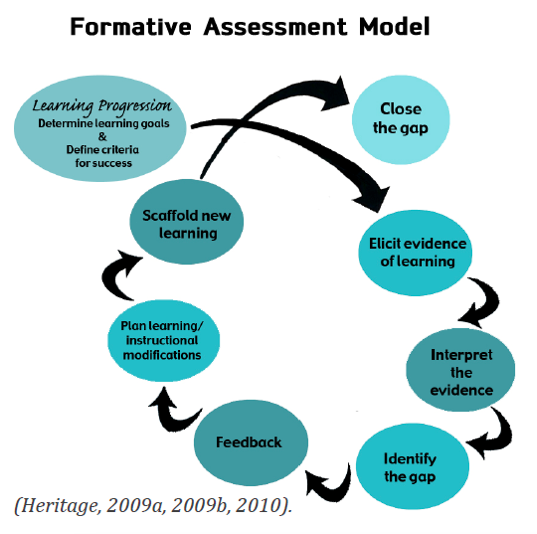
From my initial reading, I have come to recognise formative assessment as a vital part of the classroom experience. Black and William’s evidence shows that formative assessment is an essential component of classroom work. This has been very informative and is certainly a background for my research project. Black and William highlight that outside the box (the classroom) there are many initiatives and assessments for learning but this leaves out what really happens in the classroom and the teaching experience. It also makes mention to students competing in the class for the best results thus leaving out many students who feel let down by their education. This could change where students become more able to assess their learning thus far and be able to change that. I feel that the acknowledgment for my students that their learning is an ongoing passage through their course they (including myself) can regularly assess how they (and myself) are acquiring the knowledge to succeed thus helping both parties.
A look at teaching methodology over the last 30 years
(8160 Words)
Second language teaching can be employed in many ways and is born from many theories hypothesizing how we acquire language through the process of first or second language acquisition. Central to these theories of language acquisition was the emergence of the concept of “methods” of language teaching. It is this language teaching coupled with its methodology I will discuss in this paper notwithstanding that teaching methods can not be applied if we do not understand how students gather all the information for their language acquisition. Methodology can be fundamentally sound but if we (the teachers) do not understand the minds of our students that much clearer, all the hard teaching work will be fruitless. Methodology in teaching in all it forms originates from questions the teacher asks himself about the students and learning environment such as: Who are the learners? What exactly do they do? For what purpose are the students learning the language? In what setting are the students learning?, With what kinds of language?, In what patterns of social interaction? , and also what are the particular outcomes in terms of quantity/quality of language use, attitudes, and motivation? This is not forgetting the teacher who must consider the design features of his lesson that might include such points as: stated objectives, syllabus specifications, and type of activities, roles of teachers, learners, and materials. These are the sort of questions and ideas that are congruent with referring to a methodology for teaching and will help with answering the question for this paper; what is teaching methodology? I will also generally try to focus on teaching methodology over the last thirty years.
To begin with, teaching methodology in all its forms helps the students in their acquisition of language. Our knowledge of the student and his learning is fundamental with respect to a proficient teaching method. We only need to look at one of the most influential researchers in the language field of developmental psychology. [1]Jean Piaget (1896-1980) explains this point a bit more. He helped posit many theories (which are discussed later in this paper). Piaget became interested in how children think. He recognised that the children’s answers were qualitatively different from the older children’s. This, of course, he recognised, did not mean the younger ones were less smart. The children answered the questions differently because they thought differently. Influential research like Piaget’s is the kind of recognition of students’ learning and capabilities that a teaching methodology has to adapt to. It is a focus like this, that I hope to put across in this paper. Teaching methodology works in many ways and has to deal with a myriad of learning styles and ages.
A must for furthering our teaching knowledge are studies in language that help to advance acquisition. Over the last 30 years, there have been and continue to be studies throughout the teaching field. Studies like Jean Piaget mentioned above, have helped broaden our focus of instruction over these years. These sorts of people have made advances in cognitive science and educational psychology that have assisted teaching ideas. Methodology has gone away from rote learning and memorised facts and professes to a more communicative base these days. The communicative base learners learn a language through using it to communicate; this is allied with authentic and meaningful communication in the classroom. Teachers use a methodology that is more typical of natural language acquisition. There are no more structural drills and repetition of set phrases as was the audio-lingual method. For the audio-lingual method, we could also say the same about the grammar translation method which looked at individual words existing in isolation. Thankfully, students these days are encouraged to play an active part in their learning. Children are made to work together in groups. With the rise of the computer, sound labs have now been replaced by computers offering multimedia. Teaching and methodology is an ever-changing subject and has seen significant changes in the ways that languages have been taught over a rather short space of time. This is not forgetting those people who have made these changes occur. For every new theory or approach, there is a person who owes his or her name to it.
One person, Noam Chomsky, who is one of the most famous linguists, helped in the teaching world by creating better teaching and learning habits. He claimed that we are constructed to develop language as much as we are constructed to walk and do other human things. Chomsky ideas were that we have an innate structure and naturally learn a language. Chomsky’s ideas and theories of language are what the communicative approach is based on. In 1957, he changed the face of linguistics when he published Syntactic Structures. He theorised that children acquire their first language with no formal education. Chomsky’s ideas were opposed to Psychologist [2]B. F. Skinner’s formal ideas for acquisition. Chomsky’s more natural approach looked at the fact that children spontaneously utter sentences they have never heard, much less practiced, before, while Skinner’s approach suggested that language was a form of conditioned behaviour. Chomsky thought it seemed so unnatural to be taught so formally at such a young age. With Chomsky’s view, there was a certain consensus that viewed mistakes as just part of learning in the classroom.
Behavioural psychologists such as B. F. Skinner conceived of language learning as a habit formation. Both the grammar translation teaching method and the audio-lingual teaching method (popular from the 1940s through the 1960s) are based on a behavioural model of learning. The methods of behavioural teaching with the students were dialogues and pattern drills. These were designed to condition the learners to produce automatic, correct responses to linguistic stimuli. This is the practice that now seems so formal and serious and not wholly beneficial to the students in their use of language in the real world. The theory behind behaviorism (behavioral model) concentrates on the study of overt behaviors that can be observed and measured (Good & Brophy, 1990). Behaviorism focuses on a new behavioral pattern being repeated by the student until it becomes automatic. The behaviorists believed you should only study those things that you can see and document. In educational settings behaviorism implies the dominance of the teacher with the learner as a passive recipient of knowledge. Skinner’s behavioral view holds that learning takes place through a process of operant conditioning, or more generally, habit formation. From this view, mistakes were seen by the teacher as bad habits which were to be unlearned
From Skinner and Chomsky’s opposing views in the 1950s to those many people who have maintained the progression and arguments of the aspects of teaching methodology, they all have radically looked at language in different perspectives that have come to profess some answers to our acquisitional traits and how best to progress them further. Within this focus on teaching methodology to help language acquisition, we find that methods and approaches have a clear difference between them. Methods are held to be fixed teaching systems with prescribed techniques and practices, whereas approaches represent language teaching philosophies that can be interpreted and applied in a variety of different ways in the classroom. Approaches can be loosely described as techniques while there can be highly prescribed methods. From approaches, methods, and theories, in the field of linguistics and second language learning, language researchers who query language acquisition are further categorized by their named ideas such as Chomsky’s innatist theory or Skinner’s behavioural theory.
Starting with the theories by Chomsky and Skinner starting in the 1950s, we find that it really wasn’t until the 1960s and more prominently in the 1970s when applied linguistic research started to change the views of classroom methodology. The increased research and new models of learning in the 1970’s resulted in the creation of a host of new ideas for second language teaching. Two such ideas were generally thought of, these approaches were informed by cognitive and humanistic models of learning which still have prevalence today in researcher’s theories. One of the recognized people in the development of cognitivism (cognitive model) is Jean Piaget the Swiss psychologist/epistemologist (mentioned earlier). Although he developed the major aspects of his ideas in the 1920s, his ideas were not really recognized until the 1960s. Some of the key concepts in cognitivism, for example, involve schema; the internal knowledge structure. Cognitivists view the learner as an active participant in the learning process. This active involvement is allied with a communicative teaching base. Within a cognitive method of teaching is the role of language awareness and consciousness-raising activities in promoting language learning. The Cognitivists want to study what is going on inside the learner’s head. Cognitivism concentrates on the growth of knowledge as a progressive construction. This cognitive output from the students lets the teacher comprehend the students’ ongoing acquisition and his teaching methods. Cognitivism attempts to study the mental processes of the learner while studying for their new second language. When we look at trying to unlock the cognitive intelligence in every student, we can use Howard Gardner’s learning theory as an example, from his book Frames of Mind (1983). This theory was a turning point for teaching methods. He proposed that a student’s intelligence was actually much more varied, that rather than there being one intelligence in a student, multiple intelligences existed. These intelligences were only activated when various teaching methods were used for the students to practice, for example, songs, games or pictures are used. This, in turn, highlights how one student may be more cognitively aware in a certain area but not so much in another. Teachers use different teaching methods to highlight intelligences in students and thus viewed every student as being able to be cognitively capable although not in every area of intelligence. Therefore the teacher, with this teaching method, becomes more aware of his student’s capabilities. This view was in keeping with the cognitivist paradigm.
Moreover, cognitivism figures that the student already has some knowledge/concept of something and this is then combined and extended to accommodate new information. This learning involves associations established through contiguity and repetition. Piaget theories also emphasized a scaffolding approach towards teaching. This meant that the teacher uses teaching methods that build language during his lesson(s). This, of course, furthers the student’s language education onto their preexisting levels of knowledge and experience. This method of teaching also notices a three-stage cognitive information processing model. This is shown when the teacher shows new information to the students, this is then first inputted into the sensory resister in the brain and processed into the short-term memory and then into the long-term memory for storage and retrieval. It is the teacher’s awareness of the student’s learning and his methods that help this storage and retrieval. Cognitivists place greater interest in knowledge, meaning, intentions, feelings, creativity, expectations, and thoughts. For example, Lucksinger (2001) recognized cognitive structures and processes such as memory, perception, problem-solving, comprehension, attention, and concept- learning as prevalent in the student’s language learning. Cognitivism can be further explained by Good and Brophy:
“Cognitive theorists recognize that much learning involves associations established through contiguity and repetition. They also acknowledge the importance of reinforcement, although they stress its role in providing feedback about the correctness of responses over its role as a motivator. However, even while accepting such behavioristic concepts, cognitive theorists view learning as involving the acquisition or reorganization of the cognitive structures through which humans process and store information.” (Good and Brophy, 1990, pp. 187).
The humanist view on education on the other hand still had cognition as an aspect of the cognitivist’s ideas but looked at the divergent aspect of cognition which helps develop creativity in every student. Researchers with humanistic views such as Jean Piaget and [3]Lev Vygotsky not only influenced the language teaching theory in the first half of the 20th century but also in the 1960s and 70s. Lev Vygotsky was a Soviet psychologist whose work was suppressed after his death in the 1930s and was not discovered by the West until the late 1950s. Some of his and Piaget’s humanist language theories, with reference to the classroom, put a greater focus on the learner and on classroom social interaction with the emphasis on everybody involved. We find that the Humanistic approach does not exclude cognition: “it is not a question of lowering standards for students’ cognitive development, but of recognizing that it can be very beneficial for teachers to choose to focus at times on affective matters also” (Arnold, 1998:8). A teaching example of a humanist method, is to have students participate in group work, especially cooperative learning, in order to develop social and affective skills to help their learning. This makes the teacher more of a facilitator while the students work together. Cooperative learning expresses a need for understanding of the students more than accuracy in language. In this type of learning the students can take control of their learning. While the students are learning together, the humanistic approach refers to the respect the teacher has for his students’ personalities. The teacher has to observe their learning styles, their personalities, if they are shy or extroverts and get these different learning styles to gel. He has to take into consideration whether error correction is embarrassing to the students, as well as never putting them in a position of feeling ridiculed. A central assumption out of the Humanistic approach is that human beings behave out of intentionality and values (Kurtz, 2000). In the classroom the humanistic approach can encourage the students to be observant of others, to encourage creativity in their responses. This will help others to feel less inhibited. Therefore, the humanistic model also places importance on the role of affective factors in the classroom. In general, the goal is to reduce anxiety and create a safe place where students can feel comfortable taking the risks necessary to communicate in a second language. For instance, some approaches to the humanistic idea favor playing soothing music in the background to help students relax. Under a humanistic model, the teacher’s teaching methods use the students as active participants in language education process with communicative desires and purposes. The teacher is not only teaching but also observing the students learning traits. This can help the students by using teaching material they are mostly interested in. This way the students are encouraged to become independent, self-guided learners.
Moreover, this participation and control of the direction of their (students) learning was theorized by Carl Roger. His theory of learning evolved as part of the humanistic education movement (e.g., Patterson, 1973; Valett, 1977). He proposed that learning is facilitated when the student participates completely in the learning process and they have control over its nature and direction. Drawing on Carl Roger’s ideas of the students not as a class but as a group, Charles Curran, in the 1970s, developed a new teaching model. The new way of teaching he called counseling-learning. For the learners to achieve, they had to communicate within a group format using their interpersonal skills to build relationships and their second language. As much as the humanistic saw students as communicators with feelings and language needs, the community language learning idea was to encourage teachers to see their students as whole persons, where their intellect, interpersonal relationships, protective reactions as well as feelings. This addressed and balanced the students desire to learn the language. This process would have the students sitting around in a circle with the teacher on the outside. The students were allowed to say anything they wanted in their first language this was then translated back to them by the teacher in the second language. This process of using language built their skills up over time until the student felt a certain independence with their acquired newly language. This laid a foundation for learning that spontaneity and regular communication was practiced.
Within this group work structure, allowing students creativity, we can also refer to a project-based approach. This approachmay be taken in which students are required to work independently or in groups on language-related projects of their own choosing. This approach has the teacher becoming more of a facilitator in the student’s learning. One approach is to have the students take responsibility for their learning by producing a seminar that is on a chosen subject of their own. The students can also help in the process of planning lessons, the teacher may ask students to provide ideas for topics or situations of interest. These lessons main focus is to have the students as actively involved with each other as possible. In summary, the purpose of humanistic learning is to provide a foundation for personal growth and development so that learning will continue throughout life in a self-directed manner. This is linked with the Cognivists point of view where they feel as if the learner’s thoughts and background need to be considered when developing lesson plans. ” By building on the child’s experiences and providing moderately challenging tasks teachers can provide the ‘intellectual scaffolding’ to help children learn and progress through the different stages of development.” (Conway, 1997)
Development of the students is the highest priority in teaching. The environment and the culture the learner is in, and the interactions the learner has in the classroom, play a fundamental part in their language acquisition. Of course, the teachers are the main part of this interaction. These are the working of a teaching methodology that has the student’s development as their number one thought in the teacher’s mind. This collaboration of all involved in the class highlights the idea of classroom culture. This communal view can serve as a basis for the new natural-communicative approaches that the teacher can develop. The classroom interaction of teacher-students, as well as students-students, is what builds rapport. This rapport, in turn, helps their language progression. For example, Piaget studied children and their effects from interaction with adults. This focused and how they develop with aid of someone of higher intelligence who can advance their learning. This development of communication, was theorized in the 1980’s by Michael Long’s (1983). His interactionist theories highlighted communication in the classroom. Language essentially is interaction and it is an interpersonal activity. The concept of Interaction is at the core of many theoretical approaches to explaining language acquisition. Long says that much second language acquisition takes place through conversational interaction, the people in the classroom have. This is the communication between everybody in the class working together to achieve a context and meaning to the lesson with the teacher at the forefront. This interactionist view is based on the communicative approach to learning. The interactionist’s view supports interaction in language learning. From the view of interactionists, the learning strategies for the students are where they use their teacher to further their language acquisition. This interaction can be vastly beneficial to the students’ natural acquisition. This means that the students take control of their learning. Yule and Tarone (1991) allied with the interactionist theory. They proposed that if learners can use communication strategies as a way to negotiate meaning, not only their comprehension will improve, but also they can learn new words. They then have an opportunity to talk in their second language. Therefore, this highlights a teacher’s teaching methodology which should provide more chances for students to interact with each other as well as the teacher. These interactions, in the classroom through communication, were theorized by Stephen Krashen, an applied linguist. His views showed that while communication is beneficial this input at a right level is more important for language acquisition. He thought that the teacher should make sure that he speaks at a level the students can comprehend. Micheal Long (1983) also suggested that modified interaction, similar to the child-directed speech in first language acquisition is essential to second language learning.
Moreover, this interaction within language learning was theorized by Vygotsky (1978) who also professed that language develops entirely from social interaction. The focus is the collaboration in the classroom setting. Vygotsky said that any person will benefit more from conversation, than learning on their own without any guidance. As a teaching methodology, these interaction ideas mirror a more collaborative and co-operative theory of learning and teaching in the classroom. These were the ideas posited by Vygotsky. The term cooperative learning seems to date back to the 1970s when a lot of research was done. In the classroom the students are viewed as problem solvers. Through collaborative and cooperative methodology, the students perform problem solving and inquiry that stresses their cognitive skills. The teaching concept of collaborative method pertains to the grouping and pairing of students for the purpose of achieving an academic goal. On the other hand the cooperative method still has the students in groups although there can be many mechanisms for group analysis. We find that cooperative learning is closely controlled by the teacher while collaborative learning is more student centered. With reference to this, Vygotsky viewed cognitive developments as a result of a dialectical process, where the student learns through shared problem and solving experiences with someone else, such as parents, teacher, siblings or a peer.
Communicative teaching methods where everybody partakes in the education process has been associated with a higher level of thinking, self-esteem and the students liking the subject matter. The teacher builds his lesson through methods, on the students working together to discover meaning. The teacher through his teaching finds that he must trust the peer interaction to do many of the things he has felt responsible for himself. As for a teaching theory, referring to this collaboration of persons in the classroom, the type of theory referred to, is sociocultural. This theory shows how much students benefit from assistance in their learning. This sociocultural theory proposes that social interaction plays a fundamental role in the development of cognition. Of course, this interaction must include sociocultural features of second language. The teacher has to show that language and social interaction are used by many groups of people around the world that speak the language the students are learning. The teacher’s teaching has to show within this interaction, while using their second language, socially-determined cultural codes are used in meaningful ways. These cultural codes are often termed ‘appropriacy’. The teacher must show and also the students recognize; how is the language used, when, why, and by who (or whom)? The teacher has to show the students language etiquette (e.g. formal or informal ways of greeting, language used in discussions, presenting different viewpoints, formal language in business meetings). With reference to this, we find that three key pedagogical principles that developed around communicative language teaching were: the presentation of language forms in context, the importance of genuine communication, and the need for learner-centered teaching.
Moreover, there is a clear relationship between communication and society. Vygotsky viewed language learning as coming from a social context. Of course, within this language teaching we must remember that language is primarily a tool of communication. The student needs to be stimulated by others to achieve. An implication of this theory in teaching is that a learner learns under the guidance of an expert. The language classroom can be considered as a social environment for the students. The teacher provides assistance and support by adjusting the difficulty of the task. The individual’s language development at school/ college is heightened by the result of this culture in the classroom. Vygotsky’s social-interactionist theory serves as a strong foundation for modern ideas. It lends support to less structured and more natural, communicative and experiential approaches. It points the teacher to the importance of real-world human interaction in foreign language learning.
As much as one theory leads to another, Vygotsky’s theories mirror another famous linguist [4]Stephen krashen, as they both find that the environment that we learn in, adds many factors to our acquisition. Krashen has had a large impact in all areas of second language research and teaching since the 1980s. Krashen (1982) looks at the innatist view in his theories. This innatist view follows Chomsky’s ideas. The innatist theory shows that many speakers unconsciously are fluent in language without ever having learned rules. This, of course, is referring to our first language acquisition method without formal instruction. The students can learn from interactions with others. His theories look at first language acquisition and how it relates to second language acquisition. Should we model our lesson when teaching students on how children acquire their first language? With this in mind, we could refer to the Direct Method of teaching language. This is the method that became very popular during the first quarter of the 20th century. This method has the students using only their second language in the classroom. It excludes the student’s native language from the classroom environment. The teacher has the students completely immersed in their new second language. This brings us back to the innatist idea that the process of learning the new language should almost mimic the progression of a child learning their first natural language.
Understanding acquisition of second language can be through the recognition of how we acquire our first language. The Natural Approach to teaching refers to this. The Natural approach was born out of communicative language teaching. This approach was theorized by Tracy Terrell, a teacher of Spanish in California, in 1977. He designed “a proposal for a ‘new’ philosophy of language teaching which he called the Natural Approach (Terrell 1977; 1982: 121). He joined forces with Stephen Krashen, in elaborating a theoretical rationale for the Natural Approach. This drew on Krashen’s influential theory of second language acquisition. As for a teaching method Krashen’s and Terrell’s Natural Approach in the 1980s was the latest trend in language teaching. Krashen and Terrell’s combined statement of the principles and practices of the Natural Approach appeared in their book, The Natural Approach, published in 1983. Terrell stated that “acquisition can take place only when people understand messages in the target language (Krashen and Terrell 1983: 19). As part of the Natural Approach, students listen to the teacher using the target language communicatively from the very beginning. Class time is committed to providing input for acquisition. This, of course, showed that language is not grammar but a lexcicon that works on meaning. For the classroom, it places less emphasis on teacher monologues, direct repetition, and formal questions and answers, and less focus on accurate production of target language sentences. There is also a focus on activities including games, role-plays, dialogs, group work, and discussions. They posited the ‘input hypothesis’ (Krashen & Terrell, 1983) that states that we acquire a language as we comprehend meaning in that language in the form of written or spoken words. They also stressed the importance of comprehensible input. This challenges students to stretch their understanding. Krashen and Terrell (1983: 32) expressed this as the ‘input hypothesis’. They also advocated the need for a “silent phase”, waiting for spoken production to “emerge” of its own accord, and emphasizing the need to make students as relaxed as possible during the learning process. This, of course, had a major focus not only on teacher’s methods but also how they taught those methods.
The teacher plays a major part in creating a relaxed classroom environment that has a hand in students being productive. The students’ understanding of the language during this time in the classroom is paramount. Dell Hymes, an American sociolinguist, and Michael Halliday, a British linguist, highlighted the point that language is not just something we have knowledge of. They highlighted that language is constructed by interaction in the social environment. This is the social interaction between the people in the classroom. In the 1970s, the concept of communicative competence was originally thought of by Hymes (1972). His thoughts were a response to his perceived limitations in Chomsky’s competence/performance model of language. At that time (1970s) Halliday showed that language teaching only really focused on structural content as was the audio-lingual method. This didn’t really help for real-world situations that the students needed their language for. He emphasized that language has to be appropriate for the language situation. Hymes drew attention to the importance of knowledge of the rules of language use (i.e. communicative competence). He said that in order to speak a language correctly, one needs not only to learn its vocabulary and grammar, but also the context in which words are used. This gives more meaning and understanding for language as a productive output not just a knowledgeable, in the head, fact. Hymes put emphasis on real data going on in the world. This includes the society and the culture we live in, wherever we are in the world. Language is certainly not black and white. For example, a teacher telling a story to the class can add colour to it by adapting it and use; different characters (be an animal, be an old person), different voices (angry, sad, scary story), get the children to join (sing together, be different characters), make it a comedy, make it factual. Language has many more facets than just words on a board. Hymes emphasized that “There are rules of use without which the rules of grammar would be useless” (Hymes, 1971, p. 10).
Of course within communicative teaching, rules are not just completely forgotten. Krashen’s (1982) ideas related this point where he said that learning” is seen as a conscious activity that proceeds by formal instruction and results in conscious knowledge about the language’. Krashen and Terrell saw communication as the primary function of language. Deductive learning of grammar rules is a good example of language learning in Krashen’s terms. Deductive teaching methods progress from the general concept to the specific use or application. This learning helps students articulate their mental processes. It is an approach to language teaching in which learners are taught rules and given specific information about a language. Then, they apply these rules when they use the language. Learning deductively is one of the communicative approaches that encourage students to communicate fluently. Krashen believes that it is the subject matter itself, the study of grammar, that is responsible for the students’ progress, but in reality, their progress is coming from the medium and not the message. Krashen also suggests that natural communicative input is the key to designing a school syllabus, ensuring in this way that each learner will receive some ‘i + 1′ input that is appropriate for the students’ current stage of linguistic competence. This is where the teacher modifies his language and the lesson, to make it easier for the student to understand. Cooperative learning follows along the lines of the ‘i+1’ input, as working with a quantity of comprehensible input that peers in the classroom can help each other take in. This input has to be comprehensible to the students and not above their level for acquisition. Of course, language output can only be shown by the content of the different tasks/methods the teacher uses. Krashen (1984) established the importance of context by suggesting that language learners understand material more efficiently when it is presented in a comprehensible context, rather than in fragmented examples of sentences and words lacking connections.
Moreover, a teacher can still follow a Natural Approach while still prevailing to some sort of teaching structure in the class. The fact is that the teacher can have a certain social interaction (Natural Approach) in the class but how does the teacher follow from this? This means that the teacher should have a teaching methodology that builds the next layer of education on the students’ preexisting levels of knowledge and experience. With reference to this, Wood & Middleton, 1975; Wood. Bruner, & Ross (1976) looked at the active role the teacher plays in interacting with children to support their development. They called this structure of teaching and learning ‘scaffolding’. This idea describes the effective intervention by a peer or teacher in the helping of other students. Teachers scaffold students’ development in language by providing structures that support the students, to stretch their understanding beyond the level at which they’ve been functioning on their own. Vygostky’s sociocultural theory viewed humans as culturally and historically situated. Student are not as isolated individuals, they work and relate off other people. Vygotsky described this concept as the zone of proximal development (Vygotsky, 1986). The teacher plays a pivotal role by using scaffolding strategies that support the children’s efforts in specific ways. It is the teacher’s job to put forward ideas that are at a level for the students involved. The process works by way of an expert (teacher) who models an activity, provides the learner with advice and examples, guides the student in practice and then tapers off support until the student can do the task alone. This teaching method includes proposing a form of the act to be performed; raising and maintaining the learner’s interest during the class. The teacher may also have to simplify the task while correcting their results. The teacher’s priority is to reduce the stress during the learning process to heighten acquisition. For example, cooperative learning overlaps with the sociocultural theory by attempting to build an environment that fosters mutual aid. We find that the term scaffolding originated in the socio-cultural theory and was developed by later theorists. A related idea within the method of learning and teaching claim that sequencing of the teacher’s instruction should be based on a hierarchical progression from simple to complex learning outcomes. Related to this, Gagné developed a technique of constructing learning hierarchies for analyzing (students’) skills. For example, the teacher shows a skill for the students to learn, this is rationally decomposed into parts and sub-parts; then instruction is ordered from simple sub-skills to the complete skill. Also, ID. Newman, Griffin, and Cole (1989) characterized traditional design methods. First, the tasks are ordered from simple or easy to complex or difficult. Second, early tasks make use of skills that are components of later tasks. Third, the learner typically masters each task before moving onto the next.
As much as we see scaffolding as the building of the students’ knowledge through stages, it could be coupled the ‘multiple intelligences’ theory. This theory was named in 1983 by Howard Gardner. He looked at children Intelligences and how each student can excel in different area of knowledge. In many ways, the teacher needs to look at every skill the student can use in learning a language. This varies the class and broadens the creative aspect. This use of the students’ skills is shown through the teacher using different teaching methods. Creative self-expression in teaching is seen to be valued. We can say that David Beckham excels in sport but give him a political science question, he may well be confused. As much as Tony Blair, the Prime minister of England can not kick a football perfectly, he is the leader of a country. This fact also alludes to the cognitive model that also emphasizes the fact that not all students learn in the same way. Of course, we find that within communicative, humanistic, and natural teaching models peer help is intrinsic. Thus many skills are learnt by all. Scaffolding can work with multiple intelligences and be used in the lesson plan to build students cognitive knowledge and skills. Through ‘multiple intelligences teachers understand how students learn in different ways. For example, knowing which students have the potential for strong interpersonal intelligence will help the teacher create opportunities where the strength can be fostered in others.
From people like Howard Gardner with his multiple intelligence theory, we find in the 1980s what was needed to be taught was ‘no longer just linguistic competence but also sociolinguistic competence, discourse competence, and strategic competence’ (Canale, 1983; Canale and Swain, 1980). The 1980s for language teaching saw it maturing in its growth and starting to encompass a broad approach to language teaching. During this time more interactive views of language teaching were used which collectively came to be known as Communicative Language Teaching (CLT). This, of course, means the lessons must be authentic for the students’ real needs. The focus of the communicative process in the classroom became as important as the linguistic product, and instruction became more learner-centered. Certain factor became more prominent in learning, for example, the communicative approach put greater emphasis on listening. This was a hard task because the students were used to listening to their teacher but not their peers in the class. A major factor was the student as an active listener who is challenged to interact with other speakers in order to get the supposed information and further their language skills. It was recognized that authentic and meaningful communication should be the goal of classroom activities. Gerngross & Putcha (1984 p.92) gave the example of a textbook that showed English children having a pet show. Gerngross & Putcha highlighted the fact that ‘even when the learners act out this scene creatively and enthusiastically, they do not reach the depth of involvement that is almost tangible when they act out a short text that presents a family conflict revolving around the question of whether the children should be allowed to have a pet of not’.
The use of meaningful texts helps students’ studies, therefore for them to further themselves there must be output from them. This is the use of their acquired language so far. This will show their language aptitude which will become clearer to themselves as well as the teacher. In light of this, many researchers gave an importance on the role of two-way communication (Ellis, 1997; Lightbrown and Spada, 1999; Long, 1996). These researchers claim that interaction between learners will facilitate acquisition, such as via negotiation of meaning and feedback. This method of teaching puts a focus on the learner’s education. This functional language use where the students show their ability to express their own ideas, feelings, needs, etc highlights communicative teaching. The fact is that comprehensible output helps learners to test their hypotheses concerning this language aptitude. Carroll (1981, as cited in Larsen-Freeman & Long, 1991) defined language aptitude as “a concept corresponds to the notion that in approaching a particular learning task or program, the individual may be thought of as possessing some current state of capability of learning that task.” Students were seen as having to learn the language not just as a classroom exercise but as authentic material that would be beneficial to them outside of the class. Some researchers saw the way to achieve this kind of learning through various types of teaching methods. For example, task-based learning had the teacher getting the student engaged in authentic tasks and projects.
Furthermore, task-based learning steers the students to a context in which they need to produce output which others can understand while making the classroom situation resemble real life. In task-based learning, language forms are ‘not prescribed in advance and so learners’ are ‘free to use any of their second language they can’ in completing the required task (Willis and Willis 2001: 174). An example of task based learning could have two students with a card with pictures that have been mixed. The students, without looking at each others card, have to describe their pictures to one another. After that, they need to put together a logical story by finding and agreeing on the sequence of the pictures. Of course, after this, the problem for most students in classroom learning is the question of relevance: “How does this relate to my life and goals?”. Task based learning and moreover the situated learning approach attempts to place the learning activity in an environment that allows the students to resemble the lesson to a real-world situation. This major factor in these approaches is an authentic context that reflects the way that knowledge will be used in real-life.
As an educational philosophy constructivism follows the path of task-based learning as it includes the importance of contextualized learning. This includes the need for learners to make sense of their environment by drawing on their acquired knowledge and ideas that are used in their learning of new contexts. The constructivist approach assumes that the learners can build their own knowledge, so the student is viewed as an autonomous learner and inquirer, although I must say at this juncture this way of learning seems to favor more complex learners. All the same through constructivism, the task of the teacher is to provide material and guide the learner in ways that encourage students to use their own knowledge and integrate it onto a higher learning plane. This gives the students a chance to solve the problems within the framework that the teacher has set. Constructivist approach has the learner discovering knowledge in his own way. Constuctivism also allows the learner’s knowledge to go above and beyond the original intent of the instruction at times when the learner is motivated to learn more. The constructivist approach allows the learner to discover knowledge in his own way.
Moreover, on the subject of authentic teaching, in the late 1980s, Brinton, Snow and Wesche (1989, p. 2) defined content-based teaching. This method of teaching was seen as viableteaching theory that used content and language. Content-based teaching was seen as “the concurrent teaching of academic subject matter and second language skills.” This type of instruction allows the students to focus upon the substance or meaning of the content that is being taught. A particular advantage of this method was that content-based teaching had obvious applications in the area of English for Specific Purposes. There are a lot of English classes that the learners have to focus on English relevant to a particular field of work or study.
In light of all the new teaching methods, we find the predominant modern idea to teaching still comes from a communicative approach which is used in most prominent methods, that have been mentioned earlier, such as content and task-based learning. These two particular versions of learning, already mentioned, are recognized in communicative teaching because the teacher has a less dominant role. The fundamental ideas within these methods show that communicative classroom activities allow learners to actively learn for themselves. This modern idea puts more emphasis on the learner. This, of course, encourages the students to be ‘more responsible managers of their own learning’ (Larsen-Freeman 1986: 131). This focus recognizes that a more communicative approach proposes a way for the learner to internalize their new second language and to use this with effect in the classroom. The teacher’s methods are trying to bring forth this language use. We find that within the sphere of the communicative approach there are certain methods that are used in order to encourage meaningful language, for example: elements of puzzle-solving, role play, or simulation which is aligned with skills to do things such as: guessing, searching, matching, exchanging, collecting, sharing, combining, and arranging. All theses factors are used to have the students as active communicators in the classroom.
Furthermore, on the theme of communicative teaching while bringing this paper more up to date, it is recognized that language lessons that use communication activities still have to be engaging. These lessons have the students interacting together as well as with the instructor/teacher to achieve a language goal. Within this language goal, we have to recognize that is not just methodology that has to work in the classroom. For example, Shulman (1994) and Woods (1996) highlighted the fact that the teachers’ language, as well as methodological knowledge/skills, is what makes the teaching. The opinion is that of the teachers’ knowledge, skills and attitudes have more of an influence than teaching methods. This has an influence on observable teaching behaviors (Karavas-Doukas, 1996) We also find that there is also the fact, of the teachers’ intelligence, self-awareness, and rapport with the students which has a factor in a productive class (Bridges, 1993; Prodromou, 1998).
Of course, communicative approaches have been mentioned as beneficial, but these methods have to have the teacher being able to contextualize the task, so the students interpret it properly. Therefore we see a theory where development “involves changes in knowledge and beliefs and not simply changes in skill” (Elliot & Calderhead, 1995). The teacher-student relationship in this theory is paramount. The trust between them is a mutual quality and must flow between people in the classroom. The lesson can only flow if effective filters (Krashen, 1981) are successfully disabled, and teaching/learning is to be efficient and effective. These are fundamental ideas because with all the teaching methods old and new there are still language classrooms that often continue to be threatening environments (Finch, 2001), with teachers imposing their opinions of life and language learning.
As much as we have just mentioned the teacher’s manner and teaching methodology that helps language acquisition, it is also the student’s motivation to learn that has to help in their language acquisition. Student’s motivation to learn comes from their desire to communicate in meaningful ways about meaningful topics. We see that in the structure of a teaching methodology, it is also the change in students’ general perception and valuation, of the issues related to language teaching and learning during the course, that helps (Karavas-Doukas, 1996). The students’ perception of their learning highlights the fact that the teacher’s methods have the students enter a cycle of reflection during their learning. Of course from a teacher’s point of view, this is likely to empower both himself and the student. This is not forgetting, it is teachers who control the class. Stevick’s asserts that “success depends less on materials, techniques, and linguistic analysis, and more on what goes on inside and between the people in the classroom” (Stevick 1980). The teacher is trying to have a climate of cooperative social interaction which “produces new, elaborate, advanced psychological processes that are unavailable to the organism working in isolation” (Vygotsky 1986, p. 61). Reid also points to the responsibility of teachers to “provide the scaffolding for more effective and efficient learning” (Reid 1999) by raising student awareness of effect, and then listening to the students as they express their needs, beliefs, and perceptions.
Within the study of language teaching there certainly is the push for the students to be active learners while the teacher actively contributes to the process. A student-centered approach presupposes a learning climate of trust and clarity. Legutke & Thomas (1991, p. 64) see trust as an indispensable goal, governing teachers’ choices and preceding the learning process. This modern idea in the classroom has a leaner-centered environment which provides plenty of opportunities for interaction. This helps the teacher support learning awareness. The group can move towards the language goal. There is a need for trust in the learning climate which is generally seen as more facilitating than innovative tasks, techniques, or principles. As a whole, the communicative turn in language teaching represented by CLT has clearly highlighted the importance of the broader discourse and sociocultural features of language. Communicative approaches to teaching challenge the teacher’s understanding of the goals of instruction. There is an emphasis on meaningful use over form. This means that accuracy and acquisition of the formal features of the second language are less a measure of successful language learning than are fluency and an ability to get something across comprehensibly to a native speaker
To conclude, I feel as though during my research into this paper and through the writing of it, I have acknowledged that there are many methods and theories out there for the teacher to try. This paper has shown that language teaching ideology has progressed over the last thirty years or so. It is accepted that there are many methods that influenced and gave birth to other methods and approaches. This, of course, does not say which is the best method. Individual teachers have to find that out for themselves. I have also recognized that there have been major developments in teaching. This is highlighted by a great emphasis on individualized instruction as well as more humanistic approaches to language learning. We also find a greater focus on the learner, and greater emphasis on development of communicative, as opposed to merely linguistic, competence. I feel with this paper and the research I have done has led me down a path that I come to see communicative learning as a viable method and thus has affect on the students’ language acquisition. This type of learning I also feel has valuable insight into getting the students learning for themselves. I also feel that even though this paper was about methodology I have also shown that other major factors have come to the surface; those being the student’s attitude to learning as well the teacher’s attitude to his methodology and his student’s learning. These are the factors that work in line with a successful teaching methodology and hopefully get a teacher to see the wider picture that teaching methodology has to offer.
References
Bernhardt, E. B. (1991). Reading development in a second language: Theoretical, empirical, and classroom perspectives. Norwood, NJ: Ablex.
Bruner, J. (1985). Vygotsky: An historical and conceptual perspective. Culture, communication, and cognition: Vygotskian perspectives, 21-34. London: CambridgeUniversity Press.
Schütz, Ricardo. “Stephen Krashen’s Theory of Second Language Acquisition.” English Made in Brazil <http://www.sk.com.br/sk-krash.html>. Online. 28 de março de 2005.
Banaszynski, Joe, (2000). Teaching the American Revolution: Scaffolding to Success. Education World: The Educator’s Best Friend. Retrieved November 1, 2002, from http://www.educationworld.com/a_curr/curr218.shtml.
http://www.georgejacobs.net/methodology.htm
Spada, N., & Lightbown, P. (1993) Instruction and Development of Questions in the L2 classroom. Studies in Second Language Acquisition, 15:205-224.
Long, M.H. (in press). Task-based language teaching. Oxford: Blackwell.
Long, M.H., & Crookes, G. 1987. Intervention points in second language classroom processes
Gagné, R. M., & Driscoll, M. P. (1989). Essentials of learning for instruction (2nd ed.). Englewood Cliffs NJ: Prentice-Hall.
Hymes, D. 1972. “On communicative competence.” In Pride, J.B. & J. Holmes (eds.), Sociolinguistics.Harmondsworth, England: Penguin Books.
Larsen-Freeman, D. (2000). Techniques and principles in language teaching. Oxford: OxfordUniversity Press.
Gardner, H. (1983). Frames of mind. New York: Basic Books.
Stevick, E.W. (1980). Teaching Languages: a Way and Ways. Rowley, M.A.: Newbury House.
Schumann, J.H. (1975). Affective factors and the problem of age in second language acquisition. Language Learning.
Reid, J. (1999). Affect in the classroom: problems, politics and pragmatics.
[1] Jean Paiget (1896-1980) was one of the most influential researchers in the area of developmental psychology during the 20th century
[2] B. F. Skinner, an American psychologist (1904-1990)
[3] Lev Vygotsky (1896-1934). – Vygotsky was born in Russia in the same year as Piaget. Vygotsky was not trained in science but received a law degree from the MoscowUniversity. He went on to study literature and linguistics and became his Ph.D
[4] Stephen Krashen (University of Southern California) is an expert in the field of linguistics, specializing in theories of language acquisition and development.


