Dr Faustus
Consider the treatment in one text of one or more of the Seven Deadly Sins
(776 Words)
As knowledge seekers, many people will strive harder or try appropriate means to achieve their goal for further knowledge to the extent that bridges onto excessiveness that reflects one of the Seven Deadly Sins. Doctor Faustus is this seeker of knowledge who wants to find out more than is suitable and appropriate for him to know. Faustus is a disdainer who gets a scorner’s comeuppance. He commits a mortal sin and goes to hell for it.
Dr Faustus deals with the ambition of the Renaissance to cultivate an ‘aspiring mind’. The Renaissance as a time of intense, all-encompassing infinite knowledge is embodied in Faustus. However, he shows little discrimination in his pursuits. He delights, for example, in the Seven Deadly Sins, ironically remarking ‘O thus feeds my soul’. Throughout the twenty-four years, he seeks experience of all kinds in the true Renaissance manner; however, instead of freedom, his knowledge brings him despair.
Nevertheless, Faustus, the Renaissance humanist has the desire to reach the highest peaks of life experience; there lies a quality possessed by this ambitious seeker. To enter the new world where distant shores could be talked about. This is manifested in Faustus, however, in his desire for none other than a God: ‘A sound magician is a demi-god’.
‘How am I glutted with conceit’ shows how his excessive pride is overtaking him. His almost unconcerned use of the words ‘I’ and ‘will’ (‘I’ll’) embodies a man of cupidity. He is a fearless taker of everything for his own greed. In an age of reason, Faustus tries to stand on his own two feet and work out his salvation. He is motivated largely, by his desire for pleasure. He is covetous in his thoughts of ‘flying to India for gold’, ‘ransacking the Orient for Orient pear’. He hedonistically rides on the crest of sin. So blind is the lust of gain.
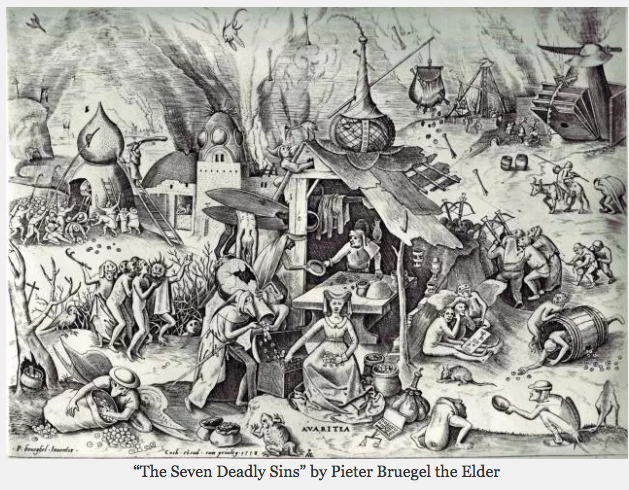
Faustus’ desirous journey is the ‘Perils of the Pilgrim’: ‘For the wicked boasts of his heart’s desire and bless the covetous, of whom the LORD abhorred. The wicked, through the pride of his countenance, will not seek after God: God is not in all his thoughts. His ways are always grievous; their judgments are far above out of his sight: as for all his enemies, he puffs at them. He had said in his heart, I shall not be moved: for I shall never be in adversity. His mouth is full of cursing and deceit and fraud: under his tongue is mischief and vanity’ (Psalm 10, 3-7).
Aristotle stated that a tragic hero is predominately a good man, whose undoing is brought about by some error of human frailty, ‘the stamp of one defect’. The audience sees three such defects in Faustus that lead to his ultimate domination of Mephistopheles: his pride, his relentless intellect, and his desire to be more than man (to possess the power and the insight of a God). Any one of these three defects would have been sufficient to ensure his downfall in terms of the theory of tragedy. In his pride, he is guilty of hubris, a quality that the Greek tragedy was certain to arouse the wrath of the Gods. His desire to be equated with God is a sin in Christian terms as well. His restless intellect and deep dissatisfaction with the normal life inevitably lead to misfortune. Faustus falls to damnation
In some ways, Faustus’ aspirations are admirable. It was the glory and the ambition of the Renaissance man to have an ‘aspiring mind’. Faustus, on the one level, represents the new man emerging from the womb of the Middle Ages. The authority of the Church, which had limited the thought of the Middle Ages, was lessening. There was a movement of power from the Church to the state, which meant to a limited extent, the transfer of power to the individual man. The classical spirit was certainly a source of influence for Marlowe. The Greek attitude to their Gods was very different from that of the Medieval Church. The Greeks encouraged a spirit of inquiry in their thought that was quite foreign to the attitudes of the Medieval Church.
Above all, Marlowe’s story of Dr. Faustus is of a Renaissance figure, adventurously surveying a world whose horizons were widening every day as a result of voyages and explorations that results in a person to aspire to the greater, to hold knowledge over wisdom, to have a desire for material wealth or gain and ignore the authority of the spiritual world. One could well be blind to the ‘Seven Deadly Sins’ where one was on an ardent quest for knowledge and unsatisfied with being mortal.

Political and Philosophical theories place too heavy a burden upon a writer. The inevitable result seems to be texts that are didactic and polemical, rather than imaginative and creative. Discuss any one text, which you believe disproves this assertion.

(706 Words)
Dr. Faustus by Christopher Marlowe can be said to be a didactic text that details the death of the main character; the time leading up to that point and what becomes of his soul. It teaches us about his condemnation, not his salvation. However, contrary to this to disprove this assertion, Dr. Faustus is not just a didactic play. It is a play about Man pushing himself further, trying to have an intoxicating time and dream. He is a man that has been given three wishes and could be said to have found a genie in a bottle. What would the reader do with the wishes/genie? How would the reader strive for more than what they have got? Having the desire to have three wishes or to find a genie in a bottle is found in any person that allows not only them to be imaginative and creative but also the author.
Dr. Faustus wishes for many things and finds his genie in Mephistopheles. Dr. Faustus makes use of his newfound chances. He is a man who is a knowledge seeker. He wants to find out more than is good for him to know. This can not be wrong as a man who wants more than he has been offered. He does not want to plod along in life. He wants to eat, drink, and be merry. It is no accident that he compares himself to Colossus (IV, VII). Faustus is a scholar, books are his trade, philosophy his strength. Dr. Faustus begins by reading about the Greeks, Aristotle and ends up desiring Helen of Troy. His reading also contains maps that show Faustus exotic lands with their promise of new sensations. His study of classical authors has to be commendable as they are immense stories of biblical status.
The reader can, of course, decide to view Faustus through more modern eyes; he strives to better himself, his covetousness is soaring. This is particularly shown through the eyes of those who, in the eighteenth century, used him as an example of a positive thirst for knowledge, as a ‘striver’, as someone who anticipates the Age of Reason and tries to stand on his own two feet and work out his own salvation and try to better himself. He is motivated largely, but perhaps not entirely, by a desire for pleasure. The reader can assume that during most parts of the play, Faustus is a popular character, a great source of fun. Faustus hears renaissance voices who tell him to extend the boundaries of human knowledge, seek wealth and power, live this life because tomorrow you will be dead, such a popular theme is known as ‘carpe diem’ or ‘seize the day’.
In his superhuman aspirations, he mixes a desire for knowledge with no less strong desire for pleasure, power, and rape of overseas provinces, which were beginning to be colonized and exploited at the time. There is something of a rude soldier of fortune of him: ‘As Indian Moors obey their Spanish lords’ 1:121, draws a specific analogy between the quest for hidden knowledge and the brutal activities of their colonial powers. He acts as if he were king, he commands, dictates terms. He wants to be some sort of superhero and why not? Life for him is for living.
Faustus decides to live bravely for his time on earth, a strong man who challenges life, he goes and explores, he does not wait for life to come to him. The play mentions that he does grand things that are useful to his countrymen, but he only feels at peace when he is playing practical jokes. His last two words are ‘Ah Mephastophilis’, he dies in the arms of his deceitful friend with immense relief, also gratitude, surprise, love, forgiveness, and exhaustion. It is the happiest death in drama.
Christopher Marlowe‘s assertion to a modern reader can be very different from those at the time; this is where you can think of Faustus not only as an explorer but also as someone who wants to extend the boundaries of life. This could be a lesson for all which is relayed to the reader from Marlowe’s imaginative and creative text.
.
Consider the treatment of one or more of the Seven Deadly Sins
(1133 Words)
As seekers of knowledge, individuals may strive relentlessly, employing whatever means they deem necessary to achieve intellectual or spiritual enlightenment. However, the pursuit of knowledge can become excessive when it transgresses moral, theological, or human limitations. Christopher Marlowe’s Doctor Faustus dramatises precisely this tension. Faustus is an intellectual explorer whose desire for knowledge and power exceeds what is considered appropriate or permissible for human beings. His relentless pursuit of forbidden knowledge ultimately becomes an act of transgression: he embraces mortal sin and, within the play’s Christian moral framework, is condemned to Hell.
Marlowe’s Doctor Faustus engages closely with the Renaissance ideal of the ‘aspiring mind’, embodying the period’s fascination with intellectual expansion, individual ambition, and the possibility of transcending established boundaries. Faustus represents this aspiration in its most extreme form. Yet his pursuit of knowledge is characterised by a striking lack of discrimination. Rather than directing his intellectual abilities towards morally or intellectually valuable ends, he becomes fascinated by pleasure, wealth, power, and the supernatural. His response to the personification of the Seven Deadly Sins—“O, this feeds my soul”—is particularly revealing. The statement suggests that Faustus has begun to derive intellectual and emotional gratification from transgression itself. During the twenty-four years granted to him through his pact with Lucifer, he seeks experiences of every kind, seemingly embodying the Renaissance desire for exploration and discovery. Paradoxically, however, the supernatural power he acquires does not produce genuine freedom; instead, it ultimately leads to anxiety, despair, and spiritual destruction.
Foremost among Faustus’s characteristics is his ambitious desire to experience the fullest possible range of human existence. As a figure associated with Renaissance humanism, he seeks to transcend conventional limitations and enter a new intellectual and experiential world. His ambition is ultimately expressed through his desire to approach the status of a deity: “A sound magician is a mighty god.” The statement demonstrates the extent to which his intellectual curiosity has developed into an aspiration for absolute power. Faustus no longer wishes merely to understand the world; he wishes to control it. His desire therefore shifts from knowledge to mastery, revealing the dangerous consequences of an intellect that recognises no ethical boundaries.
Faustus’s declaration, “How am I glutted with conceit,” further illustrates the destructive effects of excessive pride. The language of ‘glutted’ suggests an appetite that has become excessive and insatiable, while his repeated emphasis on the first-person pronoun reinforces his egocentricity. Faustus increasingly imagines himself as autonomous and self-determining, attempting to construct his own destiny independently of conventional religious authority. His ambitions are also explicitly materialistic. He dreams of “flying to India for gold” and “ransacking the ocean for orient pearl,” revealing that his intellectual aspirations are inseparable from greed and acquisitiveness. His pursuit of knowledge therefore becomes corrupted by cupidity: what initially appears to be intellectual curiosity develops into a desire to possess wealth, pleasure, and power without limitation. His apparent liberation from conventional restrictions consequently becomes another form of enslavement—to appetite, pride, and sin.
Faustus’s rejection of human and divine limitations also resonates with the biblical condemnation of pride and covetousness. In this respect, his character can be understood through the moral framework of the Book of Psalms, particularly its association of pride, greed, and the rejection of God with spiritual corruption. Faustus similarly attempts to place himself beyond divine authority. God is effectively displaced from his intellectual universe, while his own desires become the principal measure of value. His tragedy therefore emerges not simply from his possession of supernatural power, but from his refusal to recognise any authority greater than himself. His intellectual independence becomes spiritually destructive because it is accompanied by an unwillingness to accept moral limits.
Furthermore, Faustus can be considered in relation to Aristotle’s conception of the tragic hero. In Poetics, Aristotle argues that tragedy centres upon a figure who is neither wholly virtuous nor wholly corrupt, but whose downfall arises from an error or weakness inherent in human nature. Faustus embodies this model through several interconnected flaws. His pride, his relentless intellectual curiosity, and his desire to transcend the limitations of humanity all contribute to his eventual destruction. His pride constitutes a form of hubris: he seeks to elevate himself beyond the position assigned to human beings. From a Christian perspective, his aspiration to become godlike represents an even more profound transgression, since it challenges the fundamental distinction between the human and the divine. At the same time, his restless intellect and dissatisfaction with ordinary existence prevent him from accepting the boundaries imposed by religion, morality, and mortality. His tragedy consequently emerges from the interaction between intellectual ambition and moral blindness.
Nevertheless, Faustus’s aspirations cannot be dismissed as entirely reprehensible. His desire for knowledge reflects one of the most significant intellectual characteristics of the Renaissance: the elevation of human curiosity, individual potential, and intellectual inquiry. In this respect, Faustus can be interpreted as a representative of the ‘new man’ emerging from the intellectual culture of the Middle Ages. The authority of the medieval Church, which had exercised considerable influence over intellectual and social life, was increasingly challenged by new forms of humanist thought, scientific inquiry, geographical exploration, and political individualism. The Renaissance consequently witnessed a growing emphasis on human agency and the capacity of individuals to investigate and understand the world independently.
Marlowe’s engagement with classical thought is also significant in this context. The classical world offered Renaissance thinkers alternative models of intellectual and cultural authority, while Greek literature frequently presented human beings who challenged established boundaries and confronted the power of the gods. Although Marlowe’s play is ultimately shaped by a Christian moral framework, its protagonist possesses a distinctly Renaissance fascination with inquiry, experience, and self-determination. This creates a fundamental tension at the centre of the drama: Faustus embodies the intellectual freedom of the Renaissance while simultaneously being judged according to the theological values of the medieval Christian worldview.
Ultimately, Marlowe presents Faustus as a quintessentially Renaissance figure whose intellectual ambition develops into an ultimately destructive desire for absolute knowledge and power. He surveys a world whose horizons appear to be expanding through geographical exploration, scientific inquiry, and renewed engagement with classical learning. His aspiration to exceed conventional human limitations is therefore both admirable and dangerous. Faustus represents the possibility of intellectual liberation, but he also demonstrates the consequences of pursuing that liberation without ethical restraint. His tragedy lies precisely in this contradiction: he possesses the curiosity and ambition associated with the Renaissance ‘aspiring mind’, yet his inability to reconcile those aspirations with the moral limitations of his Christian world leads ultimately to his damnation. In this sense, Doctor Faustus concludes with a distinctly medieval warning about the dangers of Renaissance ambition: the desire to know more may be intellectually admirable, but when knowledge becomes indistinguishable from pride, greed, and the desire for godlike power, aspiration becomes transgression.

