Conrad
Consider the importance of setting in any one text – The Heart of Darkness


Joseph Conrad’s The Heart of Darkness is not a story without its settings; the nightmarish journey of Charlie Marlowe (our narrator) into the unknown where we find ourselves traveling by boat to and in the Belgium Congo in 1890. The use of this setting shows and explains the exploitation of a colonial country and challenges the basic ethical question of good and evil of mankind. Marlowe’s setting is perfectly placed to give the reader a glimpse of the political environment of the Congo and the African exploration that was quite popular in Conrad’s day.
Although most of the action in The Heart of Darkness is set in the uncivilized jungles of the African Congo, the tale itself is narrated by Charlie, an experienced sailor aboard a pleasure boat with four other Englishmen as they lounge on the deck at the mouth of the Thames River outside London. Charlie sits Buddha-like to narrate his story. Here, the reader gets a glimpse of the Thames as a mighty river at sunset with the gauzy radiant lights of civilized London, which reflect on the river’s surface. This is represented where both the time of day and the spot are significant. It’s sunset. As the tale turns gloomier, images of darkness get more and more pervasive. The evening grows gradually darker, so that by the time Marlow finishes, late in the night, his listeners have literally been enveloped in darkness.
Consider how criticism might engage with race and religion (through two texts)
(889 Words)
Race and religion can form vital parts of any play or novel; history has proved that tension, be it through different religions/ races of people, has stirred up many conflicts. In this essay, I will refer to two texts namely ‘The Jew of Malta’ by Christopher Marlowe and ‘The Heart of Darkness’ by Joseph Conrad. I would like to show how criticism can engage from a story and that we can see the undertones of the text that shows racial and religious streams of thought and action. These narratives both show the act of colonialism/countries powers, which are true accounts of the Christian colonizers and the Turkish Siege of Malta as well as King Leopold and the Belgium Congo.
Initially, The Jew of Malta resonates with themes of religious tension, which was a parallel to the time, in the sixteenth century. There were not many Jews in England during this time. Jews in England secretly practiced. Many Jews who were born into the Jewish faith either converted or pretended to be Christians. Criticism can be pointed not only towards the non-secular people in England but also where this play tries to deal with the anti-semitic feeling that was rife throughout the whole of Europe. The Jewish people did not believe in Christianity, so they were a threat to social order. English Protestants felt that Jews were outsiders as well as Muslims and Catholics. Marlowe forces the reader to re-examine the factors that were the start of internationalism. It makes the reader comment about the internal affairs at that time. The subject of commerce and internationalism had a role in the unfolding drama that could be equal to the effects of antisemitism.
Furthermore, in 1594 the Queens physician Roderigo Lopez, a Portuguese Jew was tried and executed for treason on charges that included conspiring to poison the queen. The Lopez case inspired a wave of anti-Jewish feeling and was probably responsible for the appearance of several dramas dealing with Jewish characters including the revival of the Jew of Malta. At that time, Marlowe’s story would have assessed the Jewish implication as much as we do now. Barbaras is a Jewish merchant he is angered by the passage of law requiring all Jews to either convert to Christianity or give up one-half of their wealth. Barbaras’ daughter is also in love with a Christian. He commits crimes for revenge because he hates Christian race.
Marlowe wrote it about a Jew, of another religion, and let the reader see Barbaras as someone that is capable of any heinous crime, a factor brought on by other people’s motives. He is a wealthy Jewish man that cannot be trusted. Marlowe shows us a character of a Jew (Barbaras) and gives us that experience and thus forms the reader’s opinion. The main character Barbaras displays the kind of strategic cunning that is at odds with the Christian notions of altruism, but he shares much with Machiavellian self-advancement. There was anti-Machiavellian feeling that was widespread in Elizabethan England. In all do we admire or criticize Barbaras for his fight against the invaders?
In Conrad’s novel, we find a certain racial tension, which is documented throughout the novel, with reference to black and white with the insinuation to bad and good. The white race has the strong hold on the black. We find arguments with the whites who exploit the blacks though the whites are seen as dark souled. You feel pity for the blacks who are taken over. Europe at the time of the late 1900’s was generally thought a place of light or enlightenment and Africa was generally thought as a place of darkness. Conrad finds disparagement with the history of colonialism as it was applied in the Belgium Congo. We find criticism in the ways of the whites. He writes about the sociological investigation of those who conquer and those who are conquered and the complicated way between the two races.
King Leopold founded the ‘International Association for the Suppression of Slavery and the Opening up of Central Africa’ where he attempted to impose civilization and order. This colonial greed just fostered widespread abuse; so much for racial alliance! Conrad’s disparagement not only festered when he visited the Congo but also saw that exploitation suppurate everywhere. Again, we have reason to analyses; we find a race of people with their own motives trying to take over another country. Essentially, we come to evaluate the white race for their love of spreading salvation, religion, culture and commerce and not letting the blacks have their own. Do we admire or criticise the whites invaders for this?
To conclude, we find motivation for criticism because of some heinous acts from people of dissimilar races and religions. The height of racial tension must be thought to come from the colonialists who then thought that they were of superior wealth and knowledge that they would bring great ideas and make everything for the better although we find that they are not of the right knowledge to see the problems that they are causing. Here we have to challenge their motives. Racial and religious tension is made from acts that will not be forgotten with the passage of time, and we see here what mistakes each race of people could have made and the reactions that are born from them.


.
Discuss the ways in which attraction and revulsion are linked in one text
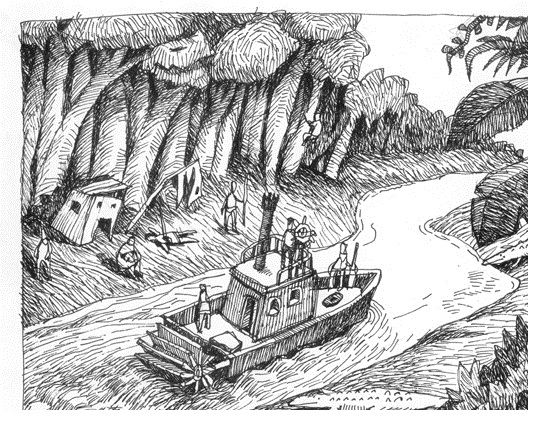
(789 Words)
In Joseph Conrad’s Heart of Darkness, we find the protagonist Marlow, a man of adventure having sailed many a sea living in an era of the Victorian explorer David Livingstone who had not long returned from his African expedition in 1890. This is where tales of African exploration were told of different lands; those inquisitive minds couldn’t help but see the attraction of Livingstone’s journeys to this continent. Accompanied with this, is this new found land that is the reverse of Marlowe’s attraction to see Africa, it is where he gets a candid look at the reality of colonisation and imperialism. The journey for him finds the attraction and revulsion of it all.
In the opening scene, we see Marlow as the only one on the boat who still “follows the sea”. This seaman still sees the appeal of the open rivers and seas. He is a “wanderer”. Maps have always fascinated him, the blank spots, and those places yet explored. He wants to explore the inner Africa, the place associated with darkness. He wants to travel further into the long Congo, a captivating and extremely life-threatening river that lies like an immense snake. He remarks of the river that it is like traveling to the earliest beginnings of the world, the brilliant sunlit land offers ‘no joy’ but a “treacherous appeal”.
Even early on we get an idea of the revulsion Marlow experienced as he sits on the boat in London. He allegorises to the Ancient Romans who came to conquer England when it was untamed with Pagan natives running about, how they would have felt with the immense darkness and the abomination of Celtic England. He imagines this making the Romans want to escape. His allegory points to the mess of the Congo where Marlowe sees colonisation as “robbery with violence”.
The Congo is a jungle wilderness, the object of attraction. Ivory is the new gold, hardly a necessary item for survival. A desolate land far removed from the Industrialisation of white man England. Marlow’s view of the people he knows, the white race, those people who should be sophisticated are that of ones insane and pointless. How could people change so much? It is, however ‘reality’ for the men and that is all that civilisation cares about. The wilderness shows the greed and brutality that lie under the noblest of ideals.
On a more personal level, Marlow does see an attraction to the black man. He remarks they wanted no excuse for being there. He shows his attitude towards the black Africans where he says “the worst of it is suspecting they are not being inhuman”. Then there is Kurtz, an ivory trader sent by a Belgium company into the heart of the Congo, who on the other hand succumbs to the savagery of the wilderness. His aspiration is gone and he has “kicked himself loose of the earth”. The wilderness brings out the darkness and brutality in his heart. The natives didn’t invite the imperialists; they just turned up and gave orders.
Marlow continues his journey where some people would have given up; the desolation of it all is strange to see. Here you find the attraction for Marlow, he battles on to the “inner station”, there must be something inside him that wants an answer, that wants to see more, although at the same time repulsed by the sights he sees. Going up the river was like traveling back to the earliest beginnings of the world, a past remembered: “in the shape of an unrestful and noisy dream.” The brilliant sunlit land offers “no joy” but a “treacherous appeal to a hidden evil, to the profound darkness of its heart.” The rape of the land is revulsive to Marlow, as he travels past the settlements of the white man with their inefficiency and brutality.
Marlowe certainly develops a strong purpose up the river, past the native villages and colonial agents in their settlements, to see and talk with Kurtz, the supposed beacon of civilisation, that it becomes somewhat of an obsession with him. He wants to see the darkness in man, which has developed his ardent resolve. Along the way, Conrad’s main purpose in this story is the discovery and analysis of the black and white man. His search is for the inner truth. The black man typifies truth and reality which is an attraction while the revulsion can be pointed at the white people.
Marlow after his long battled journey finds Kurtz, a so-called god at the Inner Station. Kurtz on his deathbed blurts ‘the horror, the horror’. Marlow has achieved his goal, the attraction of it all has reached its peak and the revulsion of the inner station has been seen.
.

