TEFL
Giving and Receiving Feedback, It Will Never Be Easy But It Can Be Better
(633 Words)
I think at times teachers can have a little trouble with receiving and giving feedback. Their feedback skills could be said to need a little practice. I think this is important because as a teacher you will need feedback from your students to tell you if they like your teaching. Also, the students will want feedback on their learning. Each piece of feedback needs a positive, constructive base.
A first reaction, when thinking about feedback, may well be to go on the defensive when it is given. On the defensive, I mean that you are not really listening to the person giving the feedback. The point is feedback is information that can be heard by the receiver as evidenced by the fact that they do not go on the defensive. I agree that feedback has great value but only to us if we can let the feedback in and effectively use it.
There is also ineffective feedback. These are judgmental statements and can upset people. During a reflection, a teacher was told they were talking too much in class but the observer seemed to forget to look at the students who were fine with this talking. Other people said it was a lower level, and the students did not talk much anyway. Would you feel bad for the teacher? Was the observer too opinionated?
Another aspect is getting feedback but not using the experience as a positive move forward. The observer is just making a comment. The teacher needs to ask them such questions as ‘Why’? and ‘What do you think is better?’ For future actions, a teacher should take the time to realize that they could be wrong and that they should take in the information (feedback) that has been given. They should ask for clarification and realize that it is not a battle, and the comment is to help. They should reply with what they think. Thus hopefully getting a discussion going.
Moreover, the information that is given in the feedback can be shut out. Teachers sometimes lack the skills to send and receive feedback. For example, a teacher thought of a lesson plan idea and mentioned it to another teacher. Basically, they were told that the lesson plan was off-target because the lesson was not student-centred thus in the lesson plan the teacher would speak more which they are not supposed to do. The problem was that the teacher had thought about this lesson for a long time and had it planned. Now the first reaction, when they were told it was off-target, was to get a little angry. They felt as though it was an attack against them personally. Maybe they felt as though they were not good enough; their ideas were not good enough. So, they felt a bit sorry for themselves. One idea could be to say, “shall I forget about that lesson plan?’ and if they said ‘yes’, say to them “what do you think then?” or “how can I develop it?” The teacher could have asked why they thought it was off-course and what ideas the teacher should think of. The teacher should have got to the bottom of their thinking as they might think up another lesson plan like this and have the same trouble again.
In conclusion, a teacher’s acceptance of feedback does not mean that they need to always act on it. The feedback should have been encouraging, helpful, and given with clarity. If so, then the teacher needs to consider the feedback, and decide how, if at all, they wish to act upon it. This is strictly their choice, but it is important to bring to mind that the person giving the feedback felt strongly enough that they mentioned it. Let’s face it, how would you react in any given feedback situation?
Teacher Classroom Observation Questions
Do second language students often ask for clarification, verification, or correction?
Do the L2 students co-operate with their peers or seem to have much contact outside of class with more proficient users?
Do your lesson plans incorporate various ways that L2 students can learn the language you are modelling, practising or presenting, in order to appeal to a variety of learning styles and strategies?
Does your teaching allow L2 learners to approach the task at hand in a variety of ways? Is your Learning Language Strategy training (LLS) implicit, explicit, or both?
Is your class learner-centred?
Do you allow L2 students to work on their own and learn from one another?
As you circulate in class, are you encouraging questions, or posing ones relevant to the L2 learners with whom you interact?
Do L2 students seem to have grasped the point?
Did they use the LLS that was modelled in the task they were to perform?
What improvements for future lessons of this type or on this topic might be gleaned from L2 students’ behaviour?
Questions for students
In this class:
I want to….
will/won’t….
My favourite/least favourite kinds of class activities are…
I am studying English because…….
Journal Questions
This week:
I studied…
I learned…
I used my English in these places…
I spoke English with these people…
I made these mistakes…
My difficulties are…
I would like to know…
I would like help with…
My learning and practising plans for the next week are…
Teaching Young Learners – Working with a Course Book
TASKS
Look at some of the material and state how you would make the lesson interesting by supplementing or expanding upon the content of the page.
- Swimming pool
For this exercise, I would personalize the exercise by giving the characters who say something in the picture names. As an introduction, I would follow the original lesson getting the children to repeat the sentences but each time I moved on to each person I would elicit some more ideas and vocabulary relating to that person.
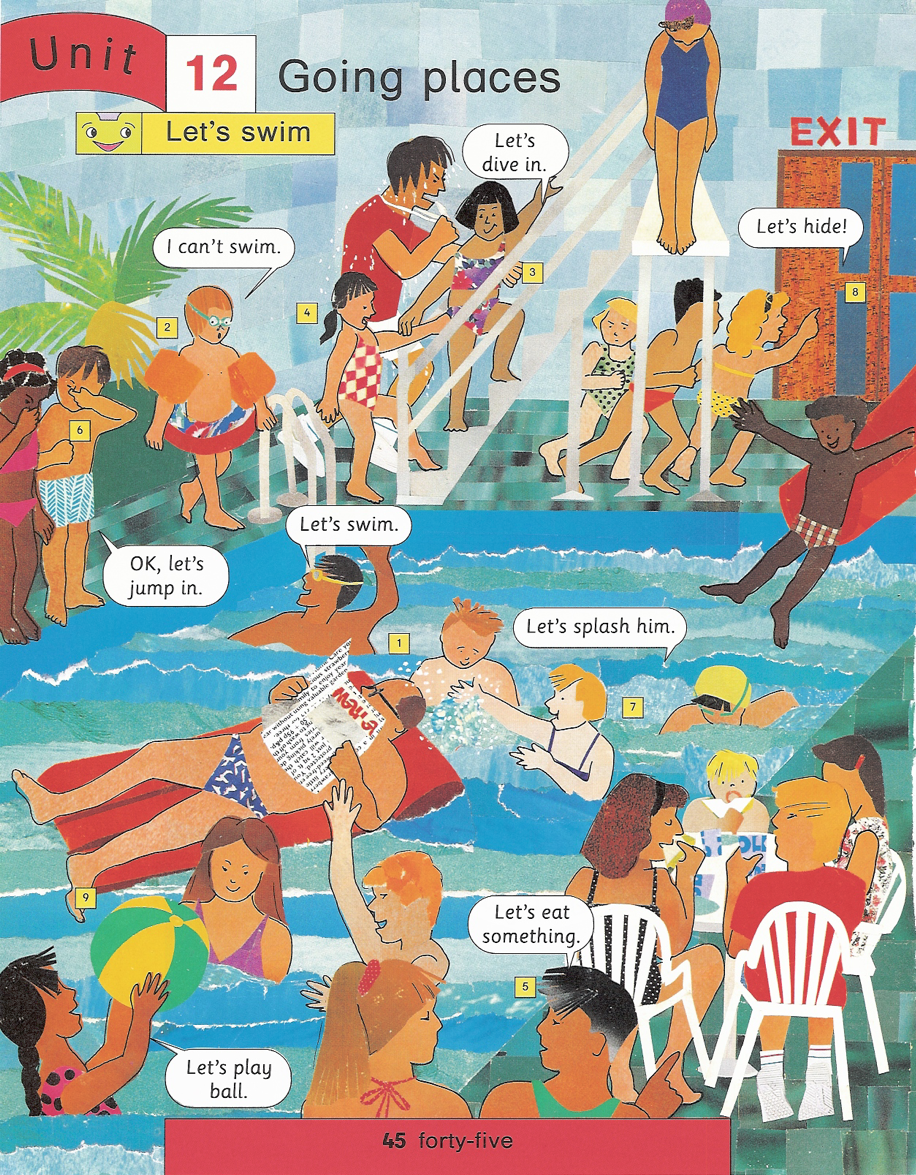
For example, Dave, who says ‘let’s eat something’
Is Dave swimming?
What color hair does he have?
Who is he with?
After completing the exercise, having discussed each person saying something, I would give the learners a freer practice. I would get the learners into groups and get them to look at the pictures and elicit any more information from the picture. I would then get them to write 2 sentences each for 3 people.
For example He is wearing goggles. She is playing with a ball.
I would now take the pictures away from each group
I would then have a quiz where each group has to ask say 2 sentences and then ask two questions. This would be repeated two times.
For example 1. He is wearing goggles. He has ginger hair.
What is his name?
What does he say?
2. She is climbing the stairs. She is with a friend.
What is her name?
What does she say?
The teacher and learners could check all the scores to see who has won the little competition.
2. Objects
For this activity, I would expand it by getting the learners into pairs and giving them identical pictures. These pictures could have a street scene or just objects. Although the pictures and the objects in the picture are the same, each of the learners has some of their objects colored in and others left blank (white). Some of the objects are colored the same. For example, in picture 1 the car is red but in picture 2 the car is blank, but picture 1 has a blue bird and picture 2 has a blue bird. The learners complete the task by sitting opposite each other so they are not able to see each other pictures. The task can be done like the game of battleships where they have a screen to divide themselves. It is up to the learners to work together telling each other the colors of objects in each other’s picture. They complete the drawing by coloring every object until they have identical colored pictures. The teacher can have a feedback session with the learners to check over their work.
Teaching Young Learners – Songs, Rhymes and Chants
Task One
Where would you put the stresses on the following rhyme?
I would put the stress on the vowel (letter strings) in each sentence, showing rhyme. Nearly all of these vowel sounds also marry up with the final consonant sounds (n-ew-s / sh-oe–s). I would give the students more examples of these sounds (choose, lose, blues). With younger learners I think vowel sound is important but also the sound they make with the final consonant.
Have you heard the latest news? Isabel has bought new shoes
And did you know that Harry’s dad has got a dog that’s completely mad?
Well, Alice copied Tommy’s work and she’s taken Helen’s skirt
Johnny Jones has been much worse, he’s stolen money from Angie’s purse
Wait till you hear what Cathy’s done, she’s eaten a worm, just for fun!
Task Two
Choose a song or devise an activity that can be used in the classroom. State the age you have in mind.
1. Old MacDonald’s Farm
Age: Young learners
Aim: Practice listening and singing
Practice listening for animal names and sounds
Preparation: Collect pictures of a farm and a farmer, models of animals
1. The teacher starts by showing a picture of a farm and a farmer.
2. The teacher asks the learners ‘who and where is this?’ and gets them to call out the place and hopefully the farmer’s name (Old MacDonald).
3. The learners are told this is ‘Old Mac Donald farm’. The students are asked ‘What animals can you see on a farm?’
4. The students can shout out the names of animals. The teacher can check that they know the English word for the animals.
5. The teacher gets the children to think about their favourite animal that lives on a farm.
6. The teacher then shows some models of animals including the ones in the song. The names for the animals are elicited and chorally drilled.
7. The teacher then asks ‘what sound they make?’ The teacher gives examples.
8. The teacher already has prepared sheets of paper to match animals and their sounds. The teacher gets the learners in groups and gets them to match the animals and sounds. This helps to solidify the exercise a little more.
9. The teacher gives each group the animal models from the song. She tells the group when they hear in the song an animal’s name she wants them to grab the animal. This helps them get an idea of the animals in the song. She plays the song and lets the groups grab the animals. She checks who got the most animals in each group.
10. If it is necessary, stop the song line by line until they get the idea.
11. The teacher gets the learners to sing the song together with the accompaniment provided by the tape. The children may learn very easily by using echoic memory. The teacher could promote mimics, gestures, etc. associated to the meaning to make children play a participative role freely.
12. A follow up could be that the learners make their own farm or individual groups come up to the front and sing.

