TEFL Trainer
Group Work: An Exploration of Its Effectiveness in Language Learning
Classroom Research
Abstract
This paper explores issues that arise when teachers do not receive the responses or levels of participation they expect from students. It considers ways in which teachers can develop greater awareness of their students’ learning needs, while also encouraging students to become more aware of their own learning position, responsibilities and objectives.
A particular focus of the research is the use of group work as a means of encouraging students to work collaboratively towards shared language-learning goals. The paper considers how teachers can best support group work within the classroom and, in doing so, encourage students to become more active and increasingly self-directed learners.
Introduction
There is widespread agreement among researchers that cooperative methods can have a positive effect on student achievement (Slavin, 1989). Group work is one pedagogical strategy that promotes participation and interaction between students. By allowing students to participate more actively, teachers can create opportunities for a wider range of ideas and responses to emerge.
Group work can also encourage a deeper and more active learning process. Students are exposed to different approaches, opinions and ways of thinking, while working collaboratively can create a stronger sense of belonging. This may help to reduce the anonymity, isolation and shyness that some students experience within a traditional classroom environment.
Working together also provides students with opportunities to learn from, and teach, one another. Classroom research suggests that students can often learn effectively from their peers because they are able to explain ideas and concepts to one another in ways that may be different from those used by the teacher.
For the language teacher, failing to recognise the potential of the whole class can result in a narrow approach to learning. Teachers can, sometimes unintentionally, create barriers that restrict the development of both themselves and their students. Students may become increasingly removed from the learning process if they are not active participants.
This research therefore aims to explore how group work can strengthen the classroom as a community of active learners. In a one-hour lesson involving twenty learners, for example, the opportunities for each student to use English individually are inevitably limited. Group activities can substantially increase these opportunities by allowing students to communicate with several other learners and use English for meaningful purposes.
More Hands Make Lighter Work
Group assignments can easily be planned or implemented poorly, and when this happens they may fail to produce the intended benefits. However, when group work is carefully designed and appropriately implemented, its benefits within the classroom have been well documented.
The following discussion considers some of the benefits of group learning before examining the conditions necessary for effective group functioning. It then considers practical approaches to using groups in the classroom. If appropriately applied, these approaches can make group work a satisfying and productive experience for students and may even become one of the most valuable elements of a course.
Benefits of Group Learning
The benefits of group learning identified in the literature can broadly be divided into three categories: cognitive gains, affective gains and professional gains.
Cognitive Gains
Michaelson (1983) suggests that group learning can result in students becoming actively involved in the learning process. Students receive immediate feedback, have access to individual help and are given opportunities to work on challenging problems. Group learning has also been associated with the development of higher-level problem-solving skills.
Other researchers have suggested that group work encourages students to take greater ownership of their learning (Bouton & Rice, 1983). This sense of ownership can contribute to a more positive attitude towards education and learning (Slavin, 1989).
Affective Gains
Although the cognitive benefits of group learning are important, the affective benefits should also be considered. Davis (1993), for example, notes that group work can be particularly effective in influencing the attitudes of group members.
Slavin (1989) identifies evidence suggesting that group learning can improve attitudes towards diversity. When students work with people from different racial, ethnic or cultural backgrounds, opportunities arise for them to develop greater understanding, liking and respect for others.
This is particularly relevant to language learning, where communication involves not only the acquisition of linguistic knowledge but also interaction with people who may have different experiences and perspectives.
Professional Gains
The benefits of group learning can also extend beyond the classroom. Millis (1995) suggests that group learning can help prepare students for an increasingly team-oriented and culturally diverse workplace.
Kraft (1985) identified several characteristics that employers desired in college graduates. These included:
- Reasoning and problem-solving abilities.
- The ability to read and interpret written materials.
- The ability to write clearly and concisely.
- Oral communication skills.
- The ability to work effectively with others.
Many of these abilities are directly encouraged through group learning. If one of the purposes of education is to prepare students to function effectively in the workplace, then learning to work collaboratively would appear to be an important part of the classroom experience.
Group work is likely to be most effective when assessment recognises both individual and group contributions, potentially including an element of peer evaluation.
Group discussion can also be strengthened when students recognise that misinformation exists and accept responsibility for questioning and correcting it rather than simply repeating it. Most students do not necessarily want to express their opinions without purpose; they want to leave the classroom feeling that they have learned something from the discussion.
Creating a classroom atmosphere in which students work collectively to discover and evaluate information can therefore shift the focus away from personal disagreement and towards the shared objective of developing better understanding and critical thinking.
Hypothesis: Getting Students Working
Students’ awareness of their learning goals can be questioned, as can their motivation and general attitude towards learning. My hypothesis is that the more aware students become of what they are doing and why they are doing it, the clearer their goals may become. Increased awareness may therefore lead to greater attention and engagement.
Active learning may be particularly important in language classrooms. However, there are several difficulties that need to be considered.
Firstly, where students have little genuine need to communicate in English, communication in the target language may appear artificial or unnecessary. Secondly, where learners share a common culture and are often of a similar age, there may be limited curiosity about what other members of the class think or do. This can reduce the usefulness of activities that depend upon students discovering new information about one another.
Thirdly, there is an interesting paradox in language learning: the more interesting or motivating an activity is, particularly when it contains a competitive element, the more likely students may be to use their mother tongue in order to complete the task successfully or quickly.
Finally, communicating in a foreign language requires greater effort than communicating in one’s mother tongue. Students may therefore naturally revert to their first language when they believe this will enable them to complete a task more efficiently.
Active learning can broadly be understood as anything students do in the classroom beyond passively listening to a teacher’s lecture. It can include listening activities, short writing exercises, responses to teaching material and more complex group activities in which students apply course material to real-life situations or unfamiliar problems.
Cooperative learning represents a particular form of active learning in which students work in groups, often involving three or more learners. Cooperative learning activities are generally more formally structured, with students being given complex tasks such as multi-stage exercises, research projects or presentations.
Collaborative learning is related but can be distinguished from cooperative learning. Collaborative learning places the teacher and students on a more equal footing, with students potentially becoming involved in designing assignments, selecting texts or presenting material to the class.
For the purposes of this research, the focus is primarily on active and cooperative learning techniques that can be incorporated into the existing classroom structure.
The Theory of Group Work
When considering group work, it is important to recognise that a group is more than simply a number of students sitting together. The structure, development, behaviour and relationships within the group can all influence its effectiveness.
The Structural Approach
When establishing the structure of a group, several factors need to be considered:
- The patterns of relationships that appear to exist between members of the group.
- The sub-groups operating within the larger group and the relationships between them.
- Whether members are constrained by the way in which the group has been established or structured.
- Whether a particular model or pattern is influencing the structure of the group.
Processes and Stages
It is also important to consider:
- The stage of development that the group has reached.
- How far the group has progressed towards its objectives.
- Whether the natural lifespan of the group is approaching its conclusion.
Group Behaviour
The behaviour of the group can provide useful information. This includes:
- Changes in group behaviour following the achievement of early objectives.
- Problems arising from interactions between group members.
- Distractions introduced into the group process by one or more members.
- The contributions made by individual members and what these contributions reveal about the roles they have adopted.
Rules and Functions
The teacher should also consider how the group:
- Accepts and operates within the boundaries established for it.
- Develops a hierarchy of members and whether some members have greater influence over existing rules.
- Develops and adapts over time.
- Responds to the need to accept agreed rules and carry out its functions.
- Recognises and fulfils the roles allocated to individual members.
Group Dynamics
The dynamics of the group should also be observed. For example:
- Is one member dominating normal interaction?
- Is the agreed agenda being followed, or is pressure developing to change it?
- Is the group becoming focused on the immediate situation or on what has already happened rather than on its objectives?
- Is there any reduction in the group’s shared sense of purpose?
Interactions
Finally, it is important to consider whether the group is functioning in a way that:
- Keeps interactions directly related to the purpose of the group.
- Encourages functional rather than dysfunctional interaction.
- Allows emotions and thoughts to be expressed.
- Prevents emotions and thoughts from becoming unnecessarily repressed.
Parameters of the Study
For my research, I used a group of intermediate-level students consisting of fourteen learners. There were ten female students and four male students, ranging in age from approximately sixteen to thirty-five.
I taught the group for thirty hours over one term of study. The research reported here focused on approximately ten hours of teaching, covering four lessons over a two-week period within the six-week course.
For the inquiry, I used triangulation, involving a variety of techniques to collect the data required to address my research question (Freeman, Doing Teacher Research, p. 96).
Setting Ground Rules
In many classroom situations, teachers can reduce the likelihood of students making hurtful or inappropriate statements by establishing ground rules at an early stage of the course. This can be particularly important where controversial or sensitive topics may arise.
Ground rules can be introduced during the first days of a course and should provide a framework for discussion that everyone is expected to follow. Students should be given the opportunity to review the rules and contribute to the agreement by clarifying them or suggesting additional guidelines.
When problems arise later in the course, both teachers and students can refer back to the ground rules that were collectively established. Involving students in the creation of these rules also encourages them to consider what constitutes a productive discussion and how a classroom can become a safe environment in which everyone feels able to participate.
Ground rules do more than prevent students from making potentially harmful statements. They can also encourage fruitful discussion and critical thinking. Even when the subject matter is not controversial, such guidelines can help students understand that speaking in class should contribute to learning rather than simply provide an opportunity to express personal opinions.
Establishing a “Zone”
Establishing a safe classroom atmosphere is important in increasing students’ confidence and comfort. As discussed above, this can begin with clear ground rules for controversial, emotional or potentially offensive topics.
Introducing these expectations at the beginning of a course can prevent some problems from developing later. However, there is also a possibility that overly formal rules may inhibit the free flow of ideas. The approach therefore needs to be compatible with the objectives of the course and with the teacher’s personality and teaching style.
The challenge for the teacher is to establish sufficient structure to support productive interaction without creating so many restrictions that students become reluctant to communicate freely.
Research Method
For group work to be successful, there needs to be an environment in which students want to participate and can learn from one another. This became an important focus of my research.
There are many aspects of teaching that require reflection. In my experience, active student involvement in learning can increase what students remember, how effectively information is assimilated and how successfully learning can subsequently be applied in new situations.
When students explain their thoughts about a class topic to their peers, they are required to articulate those thoughts clearly and make them available for examination by others. At the same time, listening to their peers exposes students to different ways of interpreting and applying classroom material.
This can provide students with a wider range of examples of how information can be used. In a course that emphasises the application of knowledge, therefore, participation in classroom discussions can become an important part of learning.
For this reason, I attempted to vary the organisation of the class and move students around so that they had opportunities to work with different people. From my observations, this appeared to be an effective way of gaining students’ attention.
One approach involved the whole class working together as one large group. My perception was that students generally enjoyed working together, and the arrangement allowed them to ask more people for help when they encountered difficulties.
A further approach was to arrange students in a complete circle so that they could see and listen to one another more easily. I also used smaller groups for reading tasks in which students had to identify positive and negative aspects of a text.
While observing the students, I began to recognise that the size of the group was important. If groups became too large, the intended teamwork could be weakened because students might become less directly involved in the discussion.
One method I developed during the second lesson was to nominate one person in each group of four as a secretary. This student was responsible for writing while the other members concentrated on speaking and discussing their ideas.
I felt that this small group arrangement worked well because the students had to ensure that the secretary recorded their information accurately. I also asked all students to speak at the end, so their ideas were represented both verbally and in writing.
The size of the group appeared to be particularly important. With four students, there was sufficient opportunity for everyone to contribute without the group becoming too large.
Getting the group to speak also meant that other students could hear different points of view and question them. Their ideas were therefore expressed twice: first within the smaller group and then to the whole class. I regarded this as a useful test of participation because it provided each student with an opportunity to speak.
I also observed some students negotiating over who would speak first. I interpreted this as evidence that the activity presented them with a genuine challenge and required them to take responsibility for their contribution.
Student Responses
The students’ comments were critical to this inquiry because they provided an opportunity to compare my observations with their own perceptions of group work.
When I questioned the students about the group format, there was strong agreement that group work was an effective form of learning. Most students identified group work as a useful way to share ideas and opinions, including opportunities to develop an understanding of new vocabulary.
For me, an important aspect of this was the opportunity for students to share their English and demonstrate their ability within the class in response to the tasks set by the teacher.
Only one student specifically identified enjoyment as a benefit. However, I believe that enjoyment has an important place within learning. Students may be physically present in groups, but if they are not interested in the activity, they may be less willing to engage with the task.
A lack of interest may also affect students who are susceptible to peer pressure, potentially preventing some learners from participating fully.
My observations also highlighted the importance of the physical arrangement of the classroom. For example, I noticed that Steve recognised the value of a group format but did not arrange the students in a circle. As a result, students were not always facing one another, which may have reduced opportunities for communication and made it more difficult to hear other speakers.
In one group, I observed a student writing the answers while another student appeared to lose interest. This reinforced my view that the physical organisation of a group can influence participation.
I also concluded that students need clear and precise instructions. During Steve’s introduction to one activity, students were asked to write about cars, but the initial explanation was not sufficiently clear. Individual students appeared to be trying to interpret what they were expected to do and several were uncertain about where to begin.
Steve recognised this difficulty and rephrased the task, eventually writing on the board: “What do you use a car for?” At this point, the students began producing the expected material.
In retrospect, I felt that this activity could also have been introduced through group work, allowing students to help one another understand the task. Approximately five or six minutes passed before the students became fully engaged in the learning activity.
This observation reinforced my view that group work can be a valuable element of teaching, but that it requires careful planning. The students appeared to value groups partly because they provided opportunities to meet other people, exchange ideas and use language collaboratively.
Evaluation of Results
One effective format appeared to be arranging students in a complete circle so that they could listen to one another more easily. I also used groups for a reading task in which students were asked to identify positive and negative aspects of an email.
Initially, I noticed that the students were largely working individually, with their heads down and focused on their own work. This led me to question whether the group was too large or whether the task itself was sufficiently collaborative.
This observation reinforced my belief that large groups can sometimes hamper effective teamwork. In response, I used the secretary system described above, with one student responsible for writing while the other members concentrated on discussion.
The group of four appeared to work effectively because students needed to communicate their ideas clearly enough for the secretary to record them accurately. I then asked all students to contribute verbally so that the information was communicated both through writing and speech.
Again, the relatively small size of the group appeared to support participation. Asking students to present their ideas also provided an opportunity for others to hear and question their points of view.
The ideas were therefore communicated first within the group and subsequently to the wider class. This gave students repeated opportunities to use the language they had been learning.
Group Awareness
Sample Lesson Plan
Aims
By the end of these stages, students will have developed an awareness of direct and indirect questions through a series of activities.
Materials
Sentence strips.
Stage 1
The teacher asks students to examine a series of questions and identify what makes the questions polite.
The teacher then explains the difference between direct and indirect questions and checks whether students can identify the differences between the two forms.
Stage 2
Students change direct questions into indirect questions.
Stage 3
The teacher provides students with questions and asks them to interview five friends. The activity is then followed by whole-class feedback.
Stage 4
The teacher explains that students are going to take part in a general knowledge quiz and provides several examples, such as:
- Could you tell me who the President of the United States is?
- Do you know which team won the Premier League in England this season?
- Do you know how much one pound is worth in Thailand?
Stage 5
The teacher divides the students into two groups. Each group is asked to develop questions and then ask them to the other group.
Evaluation of Results
My initial view was that group work could be an effective way of supporting learning, but I wanted to examine the students’ data to determine whether their responses supported my observations.
Rather than focusing on one specific question, such as which seating arrangement students preferred, I examined the responses to all six questions that I asked the students.
I organised the data into two categories: “ways of understanding” and “problems”. I placed these headings at the top of the page and organised the responses beneath them.
When reviewing the data, I found that students frequently referred to group work as a “way of understanding”. Responses included comments such as “some people to help me” and “I like debating”. These responses appeared to emphasise the value of having more people with whom to use language and discuss ideas.
This was particularly evident during the fourth and final lesson, when I was teaching indirect questions.
Initially, we worked through how the sentences were formed, and the students changed five direct questions into indirect questions. This was a relatively steady progression through the grammar point.
I then gave the students sentence strips containing indirect questions. Once the students were given the opportunity to stand up and use the questions with their peers, I was struck by the change in their reaction.
The students appeared relieved to be standing and actively using the language. The whole class was initially working together, before naturally developing into smaller groups and pairs. This created a much more active classroom environment.
I felt that the activity was successful because the students appeared enthusiastic about communicating with one another. They became absorbed in the task and began asking me questions about how particular questions should be answered.
This suggested to me that their learning and language acquisition were becoming active processes rather than simply something they received from the teacher.
It could be argued that some of the students’ reaction resulted from the simple fact that they were no longer sitting down. However, I believe that the previous grammatical preparation was also important. Once the groundwork had been established, the students were given an opportunity to experiment with and use their new language.
Again, the central theme was the whole class working together as a group, while also allowing students to move between smaller groups and pairs.
Summary of Results
The data collected showed that 12 out of the 14 students questioned identified group work as their favourite approach to learning.
The students’ responses also indicated that group work was valued as a way of sharing ideas, receiving help from others, debating and developing an understanding of new vocabulary.
The findings therefore broadly supported my initial observations that group work could increase opportunities for communication and encourage students to become more active participants in the learning process.
Discussion
The findings from this research have encouraged me to think more carefully about what happens when students are given responsibility for communicating with one another.
My observations suggest that group work does not automatically produce effective learning simply because students are placed together. The size of the group, the physical arrangement of the classroom, the clarity of instructions and the structure of the task all appear to influence the extent to which students participate.
The use of smaller groups, particularly groups of four, appeared to provide a useful balance between having enough students to generate ideas and keeping the group small enough for everyone to participate.
The role of the secretary was particularly useful because it separated the processes of writing and speaking. This encouraged the other students to concentrate on communication rather than spending much of the activity writing individually.
The research also demonstrated the importance of movement and classroom organisation. When students were able to stand, move around and speak to different classmates, their level of apparent engagement increased.
This was particularly noticeable during the indirect-question activity. The students appeared to enjoy the opportunity to use the language they had been practising in a more natural and communicative situation.
However, the research also showed that group work needs to be carefully supported by the teacher. Clear instructions are essential. Where instructions are unclear, valuable learning time can be lost while students try to establish what they are supposed to do.
The teacher therefore has an important role, not necessarily as the person who provides all the information, but as the person who creates the conditions in which students can learn from one another.
Conclusion
To conclude, the weeks I spent working in the classroom and analysing the data have given me a clearer perspective on many aspects of teaching and learning. In particular, the research has changed the way I think about students’ acquisition of language.
I have come to understand the students to a much greater extent. Before undertaking this research, it was possible for me, as a teacher, to become absorbed in delivering a lesson and consequently lose sight of how students were actually acquiring the language.
This research has reminded me that teaching should not simply be about delivering the planned lesson. Students need opportunities to be tested, challenged and, importantly, to enjoy their learning without being unnecessarily restricted by the teacher.
The teacher needs to be there to support students and to act as a means of facilitating their acquisition of a second language. I have also come to recognise that the teacher needs to remain relaxed and responsive.
Although lesson planning and objectives remain important, I believe that the teacher should not become so concerned with delivering the lesson perfectly that they lose sight of the students’ actual learning.
The most important lesson I have taken from this research is that teaching involves paying attention to the students as much as to the lesson itself. There are many different aspects to teaching, and I recognise that I am still developing my understanding of the wider teaching process.
This research has, however, opened up many possibilities for further investigation. I would like to continue researching group work because every class is different, teaching methods continue to change, and students themselves bring different needs, experiences and expectations to the classroom.
For me, this is perhaps the most important conclusion from the research: effective teaching requires the teacher to remain observant, reflective and willing to adapt. Group work has shown me that students can contribute significantly to one another’s learning when the classroom environment gives them the opportunity to do so.
TEFL Teacher Trainer – Roles and Responsibilities
As a teacher of TEFL to prospective teachers, there are first a number of general responsibilities for the daily teaching job. I must provide a learning environment that is conducive to a TEFL learning atmosphere. I must be teaching the methods of TEFL using recognised teaching methods. I also have to show how TEFL would be taught in the classroom. This means explaining my methods of teaching a foreign language that mirrors methods that can be taught in their classes. Furthermore, I need to show future teachers how to interact with others and help them with their initial questions and understanding of TEFL. I have to instruct them on the basics and fundamental needs of a career starting in TEFL teaching which will teach them to be creative and provide them with an understanding of what will entail when they take up their first teaching role abroad.
My job has a range of specific duties, I must complete on a daily basis. I have to create a lesson plan that fulfills all the units of study that the students have to understand, complete, and reflect on. This learning of the basics of TEFL teaching gets the students ready for their employment abroad with a deeper upstanding that will give them confidence. I have to set an educational plan for each day so I am satisfied I have completed all that is needed to be covered for the TEFL certificate while making sure all the students are involved individually and in groups while being interested, informed, and challenged.
Within the 20 hours of teaching practice the trainee teachers take, I must prepare creative activities for the students to complete. These activities although for the benefit of the teachers must also highlight the teaching methods of TEFL as the groundwork for their future needs. It is my prerogative to apply strategies that highlight TEFL teaching methods. It is important to be creative as this is fundamental to the methods of teaching TEFL. This involves group work, presentations, teaching practice, feedback, and reflection.
I have to also monitor the students’ development over the course. This entails helping them with their ideas, teaching practice, and showing them how to teach. I must also recognise those who are taking the course and not showing a willingness to complete it or who think that just appearing is a pass. These people have to be spoken to or encouraged to work as an individual and in a group to complete all tasks and to complete the certificate program that agrees with all TEFL accreditation.
Form Meaning Use – Lesson Evaluation
I used Prezi presentation for this class. I used the same material, but this time I put it up on the screen for the students to see. I think this worked a lot better. I think sometimes the students do not follow you that well when you hand out sheets and start talking about it. I have noticed they do not follow that well. So, this time I had both, sheet and Prezi. This went a lot better. I also added a story for them to follow as I was teaching an understanding of sentences and the use of a story very much highlighted the concept that I was putting across. It was amazing as well how many students kept asking questions for clarifications. Of course, they are native speakers and the story had missing information, but I thought it was great because as an English teacher they were asking questions in English. One point of issue is that at the end of my presentation I asked the students to try Form Meaning Use in a sentence, but they just used my last example and thought they had to copy that. I did not follow that they only thought they had to copy my last example and not make up their own. I thought I made it clear.
Reflection
Firstly, I started using Prezi for this class as it was new to me and I certainly found the benefits of it worked for the class. This was part of my reflection process as I was debating from the last class how to improve. It was hard to just get the students to follow me on the sheets, so Prezi worked well. I also improved my explanation of Form, Meaning, and Use. I now started to include a demo lesson to explain the point which highlighted the lesson subject far clearer. I feel all my thoughts and subsequent changes to my lesson relate to points made by Richards and Lockhart that “much can be learned about teaching through self-inquiry” and also that “much of what happens in teaching is unknown to the teacher” (1994, p.3). I feel now that this lesson is where I want it to be, but it would not have been there if I had not made that ‘self-enquiry’. Moreover, as I mentioned in my first reflection that it was ‘amazing how many students kept asking for clarification.’ The students now have material that is of some quality for their studies that encourages questions and understanding.
Richards, J. C., & Lockhart, C. (1994). Reflective teaching in second language classrooms. Cambridge: Cambridge University Press.
A TEFL Trainer – Ofsted Quality Assurance
(1011 words)
Quality Assurance is a high priority for the company I work for. First of all, the students are our customers, so the company’s aims revolve around giving a high standard product that leaves the students feeling they made the right move to choose our company’s second language teaching course. For this piece of writing, I will outline some of the provisions my company and I have/use to not only keep the quality high but also to gain knowledge for improvement.
To promote equal opportunities
The courses I teach have students from many backgrounds, countries, and of varying ages. It is my job to accept all these people as achieving the goal of passing the course and being involved. For example, on the last course, there was a woman from Poland who was 28, an 18 year Englishman who was just taking his A levels, and an older Englishman of about 55 years of age. Taking these three as an example, they all had their reasons to be there, and the only way for them to pass the course was to work together as a group and as individuals. To promote this combination, my first job as their teacher trainer, as soon as they arrive, is to welcome them and get them introduced to each other, so they feel part of the group and they get the chance to meet each other. During the course, there are many pair-work and group-work activities, so it is my job to encourage collaboration between these kinds of people whatever their background. I promote peer and group evaluation where students constructively help each other. Eventually, when they come to complete their practice teaching in pairs there is encouragement from all the class towards a successful conclusion.
To identify, understand and learn from the factors which facilitate or hinder the students
The course has set modules, but within that, in my job as a trainer, I still have to make the students confident and knowledgeable about teaching a second language. In this respect, formative assessment is taken after each module to give feedback to the trainer, and for the students to be able to discuss how the course is progressing and their grasp of the facts so far. For example, one formative assessment has each of the students choosing to stand in a particular corner of the room which relates to their experience and knowledge of the class they just had. One corner may have the statement, ‘I have a question’. The students who stand in this corner have a chance to discuss issues they may have. They are then told to write down some questions they may have which are then discussed with the trainer and the rest of the group. The trainer can take away this assessment to improve on the next lesson while the students have been given a platform to voice their problems (good or bad). The reason for writing their ideas is that the trainer can take away the material and assess it to see for improvement.
Post Course Feedback from students
Once the students’ course is complete, they are sent a feedback form where they are given chance to comment on the course and the trainer that delivered the course content. That feedback is collated by my company and discussed with them internally. If need be I am contacted and made aware of issues that the students had or content that was valuable for the students. Correspondence is always made between myself and my manager post-course to discuss issues.
To set and achieve high standards and targets across all provision
For the 20 hours of study, a scheme of work and lesson plans are written detailing all aspects of the course. This makes provision for the encouragement of active learning while giving available time for the students to practice their teaching and discuss material. There are also resources for the students to use and contemplate over that show course content. The trainer also uses Prezi presentation facility to help students understand the content clearly.
Observation (form and feedback)
Over the 20 hours of study, the students complete two practice teaching lessons. They are given help in completing their lesson plans by the trainer. This sets them on the right path while lesson stages are discussed. This puts them in good stead for performing for the first time in front of the class. Once they start their practice teaching they are observed by the trainer who completes an observation form. This form is given to the students which includes all stages and the techniques they used in their lesson as well as comments on how they performed. There are also comments on what may need to be changed in their next practice teaching. This form is given to them for them to contemplate over and ask questions if need be. Also, after their teaching is finished as a group there is a feedback session where students can make comments on what they liked, and maybe what they would change. I feel this gives the students a holistic picture of where they are at with the course and their teaching.
Facilities for learning (To provide a safe environment)
The students are first welcomed outside the class. Coffee, tea, and biscuit are provided nearby. The students have seats and two sofas, so they can relax before the course starts. At times when there is a break, these facilities are used. The classrooms are adequate for the 15 to 20 students there are. There is a good size screen for the projector for the students to observe the course content. The table and chairs are put into a U shape which encourages discussion. The heating in the room is put on before the students arrive, so once they have had their coffee they are welcomed into the warm classroom. The provision for food is excellent as below the classroom there is a restaurant, and within 3 minutes walk, there is a newsagent and a Tesco store that sells less expensive food (sandwiches, crisps, and drinks).
Outline Enquiry Plan – Formative Assessment in teaching Trainee Foreign Language Teachers
(720 words)
Which aspect of your practice do you wish to develop?
With respect to planning trainee teacher lessons and the delivery of them, while making sure concepts delivered through each session focus on foreign language teaching, I still wonder within the short time allowed for each module the trainee teachers actually absorb the vital information given to them. Consequently, when they finish the TEFL trainee teacher course, they can put all these factors into practice in their new employment overseas. My job as an instructor is to help the trainee teachers become proficient educators. While I try to administer these various teaching sessions, I need to see more proficiency in the trainee teacher’s lesson planning and practice teaching where I can observe them using techniques they had already been taught to them over their time learning to teach a second language. This strengthens my thoughts and beliefs about how well they are achieving on the TEFL course and how well I have delivered the content of each teaching module.
What are your reasons for choosing the above?
Having used formative assessment in my classes before and been given written feedback on this, I consider this is a worthy method to check my (trainee teachers) students’ understanding of methods of teaching a second language at various stages over the length of the TEFL course. Of course, my assessment procedure needs work, and getting to know how much of the subject matter the students have processed is a major factor for myself succeeding in my class and personal pedagogically. My 20 hour part of the 120 hour TEFL course and the modules within it are each on a set time limit and students have some difficult days of study absorbing all the information. Within the 20 hours of the practical part of the TEFL course, the students have many modules to complete. From this, it means that students must be able to comprehend the subject matter for each module, take in all that the teacher offers and be able to show this in practice in their teaching as a final project. Although I am fundamentally teaching the basics of TEFL and what the students essentially need to begin their first teaching experience abroad, I still need to give them more than enough information to achieve this. This leads me to improve on improving on my approach, method, and techniques to enhance the learning experience that each and every student has grasped the subject matter of the module. The students then can walk away after the course feeling they have the confidence and the knowledge to prepare for their first foreign teaching assignment, while at the same time, the knowledge they have gained will inject that incentive to further their studies and their teaching. It is this inspiration through my teaching that I want to improve on. This, I feel, can be enhanced by formative assessment of each module during the TEFL course.
What relevant secondary sources (e.g. existing publications etc) have you found. How have they helped to clarify your research?
As teachers use assessment and learning dynamically, they increase their capacity to derive a deeper understanding of their students’ responses. This then serves to structure increased learning opportunities (Darling-Hammond, Ancess, & Falk, 1995, p. 131).
Inside the Black Box: Raising Standards Through Classroom Assessment By Paul Black and Dylan Wiliam
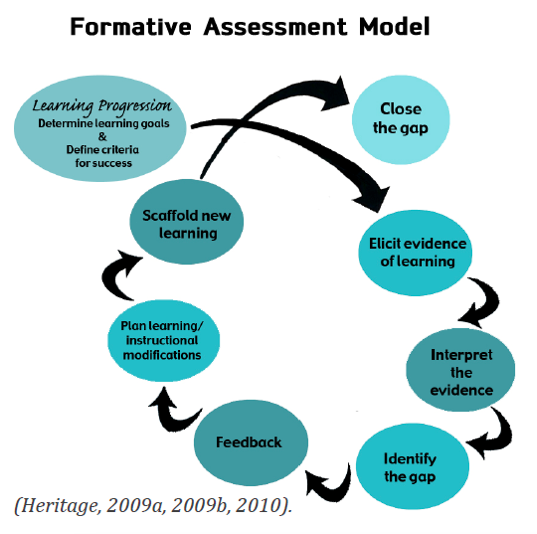
From my initial reading, I have come to recognise formative assessment as a vital part of the classroom experience. Black and William’s evidence shows that formative assessment is an essential component of classroom work. This has been very informative and is certainly a background for my research project. Black and William highlight that outside the box (the classroom) there are many initiatives and assessments for learning but this leaves out what really happens in the classroom and the teaching experience. It also makes mention to students competing in the class for the best results thus leaving out many students who feel let down by their education. This could change where students become more able to assess their learning thus far and be able to change that. I feel that the acknowledgment for my students that their learning is an ongoing passage through their course they (including myself) can regularly assess how they (and myself) are acquiring the knowledge to succeed thus helping both parties.

