TEFL
TEFL Teacher Trainer – Roles and Responsibilities
As a teacher of TEFL to prospective teachers, there are first a number of general responsibilities for the daily teaching job. I must provide a learning environment that is conducive to a TEFL learning atmosphere. I must be teaching the methods of TEFL using recognised teaching methods. I also have to show how TEFL would be taught in the classroom. This means explaining my methods of teaching a foreign language that mirrors methods that can be taught in their classes. Furthermore, I need to show future teachers how to interact with others and help them with their initial questions and understanding of TEFL. I have to instruct them on the basics and fundamental needs of a career starting in TEFL teaching which will teach them to be creative and provide them with an understanding of what will entail when they take up their first teaching role abroad.
My job has a range of specific duties, I must complete on a daily basis. I have to create a lesson plan that fulfills all the units of study that the students have to understand, complete, and reflect on. This learning of the basics of TEFL teaching gets the students ready for their employment abroad with a deeper upstanding that will give them confidence. I have to set an educational plan for each day so I am satisfied I have completed all that is needed to be covered for the TEFL certificate while making sure all the students are involved individually and in groups while being interested, informed, and challenged.
Within the 20 hours of teaching practice the trainee teachers take, I must prepare creative activities for the students to complete. These activities although for the benefit of the teachers must also highlight the teaching methods of TEFL as the groundwork for their future needs. It is my prerogative to apply strategies that highlight TEFL teaching methods. It is important to be creative as this is fundamental to the methods of teaching TEFL. This involves group work, presentations, teaching practice, feedback, and reflection.
I have to also monitor the students’ development over the course. This entails helping them with their ideas, teaching practice, and showing them how to teach. I must also recognise those who are taking the course and not showing a willingness to complete it or who think that just appearing is a pass. These people have to be spoken to or encouraged to work as an individual and in a group to complete all tasks and to complete the certificate program that agrees with all TEFL accreditation.
Form Meaning Use – Lesson Evaluation
I used Prezi presentation for this class. I used the same material, but this time I put it up on the screen for the students to see. I think this worked a lot better. I think sometimes the students do not follow you that well when you hand out sheets and start talking about it. I have noticed they do not follow that well. So, this time I had both, sheet and Prezi. This went a lot better. I also added a story for them to follow as I was teaching an understanding of sentences and the use of a story very much highlighted the concept that I was putting across. It was amazing as well how many students kept asking questions for clarifications. Of course, they are native speakers and the story had missing information, but I thought it was great because as an English teacher they were asking questions in English. One point of issue is that at the end of my presentation I asked the students to try Form Meaning Use in a sentence, but they just used my last example and thought they had to copy that. I did not follow that they only thought they had to copy my last example and not make up their own. I thought I made it clear.
Reflection
Firstly, I started using Prezi for this class as it was new to me and I certainly found the benefits of it worked for the class. This was part of my reflection process as I was debating from the last class how to improve. It was hard to just get the students to follow me on the sheets, so Prezi worked well. I also improved my explanation of Form, Meaning, and Use. I now started to include a demo lesson to explain the point which highlighted the lesson subject far clearer. I feel all my thoughts and subsequent changes to my lesson relate to points made by Richards and Lockhart that “much can be learned about teaching through self-inquiry” and also that “much of what happens in teaching is unknown to the teacher” (1994, p.3). I feel now that this lesson is where I want it to be, but it would not have been there if I had not made that ‘self-enquiry’. Moreover, as I mentioned in my first reflection that it was ‘amazing how many students kept asking for clarification.’ The students now have material that is of some quality for their studies that encourages questions and understanding.
Richards, J. C., & Lockhart, C. (1994). Reflective teaching in second language classrooms. Cambridge: Cambridge University Press.
A TEFL Trainer – Ofsted Quality Assurance
(1011 words)
Quality Assurance is a high priority for the company I work for. First of all, the students are our customers, so the company’s aims revolve around giving a high standard product that leaves the students feeling they made the right move to choose our company’s second language teaching course. For this piece of writing, I will outline some of the provisions my company and I have/use to not only keep the quality high but also to gain knowledge for improvement.
To promote equal opportunities
The courses I teach have students from many backgrounds, countries, and of varying ages. It is my job to accept all these people as achieving the goal of passing the course and being involved. For example, on the last course, there was a woman from Poland who was 28, an 18 year Englishman who was just taking his A levels, and an older Englishman of about 55 years of age. Taking these three as an example, they all had their reasons to be there, and the only way for them to pass the course was to work together as a group and as individuals. To promote this combination, my first job as their teacher trainer, as soon as they arrive, is to welcome them and get them introduced to each other, so they feel part of the group and they get the chance to meet each other. During the course, there are many pair-work and group-work activities, so it is my job to encourage collaboration between these kinds of people whatever their background. I promote peer and group evaluation where students constructively help each other. Eventually, when they come to complete their practice teaching in pairs there is encouragement from all the class towards a successful conclusion.
To identify, understand and learn from the factors which facilitate or hinder the students
The course has set modules, but within that, in my job as a trainer, I still have to make the students confident and knowledgeable about teaching a second language. In this respect, formative assessment is taken after each module to give feedback to the trainer, and for the students to be able to discuss how the course is progressing and their grasp of the facts so far. For example, one formative assessment has each of the students choosing to stand in a particular corner of the room which relates to their experience and knowledge of the class they just had. One corner may have the statement, ‘I have a question’. The students who stand in this corner have a chance to discuss issues they may have. They are then told to write down some questions they may have which are then discussed with the trainer and the rest of the group. The trainer can take away this assessment to improve on the next lesson while the students have been given a platform to voice their problems (good or bad). The reason for writing their ideas is that the trainer can take away the material and assess it to see for improvement.
Post Course Feedback from students
Once the students’ course is complete, they are sent a feedback form where they are given chance to comment on the course and the trainer that delivered the course content. That feedback is collated by my company and discussed with them internally. If need be I am contacted and made aware of issues that the students had or content that was valuable for the students. Correspondence is always made between myself and my manager post-course to discuss issues.
To set and achieve high standards and targets across all provision
For the 20 hours of study, a scheme of work and lesson plans are written detailing all aspects of the course. This makes provision for the encouragement of active learning while giving available time for the students to practice their teaching and discuss material. There are also resources for the students to use and contemplate over that show course content. The trainer also uses Prezi presentation facility to help students understand the content clearly.
Observation (form and feedback)
Over the 20 hours of study, the students complete two practice teaching lessons. They are given help in completing their lesson plans by the trainer. This sets them on the right path while lesson stages are discussed. This puts them in good stead for performing for the first time in front of the class. Once they start their practice teaching they are observed by the trainer who completes an observation form. This form is given to the students which includes all stages and the techniques they used in their lesson as well as comments on how they performed. There are also comments on what may need to be changed in their next practice teaching. This form is given to them for them to contemplate over and ask questions if need be. Also, after their teaching is finished as a group there is a feedback session where students can make comments on what they liked, and maybe what they would change. I feel this gives the students a holistic picture of where they are at with the course and their teaching.
Facilities for learning (To provide a safe environment)
The students are first welcomed outside the class. Coffee, tea, and biscuit are provided nearby. The students have seats and two sofas, so they can relax before the course starts. At times when there is a break, these facilities are used. The classrooms are adequate for the 15 to 20 students there are. There is a good size screen for the projector for the students to observe the course content. The table and chairs are put into a U shape which encourages discussion. The heating in the room is put on before the students arrive, so once they have had their coffee they are welcomed into the warm classroom. The provision for food is excellent as below the classroom there is a restaurant, and within 3 minutes walk, there is a newsagent and a Tesco store that sells less expensive food (sandwiches, crisps, and drinks).
Outline Enquiry Plan – Formative Assessment in teaching Trainee Foreign Language Teachers
(720 words)
Which aspect of your practice do you wish to develop?
With respect to planning trainee teacher lessons and the delivery of them, while making sure concepts delivered through each session focus on foreign language teaching, I still wonder within the short time allowed for each module the trainee teachers actually absorb the vital information given to them. Consequently, when they finish the TEFL trainee teacher course, they can put all these factors into practice in their new employment overseas. My job as an instructor is to help the trainee teachers become proficient educators. While I try to administer these various teaching sessions, I need to see more proficiency in the trainee teacher’s lesson planning and practice teaching where I can observe them using techniques they had already been taught to them over their time learning to teach a second language. This strengthens my thoughts and beliefs about how well they are achieving on the TEFL course and how well I have delivered the content of each teaching module.
What are your reasons for choosing the above?
Having used formative assessment in my classes before and been given written feedback on this, I consider this is a worthy method to check my (trainee teachers) students’ understanding of methods of teaching a second language at various stages over the length of the TEFL course. Of course, my assessment procedure needs work, and getting to know how much of the subject matter the students have processed is a major factor for myself succeeding in my class and personal pedagogically. My 20 hour part of the 120 hour TEFL course and the modules within it are each on a set time limit and students have some difficult days of study absorbing all the information. Within the 20 hours of the practical part of the TEFL course, the students have many modules to complete. From this, it means that students must be able to comprehend the subject matter for each module, take in all that the teacher offers and be able to show this in practice in their teaching as a final project. Although I am fundamentally teaching the basics of TEFL and what the students essentially need to begin their first teaching experience abroad, I still need to give them more than enough information to achieve this. This leads me to improve on improving on my approach, method, and techniques to enhance the learning experience that each and every student has grasped the subject matter of the module. The students then can walk away after the course feeling they have the confidence and the knowledge to prepare for their first foreign teaching assignment, while at the same time, the knowledge they have gained will inject that incentive to further their studies and their teaching. It is this inspiration through my teaching that I want to improve on. This, I feel, can be enhanced by formative assessment of each module during the TEFL course.
What relevant secondary sources (e.g. existing publications etc) have you found. How have they helped to clarify your research?
As teachers use assessment and learning dynamically, they increase their capacity to derive a deeper understanding of their students’ responses. This then serves to structure increased learning opportunities (Darling-Hammond, Ancess, & Falk, 1995, p. 131).
Inside the Black Box: Raising Standards Through Classroom Assessment By Paul Black and Dylan Wiliam
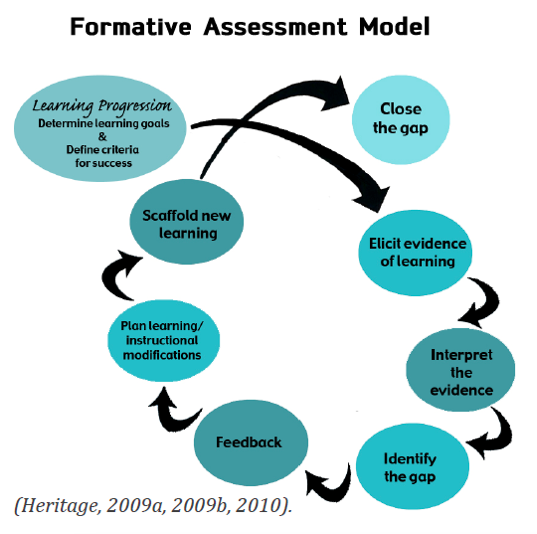
From my initial reading, I have come to recognise formative assessment as a vital part of the classroom experience. Black and William’s evidence shows that formative assessment is an essential component of classroom work. This has been very informative and is certainly a background for my research project. Black and William highlight that outside the box (the classroom) there are many initiatives and assessments for learning but this leaves out what really happens in the classroom and the teaching experience. It also makes mention to students competing in the class for the best results thus leaving out many students who feel let down by their education. This could change where students become more able to assess their learning thus far and be able to change that. I feel that the acknowledgment for my students that their learning is an ongoing passage through their course they (including myself) can regularly assess how they (and myself) are acquiring the knowledge to succeed thus helping both parties.
Getting used to study methods in Asia – My research
(1611 words)
RESEARCH QUESTION
What salient aspects of XXXXX (An Asian) University and the students that attend do you see as a contradiction?
ABSTRACT
‘Manners maketh the man’ (William of Wykeham, 1350). Whether you are in the street, in a restaurant, or in our case in a university certain etiquette prevails. My observations were done to draw attention to the value of etiquette and also to show the extent of contradiction to normally accepted good manners there are in a university. The results showed that the philosophy lecture room in this Asian University far from being a quiet room of studious individuals was in fact a myriad of factors void of study ethics. The conclusion is that when it comes to studying there is not a universal ideal as the acceptable method.
INTRODUCTION
Etiquette is not a new idea and is changing all the time, as we see nowadays with the development of mobile telephone, but propriety still holds to essential tenets. There are unspoken rules about daily etiquette such as talking loud, using telephones in the wrong place, and being aware of others. There can be a lot of daily life that breaches social manners. In a recent survey, 90% of people thought it would be rude to receive a telephone call at a church which goes to say certain arenas are faux par for telephone use.
In a social minefield for new students to university, one business has recognized what many would not think was needed for learning, and as such, CLM Business Etiquette Consulting in Austin Texas now advises how students should invest in their courses to get them through their university course. CLM’s study courses highlight factors such as establishing meaningful relationships with your professors and other students to ascertain a cooperative experience.
My observations will show that new students in this Asian University need to be shown, taught, and given rules as to how to behave in a lecture room whilst understanding other people’s feelings.
METHODS
Participants
In general, classes consisted of up to 60 to 70 people but due to lateness and students deciding not to come or come back from lunch break numbers fluctuated.
Instruments
Observations were done using a tally system where marks were put onto a written table in the notebook.
Procedures
As most of my pre-research knowledge so far had been through watching university life, it was thought that it would be the right transition to use observations in this part of the research. So, the first thought was to think of categories for the research which were the aspects of study that been had found to be strange.
- Telephone ringing – students don’t put their phone on vibrate. So the lecture room has many ring tones going off.
- Telephone SMS – although not as bad as ringing it still has a high pitch sound
- Coming late – the lesson is supposed to start at 9am although it does not actually start till 9.30am so this gives even later than late students time to arrive.
- Going in and out of class – it is generally presumed that you have prepared for a lecture you would not need to go out of the lecture room before the next break.
- Lecturer making students quiet – this tags along with students talking excessively. It is generally excepted than university is not a school.
- Playing computer (games) – even though this seems strange, it was added because students were observed playing fighting games and using facebook.
- Listening to music – as above, it was observed on the computer and shown from wire coming from student’s ears.
- Sleeping – be it at the start of the morning or the start of the afternoon period, students find they need to sleep more.
- Dress code – being a hot Asian country does mean people get hotter with more clothes but some decorum still has to be kept. Also, the fact that students think that that university is like a fashion show and they must look their best.
- Acting inappropriately – generally being not interested in the lecture thus doing something different.
- Food/snacks – again everything is okay if kept within reason but excessive snacks is not really needed.
So, it was now time to set up observation times. It seemed obvious to set up an observation in the morning on the first class. There was generally the rule that once the lecturer says ‘good morning’ he expects the students to be quiet, listening and generally be ready for study. This was always around 9.30am, so this was made the start time. Normally, there was a break around 10.30am, so this worked well to have a one hour observation time. The thought was that it would be best to observe in the afternoon too, to see how students reacted to having a lunch break. Also, they had been in university since 9:00am, and there was all day of lecture, so it was interesting to see their endurance level. There was also the case of how many hours of observation would be done. With the philosophy course, which was being observed, it was only one month, so three lecture days were observed. This meant observations would be over three mornings and three afternoons. In total a period of three hours for morning and three hours for afternoon lectures. Then, a tally sheet was written up as to help keep a record of the times students and the lecturer performed anyone of the categories that had been suggested.
RESULTS
In the end only 7 categories were calculated on.
- Telephone ringing
- Telephone SMS
- Coming late
- Going in and out of class
- Lecturer making students quiet
- Sleeping
- Acting inappropriately
These categories not scoring, I thought were mostly due to the lecturer advising students not to do certain actions. Another factor was due to the lecturer being professional and knowing his subject matter. The feeling was there was some respect to the lecturer which came from his professionalism thus students were less interested in turning to other means of interest.
For the morning results, there was amazement regarding how many times the lecturer had to make the students quiet. In the space of three hours the lecturer had to tell some of the students twenty two times to be quiet. That works out at once every eight minutes. It has to be noted that there was a genuine disrespect for the lecturer from parts of the class, not only his lecturing but also the years of study he had completed to become so knowledgeable and competent in his job. Surprise was felt by how many students needed to go out even though they had time before the class and also that the break was not far away. It was recognized that the telephone problem of ringing and SMS messages was very low in the tallying. This was mainly due to already being talked about several times. Students actually had heeded the lecturer’s warnings albeit warnings many times before observations. A little bit of confusion was shown as to why students still turned up late when the lecturer started thirty minutes late. It was felt that even if he started one hour late they still would be late because they knew when the lecture started they would arrive sometime after.
For the afternoon session, it was always immediately noticed that big groups of students were missing. It was assumed that they just came to sign in the morning and thought that was good enough for the whole day. For some reason during the afternoon session, the rate of people going in and out of the class increased by 55% from the morning session. This worked out at one every three minutes during a three hours period. Some students actually arrived late and then left. This actually created two points on the tally card, one for late and one for going in and out. Again, there was bewilderment by the amount of times the lecturer needed to tell the students to be quiet, even to the extent of asking one group ‘what did I just say?’ as to question them if they were listening. This was done two times over a space of ten minutes and was met by laughter and a general nonchalance by those students who were devoid to the lecturer’s job in hand. There was actually an 83% increase in the lecture making the students quiet from the morning session.
CONCLUSION
It is recognized that in some countries certain etiquette is not thought about and study ethics are laughed at. Some students, although being new to university, still adopt old ways of studying so even though they have reached adulthood they still assume a child like attitude to learning. They feel that it is the lecturer job to keep them quiet and not their own personal position to be individuals who think and take responsibility for their actions. The overriding factor that has been shown through this observation has been some students total lack of awareness of others and their general detachment from other people who are at the university for the purpose of learning. One gets the feeling that students deride people that show a willingness to learn. Students studying get distracted easily so even someone going outside creates noise which is acknowledged with a quick glance from a studying student. It is also amazing because the attitude of the lecturer in this study who has a PHD and has shown to be the epitome of a university lecturer was scorned by many who felt the need to go in and out of the lecture room and talk.
Bibliography:
William of Wykeham, Motto of Winchester College and New College, Oxford (1324 – 1404)
Patricia Lee MA (Oxon), MA (QUB) holds qualifications from the British Psychological Society and in teaching adult literacy. She has been a school governor, sat on the working party for the Jigsaw Visitors’ Centre at Armley Prison and made 1933-style shorts for the Leeds Metropolitan University Gymnastics Squad.

