Power
Consider the treatment in one text of one or more of the Seven Deadly Sins
(776 Words)
As knowledge seekers, many people will strive harder or try appropriate means to achieve their goal for further knowledge to the extent that bridges onto excessiveness that reflects one of the Seven Deadly Sins. Doctor Faustus is this seeker of knowledge who wants to find out more than is suitable and appropriate for him to know. Faustus is a disdainer who gets a scorner’s comeuppance. He commits a mortal sin and goes to hell for it.
Dr Faustus deals with the ambition of the Renaissance to cultivate an ‘aspiring mind’. The Renaissance as a time of intense, all-encompassing infinite knowledge is embodied in Faustus. However, he shows little discrimination in his pursuits. He delights, for example, in the Seven Deadly Sins, ironically remarking ‘O thus feeds my soul’. Throughout the twenty-four years, he seeks experience of all kinds in the true Renaissance manner; however, instead of freedom, his knowledge brings him despair.
Nevertheless, Faustus, the Renaissance humanist has the desire to reach the highest peaks of life experience; there lies a quality possessed by this ambitious seeker. To enter the new world where distant shores could be talked about. This is manifested in Faustus, however, in his desire for none other than a God: ‘A sound magician is a demi-god’.
‘How am I glutted with conceit’ shows how his excessive pride is overtaking him. His almost unconcerned use of the words ‘I’ and ‘will’ (‘I’ll’) embodies a man of cupidity. He is a fearless taker of everything for his own greed. In an age of reason, Faustus tries to stand on his own two feet and work out his salvation. He is motivated largely, by his desire for pleasure. He is covetous in his thoughts of ‘flying to India for gold’, ‘ransacking the Orient for Orient pear’. He hedonistically rides on the crest of sin. So blind is the lust of gain.
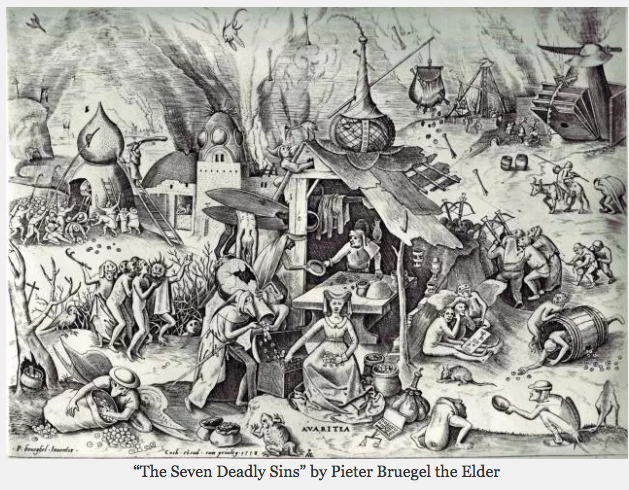
Faustus’ desirous journey is the ‘Perils of the Pilgrim’: ‘For the wicked boasts of his heart’s desire and bless the covetous, of whom the LORD abhorred. The wicked, through the pride of his countenance, will not seek after God: God is not in all his thoughts. His ways are always grievous; their judgments are far above out of his sight: as for all his enemies, he puffs at them. He had said in his heart, I shall not be moved: for I shall never be in adversity. His mouth is full of cursing and deceit and fraud: under his tongue is mischief and vanity’ (Psalm 10, 3-7).
Aristotle stated that a tragic hero is predominately a good man, whose undoing is brought about by some error of human frailty, ‘the stamp of one defect’. The audience sees three such defects in Faustus that lead to his ultimate domination of Mephistopheles: his pride, his relentless intellect, and his desire to be more than man (to possess the power and the insight of a God). Any one of these three defects would have been sufficient to ensure his downfall in terms of the theory of tragedy. In his pride, he is guilty of hubris, a quality that the Greek tragedy was certain to arouse the wrath of the Gods. His desire to be equated with God is a sin in Christian terms as well. His restless intellect and deep dissatisfaction with the normal life inevitably lead to misfortune. Faustus falls to damnation
In some ways, Faustus’ aspirations are admirable. It was the glory and the ambition of the Renaissance man to have an ‘aspiring mind’. Faustus, on the one level, represents the new man emerging from the womb of the Middle Ages. The authority of the Church, which had limited the thought of the Middle Ages, was lessening. There was a movement of power from the Church to the state, which meant to a limited extent, the transfer of power to the individual man. The classical spirit was certainly a source of influence for Marlowe. The Greek attitude to their Gods was very different from that of the Medieval Church. The Greeks encouraged a spirit of inquiry in their thought that was quite foreign to the attitudes of the Medieval Church.
Above all, Marlowe’s story of Dr. Faustus is of a Renaissance figure, adventurously surveying a world whose horizons were widening every day as a result of voyages and explorations that results in a person to aspire to the greater, to hold knowledge over wisdom, to have a desire for material wealth or gain and ignore the authority of the spiritual world. One could well be blind to the ‘Seven Deadly Sins’ where one was on an ardent quest for knowledge and unsatisfied with being mortal.

History of Power and How it Shapes the World
(1126 Words)
So long as people have power, so long as people under no circumstances change their attitude, history will be the same and repeat itself over and over. War will always be seen as a venture for peace, be it started through the power of religion, power of kings, or by the powers of countries. In this essay, I would like to make a comment on aspects involved in three movies I have recently seen. These are King Henry VIII, set in the 16th century, Les Miserable, set around the time of the French Revolution, and Good Morning Vietnam which was set during the Vietnam War in 1965. They all depict forces attacking each other. We identify that everyone has a motive, but only in their eyes are they right but for what good? All three films show power can work in many ways. The will of governments, royalty, and religion can not be stopped and those who try to stop them can get hurt.


Continuing our theme of power, the third film ‘Les Miserables’ although set after the French Revolution, for the purposes of this essay we can define a period around and after the revolution as the insurrection in France. We are still drawn into a time of change that had the power of the people and the power of the kings and nobles. We recognise a time when new ideas about the power of the people start to take hold. The influence of the Enlightenment which celebrated science and reason over faith and religion can not be overestimated. We know that political power in France was concentrated in very few hands. Sovereignty was no longer to rest with the monarch as a Divine Right, an appointment from God but rather with the people. Popular sovereignty now rested with the people and the idea of a Nation-State was conceived. In the movie, we are moved by the general destitution of people. France had the largest population in Europe and could not feed itself adequately. The French Revolution spawned the idea that everyone should be entitled to some principal rights. The French people were oppressed. The power of the French people has been shown throughout the world where support to revolutions that assert the right to self-determination.
To conclude, we see in all the films and aspects from them as history in the making. Why does the ‘French cause’ matter now? There are still some governments that lack the support of a majority of their people and still use the power of terrorism to control their citizens. Places like Myanmar and North Korea live under a cloud or tyranny. Burma is a poor country, but the military regime is rich enough to expand its armed forces while news from impoverished North Korea tells you about their new weapon technologies. These countries ignore the past and seem to not learn from the experience of others. It is true that the past causes the present, and so the future. Henry VIII’s break from Rome had enormous consequences on English history not only in making it possible for the transformation of England into a powerful nation but also in the seizing of economic and political power from the Church. England now enjoys a secular state. America too has changed. The Vietnam War ended American innocence. It is recognized that no foreign war can succeed without that large domestic support. America’s democratic economy is the strongest in the world. It is a light that has seen many countries push towards democracy. Communism is finished. So, history helps us understand change and how the society we live in came to be. Many people have suffered because of change. Hopefully, from this, the world will learn.

.

