Kurtz
Discuss the ways in which attraction and revulsion are linked in one text
(789 Words)
In Joseph Conrad’s Heart of Darkness, we find the protagonist Marlow, a man of adventure having sailed many a sea living in an era of the Victorian explorer David Livingstone who had not long returned from his African expedition in 1890. This is where tales of African exploration were told of different lands; those inquisitive minds couldn’t help but see the attraction of Livingstone’s journeys to this continent. Accompanied with this, is this new found land that is the reverse of Marlowe’s attraction to see Africa, it is where he gets a candid look at the reality of colonisation and imperialism. The journey for him finds the attraction and revulsion of it all.
In the opening scene, we see Marlow as the only one on the boat who still “follows the sea”. This seaman still sees the appeal of the open rivers and seas. He is a “wanderer”. Maps have always fascinated him, the blank spots, and those places yet explored. He wants to explore the inner Africa, the place associated with darkness. He wants to travel further into the long Congo, a captivating and extremely life-threatening river that lies like an immense snake. He remarks of the river that it is like traveling to the earliest beginnings of the world, the brilliant sunlit land offers ‘no joy’ but a “treacherous appeal”.
Even early on we get an idea of the revulsion Marlow experienced as he sits on the boat in London. He allegorises to the Ancient Romans who came to conquer England when it was untamed with Pagan natives running about, how they would have felt with the immense darkness and the abomination of Celtic England. He imagines this making the Romans want to escape. His allegory points to the mess of the Congo where Marlowe sees colonisation as “robbery with violence”.
The Congo is a jungle wilderness, the object of attraction. Ivory is the new gold, hardly a necessary item for survival. A desolate land far removed from the Industrialisation of white man England. Marlow’s view of the people he knows, the white race, those people who should be sophisticated are that of ones insane and pointless. How could people change so much? It is, however ‘reality’ for the men and that is all that civilisation cares about. The wilderness shows the greed and brutality that lie under the noblest of ideals.
On a more personal level, Marlow does see an attraction to the black man. He remarks they wanted no excuse for being there. He shows his attitude towards the black Africans where he says “the worst of it is suspecting they are not being inhuman”. Then there is Kurtz, an ivory trader sent by a Belgium company into the heart of the Congo, who on the other hand succumbs to the savagery of the wilderness. His aspiration is gone and he has “kicked himself loose of the earth”. The wilderness brings out the darkness and brutality in his heart. The natives didn’t invite the imperialists; they just turned up and gave orders.
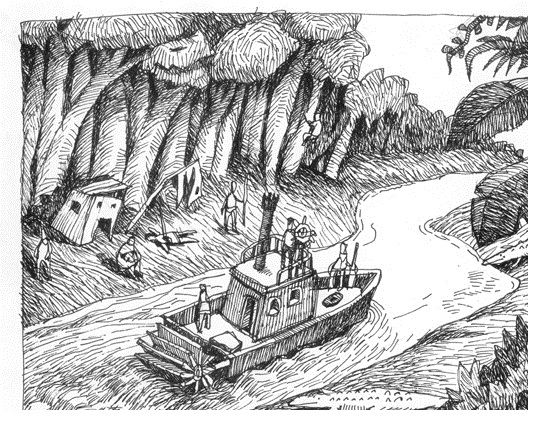
Marlow continues his journey where some people would have given up; the desolation of it all is strange to see. Here you find the attraction for Marlow, he battles on to the “inner station”, there must be something inside him that wants an answer, that wants to see more, although at the same time repulsed by the sights he sees. Going up the river was like traveling back to the earliest beginnings of the world, a past remembered: “in the shape of an unrestful and noisy dream.” The brilliant sunlit land offers “no joy” but a “treacherous appeal to a hidden evil, to the profound darkness of its heart.” The rape of the land is revulsive to Marlow, as he travels past the settlements of the white man with their inefficiency and brutality.
Marlowe certainly develops a strong purpose up the river, past the native villages and colonial agents in their settlements, to see and talk with Kurtz, the supposed beacon of civilisation, that it becomes somewhat of an obsession with him. He wants to see the darkness in man, which has developed his ardent resolve. Along the way, Conrad’s main purpose in this story is the discovery and analysis of the black and white man. His search is for the inner truth. The black man typifies truth and reality which is an attraction while the revulsion can be pointed at the white people.
Marlow after his long battled journey finds Kurtz, a so-called god at the Inner Station. Kurtz on his deathbed blurts ‘the horror, the horror’. Marlow has achieved his goal, the attraction of it all has reached its peak and the revulsion of the inner station has been seen.
.

