Henri Cartier Bresson – a master of snapshot photography


(1208 Words)
Henri Cartier-Bresson: The Decisive Moment in Two Photographs
Henri Cartier-Bresson’s photographs are widely regarded as masterpieces of street and snapshot photography. When viewing his portfolio, two works in particular captured my attention and imagination: The Var Department, Hyères, taken in France in 1932, and Behind the Gare Saint-Lazare, taken in Paris in the same year. This essay explores how these two classic photographs demonstrate Cartier-Bresson’s exceptional ability to capture movement and human activity at precisely the right moment. Although, at first glance, both photographs appear relatively simple because of their black-and-white presentation, closer examination reveals a sophisticated understanding of composition, geometry, movement, and human experience.
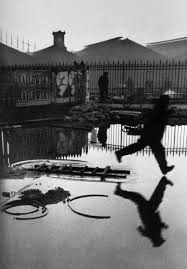
To begin with, Behind the Gare Saint-Lazare is particularly striking to me because of its multidimensional composition. The photograph immediately draws attention to the reflections of the figure, the railings, and the surrounding architecture in the water. These reflections introduce an almost ethereal quality that contrasts with the otherwise bleak and industrial character of the scene. The wrought-iron fencing, station building, workers, and scattered debris collectively establish an environment associated with urban industry and construction. Rather than presenting an idealised vision of Paris, Cartier-Bresson depicts a less glamorous and more ordinary aspect of the city.
As a photographer, Cartier-Bresson appears to capture life as an ongoing journey, and Behind the Gare Saint-Lazare exemplifies this idea particularly effectively. The central figure appears to be a man travelling to work, captured in the act of jumping across a large area of water, presumably left behind after heavy rain. Cartier-Bresson’s timing is remarkable: the slight blur of the figure prevents the viewer from becoming preoccupied with his facial expression and instead emphasises the movement of his body through the frame. His positioning creates a sense of suspension, as though the man is temporarily hovering above the water. At the same time, the ripples spreading across the surface reinforce the impression of movement. There is also an element of uncertainty, as it appears unlikely that the man will complete his leap without getting wet.
The photograph can therefore be interpreted as offering a distinctly working-class perspective of Paris. Instead of focusing on the city’s celebrated architecture and monuments, Cartier-Bresson presents an industrious and somewhat austere environment in which ordinary people negotiate the practical difficulties of everyday life. The bleakness of the setting contributes to the photograph’s sense of authenticity. Rather than appearing staged or idealised, the image presents an apparently spontaneous moment of everyday existence.
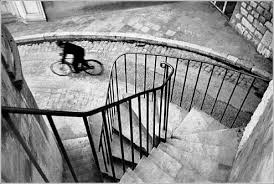
The Var Department, Hyères offers a very different composition, yet it similarly demonstrates Cartier-Bresson’s interest in movement and geometric form. The photograph contains a complex arrangement of lines and shapes that converge across the image. The contours and direction of the staircase lead the eye along several different paths, creating a composition that initially appears confusing but becomes increasingly coherent upon closer examination. These geometric qualities contribute a surreal dimension to the photograph. The unusual spatial relationships can even be compared to the work of M. C. Escher, particularly his exploration of impossible or seemingly infinite architectural spaces in works such as Relativity.
The square stonework of the wall introduces another geometric element, contrasting with the curved road that moves through the composition. The road itself appears to slope away from the viewer, creating a further sense of depth and movement. Within this otherwise static architectural environment, the cyclist becomes particularly significant. Although the photograph is frozen in time, the cyclist appears to be moving rapidly through the frame, creating a powerful contrast between stillness and motion.
The cyclist can therefore be interpreted as representing the continuous movement of human life. Cartier-Bresson frequently incorporated people into his compositions in ways that prevented the environment from becoming merely architectural or decorative. In The Var Department, Hyères, the cyclist introduces a human trajectory into an otherwise quiet landscape. His movement suggests that he is travelling towards another destination or experience, thereby giving the photograph a narrative quality. The image also evokes the wider cultural association between cycling and France, particularly the Tour de France. The contrast between the tranquillity of small French towns and the speed of cyclists passing through them provides an interesting parallel to the photograph’s own combination of stillness and movement.
Although both photographs are strictly monochromatic, I was particularly struck by their apparent range of “colours.” Cartier-Bresson uses an extensive tonal range of blacks, whites, and greys to create depth and visual contrast. These variations in tone give the photographs considerable strength and contribute to their timeless quality. The absence of colour does not diminish the visual richness of the images; instead, it encourages the viewer to focus more closely on form, texture, light, shadow, and composition.
Another important characteristic of both photographs is Cartier-Bresson’s treatment of his central figures. The people within the images are sufficiently blurred or integrated into the surrounding composition that they do not completely dominate the photographs. Nevertheless, they remain essential to their meaning. Their movements provide the images with energy and transform what might otherwise be static architectural or environmental studies into observations of human experience.
This is particularly important in relation to Cartier-Bresson’s concept of the “decisive moment.” In both photographs, the timing of the exposure appears fundamental to their effectiveness. In Behind the Gare Saint-Lazare, the photograph depends upon the precise instant at which the man is suspended above the water. A fraction of a second earlier or later would have produced an entirely different composition and potentially diminished the visual tension of the image. Similarly, in The Var Department, Hyères, the cyclist’s position within the complex geometric structure of the scene creates a moment that could not easily be replicated. Cartier-Bresson’s skill lies not simply in photographing a subject, but in recognising the precise moment when the relationships between subject, environment, movement, and composition become most compelling.
Human interest is therefore central to both photographs. The man attempting to leap across the water and the cyclist travelling through the French landscape represent different aspects of human endeavour. Both figures are engaged in movement towards somewhere else, whether that destination is a workplace, an appointment, or simply another stage of their journey. In this sense, Cartier-Bresson transforms ordinary moments into observations about the human condition.
The two photographs also present contrasting aspects of everyday life. The Var Department, Hyères possesses a quieter and more rural atmosphere, with its stone buildings and relatively empty streets creating an impression of stillness. By contrast, Behind the Gare Saint-Lazare presents Paris as an industrious and active urban environment populated by workers and characterised by construction and urban infrastructure. Despite these differences, both photographs share an underlying interest in ordinary people and their relationship with the spaces they inhabit.
In conclusion, these two photographs demonstrate Cartier-Bresson’s remarkable ability to capture an exact moment while simultaneously communicating movement, atmosphere, geometry, and human experience. His use of monochrome tones, reflections, spatial relationships, and carefully timed exposure transforms seemingly ordinary situations into compelling photographic compositions. The more closely I examine these photographs, the more possibilities for interpretation emerge. Their significance lies not only in their technical mastery, but also in their ability to provoke thought, emotion, and admiration. Cartier-Bresson succeeds in transforming fleeting moments of everyday life into images that remain visually and emotionally powerful decades after they were captured.
What is Language? – We are all insiders
(387 Words)
Language is a fundamental aspect of human communication, and as speakers, we are all insiders to the language or languages we use. Consequently, for many purposes, we may take the concept of language for granted. However, closer examination reveals considerable variation within what is commonly understood as a single language. For example, although English is spoken across the world, the English used in Glasgow differs significantly from varieties spoken in other contexts, such as Jamaica. Therefore, there is no single, uniform form of spoken or written ‘English’; rather, there are numerous varieties, often referred to collectively as ‘Englishes’.
This variation raises important questions about how languages should be defined and distinguished from one another. As Hermann Paul (1880) observed, “We must, in reality, distinguish as many languages as there are individuals.” This statement highlights the extent to which individual speakers develop distinctive linguistic patterns and illustrates the difficulty of establishing clear boundaries between different languages and varieties.
Linguists are frequently asked how many languages exist worldwide. Estimates generally place the number at approximately 5,000 to 6,000, although the precise figure is difficult to determine. This difficulty arises partly because definitions of what constitutes a ‘language’ can vary between countries, cultures, and linguistic communities. Consequently, the distinction between a language and a dialect is not always straightforward.
The relationship between language and social and political factors is captured by Max Weinreich’s well-known observation from 1945: “A language is a dialect with an army and a navy.” This statement suggests that the distinction between a language and a dialect may be influenced not only by linguistic differences but also by political, cultural, and social considerations. In this sense, it may be more productive not to focus excessively on rigid definitions, but instead to recognise that both ‘language’ and ‘dialect’ are terms used to describe forms of speech that are perceived as distinct.
Ultimately, linguistic variation exists at both the individual and societal levels. Every speaker uses language in a somewhat unique way, meaning that it could be argued that every individual possesses their own linguistic system. Nevertheless, the differences between individual speakers are generally limited enough to allow effective communication. Language can therefore be understood as a shared and flexible system of sounds, words, and structures that enables members of a linguistic community to communicate and understand one another.
Language Morphs – transfer and language change
As the echoes of ‘Gladly the Cross I’d Bear’ reverberate around the church, there sits a little girl with a questionable face thinking who is ‘Gladly’ and why sing about the unfortunate bear being cross-eyed.
So, here lies transfer and language change. For example, ‘nickname’ started off as ekename; eke being ‘also’. Through time and the use of ‘an ekename’ people began to interpret the n in an as the first letter; hence a nickname. Even Santa Claus began life differently as a Dutch word Sant Heer Niclaes. St Nicholas was shortened to Santerclaes and reinterpreted. English is full of words that are not descended in ‘pure’ state from older equivalents. So, be careful when you tell people to ‘Shaddap’ or ‘Caditout’. Reference: The Power of Babel by John McWhorter

Calm Panic Campaign Promise By Alan Ginsberg
(596 words)
2022 is only days away, a time for celebration and cheer, though are we avoiding looking at the environmental damage caused by the progress we have made in such time? The need for more, the taking without giving back. Alan Ginsberg’s poem “Calm Panic Campaign Promise” is a few thoughts on the, sometimes, careless way problems are ignored.
Many of Ginsberg’s poems show his honest opinion on world issues and “Calm Panic Campaign Promise” is no exception. It is a poem designed to make everybody sit up and notice. The opening lines using, “end of millennium” and “earth decay” are major themes. It makes the reader realise that the millennium was a big turning point, a time to look back at what has been done. This leads directly onto earth’s ongoing decay emphasising that through all achievements the earth has been abused for it. I think these contrasting ideas can make the reader think of how people overspend and overuse during Christmas still ignoring their carbon footprint and another year to reach their own sustainability ambitions. With all the happiness of these festive celebrations, there is the global dilemma of earth’s decay. Could some of their actions be put to different causes?
Alan Ginsberg uses the line, “we’re the great beast” to reinforce the point that man’s behaviour has caused the earth’s decay. This is shown further in, “fire water air tainted” to which thoughts can be turned to such problems as car fumes and plastic use. These truths are of a list that could go on and on. The poem is only on the fourth line but is already very thought-provoking using this to show that everyone can be guilty of ignorance.
Instead of using facts to get his point across, Ginsberg uses the simile of the diseased body to put his points in a way to which every person can relate. This is shown in the line, “like watching gum disease and not brushing your teeth”. This is further shown in, “getting heart failure, no rest much stress”. This makes the reader think in general terms and the use of the words, “disease” and “stress” make them realise that to overcome those problems they have to put some effort in to stop it. If they do not, it could get worse. This is what it meant in, “poor circulation, smoke more”, emphasising the denial of many people.
Denial is used twice in the poem with the lines, “denial in Government” and “need President who’ll reverse the denial”. This brings to mind how even hierarchy is guilty of the decay if not more than the citizens of each country. The thought that their knowledge will help us, as Ginsberg puts it, to “restore nature’s balance”.
However, we need more to restore this balance. We need to “calm panic”. Ginsberg sees the panic at the conditions of the earth filling the “dark bed of thoughts of the people who feel unable to do anything to stop it”. While we panic, we are unable to consider how we might take action so we deny that there is a problem. Ginsberg seems to believe that a president could see the situation and lead action to remove this.
Like many of the people Ginsberg writes of, I might have dark night thoughts on rare occasions and recognise that progress has had huge environmental costs. However, while I would join into schemes designed to avoid environmental damage, I might sometimes forget or want to enjoy driving my car and spending money. Most of the time everyday living fills the thoughts.
“Calm Panic Campaign Promise” (from 1992, from Cosmopolitan Greetings)
End of Millennium
Earth’s decay –
Fire Air Water tainted
We’re the Great Beast –
Dark bed thoughts
Can’t do anything to stop it
Denial in Government, in Newspapers of Record –
Like watching gum disease and not brushing teeth
Getting heart failure, no rest much stress
Putting salt on your greasy pork
Putting sugar in coffee you’ve diabetic
Dysesthesia on foot soles
Poor circulation smoke more cigarettes
Kick your son under the table have another beer
Need President who’ll reverse the denial –
The Calm Panic Party
to restore nature’s balance
I did not mean it like that! Language at its best (or worst).
(972 Words)
Language works in many ways and what someone says may well not truly get to the core of their true meaning or the point they were trying to get across while at the same time the receiver is stumped or takes offense. In the piece of writing, I will try to explain that the English language has many meanings, descriptions, and stumblings that we wonder how someone was actually trying to make their point and did they (or others)really know what they were saying.
In a famous Bertrand Russell’s sentence construction, we can see that we do not hold consistent opinions on facts. On a BBC program in the 1940s, Russell conjugated an “irregular verb” as “I am firm; you are obstinate; he is a pig-headed fool.” These constructions provide excellent illustrations of the varying emotional associations of words and the empathy of meaning.
What Russell was illustrating was the power of words to convey attitudes (connotations) as well as meanings (denotations).
Moreover, think about the following statements and how they convey their meanings: I am sexually adventurous, you are promiscuous, he is a slut.
We recognise connotation as ‘the emotional implications and associations that a word may carry’ and denotation as ‘the direct or dictionary meaning of a word’.
Dog = man’s best friend (connotation)Dog = four legged animal (denotation)
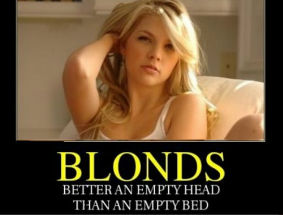
In an age where people are highly sensitive to what is said about religion, ethnicity, or even sexuality, antiquated stereotypes of someone’s hair colour can still emanate one’s perception of a person. Passing statements are said without true acknowledgement. Epithets to categorise people can be totally unacceptable. You only have to look at the examples below to see this.

But, language can work in reverse where a supposedly openly offensive word like ‘fuck’ cannot actually have the denoted meaning. For example, Bono upon receiving an award at the Golden Globes in 2003 exclaimed that it was ‘fucking brilliant’. Now, was this use of the expletive word offensive, or was it just an exclamation of the excitement at winning the award? It cannot be indecent as what is more than ‘brilliant’ without the punch in the statement he wanted.
So, do we take statements to actually mean what they say? Bono was telling us how excited and thrilled he was to win an award. What he was saying encapsulated that moment and the literal meaning came across clearly. It is strange in that case that the Federal Communication Commission reasoned that the word had no connotation other than referring to the act of fornication, and was therefore always indecent. Go figure! Well, George Callin did.
(If you are easily offended, I would advise you not to watch the George Carlin video)
So, language does not have any connotation we should take it literally all the time. Is that right?
For example, during the final days at Denver’s old Stapleton airport, a crowded United flight was cancelled.
The single agent was re-booking a long line of very inconvenienced and frustrated travellers. Suddenly an angry passenger pushed his way to the desk in front of all the others. He slapped his ticket down on the counter and said, “I HAVE to be on this flight and it has to be FIRST CLASS.”
The agent replied, “I’m sorry sir. I’ll be happy to try to help you, but I’ve got to help these folks first, and I’m sure we’ll be able to work something out.”
The passenger was unimpressed. He asked loudly so that all the passengers behind him could hear, “Do you have any idea who I am?”
Without hesitating, the gate agent smiled warmly and grabbed her public address microphone. “May I have your attention please?” she began, her voice bellowing throughout the entire terminal. “We seem to have a passenger here at the gate WHO DOES NOT KNOW WHO HE IS. If anyone can help him find his identity, please come forward to the gate.”
With the folks behind him in line now laughing hysterically, the man glared at the United agent, gritted his teeth, and spat out the words, “F… you.”
Without flinching in the least, the agent smiled politely and said, “I’m terribly sorry, sir, but I’m afraid that you’ll have to stand in line for that, too.”
We have to understand that language comes at us on multiple levels, rather than as a direct parse of the content of the sentence. In everyday life, we anticipate our interlocutor’s ability to listen between the lines and slip in requests and offers we feel we can’t blurt out directly (Pinker, 2008).
But, one has to be careful. A famous sketch from the Seinfeld show highlights the gravity of taking what someone says too literally.
So why don’t we say what we actually mean? Would it not just get out of the way all this politeness and double meaning? Why spend minutes or hours getting round to the point of the conversation?
Whimpertaives are another example of us going through the motions of being polite and less direct. People prefer to be asked nicely although it does take away the power of the person saying the statement or asking the question. Still, it would be better if a person was on a dinner date to be on their best behaviour where a sense of decorum prevailed. However, statements or questions can be overstretched.
Can you…..? (a stupid question)
I was wondering if… (a pointless rumination)
It would be great if you could… (a gross overstatement)
Politeness keeps people placated. A person can really be too blunt as if they were bossing someone about but what if we came out with what we really meant, would it not expose too much? Ricky Gervais’ Invention of Lying shows us how it is done.
References:


.

