Consider the treatment in one text of one or more of the Seven Deadly Sins
(776 Words)
As knowledge seekers, many people will strive harder or try appropriate means to achieve their goal for further knowledge to the extent that bridges onto excessiveness that reflects one of the Seven Deadly Sins. Doctor Faustus is this seeker of knowledge who wants to find out more than is suitable and appropriate for him to know. Faustus is a disdainer who gets a scorner’s comeuppance. He commits a mortal sin and goes to hell for it.
Dr Faustus deals with the ambition of the Renaissance to cultivate an ‘aspiring mind’. The Renaissance as a time of intense, all-encompassing infinite knowledge is embodied in Faustus. However, he shows little discrimination in his pursuits. He delights, for example, in the Seven Deadly Sins, ironically remarking ‘O thus feeds my soul’. Throughout the twenty-four years, he seeks experience of all kinds in the true Renaissance manner; however, instead of freedom, his knowledge brings him despair.
Nevertheless, Faustus, the Renaissance humanist has the desire to reach the highest peaks of life experience; there lies a quality possessed by this ambitious seeker. To enter the new world where distant shores could be talked about. This is manifested in Faustus, however, in his desire for none other than a God: ‘A sound magician is a demi-god’.
‘How am I glutted with conceit’ shows how his excessive pride is overtaking him. His almost unconcerned use of the words ‘I’ and ‘will’ (‘I’ll’) embodies a man of cupidity. He is a fearless taker of everything for his own greed. In an age of reason, Faustus tries to stand on his own two feet and work out his salvation. He is motivated largely, by his desire for pleasure. He is covetous in his thoughts of ‘flying to India for gold’, ‘ransacking the Orient for Orient pear’. He hedonistically rides on the crest of sin. So blind is the lust of gain.
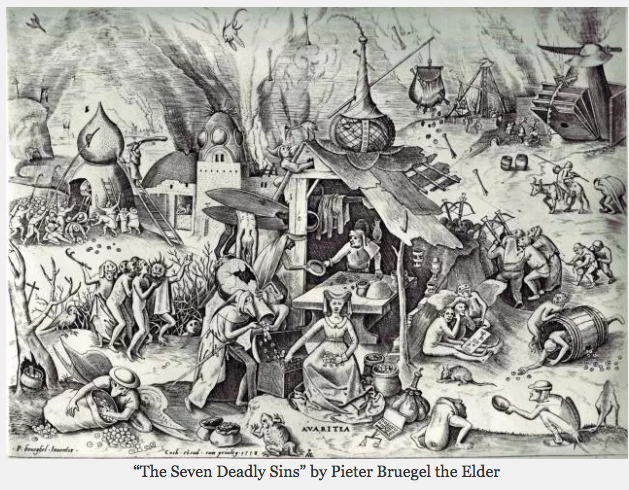
Faustus’ desirous journey is the ‘Perils of the Pilgrim’: ‘For the wicked boasts of his heart’s desire and bless the covetous, of whom the LORD abhorred. The wicked, through the pride of his countenance, will not seek after God: God is not in all his thoughts. His ways are always grievous; their judgments are far above out of his sight: as for all his enemies, he puffs at them. He had said in his heart, I shall not be moved: for I shall never be in adversity. His mouth is full of cursing and deceit and fraud: under his tongue is mischief and vanity’ (Psalm 10, 3-7).
Aristotle stated that a tragic hero is predominately a good man, whose undoing is brought about by some error of human frailty, ‘the stamp of one defect’. The audience sees three such defects in Faustus that lead to his ultimate domination of Mephistopheles: his pride, his relentless intellect, and his desire to be more than man (to possess the power and the insight of a God). Any one of these three defects would have been sufficient to ensure his downfall in terms of the theory of tragedy. In his pride, he is guilty of hubris, a quality that the Greek tragedy was certain to arouse the wrath of the Gods. His desire to be equated with God is a sin in Christian terms as well. His restless intellect and deep dissatisfaction with the normal life inevitably lead to misfortune. Faustus falls to damnation
In some ways, Faustus’ aspirations are admirable. It was the glory and the ambition of the Renaissance man to have an ‘aspiring mind’. Faustus, on the one level, represents the new man emerging from the womb of the Middle Ages. The authority of the Church, which had limited the thought of the Middle Ages, was lessening. There was a movement of power from the Church to the state, which meant to a limited extent, the transfer of power to the individual man. The classical spirit was certainly a source of influence for Marlowe. The Greek attitude to their Gods was very different from that of the Medieval Church. The Greeks encouraged a spirit of inquiry in their thought that was quite foreign to the attitudes of the Medieval Church.
Above all, Marlowe’s story of Dr. Faustus is of a Renaissance figure, adventurously surveying a world whose horizons were widening every day as a result of voyages and explorations that results in a person to aspire to the greater, to hold knowledge over wisdom, to have a desire for material wealth or gain and ignore the authority of the spiritual world. One could well be blind to the ‘Seven Deadly Sins’ where one was on an ardent quest for knowledge and unsatisfied with being mortal.


Memoirs – All For Nothing
(1022 Words)
I had just flown from Bangkok to Amsterdam’s Schiphol airport and was heading for Euro 2000: the European Football competition between neighbouring European countries. Slightly jet-lagged and a lack of sleep, I exited the airport and first went to Amsterdam Central Railway Station. I headed straight for the railway station to throw my bag in storage. It was certainly too bulky and heavy for my next experience. I was soon walking freely away from Amsterdam station, and I could now go off to the Philips Stadion in Eindhoven to see England play Portugal. Beckham and Figo et al head to head. Despite the excitement of this, I had actually booked a ticket to see the rock group Oasis in Hamburg the following day after the match; this initially was really my only plan. I had been a fan since the early days, and they were always worth seeing live anywhere in the world. So, as I strolled around Amsterdam at least I knew now I had to get from Eindhoven to Hamburg somehow.
I spent an interesting night in Amsterdam and then the next day went off down to Landgraaf by train. Talking to someone after a few drinks the night before, I had found out about a music festival; it was the PinkPop rock festival about an hour or so from Amsterdam. To my delight, it actually had Oasis playing and was not far from Eindhoven, I thought. I always remember going to this festival as I never had a ticket. As I got there in the morning, I saw lots of music lovers in a field. Various thoughts came to mind but I spent a good 30 minutes looking at how to jump the fence to get in for free. I made my move and was soon over a fence and in. This was only to find out that it was for tents/camping and the festival was in another field through more security and barriers. Anyway, I got a ticket for a cheap price, so it was not any hassle. The festival finished (I got to see Oasis without Noel Gallagher), and my next move was to think about the football. I ended up getting the train to another town one stop down from Eindhoven as the town was full of what seemed like England football fans who had taken over every hotel. Each hotel I went into to ask for a room in Eindhoven had so many football fans milling around singing and every place had no vacancies. I eventually spent the night in a hotel in the next town albeit it was full of Orange as the Netherlands were playing; the next night was the big match.
Once again, I was without a ticket but somewhere to go. I made my way up on the train from my hotel in the next town. I then spent the day drinking in Eindhoven and generally mixing with the English fans. I put the word out that I was looking for tickets, Fortunately, I found a guy who had tickets for the match. I was a bit wary because this ticket had the owner’s name on it, and match security was going to check tickets and passports/ID too. I was cautious, but I bought it anyway; I was going to chance it. I thought if security takes the ticket away, at least I tried to get in. The buzz of the impending game was growing, ultimately then came my moment of trying to get in without security’s bother. I walked closer and saw there were metal fences stopping fans, I got my ticket out and showed it. The inspector just looked at the ticket, I had made it past. I was buzzing. Yes, I had made it but what was this, it was only to the next fence. There were three of these. However, the stars were shining that night; I made it past all of them, and no real checks. The match was brilliant too, singing the National Anthem, cheering on every move, going crazy to the goals although England lost to Portugal; damn Figo!
Now, it was time to look for somewhere to stay the night. There was nowhere, I was homeless in the Netherlands. All the hotels were full, and it was getting late. What could I do? I ended up sitting in a few bars and restaurants which was not nice for me, as you meet up with many weird people from 11pm to 6am. 6am was the time the train to Hamburg left Eindhoven station. I was actually early and spent an hour waiting still seeing England fans going round singing after a big night out. I needed sleep badly. The Oasis concert in Hamburg was that night, and I had had no sleep. So, it was just my luck when I got on the Eindhoven train, and it was full and this continued through my three changes of train as I crossed from the Netherland to Germany. After a lifetime wait, I actually found a seat, but by that time I was scared of never waking up and ending up in Russia or something.
So, now I was in Hamburg standing at the railway station looking out. I found myself a nearby hotel, had a look around, and made my way to the OASIS concert. I could not believe all that I had done over the last few days. This was the only activity I had originally planned. I actually had a pre-booked ticket, I was legal. There would be no worries over security, no worries about jumping fences, and a nice paid for hotel waiting after the concert for me. I had looked forward to this rock concert for the month, I had the ‘golden’ ticket to get in. As I got to the stadium, I thought it looked a bit quiet and wondered if I had the right place. Where were the crowds of fans? I asked one of the guys there, and he said the Oasis concert had been cancelled. I had made the trip all for nothing due to Liam becoming ill. Nice one Liam!
Great Expectations – The Guardian’s Influence
(867 words)
In this essay, I will show how Miss Havisham’s influence affects her adopted daughter, Estella, and how this influence shapes Estella’s attitudes towards love and men. Since Miss Havisham was betrayed on her wedding day, she has developed a deep contempt for men. By adopting a young girl called Estella, she attempts to instil in her a similar distrust of men and encourages her to take revenge on them. As a result, Estella grows up to be cold and cruel. However, as Estella becomes older, she begins to show indifference towards Miss Havisham’s destructive ways and starts to recognise the negative influence she has had on her life.
Miss Havisham also influences Pip, the protagonist and narrator of Great Expectations, by arranging for him to visit her house. Pip sets off to Miss Havisham’s house, where it becomes clear that Miss Havisham’s plan is to encourage Estella to entrap Pip and make him fall in love with her. Pip enters Miss Havisham’s house through dark passages where only candles light the way. Estella leads him by candlelight to the room where Miss Havisham sits. Pip finally sees Miss Havisham in an armchair, with one elbow resting on the table and her head leaning on her hand. He describes her as the “strangest lady I have ever seen”. This gives the reader an immediate image of a reclusive woman who is trapped in the past.
There has been no change to the decaying house, which is repeatedly presented as dark and neglected. Miss Havisham’s weathered wedding dress is still on display, preserved from the day she was jilted at the altar. The deterioration surrounding Miss Havisham has been there for Estella to see and live amongst, symbolising Miss Havisham’s inability to move on from her past. It also characterises her relationship not only with Estella but with humanity as a whole, particularly with men. The decaying environment reflects the destructive effect of Miss Havisham’s bitterness.
The reader can imagine Estella being brought up in an environment where Miss Havisham has shut herself away from the outside world. This has an obvious effect not only on the bitter and reclusive Miss Havisham but also on the young and impressionable Estella. Miss Havisham has not taught Estella what love is or how to love another person. Instead, she teaches her to use her beauty and attractiveness to manipulate men. Dickens therefore presents Estella as a product of her upbringing.
Miss Havisham influences Pip by deliberately encouraging him to fall in love with Estella. She repeatedly tells him, “Love her, love her, love her!” The repetition emphasises the strength of Miss Havisham’s desire for revenge. She takes pleasure in Pip’s suffering and wants him to continue loving Estella regardless of how cruelly Estella treats him. Miss Havisham is therefore using Pip as part of her revenge against men, even though Pip himself has done nothing to deserve her hatred.
Miss Havisham treats Estella as though she is responsible for carrying on the bitterness that Miss Havisham developed when she was younger. However, after Estella has been away from Miss Havisham, she seems to have developed a greater awareness of the influence that Miss Havisham has had on her. As a young child, Estella appears to accept Miss Havisham’s views without questioning them. The reader understands that Estella has been taught to believe that men are objects to be controlled and hurt. Miss Havisham adopted Estella and brought her up, so Estella has a sense of respect and loyalty towards her. However, as Estella becomes older, she begins to express her own feelings and challenge Miss Havisham.
Miss Havisham cruelly treated Estella when she was a child, giving her an upbringing characterised by psychological manipulation and emotional abuse. Estella has been taught how to attract men while simultaneously being encouraged to despise them. This creates a contradiction in her character: she has the ability to make men fall in love with her, but she has not been taught how to experience genuine love herself. Dickens therefore suggests that Miss Havisham’s attempt to use Estella as an instrument of revenge has caused lasting emotional damage.
Miss Havisham eventually confronts Estella about her cold and distant behaviour. However, Miss Havisham seems to blame Estella for qualities that she herself has encouraged. She reproaches Estella by exclaiming, “You cold, cold heart!” Estella responds by asking, “do you reproach me for being cold?” This rhetorical question exposes the hypocrisy of Miss Havisham’s criticism. How can Miss Havisham be angry with Estella for being cold when she is the person who raised her to behave in this way?
Miss Havisham’s influence has been to make Estella follow her beliefs and listen to her advice. However, now that Estella has grown older and has left home, she begins to resist Miss Havisham’s control. Miss Havisham resents Estella for developing feelings and opinions that challenge the way she was brought up. Dickens makes it clear that Estella’s behaviour is not entirely her own making. She has been shaped by Miss Havisham’s bitterness, manipulation and desire for revenge. Through Estella, Dickens demonstrates how damaging it can be when a child is raised to inherit another person’s hatred and emotional pain.


An admiration of ‘Children’ by Vicki Feaver
(819 words)
In this essay, I will explore how effectively Vicki Feaver, a female poet, conveys the influence of not only a mother but potentially all mothers. The poem presents the relationship between a loving parent and her child, exploring a mother’s desire to provide her child with an upbringing filled with love, care and ambition.
The first two tercets convey the image of a woman who, whether through careless accident or careful planning, believes that her child has been brought into this world to be loved. Feaver uses the pronoun ‘we’ to encompass mothers collectively, while also making the experience feel personal and intimate. The mother is present ‘where they began’, suggesting that the bond between mother and child begins from the moment of birth. The description of the children as ‘red mewling strangers’ acknowledges the unfamiliarity of a newborn while also conveying the child’s vulnerable appearance and persistent crying. Feaver develops this idea further with the phrase ‘they tear our threshold’, suggesting that the arrival of a child dramatically changes the mother’s life. The verb ‘tear’ conveys the magnitude and intensity of the disruption caused by a newborn. However, Feaver balances this sense of disruption with the tenderness of ‘immediately we love them’. The adverb ‘immediately’ emphasises how quickly and instinctively a mother’s love develops, presenting motherhood as a powerful and unconditional emotion.
The next three tercets explore the mother’s love as the child begins to grow. Feaver refers to other people commenting on the newborn, which conveys the genuine pride a mother may feel: ‘we smile and blush’. The verbs ‘smile’ and ‘blush’ suggest happiness, affection and perhaps even embarrassment at the attention given to the child. However, motherhood is not presented as entirely joyful, as the mother must also respond to the baby’s ‘cries’. Despite this, the child’s pain becomes the mother’s pain, demonstrating the depth of parental sympathy and compassion. The child’s emotions appear to become the mother’s emotions, suggesting that the mother becomes almost entirely responsive to the needs of her child. This is also demonstrated through the phrase ‘and hold them tightly’, which conveys both physical affection and emotional protection. The mother’s attachment becomes so strong that she experiences the child as ‘a lost part of ourselves’. This could suggest that having a child allows the mother to rediscover a powerful and innocent form of love that she may have lost during her own life. The phrase also implies that the child becomes an important part of the mother’s identity, reinforcing the strength of their emotional connection.
In the final five tercets, Feaver reflects on the mother’s influence while also encouraging her to consider her own life. The arrival of a new life creates the possibility that the child may achieve more than the mother herself. This is evident in the mother’s desire to give her child ‘all the things we never had’. The phrase suggests that the mother is conscious of the disappointments and limitations in her own life and wants to prevent her child from experiencing the same difficulties. She recognises the potential pitfalls of life and attempts to protect her child from them, shown through the image of walking ‘in front of them with warning flags’. The metaphor of ‘warning flags’ suggests that the mother wants to identify dangers before the child encounters them, demonstrating her protective nature.
Feaver also explores the mother’s regrets through the statement ‘we who have failed to be authors of our lives write theirs’. The metaphor of being ‘authors’ suggests that people should have control over the direction of their own lives. However, the mothers feel that they have ‘failed’ to achieve this, so they attempt to shape and influence their children’s lives instead. This reveals both the love and potential limitations of parental influence. In wanting ‘to make heroes of them’, mothers are not content simply to protect their children; they also want them to achieve greatness and fulfil the ambitions that they themselves may not have achieved. The final image of mothers who ‘wait and watch like gardeners for flowers’ presents motherhood as patient and nurturing. The metaphor of ‘gardeners’ suggests that mothers provide care and support while waiting for their children to develop and flourish. Like flowers, the children have the potential to grow into something beautiful and admired.
Overall, Feaver’s poem portrays many powerful ideas about a mother’s influence over her child. From the moment of birth, a mother’s love affects the way she views herself, her child and the future. The poem suggests that mothers influence their children in subtle but meaningful ways, wanting to protect them from their own mistakes while also encouraging them to achieve their ambitions. Ultimately, Feaver presents motherhood as a relationship characterised by unconditional love, protection, sacrifice and hope. The mother’s desire for her child to have the best possible life demonstrates the enduring love and affection that can exist between a mother and her child.


