TEFL
A TEFL Trainer – Ofsted Quality Assurance
(1011 words)
Quality Assurance is a high priority for the company I work for. First of all, the students are our customers, so the company’s aims revolve around giving a high standard product that leaves the students feeling they made the right move to choose our company’s second language teaching course. For this piece of writing, I will outline some of the provisions my company and I have/use to not only keep the quality high but also to gain knowledge for improvement.
To promote equal opportunities
The courses I teach have students from many backgrounds, countries, and of varying ages. It is my job to accept all these people as achieving the goal of passing the course and being involved. For example, on the last course, there was a woman from Poland who was 28, an 18 year Englishman who was just taking his A levels, and an older Englishman of about 55 years of age. Taking these three as an example, they all had their reasons to be there, and the only way for them to pass the course was to work together as a group and as individuals. To promote this combination, my first job as their teacher trainer, as soon as they arrive, is to welcome them and get them introduced to each other, so they feel part of the group and they get the chance to meet each other. During the course, there are many pair-work and group-work activities, so it is my job to encourage collaboration between these kinds of people whatever their background. I promote peer and group evaluation where students constructively help each other. Eventually, when they come to complete their practice teaching in pairs there is encouragement from all the class towards a successful conclusion.
To identify, understand and learn from the factors which facilitate or hinder the students
The course has set modules, but within that, in my job as a trainer, I still have to make the students confident and knowledgeable about teaching a second language. In this respect, formative assessment is taken after each module to give feedback to the trainer, and for the students to be able to discuss how the course is progressing and their grasp of the facts so far. For example, one formative assessment has each of the students choosing to stand in a particular corner of the room which relates to their experience and knowledge of the class they just had. One corner may have the statement, ‘I have a question’. The students who stand in this corner have a chance to discuss issues they may have. They are then told to write down some questions they may have which are then discussed with the trainer and the rest of the group. The trainer can take away this assessment to improve on the next lesson while the students have been given a platform to voice their problems (good or bad). The reason for writing their ideas is that the trainer can take away the material and assess it to see for improvement.
Post Course Feedback from students
Once the students’ course is complete, they are sent a feedback form where they are given chance to comment on the course and the trainer that delivered the course content. That feedback is collated by my company and discussed with them internally. If need be I am contacted and made aware of issues that the students had or content that was valuable for the students. Correspondence is always made between myself and my manager post-course to discuss issues.
To set and achieve high standards and targets across all provision
For the 20 hours of study, a scheme of work and lesson plans are written detailing all aspects of the course. This makes provision for the encouragement of active learning while giving available time for the students to practice their teaching and discuss material. There are also resources for the students to use and contemplate over that show course content. The trainer also uses Prezi presentation facility to help students understand the content clearly.
Observation (form and feedback)
Over the 20 hours of study, the students complete two practice teaching lessons. They are given help in completing their lesson plans by the trainer. This sets them on the right path while lesson stages are discussed. This puts them in good stead for performing for the first time in front of the class. Once they start their practice teaching they are observed by the trainer who completes an observation form. This form is given to the students which includes all stages and the techniques they used in their lesson as well as comments on how they performed. There are also comments on what may need to be changed in their next practice teaching. This form is given to them for them to contemplate over and ask questions if need be. Also, after their teaching is finished as a group there is a feedback session where students can make comments on what they liked, and maybe what they would change. I feel this gives the students a holistic picture of where they are at with the course and their teaching.
Facilities for learning (To provide a safe environment)
The students are first welcomed outside the class. Coffee, tea, and biscuit are provided nearby. The students have seats and two sofas, so they can relax before the course starts. At times when there is a break, these facilities are used. The classrooms are adequate for the 15 to 20 students there are. There is a good size screen for the projector for the students to observe the course content. The table and chairs are put into a U shape which encourages discussion. The heating in the room is put on before the students arrive, so once they have had their coffee they are welcomed into the warm classroom. The provision for food is excellent as below the classroom there is a restaurant, and within 3 minutes walk, there is a newsagent and a Tesco store that sells less expensive food (sandwiches, crisps, and drinks).
Outline Enquiry Plan – Formative Assessment in teaching Trainee Foreign Language Teachers
(720 words)
Which aspect of your practice do you wish to develop?
With respect to planning trainee teacher lessons and the delivery of them, while making sure concepts delivered through each session focus on foreign language teaching, I still wonder within the short time allowed for each module the trainee teachers actually absorb the vital information given to them. Consequently, when they finish the TEFL trainee teacher course, they can put all these factors into practice in their new employment overseas. My job as an instructor is to help the trainee teachers become proficient educators. While I try to administer these various teaching sessions, I need to see more proficiency in the trainee teacher’s lesson planning and practice teaching where I can observe them using techniques they had already been taught to them over their time learning to teach a second language. This strengthens my thoughts and beliefs about how well they are achieving on the TEFL course and how well I have delivered the content of each teaching module.
What are your reasons for choosing the above?
Having used formative assessment in my classes before and been given written feedback on this, I consider this is a worthy method to check my (trainee teachers) students’ understanding of methods of teaching a second language at various stages over the length of the TEFL course. Of course, my assessment procedure needs work, and getting to know how much of the subject matter the students have processed is a major factor for myself succeeding in my class and personal pedagogically. My 20 hour part of the 120 hour TEFL course and the modules within it are each on a set time limit and students have some difficult days of study absorbing all the information. Within the 20 hours of the practical part of the TEFL course, the students have many modules to complete. From this, it means that students must be able to comprehend the subject matter for each module, take in all that the teacher offers and be able to show this in practice in their teaching as a final project. Although I am fundamentally teaching the basics of TEFL and what the students essentially need to begin their first teaching experience abroad, I still need to give them more than enough information to achieve this. This leads me to improve on improving on my approach, method, and techniques to enhance the learning experience that each and every student has grasped the subject matter of the module. The students then can walk away after the course feeling they have the confidence and the knowledge to prepare for their first foreign teaching assignment, while at the same time, the knowledge they have gained will inject that incentive to further their studies and their teaching. It is this inspiration through my teaching that I want to improve on. This, I feel, can be enhanced by formative assessment of each module during the TEFL course.
What relevant secondary sources (e.g. existing publications etc) have you found. How have they helped to clarify your research?
As teachers use assessment and learning dynamically, they increase their capacity to derive a deeper understanding of their students’ responses. This then serves to structure increased learning opportunities (Darling-Hammond, Ancess, & Falk, 1995, p. 131).
Inside the Black Box: Raising Standards Through Classroom Assessment By Paul Black and Dylan Wiliam
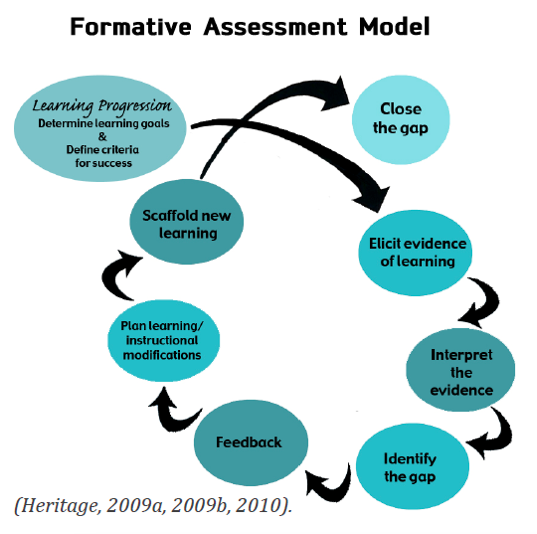
From my initial reading, I have come to recognise formative assessment as a vital part of the classroom experience. Black and William’s evidence shows that formative assessment is an essential component of classroom work. This has been very informative and is certainly a background for my research project. Black and William highlight that outside the box (the classroom) there are many initiatives and assessments for learning but this leaves out what really happens in the classroom and the teaching experience. It also makes mention to students competing in the class for the best results thus leaving out many students who feel let down by their education. This could change where students become more able to assess their learning thus far and be able to change that. I feel that the acknowledgment for my students that their learning is an ongoing passage through their course they (including myself) can regularly assess how they (and myself) are acquiring the knowledge to succeed thus helping both parties.
Workshop Title: SWBAT (student will be able to..)
(471 words)
After the workshop, please take a few minutes to jot down any ideas, teaching tips or techniques, etc that were covered, and which you felt were useful to you. How was the content of the workshop relevant to the courses that you teach? What did you gain from attending this session?
The main point I got from this workshop was about having objectives in my lessons. If I do not have objectives, and objectives that I want the students to achieve the lesson does not really have a flow and a definite conclusion. Sometimes a teacher can go through the exercise book and feel they have achieved their quota of the language learning book but has not really focused on the students achieving a goal for that lesson which is to be using the vocabulary, grammar and language speaking associated with that lesson.
I think what I got from this workshop was to be more focused on the students’ needs, their use of English language and achieving goals. The workshop made me think more about the book I use. I recognized more how the Interchange book is structured into cycles. This is that the students have a snapshot, conversation, grammar focus, and listening to assist them with their learning and thus at the end of the cycle, it should give them a freer practice to make sure they can use their newly acquired English language.
For myself, I try to get as much as I can out of each English language lesson I teach. With the information I have been given by the workshop host, I see our team of teachers are finding their way to the end of a cycle. However, there may be a question about objectives being reached for each student. I think from what the workshop talked about is that teachers should try to focus more on students’ objectives. This is the acronym SWBATs. The crux of the workshop was Students Will Be Able To’.
I think SWBAT is a focal point for me. I should be able at the end of the cycle in the book as well as the end of each lesson be able to see and hear the students using the grammar and vocabulary which I have been teaching them, hopefully without major problems. I need to know that each student knew their objectives at the start, worked through the class and hopefully achieved them by the end.
To conclude, what I took from the workshop was that teachers should remember to focus on their objectives while giving students objectives, so in the end there is a purpose to the lesson and a feeling of achievement. Thus, all students will achieve their goal of ‘students will be able to’. and teacher will be asking each other, ‘what are your SWBATs for today’s class?

Why is it important to teach a second language?
(413 words)
TASKS:
- There are at least 3000 spoken languages in existence today. T/F
This is true, it has been estimated that the peoples of the world speak at least 3,000 or more different languages although it can be estimated that there are as many as 10,000.
2. Chinese is the most widely spoken language in the world. T/F
This is true, with 400 million people speaking Chinese (Mandarin), although If the English language is included with its second language use then this would be the most widely spoken language.
3. Some countries have more than one official language. T/F
This is true of some countries that are made up of many peoples. They speak different languages. For example, Switzerland has four national languages – German, French, Italian, and Romansch with German existing in two major dialects. Belgium counts French and Flemish. Canada has two official languages, English and French.
4. Bionic and laser are words that have been in the English language for more than 100 years. T/F
This is false. One specific feature of English is the ease with which new words can be introduced or formed to meet the communication needs of science, popular culture, politics, administration and ordinary speech. The two examples ‘Laser’ and ‘bionic’ are recently adopted words. It can be seen that the English language has an exterior that is forever changing but the core stays the same. An example of this peripheral evolvement of the English language is shown by there being every year a new buzzword (“a word or expression from a particular subject area that has become fashionable because it has been used a lot especially on television and in the newspapers”). The buzzword for 2004 was ‘Chav’. This is a noun which describes young men who wear cheap gold jewellery and baseball caps and hang around in shopping centres all over Britain.
5. English is widely used as an international language in science, commerce academic study, and training. T/F
There are many nations whose unique languages are spoken by no more than a few million people. This is the case with several countries of Europe such as the Scandinavian countries, Denmark, Norway, Sweden, Finland, Holland, and part of Belgium. For these kinds of countries simply to have a large enough market for publication, many books especially scientific, technical, or academic are printed in English. For them, English has become the dominant international language in communications, science, business, aviation, entertainment, and diplomacy and also on the Internet.
- ← Previous
- 1
- 2
- 3
- 4
- Next →

