Give reasons for your viewpoint about the place of grammar and vocabulary in IELTS preparation
(386 words)
The first aspect of IELTS preparation is that candidates should only enter the course if they are at least intermediate level of proficiency in the English language, so at this point, they should be conversant with the features of grammar and vocabulary. I think it is the teacher’s job to emphasise improving candidates’ general proficiency of these features without inundating them with too much grammar and vocabulary. I think there needs to be an overall consolidation of the system of grammar, vocabulary, and also pronunciation. In my viewpoint, I think the aim of the IELTS preparation course should be to build vocabulary in the topic areas to enable candidates to comprehend vocabulary they will encounter in the reading and listening sections and to correctly use vocabulary in the writing and speaking sections. I think the underlying design of teaching IELTS preparation and the distinctive core methodology is teaching ‘in context’. The language needs to be delivered ‘in context’ in a manner that is as authentic as possible.
Grammar and vocabulary are important for the test. I think the potential for classroom lessons where grammar and vocabulary are highlighted and discussed in interesting communicative activities is vital to learning. I think it is the teacher’s choices of task-based, often inter-related skills activities, involving IELTS-relevant micro-skills of the test that help promote grammar and vocabulary.
Outside class, I would advocate reading for pleasure with the candidates having an opportunity to discuss their reading in the class. This all has to do with changing learning patterns. For example, some students are taught grammar which is deciphered while they sit down and listen to the teacher. They need to put new words into context, know what part of speech it is, and break them down into syllables and stress. In the test, they may encounter words they do not understand. A simple reading of the text can put the word into context Furthermore, candidates should learn, practice, and use their new language forms in contemporary, realistic situations. Candidates need to build confidence with their grammar and vocabulary through clear course focus and goals helped by the teacher.
I think grammar and vocabulary cannot be avoided. If the teacher has a student-centered lesson, with the help of the teacher, grammar and vocabulary can be learned through the students undertaking meaningful tasks.
References:
http://www.ielts.org/404error.aspx?aspxerrorpath=/article1.aspx
http://www.britishcouncil.org/
Teaching Young Learners – Working with a Course Book
TASKS
Look at some of the material and state how you would make the lesson interesting by supplementing or expanding upon the content of the page.
- Swimming pool
For this exercise, I would personalize the exercise by giving the characters who say something in the picture names. As an introduction, I would follow the original lesson getting the children to repeat the sentences but each time I moved on to each person I would elicit some more ideas and vocabulary relating to that person.
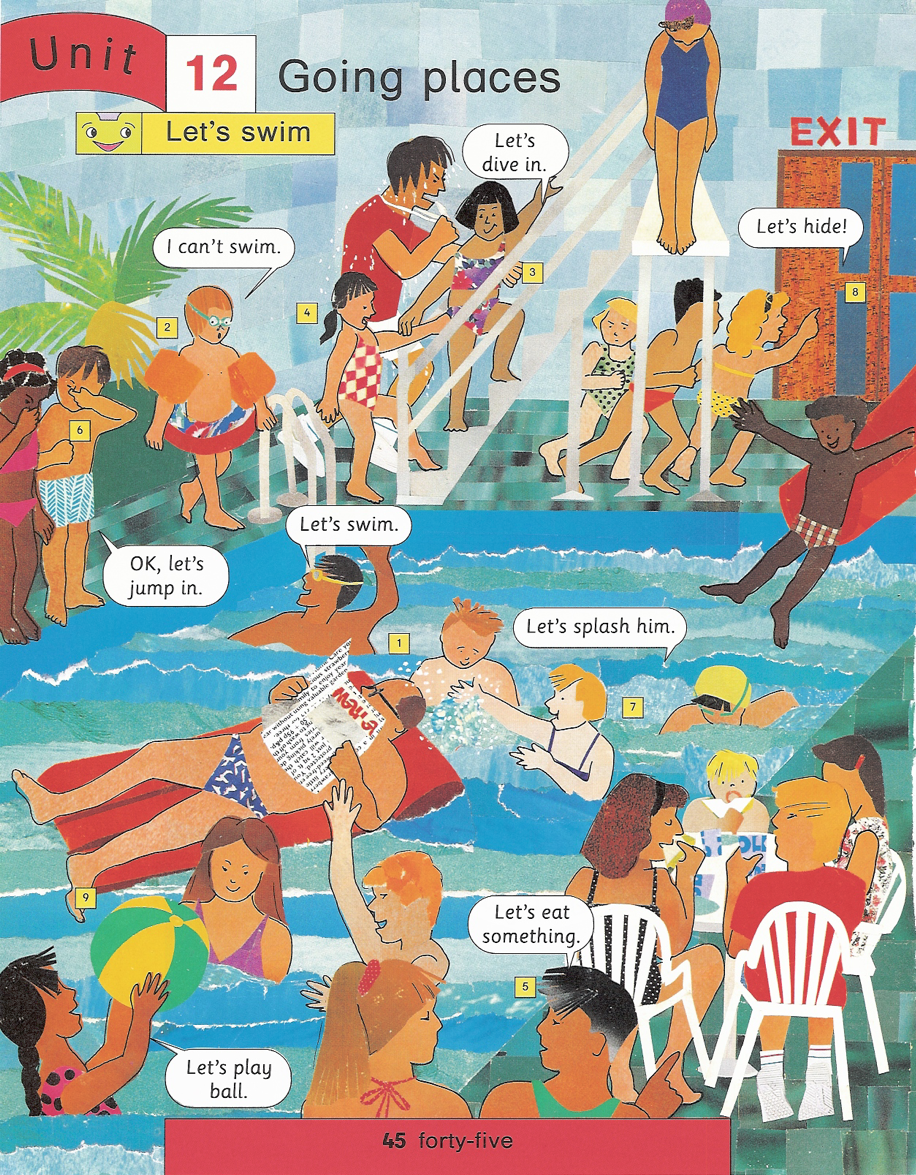
For example, Dave, who says ‘let’s eat something’
Is Dave swimming?
What color hair does he have?
Who is he with?
After completing the exercise, having discussed each person saying something, I would give the learners a freer practice. I would get the learners into groups and get them to look at the pictures and elicit any more information from the picture. I would then get them to write 2 sentences each for 3 people.
For example He is wearing goggles. She is playing with a ball.
I would now take the pictures away from each group
I would then have a quiz where each group has to ask say 2 sentences and then ask two questions. This would be repeated two times.
For example 1. He is wearing goggles. He has ginger hair.
What is his name?
What does he say?
2. She is climbing the stairs. She is with a friend.
What is her name?
What does she say?
The teacher and learners could check all the scores to see who has won the little competition.
2. Objects
For this activity, I would expand it by getting the learners into pairs and giving them identical pictures. These pictures could have a street scene or just objects. Although the pictures and the objects in the picture are the same, each of the learners has some of their objects colored in and others left blank (white). Some of the objects are colored the same. For example, in picture 1 the car is red but in picture 2 the car is blank, but picture 1 has a blue bird and picture 2 has a blue bird. The learners complete the task by sitting opposite each other so they are not able to see each other pictures. The task can be done like the game of battleships where they have a screen to divide themselves. It is up to the learners to work together telling each other the colors of objects in each other’s picture. They complete the drawing by coloring every object until they have identical colored pictures. The teacher can have a feedback session with the learners to check over their work.
Explain the difference between prefix and suffix
A common term for building up words is affixation. This involves adding to the front and rear of a word to make others. For this essay, affixation highlights the use of prefixes and suffixes to words. You put the prefix at the front of a word, for example ‘un’ in ‘untidy’. Here tidy is a verb that becomes the adjective, untidy. Suffix can be put at the end of the word, for example, ‘untidiness’ but notice the spelling. So, from this quick example of the word ‘tidy’ it can be seen to have a prefix, suffix or both. I will expand on the thought of inserting extra morphemes to change a word. That is, we can see that the word is built up this way in our lexicon (the formal term for our mental dictionary which contains morphemes and the rules for their combination).
To begin with and to give more meaning to the above explanation and make a distinction, I will first talk about suffixes. They are not words on their own so they can not stand on their own. Its job is to come at the end of a word. Once put at the end it changes the form of the word thus changing its meaning. The verb ‘govern’ is not the same meaning as the noun ‘government’. This shows the conversion of word, not only the verb into noun (entertain –entertainment), but also nouns to adjectives (certain – certainty). This is not forgetting that regular verbs which represent past tense are suffixed by ‘ed’. A suffix can be derivational or inflectional. An example is the word ‘development’ which a suffix ‘ment’ is added. In this case ‘ment’ is a derivational suffix. It should be noted that derivational affixes can be either prefixes or suffixes in ENGLISH. So, [un-] is a derivational prefix, while [-ment] is a derivational suffix. By adding ‘ment’ onto the word ‘develop’ we can make another word; ‘development’. By adding the suffix we have changed the verb ‘develop’ into a now ‘development’. We can say that if the suffix changes the part of speech is it derivational. Of course with this later example we can see that two suffix can be added namely ‘ment’ and ‘s’. [-s] simply makes the noun plural. It doesn’t change the part of speech and create a brand new word in the same way that adding [-ment] to [govern] did. The difference is that [-ment] is a derivational suffix, while plural [-s] is an inflectional suffix In the other case for the inflectional suffix the word ‘developments’ with the added suffixes only gives the word a plural meaning. In the other case for the inflectional suffix the word ‘developments’ with the added suffixes only gives the word a plural meaning. This could be said for nearly all nouns that a suffix ‘s’ changes its meaning, although it is known that there are uncountable nouns. This could be said for nearly all nouns that a suffix ‘s’ changes its meaning, although it is known that there are uncountable nouns.
We find that prefix has the same characteristics of a suffix but of course, it appears at the front of words. It is seen and acknowledged that by modifying the word it changes its meaning (tend – attend)., although there can be examples where the part of speech stays the same as in ‘kind’ and ‘unkind’ which still stays an adjective but changes the positive and negative qualities,
In this essay, I have given an introductory illustration of prefixes and suffixes. By learning about these word builders we can see how vocabulary can be built up into an Immense amount of words but also scale down to unearth the root of the word by taking away the additions. This leads one to have a better understanding of the working of a language.
Teaching Young Learners – Songs, Rhymes and Chants
Task One
Where would you put the stresses on the following rhyme?
I would put the stress on the vowel (letter strings) in each sentence, showing rhyme. Nearly all of these vowel sounds also marry up with the final consonant sounds (n-ew-s / sh-oe–s). I would give the students more examples of these sounds (choose, lose, blues). With younger learners I think vowel sound is important but also the sound they make with the final consonant.
Have you heard the latest news? Isabel has bought new shoes
And did you know that Harry’s dad has got a dog that’s completely mad?
Well, Alice copied Tommy’s work and she’s taken Helen’s skirt
Johnny Jones has been much worse, he’s stolen money from Angie’s purse
Wait till you hear what Cathy’s done, she’s eaten a worm, just for fun!
Task Two
Choose a song or devise an activity that can be used in the classroom. State the age you have in mind.
1. Old MacDonald’s Farm
Age: Young learners
Aim: Practice listening and singing
Practice listening for animal names and sounds
Preparation: Collect pictures of a farm and a farmer, models of animals
1. The teacher starts by showing a picture of a farm and a farmer.
2. The teacher asks the learners ‘who and where is this?’ and gets them to call out the place and hopefully the farmer’s name (Old MacDonald).
3. The learners are told this is ‘Old Mac Donald farm’. The students are asked ‘What animals can you see on a farm?’
4. The students can shout out the names of animals. The teacher can check that they know the English word for the animals.
5. The teacher gets the children to think about their favourite animal that lives on a farm.
6. The teacher then shows some models of animals including the ones in the song. The names for the animals are elicited and chorally drilled.
7. The teacher then asks ‘what sound they make?’ The teacher gives examples.
8. The teacher already has prepared sheets of paper to match animals and their sounds. The teacher gets the learners in groups and gets them to match the animals and sounds. This helps to solidify the exercise a little more.
9. The teacher gives each group the animal models from the song. She tells the group when they hear in the song an animal’s name she wants them to grab the animal. This helps them get an idea of the animals in the song. She plays the song and lets the groups grab the animals. She checks who got the most animals in each group.
10. If it is necessary, stop the song line by line until they get the idea.
11. The teacher gets the learners to sing the song together with the accompaniment provided by the tape. The children may learn very easily by using echoic memory. The teacher could promote mimics, gestures, etc. associated to the meaning to make children play a participative role freely.
12. A follow up could be that the learners make their own farm or individual groups come up to the front and sing.

