Aquisition
Syntax – an indepth look
(6981 words)
Human communication in all its forms almost always uses words. We could say that communication is essentially the expression of thought. Every time we speak or write we are faced with a myriad of choices to explain ourselves. Within this information transmission that uses thought, we use words to express our beliefs and judgments, intentions and desires, etc. The words are used in a combination to make others understand our desired thoughts. Human languages are among several systems of human communication (some others such as gestures, symbol systems), but language has immeasurably greater communicative power than the others. The grammar we use to communicate, the context, the people with whom we are communicating with and whether we are writing or speaking have to be in a form that is fully recognized. Sentences are not unordered strings of words; rather the words and morphemes are grouped into functional constituents such as subject, predicate, direct object, noun phrase, verb phrase, and so on. It means that we take a finite number of discrete elements (words) and combine them to create larger structures that are different in meaning from the original words themselves. The choices for expression make use of many patterns in the English language. All human languages have very similar underlying structures; they all have phrase structure rules and transformational rules. The use of these words is systematized according to syntax. It is Syntax that this paper is concerned with. In this paper, I will take a deeper look at how English language syntax helps us form the complete understandable sentences that help us communicate so well.
It is clear to see that the sentence ‘Man hits animal’ is not the same as ‘Animal hits man’. We know this because we use a code, or set of rules, to translate between orders of words and combinations of thoughts. Generally speaking, this set of rules is called generative grammar. Syntax works on a prescriptive use of grammar although spoken English is not as formal as we think and works along the lines of a more descriptive method. Descriptive syntax is about understanding the rules that a speech community employs by examining the way that the members of that community actually do talk. I will try to show in this paper syntax as comprehensively as possible while recognizing that the coverage of all the details is impossible.
The English language holds rules that can create larger more complex structures. It is by learning phrase and clause structures that give us a clearer picture of syntax. These structures are what make the syntax rules. We find that it is possible to create an infinite number of sentences, all of which can express meaningful thought. Thus it is possible to construct sentences that the speaker has never used before. It can be said that English has a finite number of rules which facilitate an infinite number of sentences. Syntax shows that sentences and the relationship of their component parts works in English. To understand a sentence one cannot merely pay attention to the order of words. Communication is grounded on getting our point across. The study of language is of the formal interrelations that exist between the elements of a language (i.e., sounds, words) themselves. Syntax is the system that speakers and writers use when they combine words into phrases and clauses, ultimately creating meaning in their structures. Thus, the point of us using words is to be comprehended. English speakers show this in their syntax that is used by every English-speaking person. The old definition of a sentence was ‘a complete expression of thought’, although today this may seem a bit vague to be helpful. An English-speaking person may say ‘beautiful day!’ which is not a grammatically complete sentence, but it is our knowledge of the sentence ‘it is a beautiful day!’ that we are able to understand the utterance. So, although a person takes the language and uses it to different extremes it is our fundamental knowledge of the original grammar that allows us to comprehend incomplete sentences.
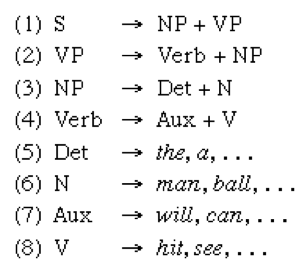
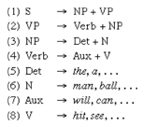
Syntax uses many components that consist of a set of rules operating upon putting into the sentence to achieve and produce an understandable result. These rules are essential language parts of syntax that are used to understand the logic of how it all works. In every sentence, certain groups of words form natural units (the constituents). These units may stand alone, be moved as a unit, or be replaced as a unit by a pronoun. We essentially have here the building blocks of language. The list below gives a few examples of the phrasal categories (noun phrase, verb phrase) and lexical categories (noun, verb, and determiner), that this paper will be using. In the following, we find that S stands for Sentence, NP for Noun Phrase, VP for Verb Phrase, Det for Determiner, Aux for Auxiliary (verb), N for Noun, and V for Verb stem.
In most English schools, they always tell you about the basic rule in the English language which is to have a Subject – Verb – Object combination, but there is much more to it than that. The subject and the object in a sentence can consist of only one word such as ‘boys like girls’, which is a simple declarative sentence. If someone says, “The boy throws the ball,” using the Subject – Verb – Object combination, it is to make whoever speaks the same language comprehend the sentence (S) without confusing him and putting across the wrong meaning. The subject and object in a sentence, name someone or something. The sentence ‘the boy throws the ball’ is known as a clause (a simple sentence) that includes a subject and predicate. The laws of syntax prevail that these words are understood in the position they are. In this initial pattern we can see that the subject comes before the verb (throws) and the object follows the verb. From the simple S-V-O pattern you can get a general picture of how a child acquires their language. There is a distinct pattern. Sentences can consist of a noun phrase either in the subject (the boy) or the object (the ball) position. We recognize a phrase as a small group of words expressing a single concept or entering with some degree of unity into the structure of a sentence, without itself being a sentence. We also find that the subject may consist of a group of words that includes the subject noun and words that modify it, for example ‘’the boy with the black hair’. ‘With the black hair’ modifies the subject ‘the boy’. As a little introduction observe the subjects in the following sentences that give a brief insight into how various subjects in a sentence can be formed.
A. The boy throws the ball. [noun as subject]
B. He throws the ball. [pronoun as subject]
C. What he threw smashed a window. [noun clause as subject]
D. Playing is fun. [gerund as subject]
E. Throwing balls in the park is fun. [gerund phrase as subject]
F. To throw a ball is fun. [infinitive as subject]
G. To be able to throw a ball is exciting. [infinitive phrase as subject]
Syntax assigns to each sentence that it generates a structural description, as are all the sentences A – G above. But before we go too quickly with too many examples, let’s get back to our original sentence ‘the boy throws the ball’. When we look at the whole sentence, we understand that the meaning of the words combined together in this sentence is quite detached from its individual parts (each word). If we arranged the words as ‘the ball throws the boy’ we would have a completely obscure sentence that isn’t the meaning that we had hoped to be put across. If a person knows what ‘ball’ and ‘throw’ mean he instinctively knows that the ball is not doing the action and structure cannot work.
The fact about language is that we want to make it interesting and colorful, a language that has character. How do we do this? We do this by using other elements that can be added to the sentence such as adverbs, phrases, clauses, and adjectives. Looking at adjectives, for example, we see that an adjective is a word designating an attribute and added to a noun, to describe the noun more fully. Adjectives or other single words that modify nouns are usually placed before the noun (the small boy throws the red ball). We can also find whole phrases acting as modifiers in a sentence. These are usually placed after the noun (the small boy in the red shirt). We also see adverbs that are normally more mobile than adjectives occurring either before or after the verb they modify (the small boy in the red shirt wildly throws the red ball), (the small boy in the red shirt throws the red ball wildly). We now get a view of how sentences get a little bit more fascinating.
So, we have words, and these need to be put into a combination to be understood. These combinations we call phrases and clauses. We do not say ‘a day beautiful is it’. We say ‘it is a beautiful day!’ or ‘beautiful day!’ In order for sentences to work with any degree of success, the rules have to be pretty much adhered to. The predominant properties that characterize each phrase and which roles they play in the sentence are determined by the properties of the principal or head word. Using syntax with the example ‘The boy throws the ball’, this sentence (S) consists of two noun phrases (NP ‘the boy’ and ‘the ball’). A noun phrase always contains a head noun. In this case, ‘boy’ and ‘ball’ are what each phrase is about. The subject is ‘the boy’ and is symbolized as:
NP → Det N (Noun Phrase → Determiner Noun)
We can see that the syntactic pattern is a determiner followed by a noun. Looking at the verb we can put it into a verb phrase that includes the noun phrase following after the verb symbolized as:
VP → V NP (VP = ‘throws the ball’).
We see that the predicate is the part of a sentence containing what is said about a subject. ‘Throws the ball’ is called the Verb Phrase/Predicate. This is so-called because it always contains a verb in a specified position. We say that the verb is the head of the Verb Phrase/ Predicate.
To give us a better picture, we can now represent the example sentence as:
S → NP + VP.
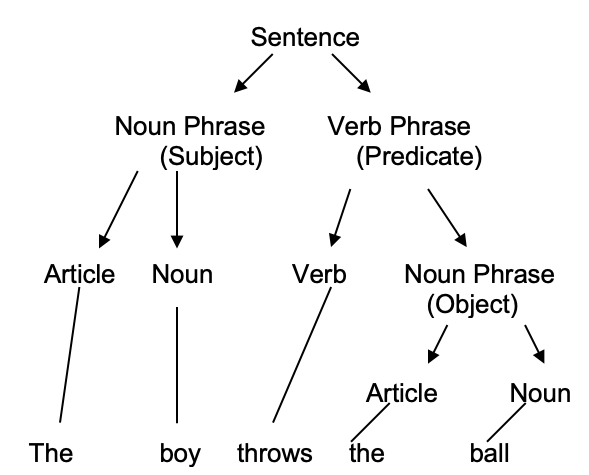
This represents the symbols of grammatical theory. The arrow itself means something like ‘consists of’ or ‘can be rewritten as. After the arrow, you will find the constituents the phrase may consist of. It is important to know in a sentence there are phrase-structure rules that make up the important parts of syntax. Phrase structure rules specify which elements can occur in a phrase, and they also specify in which order these elements (or constituents) may occur. Syntax involves Phrase Structure Rules, which yield trees (see Diagram A) with labels added to indicate the syntactic category of each constituent (e.g. Noun Phrase, Verb Phrase, etc.).
Diagram A
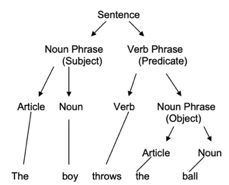
We should not forget that the subject in ‘the boy threw the ball’ sentence includes an article (the), and a concrete noun (boy). These two words together form a noun phrase, as does the noun phrase ‘the ball’. The article in both of these noun phrases is the word ‘the’. In English, the article provides the minimum specification necessary in the noun phrase. The sequence with the article ‘the’ and a noun is that ‘the’ always holds the initial position. In our sentence about ‘the boy’, the function of the article is to provide the type of reference of the Noun Phrase and the information value of what is expressed by the noun phrase. The use of the article ‘the’, makes us think that we are talking about one specific boy and ball.
In learning about syntax, a good starting point is identifying the two basic parts of a sentence: the subject and the predicate. Every predicate in a sentence includes at least one verb. In our example ‘throws the ball’ works as a verb phrase that uses the string of symbols Verb (V) + noun phrase (NP). In our phrase structure we see the symbols:
VP → V NP.
We can also see that the subject (the boy) is put at the initial position in the sentence and the object follows the verb. Looking more closely at the sentence here, we find that the verb is transitive. Transitive means that the verb ‘throws’ must take an object after the verb. The complement after the verb is called the direct object of a transitive verb. It would be an incomplete sentence to use ‘the boy throws’. Using the verb ‘throw’ we understand that it is the action of throwing. The subject is the thrower. The subject must throw something so the object takes the place of the thing thrown. The verb dictates that there must be an object. The object ‘the ball’ becomes the direct object.
Moreover, if I said ‘the boy jumped’ this is a syntactically complete sentence that does not need an object. This sentence has an intransitive verb that requires no object after it. Of course, this does not mean the end of the sentence, using syntax we can add more meaning to it by adding, for example, a prepositional phrase (PP) that makes the sentence ‘the boy jumped on the roof’. The syntactic rule states that a verb phrase consists of a verb and an optional PP. This is of course only true for intransitive verbs, which do not take an object, but this rule can already generate VPs such as the following: ‘the boy jumped’, ‘the boy jumped on the roof’. Verb phrases are a little bit more complex because they allow a fairly wide range of phrases that can modify a verb. So, we have intransitive, one-place verbs that combine only with the subject ‘The boy jumped’ (S-V). There are also ‘two place’ verbs combining with subject and, for example, a following obligatory adverbial after the verb (S – V – A). The adverbial can express time, place, or manner. For example ‘The boy is in the house’, ‘the boy played for two hours’.
Another point just to follow up is, the ‘doer’ and the ‘receiver’ in a sentence, which was shown in ‘the boy throws the ball’. ‘The boy’ is the doer and ‘the ball’ receives the action. This is generally thought to be the rule although we can also see other constructions it varies. If I say ‘She appeared in front of him’ (S → V (PP), we propose that the other person is the doer of the action and ‘she’ received the actions of him appearing. So it follows that different verbs can be followed by different kinds of words and structures. For example ‘I have a bag’ does not involve an action but is a state. We can also show that some subjects do not have an object. For example ‘He was angry’ uses an adjective as a complement after the verb that expresses meaning to the subject (He).
We can propose that within the grammar of a language there is a hierarchy of levels. The sentence is King. At the lower level morphemes are arranged into words to form phrases, and clauses into sentences and we find meaning. As speakers of English, we recognize categories such as nouns, verbs, and adjectives. These parts of speech do not actually form our language. We are more activated by patterns in our language. So, for instance, we have learned the Subject – Verb – Object sequence and we recognize this as a correct syntax pattern, but language is not so simple. For instance, we can add another object to the end of the sentence. This becomes a three-place verb, a so-called dia-transitive verb. We now read the sentence as Subject – Verb – Indirect Object – Direct Object. For example, ‘the boy throws him the ball’. We can show the sentence in these ways:
S → NP(1) + Tran V + NP(2) + NP(3)
NP(1) transitive verb NP(2) NP(3)
(subject) (predicating verb) (indirect object) (direct object)
The boy throws him the ball
As much as we recognize the ‘S – V – O’ and even ‘S – V – iO – dO’ combinations in English syntax, we can make the sentence focus more on one of the other aspects of a sentence other than the subject. Thus, in the case of our sentence, ‘the boy throws the ball’ we can now focus our attention on the ball instead of the boy. In this case, we would end up with the syntactical sentence ‘the ball was thrown by the boy’. Using our constituent S is now separated into sub constituents where we have an active sentence that reads:
S →NP1-V-NP2
(The boy throws the ball). T
The second sentence is called ‘passive’ in grammar that reads:
S →NP2 – be + en V – by + NP1.
This rule explains the grammaticality of ‘the ball is thrown by John’ given that of ‘The boy throws the ball’.
It should be observed that ‘NP1’, ‘V’ and ‘NP2’ are the parts of the context that are treated for the application of the passive rule. The passive rule involves two applications of the ‘Move NP’ rule, one moving the subject ‘NP1’ to the ‘by’ phrase, and another moving the object ‘NP2’ to the subject position. In effect, all the elements that make the passive rule specific to transitive constructions are deleted and a simpler rule (‘Move NP’) replaces it.
The passive structure has gone through syntactic transformational and movement rules, as developed by Noam Chomsky. These rules make us look at the relationship in the hierarchical tree structure into which the words of a sentence are placed. The passive sentence ‘the ball is thrown by the boy’ contains the verb ‘throw’, which as shown before ordinarily requires a direct object. But here the object is missing from its normal position; it has been ‘moved’ to the front of the sentence. This gives us a way of shifting the emphasis and quantification of a given set of participants in an event or state. The sentences ‘The boy throws the ball’ and ‘The ball is thrown by the boy’ both express the same information about who did what to what, but one of them is a comment about the boy and the other is a comment about the ball. Similarly, sentences in which a phrase is replaced by a wh-word and moved to the front of a sentence, such as What did the boy throw?, allow the speaker to seek the identity of one of the participants in a specified event or relationship. It is important for us to recognize the movement in the sentence. Transformations thus provide a layer of meaning beyond who did what to whom; that layer emphasizes or seeks information about one of the participants, while keeping constant the actual.
As shown above we can change the sentence while still leaving the same meaning. There are a number of rule-bound transformations of words in language that can change our original simple sentence into interesting and varied utterances. Because there is an underlying and simple structure to all our sentences, we can understand each other. These are the principles of syntax. Our original mentalese sentences are transformed into something besides the simple sentence. It is our power with language that we make use out of these sentences and make varied articulations. Since those transformations are rule-bound, we can make sense of each other, even with so much creativity happening. We can end with sentence like:
It is the boy who throws the ball.
The boy is the one who throws the ball.
The ball is thrown by the boy
The object thrown by the boy is a ball.
It is the moving of the sentence while adding and taking away that shows syntax at work. At this point, we can highlight case grammar that uses semantic case analysis to find the link between syntactically distinct sentences. We can say:
(A)The boy throws the ball with his left hand.
(B) His left hand throws the ball.
We see in the sentence (A) above that ‘his left hand’ works as a direct object and as a noun in the sentence (B). The fact between these two sentences is that the relationship between ball, throws, and left hand is identical in both sentences. Case grammar allows a word to have the same semantic role, despite having a different syntactic designation.
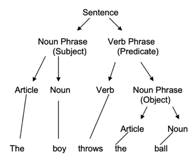
To get a better view on a sentence, an important factor to syntax is by parsing. We do this with our original sentence, as seen in Diagram A. Parsing generally describes, a word in context, grammatically, by stating the relevant part of speech, inflection, and place within the sentence structure. It resolves (a sentence, phrase, etc.) into component parts of speech for grammatical description. We can view the sentence’s grammatical structure in Diagram A repeated below. When using parsing we find the term tree is popular among linguists. Labels are added to indicate the syntactic category of each constituent. Tree is a popular word used to describe the formation of a sentence although by reading Noam Chomsky you will hear him calling them phrase markers.
Sentence: The boy threw the ball.
Subject Noun phrase: The boy
Verb phrase: Threw the ball
Article: The/The
Noun: Boy/Ball
Object Noun Phrase: The ball
Diagram A
This declarative statement above (Diagram A) can of course be used to make a question. If we look at making this sentence a question we have to run some tests on it to find its constituents. The rules of syntax can look inside a sentence and find the parts we need to form questions. Generally, this is a good way to check our understanding of the question. We can positively say the statement “the boy throws the ball” is related to the corresponding questions, “What does the boy throw?” and “Who throws the ball?” As much as statements give information, questions are sentences that seek information. They fall into two main types, depending on the reply they expect and on how they are constructed. Yes- no questions allow an affirmative or negative reply, often just a yes or no. So, we can run some tests on the sentence ‘the boy throws the ball’ to check its constituents. For example, can a constituent stand on its own? We can ask the questions:
Question: ‘What does the boy throw?’
Possible answers -‘the ball’
but ‘ball’ and ‘the’ fail the test.
We can actually use a substitution test here where we can use ‘the ball’, our noun phrase, and replace it with the pronoun ‘it’. This reveals the answer to the question.
The boy throws the ball – The boy throws it.
We can use the substitution test again on the other noun phrases to test if a pronoun could be used instead of the noun phrase.
Possible questions: ‘What does he throw? Or ‘Who threw the ball?’; ‘Did he throw the ball?’ Or ‘Did he throw it?’, and ‘Did the boy throw it?’
So, by looking at the ‘wh’ type question, from ‘the boy throws the ball’, we can look inside the sentence and see that by moving the phrase corresponding to ‘the ball’ to the front we make the question ‘What does the boy throw?’
Most questions ask for the object of a sentence: ‘The boy throws the ball”
What does the boy throw? ANSWER = OBJECT (the ball).
Regarding the question words WHO, WHAT & WHICH, if the answer is the subject, there is no auxiliary do, does, and did and the word order is the same as a statement.
Who throws the ball? ANSWER = SUBJECT (The boy).
Now let’s look at the declarative sentence from before using two objects, ‘the boy throws him the ball’. If we were to use “Wh-Question Formation Rule” for English sentences with inirect object and direct object, we would have to use a rule like this. This uses the sentence, with a missing item X.
A. The boy throws X a ball.
We need to insert the appropriate Wh-word for the expected lexical category of the answer
B. The boy throws who a ball.
Now we need to change the form of the verb to the appropriate “does X” construction.
C. The boy does throw him a ball.
We must now use Subject-Auxiliary Inversion to form an interrogative.
D. Does the boy throw him a ball?
Finally, we can move Wh-word element to the front of the sentence
E. Who does the boy throw the ball?
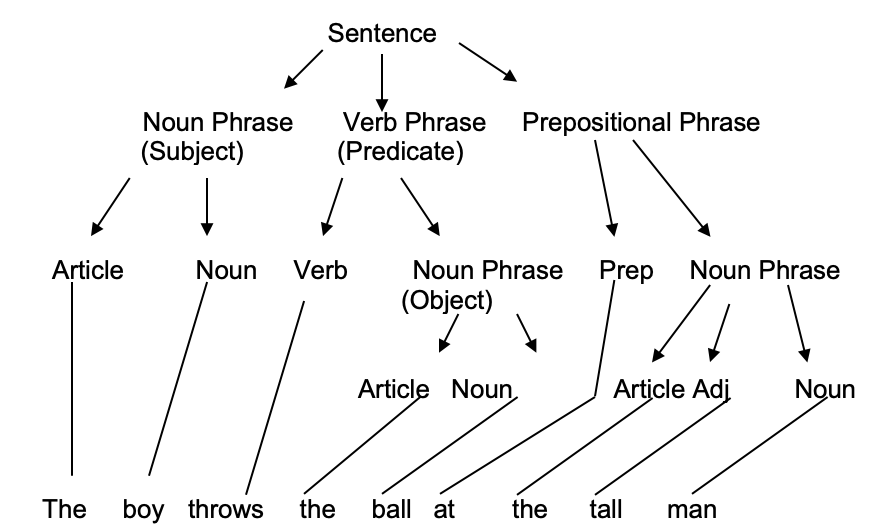
There are many constituents to a sentence and it is our job to notice them. We find that there is a hierarchical structure in a sentence; there is a rank scale where the sentence is at the top then broken down into clauses then phrases and words. Phrases and clauses are what language is made of. It is by joining together these patterns that give us the power to broaden our sentences further. For broadening our sentences, we can use phrases. For example, we can add to our original sentence ‘the boy throws the ball’. If we take this sentence to be complete, we can just add on to the sentence to extend our meaning though still keeping in the confines of a complete sentence. We can now form a new sentence like ‘the boy throws the ball at the tall man’. We have now added a prepositional phrase (PP) that consists of a preposition followed by its object and its object’s modifiers.
We see that PP → P NP, a prepositional phrase consists of a preposition (at) followed by a noun phrase (the tall man). It begins with the preposition and is followed by its object, ‘man’. ‘Man’ is modified by the adjective ‘tall’.
Diagram B
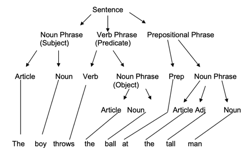
We can look at this sentence and notice the appearance of the prepositional phrase at the final position. The prepositional phrase follows a noun phrase (the ball). We notice that the noun phrase (NP) obligatorily consists of a head (ball), the noun, and additional optional elements, in this case namely a determiner (the), and then followed by a prepositional phrase (PP). In the prepositional phrase in Diagram B, we can see the symbols written as:
PP → P Det A N
We see a pattern of the preposition – determiner – adjective – noun (at the tall man). The noun serves as the object of the preposition. The adjective appears between the post determiner (the) and the head of the phrase (man). Nouns such ‘man’ in Diagram B can take an indefinite number of adjectives in front of it, while keeping the meaning coherent for example, ‘the tall dark fat man’. We must not forget that the adjective usually pre-modifies the noun but also can occur as a complement, for example ‘the ball is big’.
For this sentence, (Diagram B) using syntax, we can have a myriad of prepositional phrases that follow the sentence ‘the boy throws the ball’. If we write a phrase-structure rule to get our Noun Phrase, we need a rule like this:
NP -> (Det) N (PP)
(A noun phrase consists of an optional Determiner followed by a Noun followed by an optional Prepositional Phrase).
And the rule is that a prepositional phrase consists of a preposition followed by a noun phrase. Put these together and we get:
NP -> Det N PP, PP -> P NP
Using this theory we arrive at sentences like:
The boy throws the ball – in the classroom
at the window
with his right hand
on the roof
Now following the rules above we can show how the prepositional phrase is added to the noun we can end up with a myriad of ending to the sentence ‘the boy throws the ball’. Also following our rule NP -> Det N PP, we could be cheeky and have a sentence that goes along the lines of:
‘The boy at the window in the classroom throws the ball with his right hand on the roof’.
After a moment’s thought, we can see infinity here. Specifically, we see that the appearance of the NP within the Prepositional Phrase rule and the appearance of the PP within the Noun Phrase rule will let us make infinitely long Noun Phrases (or PP’s for that matter).
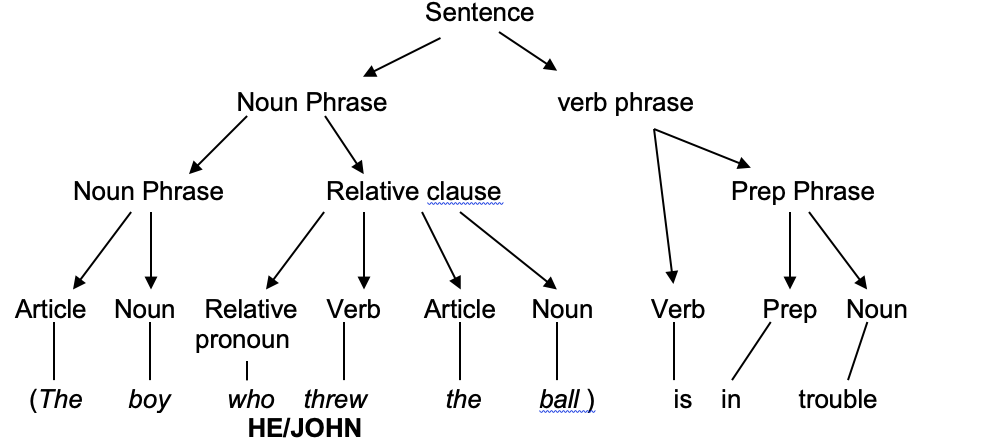
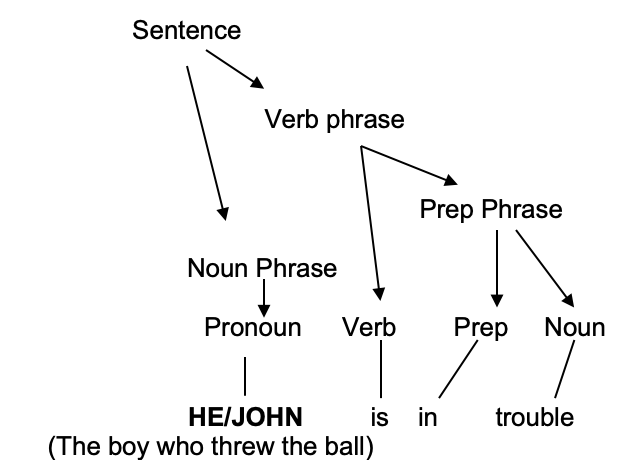
We can now see we are showing syntax working in the sentences and how we are forming longer sentences that have a more complex meaning. Moreover, syntax allows us to add another clause into the sentence and read it as, ‘the boy who threw the ball is in trouble’ (Diagram C below). We have now added a relative clause, adding more information to the sentence which in this case is ‘the boy is in trouble’. If we do not want to get confused we can run some tests on the sentence to check the syntax. First, what we can find out here is; what is the subject of this sentence? In this case it is ‘the boy who threw a ball’. This is the subject of the sentence. Our next job would be to isolate the main verb from the sentence. We actually have two verbs in the sentence ‘is in trouble’ and ‘who threw the ball’. The main verb here would be ‘is’.
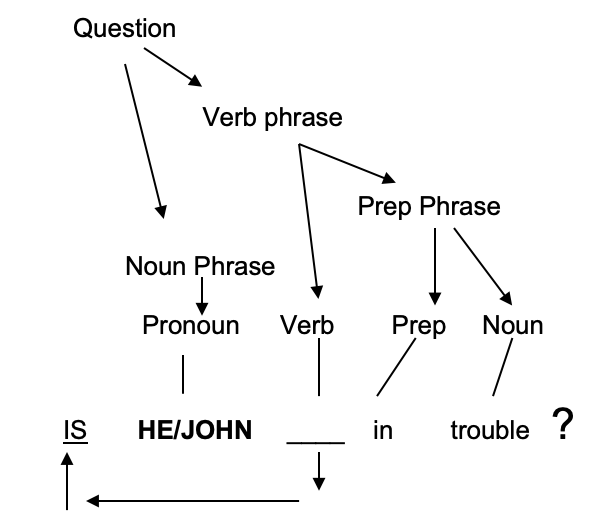
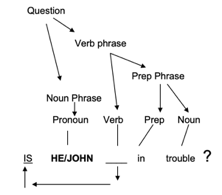
The next question would be to ask syntax to arrange this sentence in an order to make a yes/no question. In slightly more technical terms, we have uncovered constituent structure. Specifically, the whole string of words, the noun phrase, ‘the boy who threw the ball’ is a UNIT’. This happens to be playing the role of the subject in this sentence. “who threw the ball’ is a noun complement which in English typically comes after the head: they are post modifiers. We can recognize the noun phrase more if we replaced ‘the boy who threw the ball’ which is a constituent of the sentence, with a pronoun. In this case, we could replace the noun phrase with the pronoun ‘he’. This structure does not affect the sentence, for example ‘he is in trouble’. By the same rule we could add a real name such as ‘John is in trouble’. We move the “is” that is the main verb and place it to the left of the subject. In simple terms, constituents are groups of words that act as a single unit within a sentence.
Diagram C
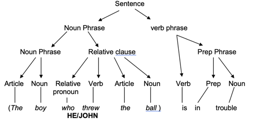
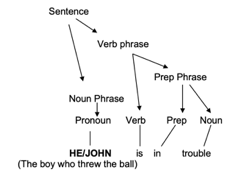
As we see with these sentences we are adding to our original sentence with more information that can be added to the sentence while being kept within the confines of a sentence. We see with the example, the relative pronoun ‘who’ is always placed in the first position in the relative clause. This relative pronoun has a syntactic function as a clause element in the relative clause. The word ‘who’ connects the subject to the verb in the dependant clause. This relative clause post-modifies the noun phrase ‘the boy’. The relative clause is a syntactic construction that allows us to provide more information about the referent of the noun phrase.
It is by looking at Diagram C that we see three combinations working in the sentence; a noun phrase, a relative clause, and a prep phrase. Now, how do we turn this into a question? Transformational rules help us here and it is by parsing the sentence that we find what we need to know in the sentence. We know that the yes/no question is ‘Is the boy who threw the ball in trouble?’ but why? What we have to find is the hierarchical structure in the sentence. The first exercise to do is find the subject in the sentence. The sentence is the noun phrase with the relative clause post modifying the noun phrase. This leaves us with a noun phrase that is ‘the boy who threw the ball’ which in this sentence is the subject. This leaves us knowing the main verb in the sentence. Once we have extracted the subject we find that the verb ‘is’, is the main verb and this, we place at the front to make the yes/no question in this case.
Diagram C2 (Question)
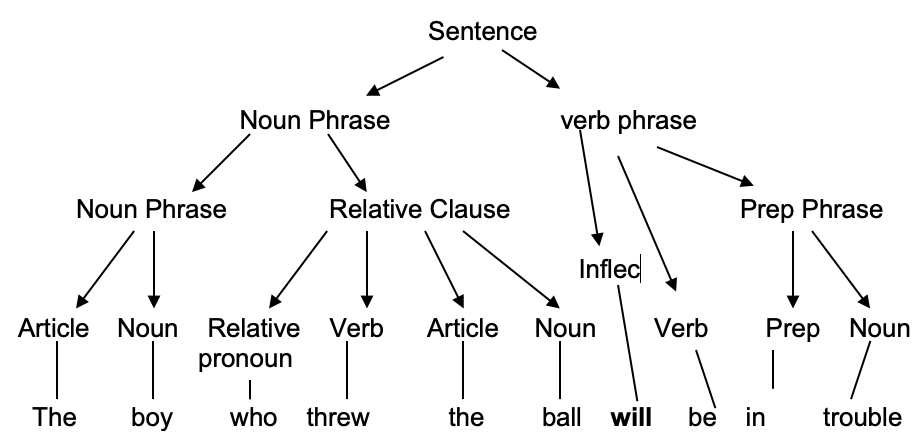
So, our sentence is getting bigger while still keeping within a syntactic structure. We have looked at the noun phrase but now we want to add to the verb phrase (VP). The headword in the VP is the verb but as we will see the verb phrase may contain elements from different verb categories such as modal auxiliaries/inflection can, may, will etc. These inflections are used to convey various types of meaning primarily the speaker’s view in the likelihood that what he says is true. The group (inflection + verb phrase) is called ‘I bar’ to indicate that it contains other things in addition. We also see that the addition of an inflection produces an ‘IP’ (inflectional phrase).
IP → NP I (a sentence consists of a noun phrase followed by an Ibar)
I → I VP (an Ibar consists of an inflection followed by a verb phrase)
Using an inflection with the example Diagram D we can now have a sentence that reads;
The boy who threw the ball will be in trouble.
IP → The boy who threw the ball will
I → Will be in trouble
We can notice that the modal ‘will’ takes an initial position before the verb as in the parsed Diagram D, below.
Diagram D
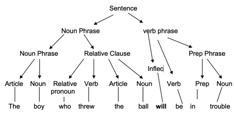
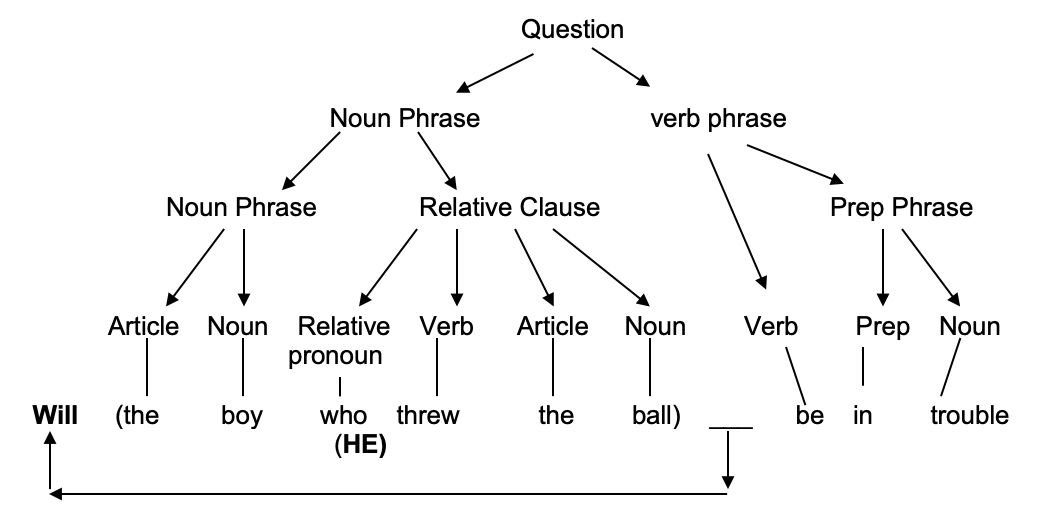
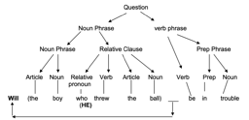
The problem is if we wish to form a question that corresponds to the assertion ‘the boy who threw the ball must be in trouble’, what must we do? We have two verbs working in the sentence. First of all, we must first find the root, which is the subject ‘the boy who threw the ball’. The consistency test we had before shows that we have a single constitute. We could substitute ‘the boy who threw the ball’ for the pronoun ‘he’. The solution is to move the auxiliary which is immediately under the right hand of the root, Diagram E.
Diagram E
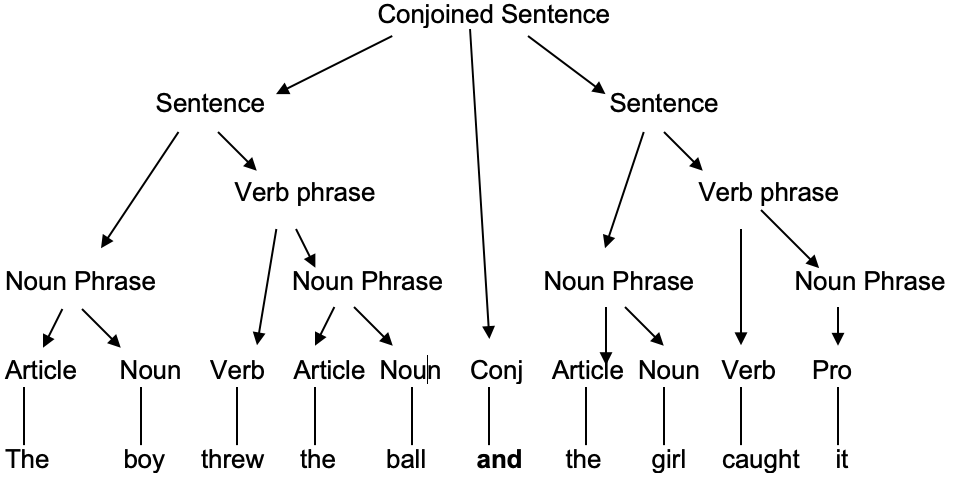
Up to this point, I have been showing complete sentences, but what if we want to join more than one sentence together. What do we do? We find that using syntax; it is also possible to extend sentences by joining together complete structures. We can take our original sentence further and classify it as multiple or compound sentence; containing two or more coordinate clauses. We can use coordination and subordination as a way to do this. Co-ordination is a relation that holds between two units of equal status, two units that are on a structural level for example:
(Clause 1) (Conj) (Clause 2)
‘The boy throws the ball and the girl catches it’.
We can recognize coordinating conjunction such as and and or. This is governed by the rule
S →X Conj X
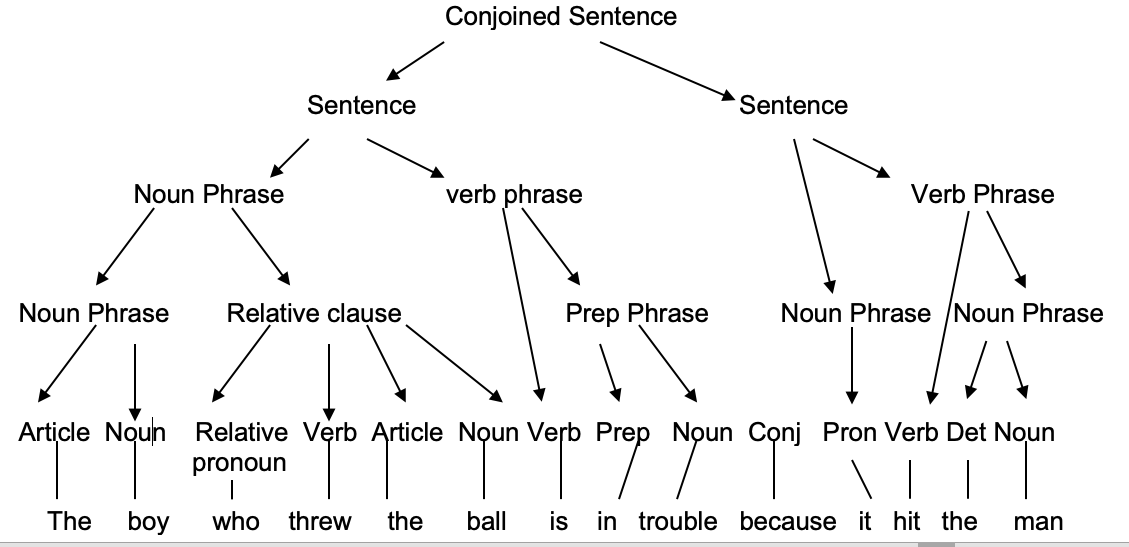
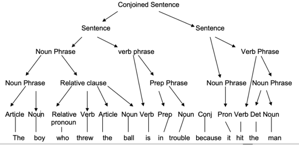
Subordination on the other hand is the relation between two units of unequal status. In this the case of clause subordination, one of the clauses, the subordinate is rank shifted. We would have a sentence that reads:
(Clause 1) (conjunction) (Clause 2)
‘The boy who threw the ball is in trouble because it hit the man’.
Looking at these sentences, we realize that two actions happened. We can look at which came first and which second. For example, we cannot say ‘The ball hit the man and the boy threw it’. Even though this sentence is in correct syntax we are actually saying that the first action was ‘the ball hit the man’ which is not the meaning we wanted. We have recognized that there are two actions even though this does not mean that one action follows another one with the conjunction ‘and’. Take the sentence ‘I sang and I danced’, this has two actions but this could mean that I did both at the same time. This sentence can be changed to say ‘I danced and I sang’ and we would still have the same meaning.
Diagram F
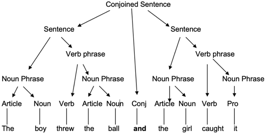
Diagram G
So far we have used the sentence about the boy to make different propositions. Nearly all the sentence types illustrated so far are statements.
The boy threw the ball
The boy throws the ball at the tall man
The boy who threw the ball is in trouble
The boy who threw the ball is in trouble because it hit the man
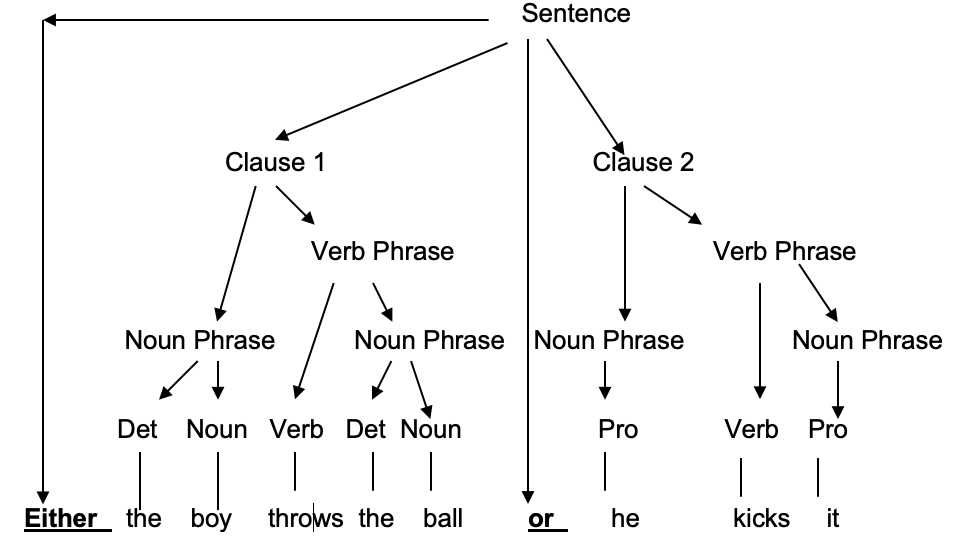
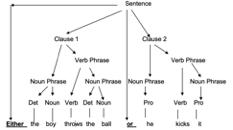
This leads us on to a further combination of syntax by using complex coordination. We can use our complete sentences to propose a different idea. We can apply this by using a marker. This marker is provided for the first and second of the coordinated elements. Correlative conjunctions are used in pairs: either…or; neither….nor; not only….but also. When these conjunctions are employed in a sentence, they must be followed by parallel construction. For instance Diagram H with either … or which show us two alternative clauses in sentences. In the sentence below, we are now talking about a choice between two possibilities.
Diagram H = S → either S1 or S2
This generates a tree such as the following below:
Diagram H
So far I have shown how clauses and phrases work to make a sentence. Then I have shown that we can expand those by adding other sentences, but how are all these words related in the sentence to give the true meaning to be understood? For example, we interpret the sentence ‘the boy throws the ball’ as having only one meaning. The sentence is about a boy who throws a ball. Let’s look at the two new sentences (a) and (b) below. Can you see the difference in meaning?
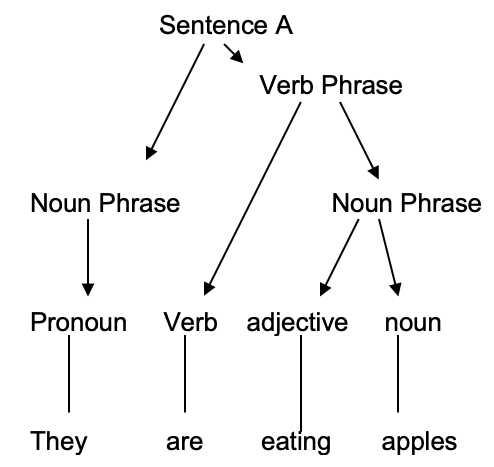
(a) They are eating apples.
(b) They are eating apples
You would not be wrong in thinking that these two are exactly the same in meaning. As you look at each sentence their syntactic structure seems to be identical. It is their surface structure which is the same but it is the deeper structure that reveals their true meaning. It is only by parsing the sentence that we get to see the sentence and how each word is working.
See Diagram I below.
Diagram I
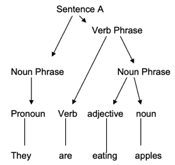
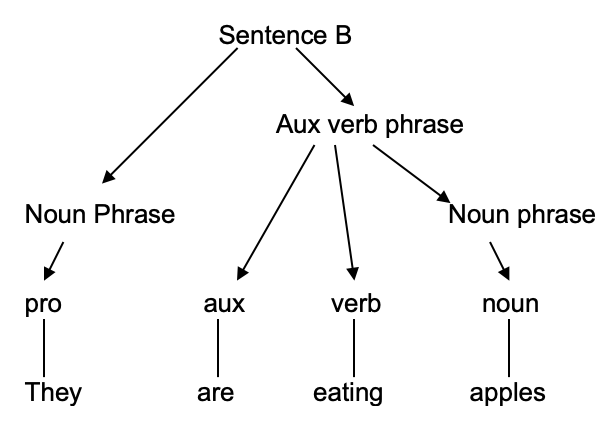
By looking at Diagram I we see that ‘eating’ is an adjective modifying the noun ‘apples’. The noun and adjective work as a noun phrase. It follows that the verb ‘are’ is used in the present tense, this states a fact about the ‘eating apples’. The speaker wants to give the meaning that ‘you can eat those apples because they are not cooking apples’. Now look at Diagram J.
Diagram J
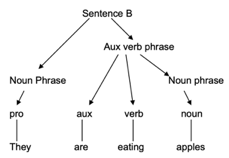
Moreover, ‘eating’ in Diagram J works as a verb denoting an action with the auxiliary verb ‘are’ and is included into the verb phrase. ‘Apples’ works as a single noun phrase. The speaker wants to tell someone that those people are doing an action, which is eating.
In addition, referring back to the use of relative clauses, we can show that there are two ways in which relative clauses relates to the head noun, as can be seen from these two examples below. This is where syntax shows its ambiguities. Can you see the difference?
(C) My brother who’s abroad has sent me a letter
(D) My brother – who’s abroad – has sent me a letter.
These two sentences appear to be the same but have a different meaning (C) means that one brother, who is abroad, sent me a letter but my other brothers did not. (D), on the other hand, means that he is the only brother I have and he is abroad.
Moreover, the two sentences below can be distinguished by the verbs ‘is’ and ‘are’. In (E) we see the plural noun ‘aunts’ is followed by the plural verb ‘are’. We recognize (E) as talking about more than one aunt. Thus we are talking about many aunts that visit. In, (F) we still have the plural noun ‘aunts’ with ‘visiting’ modifying it. Although this time the singular noun ‘is’ is used which gives us a different meaning to do with an activity. ‘Visiting aunts’ is what people do. I visit my aunts and the activity is boring. This is an activity which is singular in form.
(E) Visiting aunts ARE boring.
(F) Visiting aunts IS boring.
To conclude we have seen words working in many ways to complete ideas that we have and want to put into speech. This is shown in complete sentences. I have shown that sentences can be transformed from their original. We can take a sentence and extend it to give it more meaning. I have recognized that we can look at a statement and equate it to its associated question by recognizing the components inside. This is the structure that is built up in sentences. This is shown in phrases and clauses. I feel now, I can think of sentences as a series of slots. I have noticed that all sentences are basic patterns that in most regards begin with a noun phrase in the subject slot, followed by one, two, or three slots in the predicate. I can now say that in many respects there is a mechanical basis in the brain, and all thought has a syntax, or code. So, we see that our utterances represent this internal coding by way of our common syntax. I hope that by reading this paper people will a get a clearer picture of the intricacies of syntax and come to see it in a clearer light that will enlighten the whole language acquisition experience.
References:
Steven Pinker – The Language Instinct
Noam Chomsky – http://www.chomsky.info/
On Wh Movement – http://66.102.7.104/search?q=cache:rQOwKdRZv6EJ:www.ling.udel.edu/bruening/Courses/2001-2/610/Lecture16.pdf+tranformational+syntax&hl=th
More Transformational Grammar – http://www.cc.gatech.edu/computing/classes/cs4344_98_winter/lec06.html
Practical English Usage – Michael Swan
Language Acquisition – http://www.ecs.soton.ac.uk/~harnad/Papers/Py104/pinker.langacq.html
.