Art
Can photography become modern art?
Image Posted on Updated on
So, is this just a photograph or can it be called art?


Henri Cartier Bresson – a master of snapshot photography


(1208 Words)
Henri Cartier-Bresson: The Decisive Moment in Two Photographs
Henri Cartier-Bresson’s photographs are widely regarded as masterpieces of street and snapshot photography. When viewing his portfolio, two works in particular captured my attention and imagination: The Var Department, Hyères, taken in France in 1932, and Behind the Gare Saint-Lazare, taken in Paris in the same year. This essay explores how these two classic photographs demonstrate Cartier-Bresson’s exceptional ability to capture movement and human activity at precisely the right moment. Although, at first glance, both photographs appear relatively simple because of their black-and-white presentation, closer examination reveals a sophisticated understanding of composition, geometry, movement, and human experience.
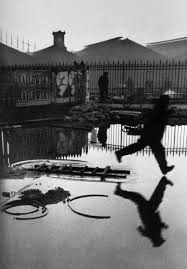
To begin with, Behind the Gare Saint-Lazare is particularly striking to me because of its multidimensional composition. The photograph immediately draws attention to the reflections of the figure, the railings, and the surrounding architecture in the water. These reflections introduce an almost ethereal quality that contrasts with the otherwise bleak and industrial character of the scene. The wrought-iron fencing, station building, workers, and scattered debris collectively establish an environment associated with urban industry and construction. Rather than presenting an idealised vision of Paris, Cartier-Bresson depicts a less glamorous and more ordinary aspect of the city.
As a photographer, Cartier-Bresson appears to capture life as an ongoing journey, and Behind the Gare Saint-Lazare exemplifies this idea particularly effectively. The central figure appears to be a man travelling to work, captured in the act of jumping across a large area of water, presumably left behind after heavy rain. Cartier-Bresson’s timing is remarkable: the slight blur of the figure prevents the viewer from becoming preoccupied with his facial expression and instead emphasises the movement of his body through the frame. His positioning creates a sense of suspension, as though the man is temporarily hovering above the water. At the same time, the ripples spreading across the surface reinforce the impression of movement. There is also an element of uncertainty, as it appears unlikely that the man will complete his leap without getting wet.
The photograph can therefore be interpreted as offering a distinctly working-class perspective of Paris. Instead of focusing on the city’s celebrated architecture and monuments, Cartier-Bresson presents an industrious and somewhat austere environment in which ordinary people negotiate the practical difficulties of everyday life. The bleakness of the setting contributes to the photograph’s sense of authenticity. Rather than appearing staged or idealised, the image presents an apparently spontaneous moment of everyday existence.
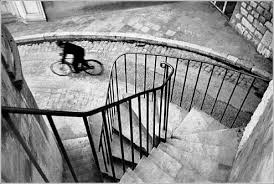
The Var Department, Hyères offers a very different composition, yet it similarly demonstrates Cartier-Bresson’s interest in movement and geometric form. The photograph contains a complex arrangement of lines and shapes that converge across the image. The contours and direction of the staircase lead the eye along several different paths, creating a composition that initially appears confusing but becomes increasingly coherent upon closer examination. These geometric qualities contribute a surreal dimension to the photograph. The unusual spatial relationships can even be compared to the work of M. C. Escher, particularly his exploration of impossible or seemingly infinite architectural spaces in works such as Relativity.
The square stonework of the wall introduces another geometric element, contrasting with the curved road that moves through the composition. The road itself appears to slope away from the viewer, creating a further sense of depth and movement. Within this otherwise static architectural environment, the cyclist becomes particularly significant. Although the photograph is frozen in time, the cyclist appears to be moving rapidly through the frame, creating a powerful contrast between stillness and motion.
The cyclist can therefore be interpreted as representing the continuous movement of human life. Cartier-Bresson frequently incorporated people into his compositions in ways that prevented the environment from becoming merely architectural or decorative. In The Var Department, Hyères, the cyclist introduces a human trajectory into an otherwise quiet landscape. His movement suggests that he is travelling towards another destination or experience, thereby giving the photograph a narrative quality. The image also evokes the wider cultural association between cycling and France, particularly the Tour de France. The contrast between the tranquillity of small French towns and the speed of cyclists passing through them provides an interesting parallel to the photograph’s own combination of stillness and movement.
Although both photographs are strictly monochromatic, I was particularly struck by their apparent range of “colours.” Cartier-Bresson uses an extensive tonal range of blacks, whites, and greys to create depth and visual contrast. These variations in tone give the photographs considerable strength and contribute to their timeless quality. The absence of colour does not diminish the visual richness of the images; instead, it encourages the viewer to focus more closely on form, texture, light, shadow, and composition.
Another important characteristic of both photographs is Cartier-Bresson’s treatment of his central figures. The people within the images are sufficiently blurred or integrated into the surrounding composition that they do not completely dominate the photographs. Nevertheless, they remain essential to their meaning. Their movements provide the images with energy and transform what might otherwise be static architectural or environmental studies into observations of human experience.
This is particularly important in relation to Cartier-Bresson’s concept of the “decisive moment.” In both photographs, the timing of the exposure appears fundamental to their effectiveness. In Behind the Gare Saint-Lazare, the photograph depends upon the precise instant at which the man is suspended above the water. A fraction of a second earlier or later would have produced an entirely different composition and potentially diminished the visual tension of the image. Similarly, in The Var Department, Hyères, the cyclist’s position within the complex geometric structure of the scene creates a moment that could not easily be replicated. Cartier-Bresson’s skill lies not simply in photographing a subject, but in recognising the precise moment when the relationships between subject, environment, movement, and composition become most compelling.
Human interest is therefore central to both photographs. The man attempting to leap across the water and the cyclist travelling through the French landscape represent different aspects of human endeavour. Both figures are engaged in movement towards somewhere else, whether that destination is a workplace, an appointment, or simply another stage of their journey. In this sense, Cartier-Bresson transforms ordinary moments into observations about the human condition.
The two photographs also present contrasting aspects of everyday life. The Var Department, Hyères possesses a quieter and more rural atmosphere, with its stone buildings and relatively empty streets creating an impression of stillness. By contrast, Behind the Gare Saint-Lazare presents Paris as an industrious and active urban environment populated by workers and characterised by construction and urban infrastructure. Despite these differences, both photographs share an underlying interest in ordinary people and their relationship with the spaces they inhabit.
In conclusion, these two photographs demonstrate Cartier-Bresson’s remarkable ability to capture an exact moment while simultaneously communicating movement, atmosphere, geometry, and human experience. His use of monochrome tones, reflections, spatial relationships, and carefully timed exposure transforms seemingly ordinary situations into compelling photographic compositions. The more closely I examine these photographs, the more possibilities for interpretation emerge. Their significance lies not only in their technical mastery, but also in their ability to provoke thought, emotion, and admiration. Cartier-Bresson succeeds in transforming fleeting moments of everyday life into images that remain visually and emotionally powerful decades after they were captured.

