Protest Songs: A look at ‘Strange Fruit’ and ‘Brother, can you spare a dime?’
(659 Words)
The 1920s and 30s in America was a time of racial discrimination for the black people while economically it was a time of the Great Depression. Times were not only hard but also scary with hatred and desperation flowing across the cities and plains of America. Like prisoners in shackles, the unfortunate ones at the bottom rung of life did not have a voice and ways of expressing how they felt inarticulate terms. This is why protest songs grew in prominence as they had a purpose, sentiment, and specific issues while invoking the reader to be shocked and angry. This is notwithstanding that these songs were meant to inspire the reader to acknowledge and change the situation. For this essay I have chosen two protest songs that epitomize the era of discrimination and depression; ‘Strange Fruit’ and ‘Brother, can you spare a dime?’ I will highlight their literary merits and social criticism.
Initially, the reader is struck by the titles of these songs. ‘Strange fruit’ asks why fruit that hangs off trees would be so strange. What must the fruit be a metaphor for? Horror upon horror the fruit is the black man lynched; no wonder the fruit looks strange. On the other hand ‘Brother, can you spare a dime?’ is plain to see as we recognize someone destitute and begging. In both cases, there are images of victims, and those victims are persecuted in different ways. One is for being non-white, and the other for being a hard-working man, both are innocent citizens who have landed in a bad place where there seems no exit.
Moreover, as the reader reads on the full reality of the themes of these two songs highlighting lynching in all of its brutality and the fall out of the Crash of 1929 are exposed. ‘Black bodies swinging in the southern breeze’ cannot get more real, as the true horror of lynching is laid bare. While ‘the bulging eyes and twisted mouth’ show the gravity of the spectacle as these poor black men hung up for all to see and for no reason at all. The protagonist in the ‘Brother, can you spare me a dime’ is left bearing his soul too, as he is ‘just waiting for bread’ instead of ‘building a dream’, and asking ‘can you spare a dime’ instead of building a railroad. Society has been criticized that has left this man and the black man fighting for their lives, notwithstanding that they could well be an upstanding member of society. The reader asks what have they done wrong to deserve this!
Here now lies the haunting social impact of the songs. The man who ‘made it run’ the railroad that is, and ‘made it run against time’ and who also ‘was building a dream’ with ‘peace and glory ahead’ now invokes a sad legacy that in all that he did and all he was asked to do, he is now discarded for society to forget. Furthermore, as much as is the case for the black man whose hanging body is ‘for the wind to suck’ and ‘for the sun to rot’. In both cases, the reader carries away the thought of life taken away. Nevertheless, for ‘Strange Fruit’ this was the first loud cries against racism. This was the way to move the black man’s story into the white man’s consciousness and Billie Holiday, the singer of Strange Fruit, her most successful song at that time. Contrastingly, Brother can you Spare a Dime still resonates in the modern-day world as the world come out of another economic collapse.
To conclude, these two songs send powerful messages that are meant to get into the readers’ awareness of society and for them to feel abhorred by the situation. The reader is meant to feel sad but on the whole optimistic that times can change so that today those times are a distant memory forever banished to the history books but never forgotten.


To Wong Foo Thanks for Everything, Julie Newmar: A journey through American Society
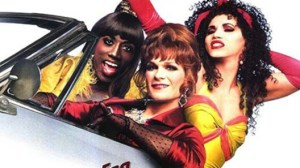
To Wong Foo Thanks for Everything
(861 Words)
At first glance, the main actors in this movie viewers would not expect the roles they have taken on. These relatively famous actors are Wesley Snipes and Patrick Swayze. Who? You say. They were famous in the nineties. So the surprise is, this movie has them dressed up in drag in a Thelma and Louise type road movie, of sorts. The fact about this movie is that they are not just transvestites; they go the whole hog to near on transsexual status where their persona and characters take on distinct female movements and nature. The movie begins by Vida aka Swayze and Noxema aka Snipes winning a New York drag queen competition and as a result, having a chance to win a national drag queen competition in Hollywood. Before they leave for Los Angeles, they bump into one of the losers, a certain South American transvestite named Chi Chi who is asked to join them. Here starts their road trip, at least until they realize they have no money, thus they sell their flight tickets to purchase a cheap beat-up Cadillac for their adventure.
The thought provoking “Anne of Green Gables”


Anne of Green Gables by Lucy Maud Montgomery
(1244 Words)
This movie takes the viewer back to the start of the 20th century; to a time when people were prim and proper and life actually seemed a little dull as there was not much imagination to lift the spirit. People just dealt with life with appropriateness. That is the picture painted as we go into the world of Mathew and Marilla Cuthbert, as they await an orphan boy they are going to adopt. The movie which was made in 1934 from a book written in 1905 must have been a great eye-opening for the public at both times; making some people do a lot of soul-searching about their attitude towards people of lesser means. As such, the film shows people’s narrow-mindedness and perception of others that can lead them to behave in strange ways without a thought to their own actions.
To begin with, the viewer is faced with Mrs. Rachel Lynde, the busybody neighbour, who is proud of her blatant self-righteous views. She sticks her nose in where it is none of her business. While gardening she notices that Matthew is dressed in a suit and off to town. She immediately goes to Morilla’s house to enquire as to this change from the norm. Marrila tells her that she intends to have an orphan boy. Mrs. Lynde’s contempt for this idea is stark and she does not mince her words, as she describes these sorts of people as ghastly creatures who will only bring sorrow for the Cuthburts.

