Thailand
Giving and Receiving Feedback, It Will Never Be Easy But It Can Be Better
(633 Words)
I think at times teachers can have a little trouble with receiving and giving feedback. Their feedback skills could be said to need a little practice. I think this is important because as a teacher you will need feedback from your students to tell you if they like your teaching. Also, the students will want feedback on their learning. Each piece of feedback needs a positive, constructive base.
A first reaction, when thinking about feedback, may well be to go on the defensive when it is given. On the defensive, I mean that you are not really listening to the person giving the feedback. The point is feedback is information that can be heard by the receiver as evidenced by the fact that they do not go on the defensive. I agree that feedback has great value but only to us if we can let the feedback in and effectively use it.
There is also ineffective feedback. These are judgmental statements and can upset people. During a reflection, a teacher was told they were talking too much in class but the observer seemed to forget to look at the students who were fine with this talking. Other people said it was a lower level, and the students did not talk much anyway. Would you feel bad for the teacher? Was the observer too opinionated?
Another aspect is getting feedback but not using the experience as a positive move forward. The observer is just making a comment. The teacher needs to ask them such questions as ‘Why’? and ‘What do you think is better?’ For future actions, a teacher should take the time to realize that they could be wrong and that they should take in the information (feedback) that has been given. They should ask for clarification and realize that it is not a battle, and the comment is to help. They should reply with what they think. Thus hopefully getting a discussion going.
Moreover, the information that is given in the feedback can be shut out. Teachers sometimes lack the skills to send and receive feedback. For example, a teacher thought of a lesson plan idea and mentioned it to another teacher. Basically, they were told that the lesson plan was off-target because the lesson was not student-centred thus in the lesson plan the teacher would speak more which they are not supposed to do. The problem was that the teacher had thought about this lesson for a long time and had it planned. Now the first reaction, when they were told it was off-target, was to get a little angry. They felt as though it was an attack against them personally. Maybe they felt as though they were not good enough; their ideas were not good enough. So, they felt a bit sorry for themselves. One idea could be to say, “shall I forget about that lesson plan?’ and if they said ‘yes’, say to them “what do you think then?” or “how can I develop it?” The teacher could have asked why they thought it was off-course and what ideas the teacher should think of. The teacher should have got to the bottom of their thinking as they might think up another lesson plan like this and have the same trouble again.
In conclusion, a teacher’s acceptance of feedback does not mean that they need to always act on it. The feedback should have been encouraging, helpful, and given with clarity. If so, then the teacher needs to consider the feedback, and decide how, if at all, they wish to act upon it. This is strictly their choice, but it is important to bring to mind that the person giving the feedback felt strongly enough that they mentioned it. Let’s face it, how would you react in any given feedback situation?
Chedi Phutthakhaya, Thailand
If you ever want to go further into Thailand and right up to the Burmese border, Sangkhla Buri district is a must. The picture below shows Chedi Phutthakhaya. This is a tall golden Indian-style pagoda that towers over the Mon Village and the lake. The gold pagoda stands out from the rest of the landscape.

Teaching Young Learners – Working with a Course Book
TASKS
Look at some of the material and state how you would make the lesson interesting by supplementing or expanding upon the content of the page.
- Swimming pool
For this exercise, I would personalize the exercise by giving the characters who say something in the picture names. As an introduction, I would follow the original lesson getting the children to repeat the sentences but each time I moved on to each person I would elicit some more ideas and vocabulary relating to that person.
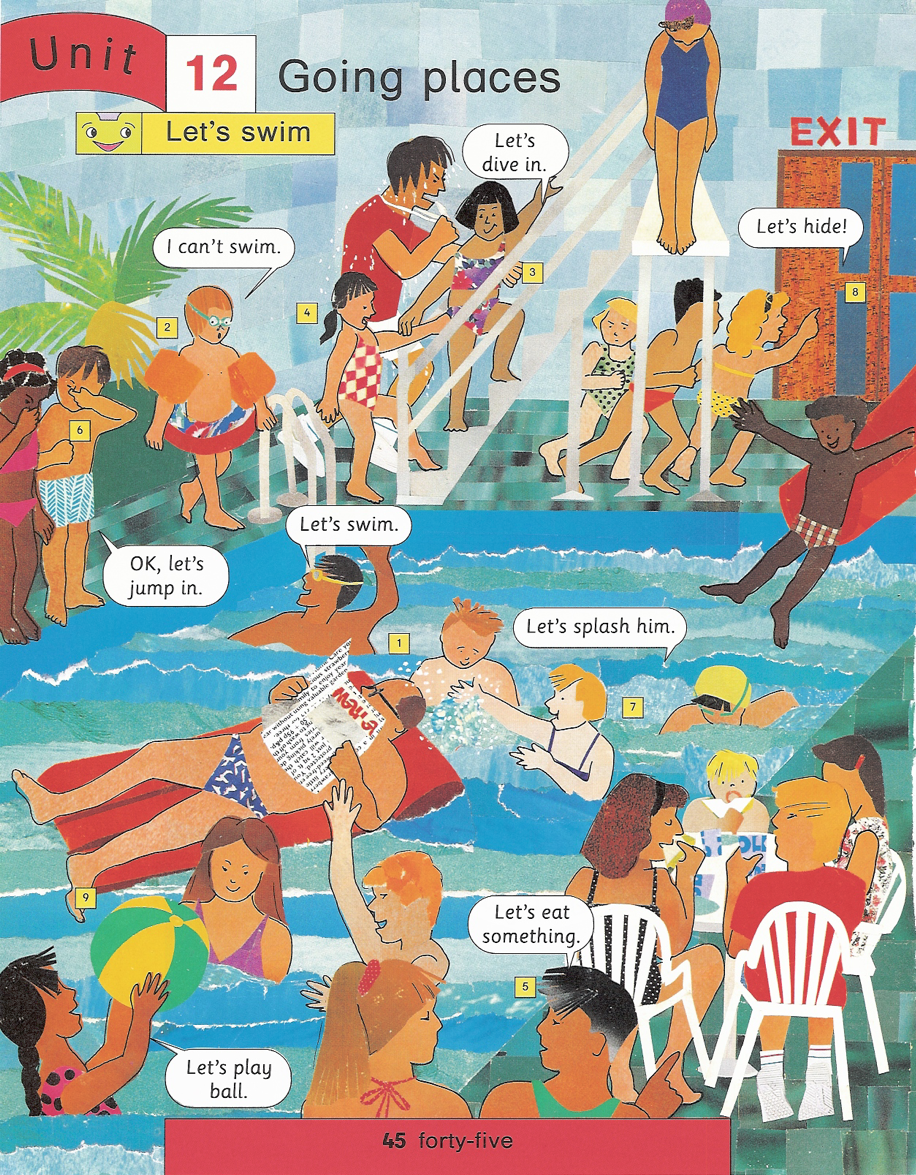
For example, Dave, who says ‘let’s eat something’
Is Dave swimming?
What color hair does he have?
Who is he with?
After completing the exercise, having discussed each person saying something, I would give the learners a freer practice. I would get the learners into groups and get them to look at the pictures and elicit any more information from the picture. I would then get them to write 2 sentences each for 3 people.
For example He is wearing goggles. She is playing with a ball.
I would now take the pictures away from each group
I would then have a quiz where each group has to ask say 2 sentences and then ask two questions. This would be repeated two times.
For example 1. He is wearing goggles. He has ginger hair.
What is his name?
What does he say?
2. She is climbing the stairs. She is with a friend.
What is her name?
What does she say?
The teacher and learners could check all the scores to see who has won the little competition.
2. Objects
For this activity, I would expand it by getting the learners into pairs and giving them identical pictures. These pictures could have a street scene or just objects. Although the pictures and the objects in the picture are the same, each of the learners has some of their objects colored in and others left blank (white). Some of the objects are colored the same. For example, in picture 1 the car is red but in picture 2 the car is blank, but picture 1 has a blue bird and picture 2 has a blue bird. The learners complete the task by sitting opposite each other so they are not able to see each other pictures. The task can be done like the game of battleships where they have a screen to divide themselves. It is up to the learners to work together telling each other the colors of objects in each other’s picture. They complete the drawing by coloring every object until they have identical colored pictures. The teacher can have a feedback session with the learners to check over their work.
Teaching Young Learners – Games and Puzzles
TASK
Choose a language item from the list below and design a simple lesson plan using one of the games to teach/practice the item.
Student Vocabulary Game
Number of players: 2-6
Age: 6+
Materials: A score/category sheet per group, a deck of alphabet cards and a pencil
Object of the game: To name objects beginning with the chosen alphabet card and to be the first person to get rid of his/her alphabet cards.
| Player name: |
| 1, Toys: |
| 2. Fruits and Vegetables: |
| 3. The Classroom: |
| 4. Things in the home: |
| 5. The Body: |
| 6. Boy’s and Girl’s Names: |
| 7. Sports and Hobbies |
| 8. Animals/Pets |
| Score: |
1) A Student shuffles the cards and deals 5 alphabet cards. The cards are laid face down in front of each player.
2) The remaining alphabet cards are laid face down on the table in front of the group.
3) Alternate people start but the first player to the dealer’s left starts play by turning over their alphabet card, and then naming something from the first category on the sheet beginning with his letter. Once the learner has said a word they must write it on their sheet. Their go is over.
4) They have 10 seconds to think of an answer, if they do not have an answer in the allotted time they must pick up an extra card from the middle of the table and place it face down in front of them. Their go is over.
5) Each student takes turns to turn an alphabet card from their pile and naming an item in the first category. Examples are not allowed to be repeated.
6) The round ends when someone has picked up all their cards and named something from the category each time.
7) The other students must add up how many remaining cards they have, and write that number on their score sheet, e.g. 3 cards remaining = 3 points
8) The process is repeated with the person to the left of the dealer being the new dealer and the person to their left starting the new game. The game continues with objects from the second category.
9) The games continue until all the 8 categories have been completed
10) The person with the lowest score is the winner.

