Education
Action Research: “If you want it done right, do it yourself.”
(411 Words)
‘If you want it done right, do it yourself’ is a seeming generalised way of introducing the subject of Action Research, this may succinctly give an idea of what it is, although as this piece of writing on action research continues I will delve a little deeper into how this research process relates to what the teacher can do to enhance a holistic experience within their classroom. This ‘teacher can do’ approach is echoed by British educational thinker Lawrence Stenhouse who said ‘curriculum research and development ought to belong to the teacher’ (Stenhouse, 1975 p. 142). Stenhouse proposed that the teacher’s work should not be studied; they themselves should be the ones studying it.
Additionally, Wilfred Carr, a Professor of Philosophy of Education, and Stephen Kemiss, Professor of Education, stress ‘since only the practitioner has access to commitment and practical theories which inform praxis, only the practitioner can study praxis. When teaching is looked at from an outside perspective, it can be seen to be difficult. Action Research as a study of praxis must thus be research into one’s own practice (Carr & Kemmis (1986: 191). The focus here is on a world of teaching that is constantly changing and the social situations that teachers find themselves in with their teaching where they can make a social and organisational change. The teacher can then be the one who is in charge of the situation for change whilst with the participation of others, namely the stakeholders, striving for everyone’s well-being in education.
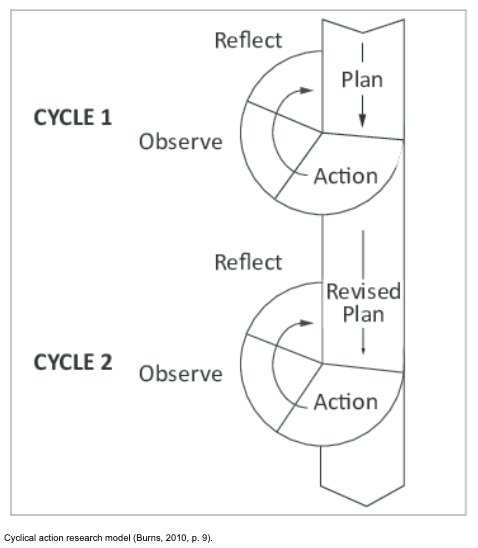
Moreover, Action Research is learning by consulting and daily problem solving and what the teacher can do to improve on the situations that surface through their teaching. Thus, within this daily practice, the teacher has to identify a problem, they have experienced, then imagine how they may change this, thus putting a plan of action together to overcome it. Once this plan has been instigated, it is to evaluate how the plan effectively succeeded or not. Action Research does not stop there as the focus is on cyclical research, so in this process, once the evaluation’s results have been collated, the process can start again where the class is modified on the back of the results. This may well end up as an ongoing process as shown in Stephen Kemmis’ diagram. In short, Action Research can be explained as – identifying the problem, then resolving it, then seeing how successful it was, then if you are not satisfied, do it again.

Comments on Little Black Boy by William Blake

Blake’s poem is dramatic, that is, in the voice of a speaker other than the poet himself. This poem of Blake’s uses the Little Black Boy to narrate the poem in first person. This projects the reader clearly inside the consciousness of the boy in the poem giving us the images from the defined observer. As a result, Blake stands outside innocence and experience in a distance position. The innocence is from ‘Songs of Innocence’, Blake’s first collection of poems, to which Blake’s subject matter shows the innocent, pastoral world of childhood. This was juxtaposed with experience, which was taken from ‘Songs of Experience’, his other collection, which shows the adult world of corruption and repression, therefore, showing the two contrary states of the human soul. The ‘songs of innocence’ dramatise the naive hopes and fears that inform the lives of children, namely the ‘Little Black Boy’ who tells this didactic story about himself in this poem.
Would you select prescriptive or descriptive method of teaching grammar? Give reasons?

There are, of course, different ideas from different people and no method can be thought of as the ultimate for learning. Although this is said, I would certainly lean towards a more descriptive method of teaching. A descriptive method can relate to the abundance of people who speak the language where it is noticed that in the global world mostly everyone needs to speak some sort of English. This also relates to countries which are very multicultural. We can not say that every one of these conversers speaks complete standard English. I will keep away from saying correct English as I think within reason there is no exact or correct way to speak. A descriptive method of teaching can be favored which allows a teacher to extract exact meaning from conversation not extracting from sentences as this could be relating back to a prescriptive form where there is a formal education that does not intrinsically allow for students’ conversational construction. One question would be: does the speaker need to be perfect grammatically to get their message across?
England, you would think after many years of using the language, the population would adhere to a ‘standard’ form of speech, but it is probably spoken natively by about 10% of the population. This was a guesstimate by Peter Trudgill. So, it shows simply being a native speaker of English is not a qualification for setting up as an EFL teacher; however well you speak it. The students, as well as the teacher, need to be aware of the situation they are in and how they should use their language the best. A language teacher can teach the students a prescriptive grammar, but on the whole grammar and language is continually in transgression. The importance of English as the language of communication nationally and internationally must input the importance of meaning. For example, Stephen Krashen wrote,”acquisition requires meaningful interaction in the target language – natural communication – in which speakers are concerned not with the form of their utterances but with the messages they are conveying and understanding.” (S. Krashen, 1981)
Of course, there are a few problems with prescriptive grammar as it only prescribes to one way of speaking. This could well be a model to rely on and teachers would be wrong to ignore the standard grammar, but to say that an English speaking person is wrong in the way they colloquially speak could well lower some learning ability. Descriptive linguistics will tell you that they do not raise questions about who is right and who is wrong, or about who has the right to adjudicate. There will be teachers and parents who will certainly tell you to speak properly, but in most cases, this would be when it is more formal occasions where you must be polite. This does mean that a person will always be in a formal occasion where ‘standard’ English is needed. There is a time and a place for using formal and non-formal language. The students need also to work this out for themselves. They need to be problem solvers. The teacher needs to put them in these social positions through role-play so the students can find out for themselves how to act. This perspective views teaching as a “conversation” in which teachers and students learn together through a process of negotiation with the curriculum to develop a shared view of the world
English is very heavily codified for non-native learners. Prescriptive grammar actually takes away the forms of English that a lot of other people use. Of course, the use of grammar is to get the right point across. For example, if someone is on the phone and they asked for a pencil. An answer could be ‘a pencil is on the table’. Although this answers the question the appropriateness of the answer is not sufficient. This relates to the meaning of grammar and how we use the language. People do use different structures. There is one problem that students will take their dictionary into the class and once they have a problem they will consult it. This does not accept their authority on meaning or grammar. For example, students will learn the ‘dead’ which is the right word for someone who has died. The sentence ‘he is dead’ is correct grammatically but would a policeman say this to the unfortunate person who he has to tell about their unfortunate relative. He, of course, would choose his words carefully as to try to lessen the strength of the sentence using ‘he has passed away’. From this little example, it is very clear that the children must be taught English and when to use it. Students should be taught that language varies. This shows the movement away from the prescriptive grammar. There is certainly a flexibility in the language and the choices of sentences for every occasion and how they and their ideas are perceived by the receiver. It has also to be said that people do not speak in complete sentences and can jump from one subject to another rapidly. Students need to be aware of speaking appropriately in different contexts, adapting their talk for a range of purposes and audiences including variants of English regionally spoken. Pupils should be taught about the variations in written English and how they differ from spoken language, and to distinguish varying degrees of formality, selecting appropriately for a task.
Focusing on communication in the classroom, the interactionist theory of teaching can be mentioned here. Learning a language in the classroom is essentially through interaction and interpersonal activity where the teacher can make sense of and respond to the behaviour of their students. Lessons can still involve using a certain grammar point, but this can be learnt subconsciously. A lot of language acquisition takes place through conversational interaction the students have. The students can work together to achieve a context and meaning to the lesson with the teacher as the facilitator. This communicative approach to learning has interaction as an important factor which supports language learning. The learning strategies for the students are where they use their teacher and their peers to further their language acquisition. This interaction can be vastly beneficial to the students’ natural acquisition. This means that the students can take control of their learning. The teacher can help [1]learners to use communication strategies as a way to negotiate meaning. This will not only help their comprehension but also help them learn new words. The students, then, have an opportunity to talk in their second language. Therefore, this highlights a teacher’s teaching methodology which should provide more chances for students to interact with each other as well as with the teacher. The teacher also has to recognize that while giving the students more freedom, the communicational input is beneficial at a right level that empowers the enthusiasm to work and mix in a group.
To conclude, I would select a descriptive teaching method as it allows the students to communicate in situations that show how they are aware of how to act. This gives the teacher the chance to see the way they are working and learning. It makes the language available to be understood and shown out in the open. This gives the students more opportunity to see the language at work instead of just written on paper.
(1222 Words)
[1] Yule and Tarone, 1991. Yule and Tarone allied with the interactionist theory.


Reflecting on a Group Project – And Group Dynamics
(Words: 1007)
Our group of five presented to our fellow Prof Ed peers on the topic of ‘Safeguarding Their Future: Well-being & Welfare in Education’. With regard to the work involved prior to the presentation, this reflective account will bear witness to the processes involved in performing a complete model to show to the audience. Henceforth, the pre-presentation period being from the tutor’s project instigation to the day of presentation and the salient points within – for this account – will be called the ‘Critical Incident(s)’ that recognizes the 1954 article on the Critical Incident Technique (reflective) model of John C. Flanagan.
First of all, the Critical Incident has to be recognised that ‘To be critical, an incident must occur in a situation where the purpose or intent of the act seems fairly clear to the observer and when its consequences are sufficiently definite to leave little doubt concerning its effects,’ (Flanagan, 1954:327). I feel I did this as an observer and group participant by analysing occurrences and situations that arose during the pre-presentation stage which would identify behaviours of positive and negative performance within our group dynamics to complete the project. The occurrences and their effects led me to question the qualitative effectiveness of the group’s progression and the positive potential results of all the group’s participants including timely interventions by the tutor. This leads to asking the Critical Incident question: what were the difficulties? To the fore came time scale and the apparent success of having a time scale of eight weeks to complete in what encapsulated each individual’s five to ten-minute window in the presentation. This was critical as essentially most work and eagerness as a group to complete the project was done in the days that saw the presentation day rapidly looming. From Flanagan’s model which suggests posing questions and answering from the perspective of another such as regarding ‘the emotions felt in that situation’ (Hitching, 2008, p.23) – the situation being pre presentation – I (as another) would have said ‘I felt I had a lot of time to spare before the actual day of presentation so there was no rush – per se – albeit showing a general weekly progression towards the goal’. Thus, here lies the fact that time scale is less of a Critical Incident for others than had been for me and therefore the effect of being overly concerned during the event varies in the group dynamic.
Moreover, another factor of Flanagan’s model gets the reflector to put themselves in the learner’s position. Jeanne Hitching says ‘you would need to take yourself back to a time when you were learning something new and unknown, just as they are’. In relation to this, there was a time when I was studying and I had a big project to complete, I always felt at the time that as long as I complete a part of it each week, this would culminate in – when collated – the project just about finished bar the finishing touches, and I feel this may have been the case with our group project because the days before the presentation members work did come together. Hence, I do empathise with our group members completing their work towards the collaboration within the final presentation.
Furthermore, we were asked to contribute to an online group’s forum. This never got off the ground, and seeing as we only met once a week at college, it was the only way to communicate. While this medium was not used to its fullest, some weeks group members came into the classroom to spend time solely on their own presentation, so again communication and group production was limited. So, referring back to the earlier point of posing questions from another’s perspective – in relation to this forum and weekly class discussions, would be: what did their behaviour signal to me (Hitching 2008, p.23)? I feel another would say ‘this was not a problem as everyone works during the day and we study at night, so you need to give people time and space’. Flanagan’s model highlights that empathy to this kind of situation would lead me to support this situation. At this juncture, although I feel this was the case nearer to the presentation date, time may still have been lost along the way and better and proficient communication on the forum and timely constructive meeting would have shown a healthier progression that would have put the group at more ease.
Moving on to nearer the presentation commencement, I could see people getting their part completed and longer discussions making better contribution to the effect of the finished product. Referring back to Flanagan’s model, it should also be recognised that it not only looks at negative aspects and as such our group’s contribution to a finished article was notably praise worthy. Posing another question, at this point, of Flanagan’s Critical Incident analysis is questioning what the group’s actual behaviour signals to me (‘me’, the perspective of another). I would have been pleased that we came together with positive productive material and a readiness to perform and smooth out inconsistencies in the presentation.
To conclude Flanagan’s model, it is interesting to think about the perspective of others in the group and their dynamics in creating a solid presentation. This reflective method functions – of course – if you are comfortable thinking this way, but I feel it did make me certainly reflect on my attitudes at the time and how these feelings can affect my behaviour: past, present, and in the future. Ultimately, I feel as a teacher I would have set a smaller time scale – regarding the fact that most students did not use the whole eight weeks for solid study and preparation – and worked with this group of students’ more, highlighting targets and roles within the group, notwithstanding creating a focus, as these get broken down easily as was noticed in our group and notably highlighted in the time scale.
Words: 1007
References
Flanagan, J. C. (1954). The critical incident technique. Psychological Bulletin, 51, 4, 327-359.
Hitching, J (2008) Maintaining Your Licence to Practise (Professional Development in the Lifelong LearningýSector Series). 1 Edition. Learning Matters.


