Thailand
Thailand Floods: Been There, Done That
(690 words)
On the topic of the recent flooding in 2011 in Thailand, I was able to access the thoughts of ten Bangkok university students to gather enough data to enlighten me as to how best to proceed with putting together my essay. I first questioned what they already knew about the subject and what their attitudes toward the flooding were. I left some guesswork up to such questions as to their general age and cultural status was.
One of the first questions I asked the ten people was whether the flood directly affected them. I wanted to know whether the water got into their houses. Of all the ten answers received, not one was in the affirmative. A unanimous “no” to such a question both surprised and pleased me since it meant my job was that much more straightforward. I knew now I had to bring the flood to them. My essay now had a clearer purpose, namely to make this ongoing crisis more of an urgent reality to be collectively acknowledged as opposed to a distant one as it currently seems to be for the ten people I spoke with.
I elaborated the first question further with another that asked if any of them had seen the floods personally. All but three said ‘no’, and even the first and second of those two had to get out via the train because of where they lived to avoid the water that may or may have not come. The third said there was water surrounding her neighborhood, but not enough to keep her from coming and going as she pleased. We also asked if any of them had trouble finding food. They all said food was easy to get, it was the clean water that people had a hard time getting.
I then conducted three polls, first I gave three choices to the question; Do you think the flood was natural, man-made, or both? Two said it was man-made, three said it was naturally caused, leaving a majority of the remaining five who chose both. Citing the tourism industry, poor management, and global warming as just some of the causes for why the flooding has been worse than it has in the past. The second poll, which asked whether the flooding will happen again, yielded yet another unanimous vote saying ‘yes’. This indicated that the group was well aware that the flooding is going to get worse and more frequent if something does not change very soon. When asked how soon the next major flood will occur, seven said “in the next few years,” with one each saying “within a decade,” “in the next three to four years,” and 5th final one saying, “possibly sooner, next year if the drains are not fixed.”
Additionally, going by observations and some guesswork, the general age varied between the early twenties and thirties; the cultural status, albeit somewhat irrelevant in today’s globalized world, ranges from Chinese to Thai to German; the educational level is college-level; their economic status is likely middle-class on average; their occupations vary; and their attitudes toward me as an interviewer were in all likelihood positive, considering I gave them little reason to feel otherwise.
Looking over the results, I was much more confident than ever about my essay because I was no longer preparing for it blindly. It was all too evident that the flooding had a far less direct impact on the people I interviewed. Although some were greatly affected by this terrible occurrence, I did my best to bring about how this problem happened, what to do to prepare for it, and were things wrong in the first place. I feel most of the audience while fortunate for now will not be so lucky in the future. It tends to give a false sense of security to the people of Bangkok when no clear organization was shown from the beginning of this tragedy. Bangkok is predicted to be underwater in the next few years, within all of our lifetimes. This is a problem that should be addressed and remedied as quickly as possible, something my essay aims to do.
Thailand flood 2011
(448 words)
Thailand is prone to rainy seasons and granted too, there is an expectation Thailand will flood during these rainy seasons. Thailand has also experienced catastrophic floods before, the most recent being in 1995. However, what is not granted is when a newly industrialized country with the second-largest economy in Asia fails to manage a situation it has had so much experience in handling and lets a situation get so far out of control.
This year’s monsoon season was like no other. However, then, why, like in recent years, was the water build-up created from the unusually heavy monsoons not released. Why were there questions about drainage systems left neglected and un-dredged for years, and why was there no system in place in the event of such a situation?
While admittedly it can be difficult to understand Thailand’s politics and systems of governance, it was clear for all to see that everything fell apart during the recent flooding situation.
The response from the powers that be was seriously questioned. Serious mismanagement of information by inter agencies and ministries releasing conflicting information, and media outlets competing in a bid to see who could sensationalise the situation the most led to the people of Thailand ending up confused, frustrated, and frightened.
As such virtual anarchy broke out as supermarket shelves were left empty due to panic buying, People fortified their houses with sandbags and concrete walls, abandoned cars were left on bridges and highways and neighbouring provinces began fighting amongst one another, while senior political figures seemed to use the situation to bolster their image and point the finger.
Was this how Thailand wished herself to be seen by the rest of the world?
It has to be said that this is not the first government that has diverted incoming water. It has happened before as recently as last year.
The question is: why do governments both past and present continue to allow cities industrial zones, highways, and other infrastructure to build in areas that are prone to flooding.
It appears truly bizarre, does it not, that a country lures multinational companies and investors such as Honda, Ford, and Toyota to their shores with promises of low wages, great infrastructure, and free trade zones only to stand by and let their 14,000 factories and warehouses be destroyed by floodwater. It could have been prevented, that is, were preventative measures put in place?
It is disappointing that in this day and age a fast-developing country puts individual political and financial agendas before the welfare of the country. It has the air of a lack of respect and care for its people and offers little in the way of compensation for its victims.
Bangkok Pollution
(615 Words)
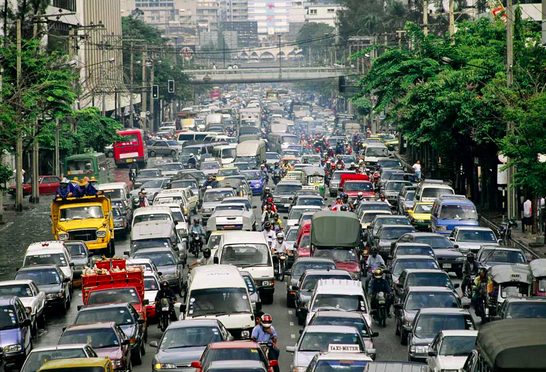
Bangkok is polluted, the smoke filled air from the early morning commuters with their cars, coming from their brand new condos, making their way to work serve to highlight the dramatic contamination levels this city has reached. Recent news from the Pollution Control Department that Bangkok’s air has reached critical levels can only confound worry. Bangkok people have learnt to put up with the pollution and ignore the three main worries associated with it; new high rise buildings, abundance of cars and filthy air. These factors will be classified in this essay.
The first factor is the brand new condos and apartments line every street in Bangkok these days. These new building have sprouted out of the ground to collect more people into a smaller areas of Bangkok. The sad fact is, there are little or no zoning laws. These seductively built premises neatly situated within eyeshot of major thoroughfares maybe appealing for the commuter belt brigade of workers but on already congested toll ways, roads and little sois, there really is no room for 50 or more families in their sparkling new condos. There are definitely signs of an oversupply of condos in Bangkok. The Government has noticed this too and has dropped the bank lending of 100% to only 90% of apartments less than 10 million baht which had made it too enticing for speculators but this will not stop the builders as they change tack and move into other avenues to entice more people into Bangkok.
Another factor is that there is no day off for traffic. Cars and buses clog the city twenty four seven. Benzene levels over Bangkok are well over the general limit. Medical studies have proved that long exposure to benzene exposure brings on cancer but this information must be kept quiet. Euro 4, one of the benzene petrol distributors have said they will try to reduce the levels of benzene emissions from 3.5% to 1%. This in itself is a great idea but what about the past and Bangkok’s contact with the smog that envelopes the city everyday. To compound the problem, these Bangkok people keep buying new cars. The roads are littered with red number plates, even with all the expense car ownership incurs; as long traffic jams every morning still grow larger. Bangkokians still continue to see their motors as prestige items.
One last aspect of pollution is the air which may seem clean to Bangkokians, some of them actually think their level of pollution is normal, but the air is not clean, dust particles lay in the atmosphere. These dust particles which can only be measured in microns of measurement that float around exceed the normal rate of air quality. Ozone levels were also found to be 0.2 percent higher than normal and volatile organic compounds were double the normal rate. Most of the 6.7 million residents are taking this air in. Plants and vegetation should help this but with not that many green areas the plants can’t give off air to cleanse and cool the area while the temperature keep rising. This heat is added to by the concrete building which retain their heat so Bangkok is still hot at night.
To conclude, there are many examples of the ways Bangkok is becoming more polluted. The truth is the Government should wake up to the dangers of air pollution but with the sheer vast amount of traffic on the streets of Bangkok it is going to a hard task. They have started the underground and BTS which unluckily invites construction but expansion of this transportation seems a distant dream and the sad aspect, Bangkok people must have given up on that vision too.
Chedi Phutthakhaya, Thailand
If you ever want to go further into Thailand and right up to the Burmese border, Sangkhla Buri district is a must. The picture below shows Chedi Phutthakhaya. This is a tall golden Indian-style pagoda that towers over the Mon Village and the lake. The gold pagoda stands out from the rest of the landscape.

SIT TESOL Certificate Course
Lesson from the Classroom
Essay #3
(1193 words)
I would first like to say that I have enjoyed this last month immensely while learning a great deal of new material. I feel as though I have further recognized, with the help of the SIT course, what the teacher’s role is in the class, as much as the student’s role. I have learned not only about the teaching side, but also the manner/presence of the teacher in the classroom.
I have taught four-practice lessons so far since starting the course, and I have been trying to become more student-centered while challenging them also. I am more aware now that in the class everyone is equal. I am also aware that the teacher is there to help the students and to facilitate their learning and not lecture. This is why I have tried to focus on each student and recognize the weaker ones. There are various levels of students in the class and also different characters. I realize after doing this course to value every one of them.
I have also valued constructed criticism. One issue in mind was my voice and my delivery of speech during class. During some practice lessons, I have modeled some stories in the class and they have become a bit disjointed, by this I mean incomplete sentences. I am glad the instructors recognized this in me and I think I have tried dealing with it but I would still like to continue to work on it. Likewise, I am pleased that there were a lot of positive points from the instructors, namely my strengths in eliciting questions, answers, and information from the students as well as getting a more student-centered class. I feel as though my fourth practice teaching gave me this experience to adapt to what I had been taught. One case in point is, I had the students in two groups, then four groups, and then pairs all the time monitoring and eliciting. I think this made for a great lesson as long as there was a purpose to do this.
I also watched some of my peers from the course that gave me a great insight into what it is like to be a new ESL teacher. Some of the teachers, because they were absolute beginners, showed some telltale signs of teaching infancy, which was interesting and fascinating to watch. The best example would be talking too much during the class. I guess even more experienced teachers can still fall into that habit. But all the same, it makes a new teacher think that they may do it without thinking.
I think this course has made me see both sides of the classroom from the teachers’ and the students’ perspectives. I have definitely become more aware of how much effort and time the students need to put into a class to get any benefit out. I would like to use my German class as an example. I was an absolute beginner and found the lesson a little challenging. It made me think about how the students in my English class must feel. We have had many practice lessons like the German class where we (SIT Students) had lessons given to us (sometimes as imaginary students). One thing, I took from these was that they were interesting and kept me attentive. It made me feel that if the teacher loses the students’ interest the lesson is so much harder. I think that keeping the students’ interests includes recognizing their learning styles as well. For example, I am the sort of student who likes learning by doing. I cannot sit for long periods. I think Thai students are a bit like this as I have found if there is a game in the lesson, they love moving about. I remember one of Anna’s lessons. She had some slips of paper on her desk at the front. Two groups had to come up to the desk one from each group at a time and take a slip of paper. They then had to take it back to their group and read it out and try and guess the movie. This kinesthetic activity got the students excited and maybe more prone to learning. I think it worked well and showed how some students prefer learning. This is why it was interesting having these practice lessons because we could find out about students’ learning. The classes for the practice session I found were very mixed. We had students from many backgrounds. There were people from Korea, Japan, and Mexico. All of them had their reasons for studying English. It made for a range of styles and backgrounds to work on which I think is very helpful, especially for new teachers.
I have found over the course that I have come to focus more on being a facilitator to the students. I have started concentrating more on my lessons and what the students will get out of my teaching. I feel as though I want every lesson for the students to leave with knowing that bit more than they did before. I have also come to believe that the students need challenges. I think the students like that and anything less would not be just. I saw one lesson by another peer in our group whose delivery was excellent with added humor. I felt he had prepared and wanted to teach us (students for his lesson). It made me realize that if the students recognize that you are serious they will be as well.
I think also the ESL instructors have shown that they can make a hard job look easy. One trainer actually gave a lesson on how to give instructions. After the lesson, I realized that some teachers make their jobs so much harder by talking too much. Furthermore, I have come to realize that the teacher must do their job, but it is the students who need the practice in speaking not you, the teacher. I believe clear instructions that are based on an interesting lesson that challenges the students will work. I also have liked the feedback session. There have been times when I thought things did not go very well but the instructors always remained very positive. I think it made me think that there are always more positives than negatives and if anything you should just be constructive. Most of the practice lessons I saw, mine included, needed some work on but the feedback was always positive and constructive. Even things that didn’t go well can be positive as long as the teacher learns from the experience.
The question I am left with is where do I find more information to continue where I left off. This course has sent me on the right path. It has given more a lot of information that has expanded my teaching knowledge. It is now my goal to continue this. First of all, I would like to keep everything fresh in my mind so this means continuing to read books and articles because I am sure I can refer back to this course. I would also like in the future to be more fully qualified in teaching.
- ← Previous
- 1
- 2
- 3
- 4
- Next →

