Support
Q&A: Participating in Teams to Benefit Children and Young People in Residential Childcare
Q1. Explain the practices that support effective team working
Effective team working means that communication, collaboration and clear responsibilities are applied to achieve shared goals and objectives, while maintaining high standards of care for children and young people (CYP) in residential childcare.
Firstly, on a day-to-day basis, when staff are finishing their shifts and preparing for the next team to take over, handover is essential. Handover provides an opportunity to share important information about the CYP, including their presentation, behaviour, incidents, activities, appointments, changes in circumstances and any ongoing risks. Effective handovers support dynamic risk assessment and ensure that staff beginning their shift have the most up-to-date information. This promotes continuity of care and reduces the risk of important information being missed or childcare needs being overlooked.
While dynamic and daily assessments are important, having prior knowledge of the CYP is also essential for providing consistent care. This information can come from referrals, care plans, placement plans and multi-disciplinary team (MDT) meetings. Referrals made by a CYP’s social worker provide important information about the reasons for the CYP entering residential care, their background, history and identified needs. Having this information helps staff to understand the CYP and means that communication between team members is better informed.
MDT meetings also support effective team working because they allow different professionals to share their knowledge, opinions and understanding of the child. Professionals may have different areas of expertise and perspectives, which can help develop a more complete understanding of a CYP’s needs. The team can agree objectives, approaches and interventions and develop a plan that can then be implemented and communicated to relevant staff.
Other practices that support effective team working include team meetings, supervision, debriefs, clear job roles and responsibilities, accurate recording and regular communication. Supervision provides staff with an opportunity to reflect on their practice, discuss concerns, identify training needs and receive support. Clear responsibilities mean that staff understand what is expected of them and who is responsible for particular tasks. Together, these practices help create consistency, accountability and a shared approach to caring for CYP.
Q2. Define the main roles and responsibilities of the following team members in a residential workplace
Manager:
The manager is responsible for the day-to-day running of the residential home and for ensuring that the welfare, safety and development of the CYP are promoted. The manager oversees the staff team and ensures that care plans, placement plans and other relevant procedures are implemented effectively.
The manager may also need to respond to and manage crisis situations, including serious incidents. The residential home must comply with relevant legislation, regulations, policies and standards, including those monitored by Ofsted. Where a serious incident occurs, there may be regulatory and reporting requirements that the manager is responsible for ensuring are followed. The manager therefore has overall responsibility for ensuring that the home provides safe, effective and appropriate care.
Deputy Manager:
The deputy manager supports the manager in overseeing the daily management of the residential home. This includes supporting the safety and welfare of the young people, supervising staff and ensuring that placement plans and care plans are implemented effectively.
The deputy manager also has administrative responsibilities and may support the development and monitoring of the CYP’s progress. They may need to respond to incidents and ensure that policies, procedures and regulatory requirements are followed. When the manager is unavailable, the deputy manager may deputise for them and take responsibility for the running of the home.
Team Leader:
The team leader supports the manager and deputy manager while also providing leadership to care staff during their shift. Their role includes overseeing the day-to-day operation of the residential home and ensuring that staff are working effectively as a team.
The team leader helps to create a supportive environment for both staff and CYP. They may allocate tasks, provide guidance to staff, monitor practice and respond to incidents that occur during the shift. They are also an important link between the care staff and management team.
Care Worker:
A children’s care worker provides direct, day-to-day support to young people, often across a 24-hour care environment. This can involve supporting CYP with their morning routines, education, activities, appointments, personal development, emotional needs and relationships, as well as responding to incidents or crisis situations.
Care workers provide nurturing and therapeutic support and may sometimes need to use physical intervention or restraint when this is necessary, lawful and in accordance with the home’s policies and procedures.
CYP in residential care may require significant emotional, social and educational support. The care worker’s role can involve being a therapeutic parent, helping to build resilience, trust and positive relationships while supporting the CYP to understand and manage challenging behaviour. Care workers also observe, record and communicate information about the CYP so that the wider team can provide consistent care.
Q3. Describe ways a residential care worker ensures they meet their own responsibilities as a team member
Care workers have responsibilities not only as an individual member of staff but also as part of a wider team. They meet these responsibilities through effective communication, accurate recording, information sharing, professional behaviour and being willing to work collaboratively with colleagues.
As staff members change from one shift to another, clear feedback and communication are essential. Handover is one important opportunity to communicate with colleagues about what has happened during the shift, including any incidents, changes in behaviour, appointments, activities or concerns.
However, communication should not only take place during handover. While on shift, staff need to continually assess dynamic risks and communicate with one another about any changes. CYP can become dysregulated for a variety of reasons, including being told “no” or having disagreements with other CYP. Planning appropriate activities and maintaining engagement can help reduce boredom and support emotional regulation. Communicating with colleagues allows them to share concerns, decisions, and ideas, and ensures they work consistently.
A care worker can also make a point of regularly checking in with other team members and duty managers when necessary. For example, there may have been an incident at school, a disagreement between CYP, or a change in a CYP’s presentation. Discussing these situations with colleagues can help me consider different ways of responding and ensure that my approach is appropriate.
It is important to remain open to ideas and constructive challenges from colleagues. Teamwork requires people to listen to different perspectives rather than assuming that their own approach is always correct. Therefore, a care worker should try to communicate respectfully, listen to others, and contribute positively to decisions that affect the CYP and the wider team.
Q4. Describe the functions of agencies that constitute the local network involved with children and young people in residential childcare. Which other agencies can an organisation regularly work with and why?
Support for CYP in residential care can involve a range of agencies depending on their individual needs. Social services are usually a key agency, with the CYP having an allocated social worker. The social worker assesses the needs of the CYP and their family and is involved in decisions about the CYP’s care and placement.
Residential care workers regularly work with social workers because they are involved in important decisions about the CYP’s care and future. For example, they may be involved in decisions about a CYP’s move from secure accommodation to an open residential setting. There is regular contact with the social worker, and the CYP may also have opportunities to speak directly with them. They record daily information about the CYP, which can be accessed and used by relevant professionals to understand their progress and make informed decisions.
Education is another important area. A CYP’s education may have been disrupted because of their circumstances, but continuing education remains important for their development and future opportunities. In secure settings, there is in-house education, while CYP in open residential homes may attend specialist schools, including schools with special educational needs (SEN) provision. Specialist education can provide smaller classes, personalised education plans and resources designed to support CYP with complex or significant needs.
Health services are also essential. Secure settings provide access to physical and mental health assessments, with a doctor visiting regularly and a health team available on site. Where necessary, they can work with external health agencies to ensure that CYP receive appropriate support, particularly where they have complex needs.
CYP in residential care may be vulnerable and may present risks to themselves or others. Therapeutic services can therefore provide important support for their emotional and psychological needs.
It is important that staff understand what support a CYP requires and which professionals are responsible for providing it. Effective communication and information sharing between a residential setting, social services, education, health and other relevant agencies help ensure that the CYP’s needs are identified and addressed. This is an ongoing process because a CYP’s needs can change during their placement.
Q5. Explain how and why referrals are made between an organisation and the external agencies. How is this done in a residential setting, who does this, and why is this needed?
When a CYP arrives in residential care, they receive a health assessment. This helps identify existing health concerns and any additional support that may be required. The assessment may identify a need for involvement from other agencies.
For example, a CYP may arrive with a history of substance or alcohol use. In this situation, a referral or communication with a specialist health service may be appropriate so that the CYP can receive education, advice and support around alcohol or substance use. Their care plan may then need to be reviewed to ensure that their identified needs are reflected in the way their placement is managed.
Obtaining appropriate support from external services is vital because residential staff cannot meet every specialist need themselves. Referrals can sometimes begin through informal communication with professionals who are already known to the service, although a formal referral may then be required for the agency’s records and assessment process.
Where a secure setting identifies a need or concern that cannot be addressed through its own services, a referral may be made to an appropriate external agency. The health team may make referrals to external health agencies because they are involved in assessing the CYP’s health needs. However, depending on the circumstances, management staff may also make contact or support the referral process.
Following a referral, a collaborative approach can be adopted between professionals. Staff and professionals from external agencies each have their own skills, expertise and knowledge. Working together helps ensure that support is coordinated and that there is less risk of duplication or conflicting interventions.
Information shared as part of a referral should clearly explain the CYP’s needs, relevant circumstances and the reason why external support is required. This helps the receiving agency understand the situation and provide the most appropriate service. Ultimately, referrals are needed to ensure that CYP receive the right support at the right time and that their health, welfare and development are promoted.
Q6. Analyse the benefits of networks and multi-agency work in supporting positive outcomes for children and young people in residential childcare. Include examples of practice.
Networks and multi-agency working provide many benefits when supporting positive outcomes for CYP in residential care. When different agencies and professionals work together and share their specialist knowledge, they can address the needs of a CYP in a more holistic way. This means that different areas of the CYP’s life, such as education, mental health, physical health, relationships and social development, can be considered together.
Residential care can support young people to participate in activities, develop relationships with peers and adults, build confidence and learn new skills. Other agencies can provide specialist support that complements the work carried out by residential staff. For example, health professionals can address physical or mental health needs, educational professionals can support learning, and social workers can oversee aspects of the CYP’s care and longer-term planning.
Effective communication and information sharing are essential to multi-agency working. Professionals need to understand what other agencies are doing so that support is coordinated and there is no unnecessary duplication. Professionals can also learn from one another and use different perspectives to develop more effective approaches.
In practice, a CYP’s wellbeing, emotional development and progress can be improved when there is effective multi-agency involvement and clear communication. A residential care worker may spend several hours each day with a CYP, which means they can observe the CYP’s behaviour, presentation, relationships and progress on a regular basis. The information they provide through daily records, communication and significant conversations can help other professionals understand what is happening in the residential setting.
Accurate information from daily observations can contribute to reviews and the development of care plans. The social worker can be kept informed about progress and concerns, while psychologists and other professionals working with the CYP can also use relevant information to inform their work.
Residential childcare homes aim to provide high-quality support, but no single service can meet every need a CYP may have. Multi-agency working therefore provides a more holistic approach, bringing together the expertise and resources required to support CYP with diverse and often complex needs.
Another benefit is that it provides a common goal. Professionals can share ideas, agree on approaches, and learn from each other while keeping the CYP’s needs at the centre of decision-making. Staff can learn from other professionals about approaches that may best support a particular CYP’s needs. They can then apply this learning in my practice and provide feedback about how the CYP responds.
Q7. Explain the value of using information prepared by other agencies. Would a care worker be able to provide effective care for young people without this?
Information prepared by other agencies is extremely valuable because different professionals have specialist knowledge and expertise that may not be available within the residential home. This information helps staff develop a more comprehensive understanding of the CYP’s history, needs, risks and strengths.
For example, assessments completed by health, education or social care professionals can provide information that may not be immediately apparent to residential staff. This information can contribute to care plans and placement plans and help staff make informed decisions about how to support the CYP.
When a CYP enters, for example, a residential home, having information from other professionals helps management and staff build a more complete picture of the CYP. Residential staff can then combine this information with their own observations and experiences to provide a more holistic approach to care.
Information prepared by other agencies is also important because it is generally produced through professional assessments, policies and procedures. These assessments can identify risks, needs and recommended interventions. Residential staff can then follow relevant procedures while continuing to monitor CYP’s progress and provide feedback about any significant changes.
It can be said that a care worker could not provide the same level of effective care without information from other agencies. They would still be able to provide day-to-day support based on observations and professional responsibilities, but they would not have the same understanding of the CYP’s history, specialist needs, assessments and professional recommendations.
Therefore, information from other agencies complements a care worker’s knowledge and observations. Combining the information provided by other professionals with what they observe in practice allows them to provide safer, more consistent and better-informed care.
Q8. Describe how failures in networks and multi-agency work have been highlighted in formal inquiries and serious case reviews. Include at least one example where a failure has been identified in a SCR.
Failures in networks and multi-agency working can have serious and sometimes catastrophic consequences for CYP. A lack of communication, poor information sharing, unclear responsibilities or inadequate leadership can mean that important concerns are not recognised or acted upon.
One example involved a CYP who died following a drug overdose. Over a relatively short period, the CYP’s circumstances became increasingly complex. They moved from mainstream education to a behavioural school and then to home education. Their risk-taking behaviour increased, and they experienced a very transient lifestyle.
A number of agencies became involved, including mental health and emotional health services, the police, youth offending services and two local authorities. There had also been several mental health or emotional health assessments. Despite the number of professionals and agencies involved, there appeared to be a lack of coordinated planning and communication.
Different professionals appeared to have different priorities. Some were focused primarily on keeping the CYP safe, while others were more focused on the risks the CYP presented. The CYP also became increasingly disengaged from some services. The result was that there was not always an integrated approach to addressing the CYP’s needs and risks.
The serious case review identified the importance of effective information sharing so that professionals could develop a fuller understanding of the young person’s circumstances and contribute to effective safety planning. It also highlighted the importance of empowering the Independent Reviewing Officer (IRO) to challenge actions where necessary.
There were also opportunities for further review following previous suicide attempts and a later overdose that may have represented another suicide attempt. However, suggested reviews were not followed through. This demonstrates how important it is that concerns are not simply identified but are acted upon and followed up.
This example demonstrates that having many agencies involved does not automatically mean that effective multi-agency working is taking place. There needs to be clear leadership, communication, information sharing, accountability and a coordinated plan. Professionals need to understand their own responsibilities as well as the responsibilities of other agencies.
In practice, this highlights the importance of recording information accurately and ensuring that significant information is communicated to the appropriate people. If information is not recorded or shared, other professionals may not have the complete picture and may therefore be unable to make informed decisions.
Q9. Describe two circumstances when it might be beneficial to have a multi-agency team around a child or young person
One circumstance where a multi-agency approach would be beneficial is where there is a suspected case of neglect. Neglect can be complex and may involve multiple factors within the family and the CYP’s environment. A single professional or agency may not have access to all the information required to fully understand the situation.
A multi-agency approach can bring together information from social services, police, education and health professionals. This allows professionals to develop a more comprehensive understanding of the CYP’s circumstances and identify any risks or unmet needs. The CYP’s welfare must remain the priority, while the circumstances of the family are also considered. Working together can reduce the risk of important information being missed and can support the development of an appropriate plan.
A second circumstance would be where a CYP has significant mental health needs. Mental health difficulties may require specialist assessment and intervention from professionals such as psychologists, psychiatrists, doctors and mental health services. A social worker or residential care worker may provide important observations and support, but they would not normally have the specialist expertise required to diagnose or treat complex mental health conditions.
Other professionals, such as education staff or counsellors, may also have valuable information about the young person’s presentation and behaviour. Multi-agency working allows these different perspectives to be brought together.
A Multi-Agency Safeguarding Hub (MASH) may also become involved where there are concerns about a vulnerable child CYP safeguarding risks need to be assessed. Overall, multi-agency working is beneficial because complex situations often require different areas of expertise, and no single agency can meet every aspect of a CYP’s needs.
Q10. Explain the tensions between maintaining confidentiality and the need to share information with other agencies
Maintaining confidentiality is highly important when working with CYP. Personal information should be kept secure and only shared with professionals who have a legitimate reason to receive it. However, there can be tensions between maintaining confidentiality and sharing information with other agencies when information is needed to provide appropriate support.
If relevant information is not shared, it can delay another professional’s work and prevent them from having a complete understanding of the CYP’s circumstances. At the same time, sharing too much information or sharing it with people who do not have a legitimate need to know could breach the CYP’s privacy and damage trust.
Information should therefore be shared on a need-to-know basis and in accordance with relevant legislation, policies and procedures. Where appropriate, consent should be obtained. If staff are unsure whether information can or should be shared, they should seek advice from a manager or the relevant professional.
There can also be a tension between confidentiality and the professional relationship developed between a CYP and a member of staff. A CYP may tell a staff member something in confidence and may specifically ask them not to tell anyone else. It is important that CYP understand from the beginning that staff cannot promise absolute confidentiality.
For example, a CYP may tell me that they are experiencing suicidal thoughts but ask me not to tell anyone. In this situation, professional responsibility is to pass the information to the appropriate people because the information is relevant to the CYP’s safety and wellbeing. This would not mean sharing the information with everyone; it would mean sharing it with the appropriate professionals so that the CYP can receive the necessary support.
It is therefore important to establish boundaries early in the relationship. It should be explained to CYP that the care worker will respect their privacy and keep information secure, but there are circumstances where there is a need to share information with relevant professionals.
Other information may not relate directly to safeguarding but may still be important to another agency’s involvement. For example, information about a CYP’s behaviour, education, health or emotional wellbeing may help another professional provide appropriate support. Staff may sometimes worry that sharing this information breaches confidentiality. In these circumstances, following policies, seeking consent where appropriate and discussing concerns with management can help ensure that information is shared lawfully, proportionately and appropriately.
The key balance is to protect the CYP’s privacy while ensuring that relevant professionals have the information they need to provide effective support.
Q11. Looking at the professional relationships that can be have built, identify where improvements can be made in practice to support future working relationships
Professional relationships are vital for effective teamwork, communication and information sharing. It is important to continue challenging work practice through reflection and professional development. Although e-learning is completed and training annually, professional development should not only be about completing mandatory training. It should also involve regularly reflecting on practice and considering what a worker could do differently or better.
Care roles bring them into contact with complex situations, and a recognition of the value of seeking support and advice from colleagues and other professionals. Sharing ideas and updates is essential, as is ensuring that the correct people receive relevant information at the right time.
One area where one could continue to improve is communication between shifts. When different staff teams take over, there can sometimes be information that is missed or not communicated clearly. For example, one shift may have agreed that a CYP is not allowed to do something, while the next shift may not be aware of the decision and allow it. This can create inconsistency and confusion for the CYP and the staff team. Staff can contribute to improving this by ensuring that important decisions and changes are accurately recorded and clearly communicated during handover.
The importance of self-reflection when managing boundaries and expectations with CYP. Sometimes staff may need to tell a young person “no”, which they may find upsetting. Staff need to consider not only the decision they have made but also how they communicate it. The language, tone and manner they use can influence how the young person responds.
Constructive feedback between colleagues is important. If they observe a colleague having difficulty communicating with a young person, they should be able to provide respectful and constructive feedback where appropriate. At the same time, they need to be willing to receive feedback themselves. They should actively listen rather than automatically feeling that feedback is criticism or that someone is putting me down.
Emotional intelligence is important in this area. Care workers need to consider how another staff member may feel if they raise an issue with them and think about the circumstances they may be experiencing. For example, they may have had a difficult day or may have been dealing with a challenging situation. This does not mean that poor practice should be ignored, but it means feedback should be delivered with empathy, professionalism and respect.
The same principle applies to the CYP they support. They need to consider their feelings, experiences and individual needs when communicating with them.
Debriefs provide a valuable opportunity for the whole team to reflect on decisions and incidents. Where a decision affects the whole team, it is useful to give everyone an opportunity to contribute. Debriefs can also provide an opportunity to raise concerns and discuss different perspectives.
Any care worker does not want issues to become frustrations that affect professional relationships. They should recognise that they may sometimes misunderstand a situation or interpret something incorrectly, so they need to be willing to listen to other people’s perspectives. Overall, they should believe that continued self-reflection, active listening, constructive feedback, emotional intelligence and clear communication will help them develop stronger professional relationships and become a more effective member of the team.
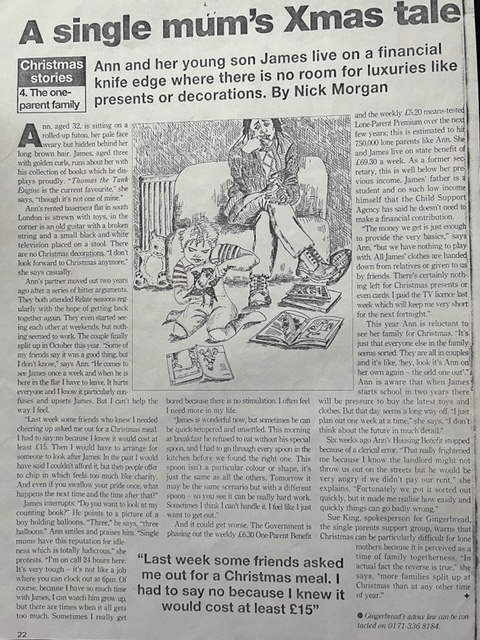
Analysis of ‘A single mum’s Xmas tale’ by Nick Morgan
(670 words)
In the following piece of writing, I will be explaining the way the writer, Nick Morgan, uses the story of a single mother to highlight what can be the quandary of lone parenting. Ann, now a single mum, is presented as declassed in the world having worked as a secretary and been in a relationship. The reader is to empathise with the single mum being in a predicament where she appears pretty helpless.
The writer starts by telling us of Ann with her ‘pale face weary’. This is the first sentence and the reader immediately conjures up an image of this young woman experiencing difficulties in her life and feeling depressed and tired. It expresses life is a hard struggle for this lady. The ‘old broken guitar with a broken string’ in the corner of the room may be a metaphor for her present situation. She has a casual approach of not looking forward to Christmas albeit resigned to an unexciting one. She is almost excepting she cannot see anyone because she has no money and is a one-parent family. She says it feels like ‘charity’ for her friends to take her out. She cannot ‘swallow her pride’. The writer is trying to emphasise to us that she has become a victim of her situation. This is further underlined by her ‘reluctant’ manner and the feeling she would ‘be the odd one out’ with her relatives. The haggard image of her is telling.
With James, the little son, the reader is invited to feel the boy is an innocent party to his mother’s situation. With his ‘golden curls’ playing around and reading books, he is shown as a bright little boy although the reader gets the feeling that he is suffering too from his mum’s position. The boy can sometimes be ‘quick-tempered’ and ‘unsettled’ the mother says. The writer tries to make the reader comprehend their predicament where this boy is stuck indoors with his mother all the time with nothing really to do except play with his book to which she says ‘though, it’s not one of mine’. The reader senses she cannot afford anything special for him because of her somewhat desperate position. Obviously, she cannot leave but she feels ‘like I just want to get out’.
As if the mother’s plight was not tough enough, there is the fact it is Christmas. At Christmas, there are plenty of images and adverts of a time of plenty, happy families, and warm decorated houses. Here the writer uses this emotive subject to contrast the mother’s family to others’ experience of Christmas. She is ‘reluctant’ to see her family. Ann’s feeling is that everyone in the family seems ‘sorted’ and it is her, single, ‘on her own again – the odd one out’ which unfortunately only compounds her difficulty at the festive time.
The reader is shown that money is Ann’s main worry. The writer comments on Government policy with ‘it could get worse ‘. The reader is already told of the mother’s financial predicament regarding clothes and toys for her son. James’ clothes are ‘handed down’. To be losing money on her benefit would ‘hit’ her. This conveys that Government policy is hammering the people already hardest hit. The writer points out that she can ‘provide the very basics’. The reader thinks about Government strategies and how they may fail to help women in these situations; reinforcing this impression with the phasing out of her ‘means tested ‘benefit. Ann does not ‘think about the future’.
The writer has made his case for us to sympathise with Ann and James and the situation of single parents. As we leave 2021, from skyrocketing petrol and gas bills to ever-increasing inflation and price increases, this year the UK is seeing a considerable increase in living costs. Single parents are often only just managing to scrape by and people like Ann remain on that financial ‘knife edge’.
Help Single Parents at Christmas. Gingerbread.org.uk provide information to help single parents support themselves and their family.