How Young Learners Learn Languages – True or False
(960 words)
For this writing task, I was asked to give my response to 5 statements about how young learners learn languages. I will answer true or false statements 1- 5 and explain why.
1) Babies are unable to respond until they are at least 6 months old.
Is this True or False?
2) Babbling has an element of the meaning of which the young child is aware.
Is this True or False?
3) Children may sometimes use words in a way different from an adult’s understanding of the language item.
Is this True or False?
4) Grammar rules cannot usually be taught to young children.
Is this True or False?
5) Repetition plays an important part in first language acquisition.
Is this True or False?
1) Babies are unable to respond until they are at least 6 months old. T/F
This is false. From the moment a baby enters the world to eight weeks, the process of language acquisition is in motion. They begin to cry and make little sounds; this exercises the vocal organs and gives them practice in controlling the flow of air through their mouth and nose. They respond to their mother by looking at her when she speaks. If a stranger speaks, the baby will respond differently than to their mother’s voice. The tone, pitch, volume, and intonation of a speaker’s voice make the baby respond differently. The baby shows a response by crying, body movements, babbling, and laughing.
2) Babbling has an element of the meaning of which the young child is aware. T/F
This is true. Language can be said to be a progression of the process which means that there is progressive emergence. Babbling plays a part in this. It can be said that language comes with age and with the form of the body where the child grows and their cognitive senses form. For instance, at 6-7 weeks the baby will be experimenting with coos and chuckles. Then at 3-4 months, the child will start to babble; making rough speech sounds. Most babbling consists of a small number of sounds, which suggests the child is preparing the sounds they will need to speak the language it is exposed to. The baby is aware as the babbling noises tend to closely approximate the language spoken in their environment. When they imitate adult sounds they are scaffolding their language for later development. Learning is intimately linked with the progressive surfacing of a child’s vocabulary and syntax.
3) Children may sometimes use words in a way different from an adult’s understanding of the language item. T/F
This is true. Younger children do not have an adult’s understanding of language; they have their own way of saying things as far as they approximate them. They are born with a special ability to discover for themselves the underlying rules for their language system. For example, a child can tell you in his verbal sounds that the dog their family has, has gone outside. He may say ‘doggie’ and point or say ‘doggie out’. This utterance may just be a few grunts but significantly the point of it is; is that the child is telling you the dog has exited the house. Speech in children can be recognised by the way a child generally uses one pivot word plus one or two additional words, such as ‘Mummy go shops’, ‘Give dolly’. Telegraphic speech as it is known like this is marked by its own grammar, especially in terms of structure. These pivot words tend to occupy a consistent position in the sentence and the word order reflects the order of adult utterances, the only difference being that in telegraphic speech the less semantically important words disappear.
4) Grammar rules cannot usually be taught to young children. T/F
This is true if we were to say that a teacher or parent tries to formally teach a child grammar. Grammar is acquired naturally; it doesn’t need to be taught so formally especially to younger students. Grammar rules taught formally can be just too hard for some children to comprehend. Learning can be modeled on the natural environment although learning needs to accentuate the rate of language acquisition. Role-play, games that highlight interesting and thought-provoking activities can have grammar subconsciously delivered where the learner is using the appropriate language without realizing that the teacher is teaching a specific grammar point. The child will gradually pick up the grammar rules by interaction. They are not pressured. Grammar becomes secondary to the learners actually trying to speak. Their language can be facilitated by the teacher. There is the fact that if the teacher tries to the child’s sentence to the correct version, it often fails. For example:
A child looks at their dolly and says question and answer.
Child: What colour?
Mother: (You mean) what colour IS IT?
Child: Red
Grammar is a progressive discovery. It seems that the child can only learn when the time is right.
5) Repetition plays an important part in first language acquisition. T/F
This is true. This does not mean a child will learn a language by repetition. Repetition helps by the way of the instructor, be that the mother or teacher who replies to the learner’s comments. The child speaks differently from a normal adult. The repetition is done when the child speaks and the mother or teacher repeats and reinforces the child’s speech with their way of saying the utterance.
Child: Daddy come
Mother: Yes, here’s Daddy
Child: Nice doggie
Mother: Yes, he’s a nice doggie isn’t he?
With this type of repetition, encouraging responsiveness, the child will develop. She will keep the child’s word order and add on the rest. The emphasis is on the child’s meaning and not on grammatical structures.
.
Photograph of the day – Khao Yai Bats
Image Posted on Updated on
On a trip in the national park of Khao Yai in central Thailand, we were told of the river of bats that stream out of the side of the mountain at night to eat. Duly fascinated, we drove from our rented cabin in the park to the destination not too far away. We parked the car and made out the way by foot along a dirt track to the base of the mountain then stood and waited in one of the many manioc fields. As we looked up at the side of the mountain, we could see that there were holes/caves where apparently the bats would come from. The best time to see the bats we were told was dusk. The sunset anticipation and excitement were increasing. In what appeared to be the start of the bats exiting the cave, we thought we had seen what we came for as a trickle of bats appeared. People started to point and shout. However, suddenly thousands upon thousands of the bats emerged to hunt the flying insects in the late day sky as the sun went down. We stood there in amazement as the snake-like movement of all the bats closely packed together weaved its way across the Khao Yai twilight. It is a sight not to be missed.


The Study of Language
(613 words)
Linguistics is the systematic study of language and, as such, should ideally be approached objectively. However, a fundamental methodological difficulty arises from the fact that humans are studying an aspect of their own behaviour and cognition. Moreover, language is the principal means through which we describe and analyse language itself. This reflexive relationship may introduce subjective assumptions that would potentially be less influential if language were being studied by an entirely external observer.
Communication is not exclusive to humans; numerous species use sounds and other signals to convey information. Although the precise complexity and semantic structure of non-human communication remain subjects of investigation, it is reasonable to consider how variations in factors such as pauses, pitch, tone, and repetition may contribute to the transmission of meaning. Visual stimuli may also assist in establishing associations between particular signals and specific situations or behaviours. For example, a child’s scream or a snake’s hiss commonly occurs in particular contexts and may function as a signal of distress, threat, or danger. By observing recurring sounds within different environmental and behavioural contexts, researchers can therefore develop hypotheses concerning the potential meanings and functions of these signals.
Humans possess a particular advantage in the study of language because we are capable of distinguishing between involuntary physiological sounds, such as sneezing or coughing, and deliberate linguistic communication. We recognise that language consists of structured units, including words, which combine according to particular grammatical and semantic principles. Nevertheless, it is important to avoid assuming that linguistic units possess identical meanings across different languages. Words are embedded within the cultural and conceptual systems of the communities that use them, and consequently, their meanings may not correspond precisely to apparently equivalent terms in another language.
For example, the Navajo term shima is commonly translated into English as ‘mother’. However, such a translation may not fully encompass the conceptual range of the original term. Its meaning can extend beyond the biological relationship implied by the English word ‘mother’, incorporating broader notions associated with nurturing and the giving of life. Consequently, concepts such as the earth or trees may be understood within a broader semantic framework associated with motherhood. This illustrates the limitations of assuming that direct lexical equivalents necessarily possess identical semantic or cultural significance across languages.
Another important consideration, particularly in relation to English, is the distinction between written and spoken language. Orthographic representation does not always correspond directly to phonetic realisation; that is, the spelling of a word does not necessarily indicate how it is pronounced. This discrepancy creates challenges for the systematic representation and comparison of speech sounds and contributed to the development of the International Phonetic Alphabet (IPA). The IPA provides a standardised system for representing the sounds of spoken language, enabling researchers to describe pronunciation independently of conventional orthographic systems. In this respect, the IPA represents a highly systematic and scientific approach to the analysis of language. There is also a certain methodological irony in the fact that a specialised symbolic system must be employed to describe and analyse the sounds of the languages through which humans ordinarily communicate.
The scope of linguistics extends beyond the analysis of language itself and intersects with numerous other academic disciplines, including sociology, anthropology, psychology, and philosophy. Although linguistics is sometimes classified within the humanities because of its close relationship with culture, society, and human thought, its methodologies frequently involve systematic observation, empirical investigation, classification, and analysis. Consequently, linguistics occupies an interdisciplinary position, combining aspects of both the humanities and the sciences. Its scientific character derives not simply from the subject matter it investigates, but from the systematic and evidence-based methods employed to understand the structure, development, acquisition, and use of human language.
Analysis of ‘A single mum’s Xmas tale’ by Nick Morgan
(670 words)
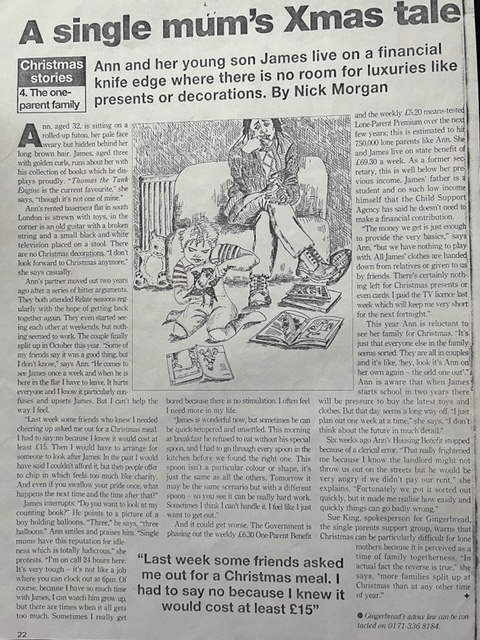
In the following piece of writing, I will be explaining the way the writer, Nick Morgan, uses the story of a single mother to highlight what can be the quandary of lone parenting. Ann, now a single mum, is presented as declassed in the world having worked as a secretary and been in a relationship. The reader is to empathise with the single mum being in a predicament where she appears pretty helpless.
The writer starts by telling us of Ann with her ‘pale face weary’. This is the first sentence and the reader immediately conjures up an image of this young woman experiencing difficulties in her life and feeling depressed and tired. It expresses life is a hard struggle for this lady. The ‘old broken guitar with a broken string’ in the corner of the room may be a metaphor for her present situation. She has a casual approach of not looking forward to Christmas albeit resigned to an unexciting one. She is almost excepting she cannot see anyone because she has no money and is a one-parent family. She says it feels like ‘charity’ for her friends to take her out. She cannot ‘swallow her pride’. The writer is trying to emphasise to us that she has become a victim of her situation. This is further underlined by her ‘reluctant’ manner and the feeling she would ‘be the odd one out’ with her relatives. The haggard image of her is telling.
With James, the little son, the reader is invited to feel the boy is an innocent party to his mother’s situation. With his ‘golden curls’ playing around and reading books, he is shown as a bright little boy although the reader gets the feeling that he is suffering too from his mum’s position. The boy can sometimes be ‘quick-tempered’ and ‘unsettled’ the mother says. The writer tries to make the reader comprehend their predicament where this boy is stuck indoors with his mother all the time with nothing really to do except play with his book to which she says ‘though, it’s not one of mine’. The reader senses she cannot afford anything special for him because of her somewhat desperate position. Obviously, she cannot leave but she feels ‘like I just want to get out’.
As if the mother’s plight was not tough enough, there is the fact it is Christmas. At Christmas, there are plenty of images and adverts of a time of plenty, happy families, and warm decorated houses. Here the writer uses this emotive subject to contrast the mother’s family to others’ experience of Christmas. She is ‘reluctant’ to see her family. Ann’s feeling is that everyone in the family seems ‘sorted’ and it is her, single, ‘on her own again – the odd one out’ which unfortunately only compounds her difficulty at the festive time.
The reader is shown that money is Ann’s main worry. The writer comments on Government policy with ‘it could get worse ‘. The reader is already told of the mother’s financial predicament regarding clothes and toys for her son. James’ clothes are ‘handed down’. To be losing money on her benefit would ‘hit’ her. This conveys that Government policy is hammering the people already hardest hit. The writer points out that she can ‘provide the very basics’. The reader thinks about Government strategies and how they may fail to help women in these situations; reinforcing this impression with the phasing out of her ‘means tested ‘benefit. Ann does not ‘think about the future’.
The writer has made his case for us to sympathise with Ann and James and the situation of single parents. As we leave 2021, from skyrocketing petrol and gas bills to ever-increasing inflation and price increases, this year the UK is seeing a considerable increase in living costs. Single parents are often only just managing to scrape by and people like Ann remain on that financial ‘knife edge’.
Help Single Parents at Christmas. Gingerbread.org.uk provide information to help single parents support themselves and their family.